Old Aalten

Category: Administration & Justice

  • Lordship of Bredevoort

    Lordship of Bredevoort

    This page is still ‘under construction’…

    County of Lohn

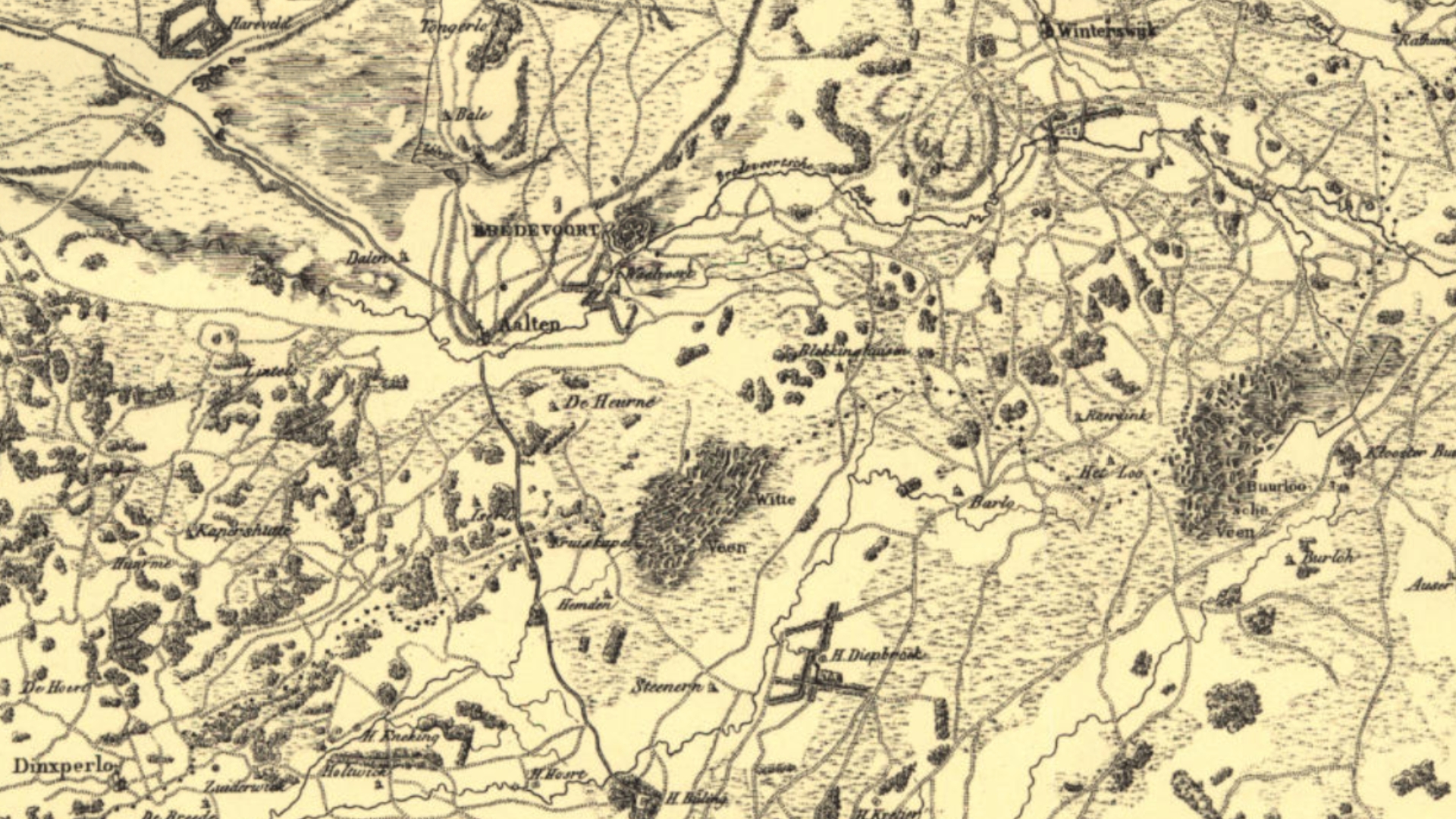
    De voormalige heerlijkheid Bredevoort maakte oorspronkelijk deel uit van het graafschap Lohn, dat vermoedelijk in de 11e eeuw is ontstaan. Dit graafschap omvatte in 1152 de kerspelen Lohn, Winterswijk, Aalten, Varsseveld, Zelhem en Hengelo (G). In hun streven naar onafhankelijkheid kwamen de graven van Lohn in conflict met de bisschop van Münster, wiens leenheerschappij zij in 1152 tenslotte moesten erkennen. De burcht Bredevoort was in 1246 voor de helft eigendom van graaf Herman van Lohn, die in dat jaar zijn deel in leen opdroeg aan graaf Otto van Gelre.

    Upon the death of the last Count of Lohn in 1316, his territory disintegrated. The parishes of Varsseveld and Silvolde went to the Lord of Wisch; the parishes of Zelhem and Hengelo had already been sold to Guelders. In 1316, the Bishop of Münster purchased half of Bredevoort Castle, along with its share of Lohnish rights, from Otto van Ahaus, one of the heirs. The other half of the castle had already been in episcopal possession since 1284.

    County of Guelders

    This purchase led to a dispute between Münster and Guelders, resulting in a war in 1324. Count Reinald of Guelders invaded the Bishopric of Münster and was defeated at Coesfeld, though he had already conquered Bredevoort. At the peace treaty concluded in Wesel in 1326, Reinald retained Bredevoort and received the jurisdictions of the surrounding parishes of Aalten, Dinxperlo, and Winterswijk as a pledge. The Bishop of Münster was entitled to redeem this pledge at any time for 3,500 gold marks, which, however, never occurred. From 1326 onwards, the area became an independent territory administered by a ducal official.

    Gemen and Steinfurt Pledge (1388-1526)

    In 1388, William of Jülich, as Duke of Guelders, pledged his castle, town, and the District of Bredevoort with its three parishes to Lord Henry III of Gemen in exchange for a substantial loan. Successive generations of this family remained pledge-holders of the lordship until 1492, when the pledge passed to his heirs and subsequently to the Counts of Bentheim-Steinfurt. It was not until 1526 that Duke Charles of Guelders redeemed the pledge and took the lordship back under his own administration. In 1534, he entrusted Bredevoort to his commander Marten van Rossum, who received the lordship as a pledge in 1545 from Emperor Charles V, the legal successor to the Dukes of Guelders.

    Anholt Pledge (1562-1612)

    When Van Rossum died in 1555, the pledge passed via Johan van Isendoorn to Hendrik van Isendoorn à Blois, who received the pledge sum back in 1562. King Philip II of Spain, acting as Duke of Guelders, then pledged the lordship for 50,000 Flemish shields to his vassal Dietrich van Bronckhorst-Batenburg. He was the Lord of neighboring Anholt in Westphalia, who already possessed many properties and rights within the Lordship of Bredevoort.

    After the Reformation, the Lords of Anholt remained Roman Catholic and aligned with the Spanish side. Consequently, Bredevoort was besieged and conquered by Prince Maurice of Nassau in 1597. Lady Gertrud von Milendonck, the widow of Jacob van Bronckhorst-Batenburg, had the lordship returned to her by the Republic in 1602. However, the pledge was redeemed by the States of Gelderland in 1612 and subsequently taken over by Prince Maurice.

    Many archival documents concerning the period 1526-1612 are located in the Bredevoort Collection within the Fürstlich Salm-Salmsches Archiv at the Wasserburg Anholt near Isselburg (D). Older documents from before 1562 were likely transferred to their house archive at the time by order of the Anholt pledge-holders as evidence of their rights. After the termination of the

    Pledge City of the House of Orange

    In 1697, Bredevoort was granted as a free lordship to King-Stadtholder William III, whose heirs possessed it until 1795.

    Van het Rijksarchief in Friesland werd in 1986 uit de collectie van het Fries Genootschap het reglement voor de poortwachters te Bredevoort van 1726 ontvangen.

    In het huisarchief van de voormalige herberg De Leste Stuver te Bredevoort, berustend te Aalten, bevindt zich o.a. een almanak, gebruikt door de Stadhouder of de Landschrijver als zakagenda in de periode 1737/38.

    In 1646 werd het kasteel te Bredevoort verwoest tengevolge van blikseminslag in de kruittoren. Het duurde ruim 50 jaar, eer nieuwe huisvesting werd gerealiseerd. In 1699 verrees aan de Landstraat te Bredevoort een nieuwe kanselarij, het Ambthuis.

    District of Bredevoort (1795-1811)

    After the Batavian Revolution in 1795, the possessions of the House of Orange were declared forfeit; the Lordship of Bredevoort was placed under civil administration. In 1798, the lordships were officially abolished. The former municipalities of Aalten, Bredevoort, Dinxperlo, and Winterswijk were established in 1795 and abolished in 1798. Following the abolition of the lordships in 1798, the former municipality of Lichtenvoorde was added to the District of Bredevoort and separated from it again in 1802.

    In 1994, Dr. G.J.H. Krosenbrink of Winterswijk donated a report concerning the administrative organization of the old District, prepared for the new District administration in the period 1798-1802, originating from the then-district board member H. Willink Azn. of Winterswijk.

    Het Ambt Bredevoort bleef als bestuurlijke eenheid in stand tot de Franse overheersing. In de jaren 1811 en 1812 werd het opgedeeld in de Mairieën Aalten, Bredevoort, Dinxperlo en Winterswijk.

    Het archief van het Ambt werd bewaard op de kanselarij, het Ambthuis te Bredevoort. In 1795 werd het op last van het Provisioneel Bewind in beslag genomen en geïnventariseerd, waarna het onder het beheer werd gesteld van de secretaris van de Municipaliteit van Aalten. Na de Franse overheersing werden bij het herstel van het Nederlands bestuur bescheiden uit het archief gelicht en overgedragen aan de nieuwe gemeenten Aalten, Dinxperlo en Winterswijk. Ook de voormalige rentmeester J.B. Roelvink van de Nassause Domeinen behield het kanselarij-archief onder zich, dat in 1985 helaas door een rechtsopvolger werd vernietigd.

    Administration

    Bredevoort was originally a small ‘borgman’ town based on the Westphalian model. The noble defenders of the castle lived in fortified houses on the outer bailey, which consequently took on the character of a fortress. In the neighboring Bishopric of Münster, such ‘borgmannen’ exercised authority and jurisdiction over their staff and the serf inhabitants of the castle complexes they managed in Horstmar and Nienborg.

    Upon the transfer of Bredevoort in 1326, the Bishop of Münster released his Bredevoort ‘borgmannen’ from their oath so they could enter Guelders’ service. In 1503, the Bredevoort ‘borgmannen’ obtained similar privileges from the then-pledge-holder, Everwijn van Steinfurt. However, no city rights for Bredevoort have survived. The military and administrative role of the ‘borgmannen’ ended after the defense was entrusted to a garrison during the 16th century.

    The daily administration of the Lordship of Bredevoort rested with the Drost (Bailiff). Following the Münster occupation during the war years 1672-1674, a separate urban administration of a stadtholder and regents of the city of Bredevoort existed briefly within the walls. The Drost often also served as the Richter (Judge). Jurisdiction was provided by the Richter with two ‘keurnoten’ (assessors). The court was held once every two weeks in Aalten, Bredevoort, and Winterswijk. Court days for Dinxperlo were held in Aalten.

    Jurisdiction in the city of Bredevoort was exercised by the Richter of the lordship with two ‘keurnoten’, as in the other parishes. Other officials at the court were the Land Scribe (secretary) and the Advocate-Fiscal (public prosecutor). The Land Scribe also served as the secretary to the Drost. Since the latter usually did not reside in the lordship, the Land Scribe often also acted as his deputy as acting-Drost or Stadtholder. Bredevoort had a fortress commander, the “Commandeur der Forteresse”. This position was often combined with that of acting-Drost in a single person. Furthermore, there was a whole series of lower officials, including a gauger, a tool sharpener, a surveyor, and armenjagers (rural constables).

    Due to the fact that members of the noble Van Pallandt family and the related families of Van Lintelo and Van Coeverden held the position of Drost of Bredevoort for a long time, a large number of documents concerning Bredevoort matters from the period 1638-1796 are also found in the archive of House Keppel, likewise held at the Gelders Archief in Arnhem.

    The last Drost of the District of Bredevoort, since the Batavian Revolution in 1795, was the Winterswijk citizen W. Paschen Gzn. of Winterswijk. His accounts for the period August 1808 – March 1811 were audited and deposited in Winterswijk on September 4, 1812, by the joint mayors of Aalten, Bredevoort, Dinxperlo, and Winterswijk. As early as 1811, Paschen, as temporary mayor of Winterswijk, requested the former Land Scribe to transfer documents concerning Winterswijk matters. According to a letter in the archive of the Municipality of Winterswijk, a chest of archival records was transported by wheelbarrow from Aalten to Winterswijk in 1813. The selection process at the time was somewhat arbitrary, so other Bredevoort documents also ended up in Winterswijk. Steward J.B. Roelvink also transferred Bredevoort documents to the Mayor of Winterswijk in 1815. Incidentally, Lichtenvoorde was only part of the District during the years 1798-1802.

    Since 1612, officials were appointed by the Nassau Domain Council. For appointment data, see the so-called ‘Ambtboek’, held in the archive of the aforementioned Domain Council at the National Archives in The Hague. Information on appointments in the District of Bredevoort can also be found in the archive of the Drost and Geërfden, inv. nos. 22-33, and in the archival collection Local Government Winterswijk, inv. no. 14. Through the Drosten, many personnel records also ended up in the Keppel house archive, held at the Gelders Archief in Arnhem.

    Besides the city of Bredevoort, the lordship consisted of three judicial districts, which coincided with the three parishes of Aalten, Dinxperlo, and Winterswijk. In each parish, a ‘voogd’ (warden) and one or two ‘ondervoogden’ (sub-wardens) were appointed, acting as intermediaries between the inhabitants of the parishes and the administration in Bredevoort. Each parish consisted of a village and a number of rural districts, called guilds, which were divided into wards. These were headed by ward and guild masters, who were responsible for the further dissemination of messages and the execution of orders. Additionally, each rural district had a messenger, an office tied to a specific farm.

    Financial matters were handled per parish by the local ‘geërfden’ (landed stakeholders). These representatives of the population were delegated per village and rural district and were accountable to the Drost. The town of Bredevoort had its own Steward, who acted on behalf of the local ‘geërfden’. Each parish had its own collector of the ‘verponding’ (land tax). In Bredevoort, the ward masters sometimes acted collectively as collectors of the ‘verponding’. The churchwardens in each parish, responsible for managing the capital and property of the local church, were elected from the ‘geërfden’ and had to provide accounts to the Drost and their fellow ‘geërfden’. Alongside the ‘diaconie’ as a church institution, there was also a secular institution for poor relief, the ‘provisorie’. Like the churchwardens, ‘provisoren’ were elected from the ‘geërfden’ and were required to account for their management in the same manner.

    Sources


  • The Vehmic Court at ‘t Walfort

    The Vehmic Court at ‘t Walfort

    In the Middle Ages, a so-called veemgericht (vehmic court) was established in the vicinity of manor house ‘t Walfort near Aalten. Veem is Low Saxon for ‘punishment’. It was a special court whose hearings took place in the open air near a grove called “Sleehegge”. Here, justice was administered four times a year at sunrise.

    The court was presided over by a free-count, a judge after the old Westphalian model. A free-count represented a so-called free seat. A free seat covered a certain area, usually similar to the gauges of Carolingian times. The free-count has its origins with the Saxons. After the subjugation of the Saxons by Charlemagne, the old vehmic courts continued to exist for a long time.

    This free-count and a number of free vehmic jurors or assessors ruled on the charges, after summoning the suspect. The vehmic court would have intervened if there were concerns that a privileged person could not be brought before a regular court, thus filling a gap in the legal system.

    The Dücker will get you

    The most famous and notorious free-count at ‘t Walfort was Berend de Dücker, also mayor of Bocholt. He was appointed to ‘t Walfort in 1430 and was particularly feared, because his convictions often ended in death. The condemned man was hung by three anonymous vehmic jurors on a noose of willow branches. De Dücker presided over the vehmic court for 61 years. A well-known threat from parents to their children, if they did not want to obey, was still until the 20th century: “The Dücker will get you”.

    Because the vehmic courts undermined the government’s monopoly to impose punishments, the Duke of Guelders forbade his subjects to comply with a summons to the vehmic court. At the end of the sixteenth century, the vehmic court on ‘t Walfort disappeared. It is the only place in the Netherlands where it has been proven that there was a vehmic court.

    In 1936, the Rotterdamsch Nieuwsblad wrote about the vehmic court at ‘t Walfort:

    Vehmic Court at the Walfort - Rotterdamsch Nieuwsblad, 5 February 1936
    The vehmic court on the Walfort.

    Arising from the pressure of the times and as a reaction to the tyrannical domination of the Pledgers, it [the cattle court, ed.] met at night. The citizens, who formed the court, sometimes did not know each other. They appeared masked. To prevent the prisoners from revealing what had happened, and where the hearings, or rather the meetings, were held, the sentence that was passed was always the death penalty. The easiest punishment to carry out was that of the noose.

    In order to show the passing that they were dealing with a vehmic sentence, the sign of the vehmic court was cut in the tree on which the hanged man had been sentenced with an axe, a so-called ‘Wolfshaak’ [or Wolfs’ Hook, ed.]. All this seems to us, at the present time, very cruel. But it must not be forgotten that the bitterness in connection with the need of the times has led to these measures.

    For chiefly the majesties turned against the dismissed soldiers of the many armies of the many little armies of the many little potentates who were constantly fighting each other.

    These warriors, who spared neither friend nor foe, scoured the countryside in larger or smaller troops. They stole cattle, chickens and food. Also money, which was scarce among the peasant population of those ancient times, as well as household goods and jewelry. And church treasures were to their liking.

    These people behaved shamefully towards women and children. And woe betide the farmer who lived on a lonely farm dared to resist their crimes. His family was abused in front of his eyes, while he watched, bound. His farm was set on fire, and he himself was the last to be beaten to death.

    The vehmic court, which was composed of residents of Bredevoort and Aalten, was later officially established on the Walfort, where the van Lintelo family, the judge, free-count or president of the court were elected. In 1573 we find Arend van Lintelo as such.

    Also read “A vehmic court on Dutch soil”, by Dr. H. Kits Nieuwenkamp (1938):

    Sources


  • Old Prison

    Old Prison

    Prinsenstraat 40, Aalten

    The former prison on Prinsenstraat in Aalten was built in 1861 in Neoclassical style as a cantonal house of detention, featuring six cells and a gaoler’s residence. In 1886, its cantonal status was revoked, but the building remained in use as a municipal prison until the Second World War. Today, the property is a private residence.

    Een inventarislijst uit 1933 noemt nog ‘meubilair en overige goederen behorend tot de gevangenis in de Achterstraat’ (de oude naam van de Prinsenstraat). Vóór 1861 bevond het plaatselijke cachot zich aan de Landstraat.

    In 1937, G.H. Rots described in a series of articles how things were handled in Aalten in earlier times. Regarding the old prison, he wrote:

    “For cantonal court matters, one did not have to walk far. After all, the cantonal judge sat in our good village, and the cantonal court was held in the town hall. The prison in Aalten was also equipped for the detention of prisoners for longer than twenty-four hours. A gaoler was appointed for this purpose, and for many years Wessel te Brake held this post. To ensure the proper fulfillment of the feeding and care of the prisoners, he had to sign a contract and provide several sureties. As a matter of interest, we publish the transcript of this contract here:

    Between the Board of Supervision of the house of detention in Aalten on the one hand, and Wessel te Brake, gaoler of the prisoners residing in Aalten, on the other, the following contract has been entered into today regarding the maintenance of the prisoners during the year 1862, at the price of fifty cents per prisoner per day.

    Article One.

    The Contractor undertakes to provide feeding and nursing for the prisoners in the aforementioned house, providing each of them daily with:

    • A. Four ounces of rye bread made of pure baked flour.
    • B. Three measures of warm drink consisting of one part fresh milk and four parts boiled water.
    • C. At midday, a nutritious midday meal at least in accordance with the dietary standards established for prisoners in general.
    • D. In the evening, two and a half ounces of well-baked rye bread as above and two and a half measures of warm drink, consisting of four parts boiled water and one part fresh milk with five wigtjes [units of weight] of coffee and the necessary chicory.
    • E. Further necessary drinking water.

    Article Two.

    The various food items must be of good quality and prepared as required, and shall always be subject to the approval of the Board of Supervision, by whose judgment the Contractor shall abide.

    Article Three.

    The Contractor shall also be required, in occurring cases, to provide sick prisoners with such food and drink as the medical practitioner shall prescribe, with the exception of medicines.

    Article Four.

    The Contractor shall be paid within two months after the submission of his three-monthly or annual declaration.

    Article Five.

    In the prescribed declaration and statements, he may charge for the day of arrival of the prisoners, but not for the day of departure. However, if the prisoners have already enjoyed the midday meal upon their arrival and stay only until the following day, so that only supper and breakfast are provided, or if they should depart again on the day of their arrival, so that only the midday meal is provided, only half a nursing day may be declared in such cases. For the maintenance of children temporarily confined with their parents, half the contract price may be charged for each full nursing day. Mention of this must be made in the Remarks column and the nominative statement.

    Article Six.

    The Contractor must always submit separate declarations and nominative statements for the maintenance costs of police prisoners, which are borne by the municipalities to which they belong. Should it be necessary in special cases to light or heat the prison, the Contractor must provide for this in such a manner as the Board of Supervision shall prescribe.

    Article Seven.

    The costs of stamps and registration of the contract, as well as the stamp duties of the mandates when these exceed ten guilders, shall be borne by the Contractor.

    Article Eight.

    Should any dispute arise concerning the correct understanding and execution of the foregoing provision, the same shall be judged and decided by the King’s Commissioner in the province, without appeal to any other authority.

    After reading the above terms, the Contractor, Wessel te Brake, declares to have understood them all well, to follow them, and for the proper fulfillment of his commitment to provide as sureties Jan Wegchelaar, messenger, and Jan te Hoonte, constable, both residing in Aalten, who are also present here and declare that they are well aware of the obligations to be fulfilled by the Contractor, hold themselves jointly and severally liable with him for the execution thereof, and renounce all exceptions that might be raised by them as sureties. And the Contractor and his sureties have also signed this.

    Done at Aalten, 10th Dec. 1861. 1861. The Board of Supervision of the house of detention in Aalten,
    (signed) F.W.J. IMMINK (President)
    (signed) L. ROELVINK, Secretary.

    The Contractor and the sureties:
    (signed) W. TE BRAKE
    (signed) J. WEGCHELAAR
    (signed) J. TE HOONTE.

    The document was registered in Groenlo. The costs for this were 20 cents plus 38 surtax, making 28 cents in total.”


    Owners

    Overview is incomplete.

    YearPlotOwnerDescription
    1862I-2633
    I-2634
    The Board of Supervision of the
    cantonal prison of Aalten
    280 m² prison, yard
    205 m² house, yard
    1891I-4414
    I-4415
    The Municipality of Aalten269 m² house of detention & yard
    185 m² house & yard
    1893I-4556
    I-4557
    The Municipality of Aalten265 m² house of detention & yard
    179 m² house & yard
    1941I-5611
    I-4557
    The Municipality of Aalten
    Antonius Johannes Veldhuis, merchant
    115 m² house of detention
    179 m² house & yard
    1967I-5611
    I-4557
    Bernardus Antonius Veldhuis,
    clothier
    115 m² part of house
    179 m² house & yard

    Residents

    Population register 1860-1870

    “Het Gevangenhuis” (The Gaol)

    Aalten 183b

    Derk Jan te Brake (Aalten, 15-12-1833), gaoler
    Hendrika Vervelde (Aalten, 20-02-1836)

    Population register 1870-1880

    Aalten 234

    Derk Jan te Brake (Aalten, 15-12-1833), gaoler
    Hendrika Vervelde (Aalten, 20-02-1836)

    Population register 1880-1890

    Aalten 257

    Derk Jan te Brake (Aalten, 15-12-1833), gaoler
    Hendrika Vervelde (Aalten, 20-02-1836)

    Next residents:

    Pieter de Vries (Winschoten, 18-05-1855)
    Elisabeth Wilhelmina Maters (Amsterdam, 04-01-1864)

    Next residents:

    Johannes Bijen (Weerselo, 19-03-1854), national constable
    Johanna Gerharda Stockenbroek (Oldenzaal, 14-11-1861)

    Population register 1890-1900

    Aalten 248

    Johannes Bijen (Weerselo, 19-03-1854), national constable
    Johanna Gerharda Stockenbroek (Oldenzaal, 14-11-1861)

    Next residents:

    Hendrik Jan Ansink (Aalten, 11-12-1863), schoemaker
    Geesje van Aggelen (Zwolle, 19-07-1869)

    Next residents:

    Jacob Jitzes Sipsma (Bozum, 26-02-1862), constable
    Margaretha Kuiper (Harlingen, 28-08-1860)

    Next residents:

    Koert Jan Balsters (Groningen, 03-04-1865), municipal constable
    Grietje Morren (Scherpenzeel,14-03-1861)

    Population register 1900-1910

    Aalten 275 > 327

    Koert Jan Balsters (Groningen, 03-04-1865), municipal constable
    Grietje Morren (Scherpenzeel,14-03-1861)

    Next residents:

    Jan Timmer (Haren/G, 17-12-1873), municipal constable
    Alijda de Goede (Amersfoort, 30-03-1873)

    Next residents:

    Jacob Blom (Haamstede, 21-11-1865), municipal constable
    Johanna Louisa ter Borg (Winterswijk, 09-02-1873)

    Population register 1910-1920

    Aalten B327 > C334

    Jacob Blom (Haamstede, 21-11-1865), constable
    Johanna Louisa ter Borg (Winterswijk, 09-02-1873)

    Population register 1920-1930

    Aalten C334

    Jacob Blom (Haamstede, 21-11-1865)
    Johanna Louisa ter Borg (Winterswijk, 09-02-1873)

    Next residents:

    Address directory 1934

    Aalten C334 > Prinsenstraat 40

    H.J. Aalbers

    Next residents (after 1934):

    Population register 1930-1940

    Aalten C334

    Sieds Douma (Dronrijp, 09-07-1898), labourer
    IJbeltje de Jong (Oosterbierum, 12-07-1900)

    Address directory 1967

    Prinsenstraat 40

    S. Douma
    J. Jansen

    Features


    Cadastral no.I-11456
    FunctionHouse of Detention,
    Residential House
    Year of construction1861
    ListedGemeentelijk
    monument
  • Ambthuis (Administrative House)

    Ambthuis (Administrative House)

    Landstraat 17, Bredevoort

    According to its wall anchors, the original Ambthuis (Administrative House) dated from 1699. For a century, it served as the centre of power for the Heerlijkheid (Lordship) of Bredevoort. The Ambthuis was also known as the Mauritshuis, as Prince Maurice had clearly left an unforgettable impression on the local inhabitants.

    Chief Court

    Following the gunpowder tower disaster of 1646, the town and lordship of Bredevoort had been left without an ambthuis (a building combining a courthouse and a town hall). It would take over fifty years before a new one was constructed. The building was likely connected to the Misterpoort, the city gate situated opposite the house.
    The building also served as the hoofdgerecht (chief court) of the lordship. While courts existed in Aalten and Winterswijk as well, serious offences were always tried in Bredevoort, with the drost (bailiff) presiding as judge.

    The cellars contained several dungeons (cachots), cells, and a torture chamber equipped with the necessary implements. Those sentenced to death were held in a cell devoid of daylight and fresh air. If a suspect refused to confess, the threat of the torture chamber was often enough to secure a plea of guilt. Sentences were traditionally pronounced on ’t Zand. In the case of a death sentence, the condemned was immediately taken to the Galgenbulte (Gallows Hill) on the Hollenberg for execution. Usually, this meant hanging from the gallows that had stood there for centuries, waiting for its victims. It is said that the gallows could be seen from the Aalterpoort. For the local population, such executions were a sensation, and people from all over Bredevoort and Aalten would turn out to witness the event.

    Other Functions

    After the French period, the building lost its original function and was used for various purposes, including as a shop for the Catholic cooperative. This cooperative was founded by the workers’ association in 1920. In the past, Catholics would frequent this shop, while those of other faiths would go to the other cooperative further down Landstraat.

    The Ambthuis was demolished around 1963. The cellars of the Ambthuis, which included two prison cells, were still located beneath the shop. In 1964, the foundation stone was laid for the construction of the Betting furniture store on this site. This building was in turn demolished in 2009, after Betting moved to new premises on Prins Mauritsstraat.

    New Construction

    Today, the site of the old Ambthuis is occupied by a care apartment complex consisting of twenty apartments and a restaurant. The new building was again given the name ‘Ambthuis’. In terms of its exterior, the new building bears many similarities to its illustrious predecessor. A replica of the historic sundial was attached to the building, and a replica of the bandstand was placed in front of it. An original gable stone from the old Ambthuis was built into the front facade, bearing the inscription: “Die kan lide haet en nijt, die overwint in korten tijd” (He who can endure hate and envy, shall overcome in a short time).


    Owners

    This overview is incomplete.

    YearPlotOwnerDescription
    1832B-104Jan Barend Top, bleacher390 m² house & yard

    Residents

    Population register 1823-1838

    Bredevoort 16

    Johannes Bernadus Top (Weseke/D, 28-07-1749)
    Hermina Legeschaar (Kruiskapel/D, 28-11-1789)

    Population register 1838-1850

    Bredevoort 8

    Johannes Bernadus Top (Weseke/D, 28-07-1749)
    Hermina Legeschaar (Kruiskapel/D, 28-11-1789)

    Population register 1850-1870

    There’s still a gap in our information here…

    Population register 1870-1880

    Bredevoort 10

    Jean Leander van Eijck (Sint-Niklaas/B, 25-11-1808 – Bredevoort, 25-02-1888)

    Population register 1880-1890

    Bredevoort 17

    Jean Leander van Eijck (Sint-Niklaas/B, 25-11-1808 – Bredevoort, 25-02-1888)

    Next (head) resident, daughter:

    Johanna Christina Theodora van Eijck (Bredevoort, 18-06-1848)

    Population register 1890-1900

    Bredevoort 11

    Johanna Christina Theodora van Eijck (Bredevoort, 18-06-1848)

    Population register 1900-1910

    Bredevoort 9 > 9

    Johanna Christina Theodora van Eijck (Bredevoort, 18-06-1848)

    Population register 1910-1920

    Bredevoort 9

    Johanna Christina Theodora van Eijck (Bredevoort, 18-06-1848)

    Next residents (1918-1922):

    Bredevoort 9 > 225

    Carl Rotthoff (Castrop/D, 24-12-1872), engineer
    Antonia Johanna Josepha Maria Sevink (Bredevoort, 05-07-1879)

    Address directory 1934

    Bredevoort 225 > Landstraat 17

    Co-op Shop “Eigen Hulp”

    Address directory 1967

    Landstraat 17

    W.H. Betting
    Mej. J.W. Betting

    Features


    Cadastral no.B-1824
    FunctionGovernment building,
    Residential house,
    Shop
    Year of construction1699
    Demolitionca. 1963
    Year of
    current building
    2010
  • Bailiffs of the Lordship of Bredevoort

    Bailiffs of the Lordship of Bredevoort

    In the Late Middle Ages, a landdrost, drost, or drossaard (bailiff) was an official who represented the sovereign lord in a specific area. Their duties included maintaining public order, legislation, the administration of justice, and the defence of the assigned territory. During the French period, the term landdrost was introduced for a Dutch administrative official who governed a specific region.

    Below are chronological overviews of the bailiffs and the acting bailiffs of the Lordship of Bredevoort, respectively.

    Sources


    • E.M. Smilda, Voorlopige lijst van namen van bestuursambtenaren in de voormalige heerlijkheid Bredevoort (Provisional list of names of administrative officials in the former lordship of Bredevoort), published in: Jaarboek Archief van de Graafschap 1980-1981, pp. 68-70, ISBN 906011-256-3.
    • National Archives, Archives of the Nassau Domain Council, inv. no. 685 (Official Record Book / Ambtboek).
    • Dr. L. Schmitz: Urkunden des fürstlich Salm-Salm’schen Archives in Anholt, Münster 1902
    • Wikipedia
  • Aalten Budget Closes at Nearly Nine Million

    Aalten Budget Closes at Nearly Nine Million

    Dagblad Tubantia, 18 January 1966

    It is truly no wonder that the explanatory memorandum accompanying the 1966 budget for the municipality of Aalten begins with the words: We are pleased to inform you… For not only is the budget for ordinary services balanced at an amount of nearly nine million guilders (including f 26,600 for unforeseen expenditures), there is also limited room for the execution of capital works. And that is a sound that not all municipalities can produce.

    For those capital works, apart from the sewage treatment plant and sewerage, the primary consideration is to resume the restoration of the streets in the old town center, with priority to be given specifically to the Prinsenstraat.

    That is not to say that everything is coming up roses. Due to a shortage of land ready for construction, there is a threat of stagnation in housing development, while it is expected that the upcoming expansion of the treatment plant will place a heavy burden on the population, who will then likely see the sewage charges to be paid approximately doubled.

    Expansive and Pluriform

    The fact that the budget is balanced is partly due to a more adjusted allowance from the municipal fund regarding the social care component starting in 1966, as a result of which the general allowance from this fund, in addition to the general increase by raising the allowance percentage, could be estimated at around f 160,000 higher.

    An amount of f 60,000 is available for interest and depreciation on new capital expenditures for 1966. This amount is too small to enable a smooth completion of many necessary works, while furthermore the “lending ceiling” established by the government acts as a hindrance. To this end, a multi-year plan was drawn up, in which the streets and roads requiring improvement in the coming years were included.

    Regarding the acute shortage of building land, the Mayor and Aldermen state that preparations for making land ready for construction have already been made in various places, but that execution must still wait because agreement had not yet been reached with the owners regarding several plots. The acquisition of land through amicable means, according to the memorandum, is clearly becoming a problem in more and more municipalities, forming a serious stumbling block in the attempt to fully realize an “expansive and pluriform construction policy.”

    One Each Year

    The memorandum further speaks of the sporadic issuance of urgency declarations for the construction of new schools. The Mayor and Aldermen would consider themselves fortunate if one new school could be built each year over a series of years. They do, however, express their satisfaction that with the completion of the gymnasium at the ULO school and the already intensively used hall of the lower agricultural school, it will soon no longer be necessary to use other locations unsuitable for this purpose, once the municipal gymnasium on the Dalweg is also completed.

    Satisfaction is further expressed regarding the administrative contact established between Winterswijk, Lichtenvoorde, Groenlo, Eibergen, Neede, and Aalten. Although there is only mention of contact and no formal body was created, this cooperation is also of value within the framework of broader regional bodies.

    In Detail

    To remain in style, after these more “general considerations” regarding the budget, we would like to proceed to the discussion of specific parts, without, as they say, being exhaustive.

    Slaughterhouse: It is expected that, after the extensive renovation, this will be self-supporting due to the intensive use for export slaughtering.

    Drinking Water Supply: Around April 1966, approximately 125 properties of the Heurne-IJzerlo plan will be connected to the water supply network. On the work program of the water company, 150 properties are estimated for Aalten in 1966.

    Public Housing: Despite the fact that an average of 100 homes per year have been completed in recent years, the housing shortage is not being reduced. The construction of so-called Bogaers houses outside the quota is also hindered by the shortage of land ready for construction.

    Ring Road: Specifications for the improvement are ready. It is possible that preparatory work, such as the felling of trees, can still take place this year. The road will be provided with a layer of asphalt over its full width, including the existing cycle path.

    Kemena Expansion Plan: Waiting for necessary land purchases. For this, however, the approval of the partial expansion plan must first be awaited.

    Paving of Dirt Roads: In 1935, 68.90 kilometers were paved, bringing the total of paved dirt roads from 49.430 km to 56.32 km. The paving of the Boshoeveweg and parts of the Kriegerdijk and Bodendijk is in preparation.

    Education

    O.L. School Aalten: The possibilities for replacing existing old schools with new ones are so slim that there can be no question of replacing the school for the time being.

    R.K. School Aalten: The original plan for the construction of an 8-classroom school has been changed to the construction of two 6-classroom schools. Final applications have not yet been submitted.

    Groen van Prinsterer School: An urgency declaration for the construction of three classrooms has been obtained. The possibility of achieving a six-classroom school through industrial construction methods is being investigated.

    Allowance per Pupil: This will be significantly increased for 1966, namely for the private G.L.O. f 70.- (f 64) per pupil, for the private ULO f 125.- (f 102), and for the private special L.O. f 135 (f 125) per pupil. The amounts stated in parentheses are those for 1965.

    Recreation VVV

    The ideal would be a new VVV office in the old building on the Markt, where the Local History Museum is already located. The collection would then be even better presented; perhaps this can be realized in the foreseeable future due to the departure of the current resident.

    The establishment of a motel at the intersection of the Bredevoortseweg with the new Hamaland route would be appreciated. This would create an attractive recreation center between Aalten and Bredevoort, with the swimming pool, the municipal estate “‘t Walfort“, the summer cottage area, and the municipal campsite in the immediate vicinity.

    Industry: Did not develop to the same extent in 1965 as in previous years. The number of male employees has hardly increased, which may partly be a result of the commute to Germany, which currently amounts to 70 men and 40 women from the municipality.

    Sources


  • Administration of Justice in Aalten (1810-1877)

    Administration of Justice in Aalten (1810-1877)

    During the French occupation of our country (1795-1813), a significant change occurred in the existing legal order. After the Netherlands was annexed to France by Napoleon Bonaparte in 1810, French legislation was also introduced here.

    Justice of the Peace Court

    By Imperial Decree of July 9, 1810, the Netherlands was divided into departments, districts, cantons, and municipalities. A justice of the peace court was established in every main town of a canton, including Aalten. The canton of Aalten consisted of the municipalities of Aalten and Dinxperlo.

    The task of the justice of the peace was to resolve conflicts peacefully before they were brought before a ‘real’ judge, in order to save a great deal of expense. In addition, the justice of the peace had the authority to handle small, low-cost cases. Other powers of the justice of the peace lay primarily in personal and family law.

    Cantonal Court

    In 1838, the legal system was reorganized again, and the justice of the peace was replaced by the cantonal judge. The justice of the peace courts of Aalten and Winterswijk were then merged into the Aalten cantonal court. This court covered the fourth canton of the third district (Zutphen) of the Gelderland Court of Appeal and was classified as a fifth-class subdistrict court based on the Act of July 1, 1830.

    The Aalten cantonal court held its sessions in the town hall on the Markt. In 1861, a cantonal house of detention was built in Prinsenstraat, with six cells and a jailer’s residence.

    The Aalten cantonal court was abolished in 1877. From that moment on, the municipalities of Aalten and Winterswijk belonged to the canton of Groenlo. The municipality of Dinxperlo was transferred to the canton of Terborg.

    Archive

    In 1968, the archive of the former Aalten cantonal court was transferred to the State Archives in Gelderland, along with the oldest part of the Groenlo archive. In 1961, the transfer of the Public Prosecution Service archive, which was still located in the Aalten town hall, took place.

    Judges and clerks of the justice of the peace and cantonal court in Aalten 1811-1877 (still incomplete)

    Additions are welcome!

    Term of officeJustice of the PeaceDetails
    ?Jan Izak Huinink (1739-1822)
    ?Abraham Casper Salomon ten Bokkel (1761-1831)lawyer, notary, land clerk, justice of the peace, temporary mayor of Aalten, and deputy bailiff
    ??
    Term of officeCantonal JudgeDetails
    1838-1855Joseph Gerard van der Schaaff (1798-1877)formerly justice of the peace in Aalten, honorably discharged
    1855-1877Frederik Willem Jacob Immink (1822-1893)formerly clerk of the Aalten cantonal court, subsequently subdistrict judge in Groenlo
    Term of officeClerkDetails
    1811Campegius Lambertus Vitringa (1786-1864)formerly a lawyer in Arnhem, subsequently clerk in Harderwijk
    Jan Willem te Gussinklo (1787-1829)
    1838-1839Jan Derk Schepers (1800-1848)formerly clerk of the justice of the peace court in Aalten, subsequently municipal tax collector in Dinxperlo
    1839-1843Jillis van Beuil (1803-1843)formerly a letter collector in Aalten, died in office
    1843-1852Bernard Andries Roelvink (1818-1882)formerly substitute prosecutor at the district court in Zutphen, subsequently notary in Aalten
    1852-1855Frederik Willem Jacob Immink (1822-1893)formerly a lawyer in Borculo, subsequently cantonal judge in Aalten
    1855-1877Cornelis Philippus Jacobus Penning (1817-1888)former position unknown, placed on redundancy pay in 1877 due to the abolition of the Aalten cantonal court
  • Aalten Constituency

    Aalten Constituency

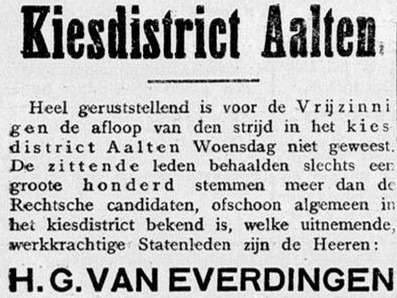
    From 1852 to 1919, the Aalten electoral district was one of the sixteen Gelderland electoral districts for the Provincial Council. The district comprised the municipalities of Aalten, Winterswijk, and Dinxperlo and held three seats.

    Following the constitutional revision of 1848, which for the first time enabled direct elections of the Provincial Council under census suffrage (voting rights for men who met a certain income requirement)1 – and the Provincial Act of 1850, Gelderland was divided into sixteen districts in 1852, including Aalten.2

    With the introduction of universal male suffrage in 1917 and the Elections Act of 1919, the elections of April 10, 1919, were the first to use proportional representation within a single province-wide constituency, after which the Aalten electoral district ceased to exist.3

    Origin and background

    During the reign of King William I (1772–1843), provincial governments were appointed bodies in which nobility and local notables held seats without election. It was only with the constitutional revision of 1848 that members of the Provincial Council could be directly elected, albeit still on the basis of census suffrage.1

    Establishment of the Aalten electoral district

    In 1850, the Provincial Act came into effect, which determined, among other things, how members of the Provincial Council were elected. Two years later, the Act regulating the division of provinces into electoral districts of November 5, 1852 (Bulletin of Acts and Decrees No. 197) established the final division: Gelderland was split into sixteen electoral districts, including Aalten.2

    Abolition and transition to proportional representation

    The constitutional revision of 1917 introduced universal male suffrage and heralded the abolition of the district system. The Elections Act of 1919 put an end to small electoral districts and introduced a single province-wide constituency with proportional representation in all provinces. This system was first applied during the Gelderland elections of April 10, 1919, at which point the Aalten electoral district ceased to exist.3

    Delegates

    Some well-known Council members representing the Aalten electoral district: 1

    1853–1860: Mr. Rudolph Willem graaf van Lynden (1808–1876)

    1853–1877: Bernhard Jan Boland (1804–1888)

    18531882: Mr. Bernard Andries Roelvink (1818–1882)

    1853–1892: Mr. Wilhelm Arnold Roelvink (1822–1917)

    1860–1885: Jan van der Zande (1819–1885)

    1877–1885: John Bernard William Maitland (1826–1894)

    1886–1892: Jacobus Wilhelmus van Hopbergen (1817–1913)

    1892–1898: Georg Ludwig Carl Heinrich Baud (1858–1921)

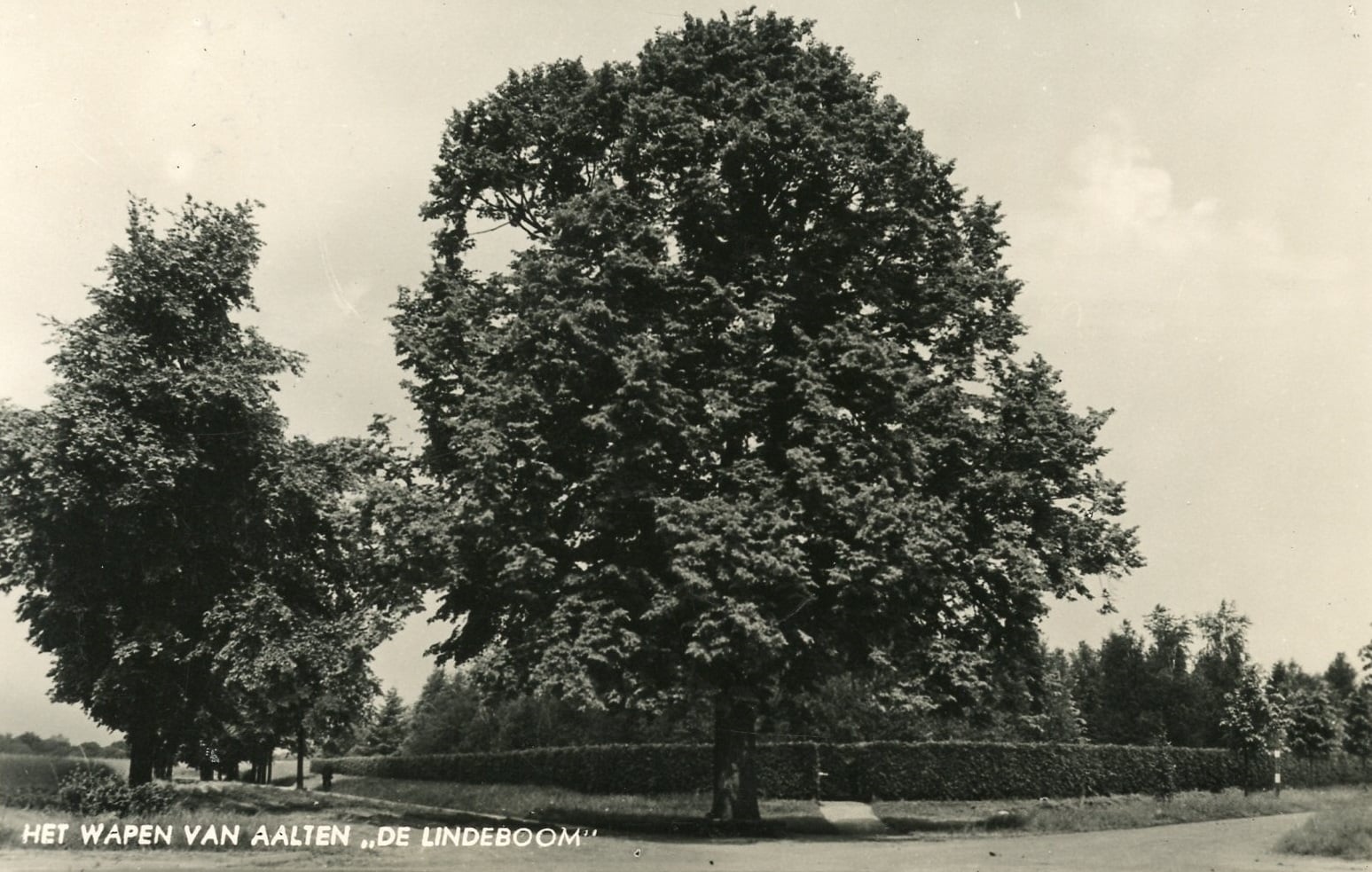
  • The Lime Tree, the Coat of Arms of Aalten

    The Lime Tree, the Coat of Arms of Aalten

    For nearly two centuries, the municipality of Aalten bore a lime tree (lindeboom) in its official coat of arms. In 2005, Aalten merged with Dinxperlo, which meant a new municipal coat of arms had to be created. Nevertheless, the lime tree remains a central symbol in the local identity.

    The coat of arms for the municipality of Aalten was applied for on 3 October 1815 by the then mayor, Christiaan Casper Stumph, and according to his accompanying note, it must have appeared on very old judicial documents. Before that time, the mayor had been obliged to make use of his own family coat of arms. The “very old judicial documents” turned out to be a stamp that Aalten had used as a municipality between 1795 and 1798, until it was incorporated into the Bailiwick (Ambt) of Bredevoort, which used a seal bearing the letters “AB”.

    Following the establishment of the Kingdom of the Netherlands, the High Council of Nobility (Hoge Raad van Adel) drew up guidelines for the registration of municipal coats of arms in 1816. On 7 October 1818, the first official coat of arms was granted to the municipality of Aalten by Royal Decree.

    The description of Aalten’s first coat of arms reads:

    “Of silver charged with a green tree, standing on a ground of the same.”

    Origin and meaning

    The origin of the tree coat of arms is unclear, although there appears to be a connection with surrounding towns. In ancient times, Bredevoort and Groenlo also bore a tree in their coats of arms, as does the nearby German city of Bocholt, which still uses a tree in its emblem today.

    The exact reason why the Aalten administration chose a lime tree at the beginning of the 19th century is not documented. It could have been a liberty tree, or it may have been derived from a freestanding lime tree on the Aalten Es near Berkenhove Cemetery, which stood there as early as the 18th century, was replanted in the first half of the 19th century, and replanted once more after World War II.

    The choice of a lime tree aligns with a broad Western European tradition. Since the Middle Ages, the lime tree served in many villages as a court-tree (dingboom) or justice-lime (gerechtslinde). Beneath this central tree, administrators and judges gathered to dispense public justice. The symbol thus referred directly to local jurisdiction and the self-governance of the place of origin.

    The Municipal Reorganisation (2005)

    On 1 January 2005, the municipalities of Aalten and Dinxperlo merged to form the new municipality of Aalten. According to the guidelines of the High Council of Nobility, the heraldic elements of both former municipalities had to be combined into a new design.

    On 8 June 2010, the new, composite coat of arms was officially established by Royal Decree. The shield was divided horizontally:

    • Upper half: The original green lime tree of Aalten on a silver field.
    • Lower half: The two crossed swords with golden nooses from the old coat of arms of Dinxperlo (originally granted in 1897), placed on a black field.
    • Crest: Since then, the shield has been surmounted by a golden count’s coronet (three leaves and two pearls).

    The Aalten Lime Tree in Delfshaven

    An interesting example of the Aalten coat of arms outside the Achterhoek can be found in Rotterdam-Delfshaven. On Havenstraat stands a building dating from 1886, which features a gable stone depicting the old coat of arms of Aalten.

    Sources


    • High Council of Nobility (The Hague): Register van Overheidswapens, registration dated 7 October 1818 (Municipality of Aalten) and revision dated 8 June 2010.
    • Municipality of Aalten: Council resolutions and correspondence with the High Council of Nobility regarding the alteration of the coat of arms (procedure 2005–2010).
    • Wikipedia
  • Gallows Hill

    Gallows Hill

    The Galgenbulte (Gallows Hill) on the Hollenberg, also known as Klaeskesbulte, was formerly the site where the gallows were erected. This was where condemned criminals, witches, and other scum drew their final breath.

    The execution site was strategically located along the road from Aalten to Bredevoort. The hill was excavated in 1939 to widen the main road.

    Approximate location

    Vehmic Court

    During the medieval period, a veemgericht (Vehmic court) was established on the Hollenberg, near the ’t Walfort manor. This was a special court whose sessions were held in the open air near a thicket known as ‘Sleehegge’. Four times a year, justice was administered here at sunrise. A nearby small farmstead is called Galgenhutte. It is said that the equipment for the executions was stored there in a small building. According to local lore, those sentenced to death were permitted to eat their final meal there.

    Havezathe 't Walfort, Jan de Beijer, 1743
    Havezathe ‘t Walfort, Jan de Beijer, 1743

    Berend de Dücker

    In 1430, Free Count Berend de Dücker, then the mayor of Bocholt, presided over the court here. He led the Vehmic court for 60 years. This Berend was notorious for his severe sentencing, frequently condemning individuals to hanging. The condemned person was hanged with a noose made of willow withes by three anonymous veemschepenen (Vehmic jurors).

    A well-known threat used by parents for disobedient children, which persisted until the 20th century, was: ‘De Düker zal ow halen‘ (The Dücker will get you).

    Records from the ‘Administrative Organisation of the Lordship of Bredevoort’ indicate that the residents of Kempink and Goorhuis in Heurne were responsible for transporting the convicted criminal to the Hollenberg after the sentence had been read at ’t Zand in Bredevoort. By order of the officer, they were also required, without exception, to transport the gallows, wheel, cross, and other instruments of execution to the site.

    By the end of the sixteenth century, the Vehmic court at ’t Walfort had disappeared. It is the only location in the Netherlands where the existence of a Vehmic court has been proven.

    Klaas Nijman

    On 3 October 1729, following a trial in Bredevoort and sentencing at ’t Zand, Klaas Nijman—32 years old and born in the district of Bocholt—was executed on the Hollenberg. He was a ‘beggar and vagabond’ accused of violent theft, arson, and other offences. Although he had been banished from various places, he continually returned. As a deterrent to others, he was strangled on the Hollenberg and subsequently set on fire.

    Harmen Brunsink

    On 12 February 1770, Harmen Brunsink was executed on the Hollenberg. He lived at the Vosheurne farm in Lintelo and had murdered ‘Aunt’ Hendersken Tannemaat. Harmen did not get along with this live-in aunt of his wife. He claimed to alerted neighbours that she had fallen, but the number and nature of the injuries made his story unbelievable.

    Harmen was sentenced to death. The executioner bound him to a wooden cross; first his legs and then his arms were broken. He was subsequently beheaded with an axe. His body was placed on a wheel atop a pole and secured with chains. His head was placed on a stake above it to deter others.

    Verdict of Herman Brunsink, 6 February 1770
    Verdict Herman Brunsink

    The Last Execution

    In 1938, G.H. Rots wrote:

    “The fact that death sentences were carried out even after the time of the Vehmic court proves that the end came for many a condemned soul in the vicinity of ’t Walfort. To the right of the road to Bredevoort, hidden under brushwood and trees, is a small mound. That is where the gallows were erected. When someone was to be executed, a number of men were officially summoned to form a circle around the place of execution. This was in case the noose should break or the condemned should break free; the circle of men stood hand-in-hand to prevent escape.

    After a long period in which no more death sentences were passed, the last gallows is said to have been erected at the beginning of the last [19th] century. The condemned man was named Klaësken, and surrounded by the circle-closers, he went in procession to the gallows. It seems, however, that they wanted to give the man a chance to flee, for when they reached the Walfortallee, they said to him: ‘That is the road to Prussia.’ The man did not take the hint, and on the hill, as the last in a line of condemned men, he met his end on the gallows. That is why that small mound is still called the Klaëskesbulte.”

    Other references

    Sources


  • The Murder of Aunt Tannemaat

    The Murder of Aunt Tannemaat

    On the early morning of January 12, 1770, the neighbors of the Vosheurne farm in Lintelo were startled by a disturbing report. “The aunt is dead, she is very bloody, she may well have smashed her head,” resident Harmen Brunsink shouted. Extensive forensic investigation by the Court of Bredevoort revealed a story of a family conflict that degenerated into murder and would end with a gruesome execution.

    Tensions in the House

    Hendersken Tannemaat, born in 1705, had lived on the Vosheurne her entire life. Her niece, Gijsberta Deemshof, born in 1739 in Doesburg as the daughter of Hendersken’s sister Johanna, was raised by her ‘moeje’ (aunt) Hendersken from the age of three. In 1761, Gijsberta married Harmen Brunsink, born in 1729 at the Bekink farm in IJzerlo. After their marriage, Harmen moved in with Gijsberta and her unmarried aunt at the Vosheurne.

    Initially, Hendersken lived with the young couple in exchange for board. In June 1768, however, she transferred all her possessions to Harmen and Gijsberta in exchange for room and board and all necessary care for the rest of her life. This was a common arrangement at the time between elderly people and their children—in this case, her niece and husband. Harmen and Gijsberta solemnly promised to fulfill this obligation.

    However, the relationship between Harmen and the aunt deteriorated over the years, and tensions arose in the house. The aunt reportedly told Harmen several times that she wanted to undo the agreement “because you treat me so poorly!”

    A Mysterious Death

    A box bed (photo for illustration)
    A box bed (photo for illustration)

    On that fateful morning of January 12, 1770, Harmen frantically gathered the neighbors because the aunt was dead. It was customary in this region for neighbors to be called upon in the event of a death to arrange practical matters, such as the funeral and the ‘verhennekleden’—undressing the deceased and shrouding them in grave clothes. When the neighbor women entered the bedroom, they found Hendersken dead in her box bed, her hands folded over her chest. Her nose and arms were blue, and when her cap fell off, they discovered flour in her hair and blood seeping down her neck.

    Gijsberta stated that she had used the flour to staunch the bleeding. Harmen added that the bruises were likely because the aunt suffered from scurvy, and that Hendersken had probably hit her head on the sharp edges of the bed plank. But the story did not add up. The neighbors did not trust it and brought the matter to the attention of the Court of Bredevoort.

    The Investigation

    Two days after Hendersken’s death, court officials arrived at the Vosheurne with two surgeons. Upon arrival, it appeared the body had already been coffined. In the presence of Harmen and Gijsberta, the surgeons examined the body. They discovered several severe injuries and bruises to the head. The injuries made it clear that an accident was out of the question. Suspicion immediately fell on Harmen and Gijsberta, who lived with Hendersken at the Vosheurne and could not provide a convincing account of what had happened.

    Both suspects denied any involvement and claimed they had found Hendersken dead on the floor in front of her box bed that morning. They claimed to have placed her on the bed, sprinkled flour on her head to stop the bleeding, and put on her cap. However, their statements contradicted each other. Harmen had told the neighbors that he had found Hendersken dead in bed, not on the floor.

    Voluntarily and without resistance, they went to Aalten, where they were taken into custody for further questioning. When the numerous head wounds were discussed, Harmen stated that these might have been the result of an epileptic seizure. Hendersken supposedly hit her head against the bed plank, the flax comb chair, the small chests, a trunk, or the beer stand. He also suggested that someone from outside the house could have broken in, as the house was in poor condition.

    Further Investigation

    On January 16, the Court, assisted by a doctor, a surgeon, and a prosecutor, returned to the Vosheurne with the suspects. Hendersken’s bedroom was meticulously examined.

    The box bed showed a large bloodstain on the bed plank at the head end, as if the blood had splashed against the plank. But it had no sharp edges, as Harmen had claimed. Due to long-term use, the plank was actually rounded, and no sharp edges were found inside the box bed either. Other furniture in the room—small chests, a trunk, and a flax comb chair—showed no traces of blood. Nothing was found under the box bed either.

    The doctor and the surgeon then examined the body even more closely. They stated primarily that there was a slight bruise on the nose, as well as severe bruising on both elbows, arms, and hands, beneath which coagulated, extravasated blood was found. These bruises could only have been caused by an external factor.

    Not only on the right side of the head, at the level of the temple, were the external coverings and fleshy parts bruised, wounded, and destroyed down to the bone, but similar bruises and wounds were visible on the left side, albeit to a lesser extent. Two openings or wounds were discovered on the left side of the skull and one on the right, each about the size of a shilling. Upon loosening the external parts, it appeared that the skull had a fracture on the right side and that on the left side, the end of the skull bone was severely bent downwards and partially broken.

    After sawing through and removing the skullcap, several ruptures were found. Due to these fractures and bone pressed outwards, the brain, particularly on the left side, was severely damaged. On both sides of the head, especially the left, extravasated blood was present on and under the dura mater and also within the brain itself. Furthermore, all blood vessels were completely filled with blood. This combination of injuries had inevitably caused her death.

    Although the suspects continued to maintain their innocence, the suspicions raised against them were only strengthened by these findings. From the situation on-site and the condition of the corpse, there was no longer any doubt that a murder had been committed. Such a thing could not happen unnoticed in a small cottage like that of the suspects, while they claimed to know nothing. The suspects were then transferred to the prison in the Ambtshuis in Bredevoort.

    Harmen’s Confession

    During the subsequent interrogations, Harmen and Gijsberta initially stuck to their story: Hendersken had died in an accident. But the evidence against them mounted. On January 19, a week after the murder, Harmen broke under the pressure and confessed what had really happened: He stated that he acted alone, without the help of his wife. He had previously said to his wife in bed: “There lies such a small pebble, I shall strike her five or six times on the head with it, then she will be gone, then the quarreling will be out of the house, then we can live in peace and unity.”

    Around four hours before sunrise, he had risen, lit the lamp, went to Hendersken’s room, and hung the lamp on a nail above the box bed. Upon entering the room, the aunt woke up from the light. Thereupon, Harmen jumped into bed with her, sat astride her, held her head with his left hand, and struck her five or six times on the head with the pebble with his right hand, until she lay dead under his hands.

    Gijsberta reportedly tried to stop him, but without success. When the aunt was dead and bleeding heavily, he ordered his wife to sprinkle flour on her head and wash off the blood. Afterwards, he called the neighbors. The stone with which he had struck her, he threw into the ditch behind the oven, near the spot where they fetched water.

    Statement of Gijsberta

    Gijsberta made her confession on January 20 and 22. She stated regarding her unhappy marriage: “Oh, how unfortunate I am! I married my husband against the wishes of my entire family, and from the beginning of our marriage, he has lived poorly with me.”

    In the early morning of January 12, her husband, before he even rose, had said to her: “I will no longer have the quarreling in the house, I want to take decisive action, I shall get a pebble, and give the Aunt but one blow to the head with it, then she will be gone, and then the quarreling will be out of the house.” She was very upset by this, but he tried to reassure her, kissed her, and said: “Do not be dismayed, let me take decisive action, she is an old person, then we can have a peaceful life.”

    He even came to her bed with gin and said: “You must drink plenty of gin, and you must be half-drunk, otherwise you would be too dismayed; we must now bite through a sour apple; but you must never betray me, even if I should happen to die, and you get another husband, then you must never say to him that I murdered your own blood.”

    She then said to him: “Could you bring yourself to kill my own flesh and blood; if it comes down to it, then I must say it,” to which he had replied: “I will nevertheless take decisive action, I want the quarreling out of the house.”

    When her husband was already in the aunt’s room and began striking her, he called Gijsberta to come there. She then went to the room, grabbed his linen smock to pull him away from the aunt, and said: “Fie, fie, what are you doing!” She added that her husband had forced her to be present, saying: “otherwise you might go and report me later.”

    Gijsberta also stated that she had long been afraid to lie in bed with him, fearing he would attack her with a knife. That night, too, a knife lay in his trousers in front of the bed. She therefore also said to him: ”I am afraid that you will do me harm.” To which he assured her: “Oh no, I will never do you harm.”

    She also confessed that her husband could not bear it if she was kind to the aunt, and that she had had constant sorrow with her husband since the aunt lived with them.

    Gijsberta stated from the outset that she did not help carry out this gruesome deed. She also did not know what her husband used to beat the aunt to death, only that in the morning, while fetching water in the ditch in front of the house by the willows, she saw a gray pebble lying in the water that had not been there before.

    Both suspects finally confessed that the aunt had never suffered from epilepsy. The neighbors and friends had also never heard of it, except only after her death.

    The Verdict

    The Court of the Lordship of Bredevoort ruled that everything indicated that Harmen Brunsink, on the night of January 11 to 12, 1770, had murdered Hendersken Tannemaat, a defenseless person estimated to be nearly seventy years old, lying on her bed in his house, in a gruesome manner, deliberately and with premeditation. Gijsberta was charged with failing to dissuade her husband, where possible, from this abhorrent intention.

    Harmen was sentenced to death: “to be brought to the place where criminal executions are customarily performed, and there to be bound by the executioner on a wooden cross, to have his legs and arms broken to pieces from the bottom up while alive, and thereafter to have his head severed with an axe. That, this having been done, his body shall subsequently be laid upon a wheel, standing on a post, and fastened thereto with chains, and his head set upon a spike above it, as a hideous example to others.” This punishment is called breaking on the wheel.

    On February 10, the residents of Dinxperlo were summoned to the Hollenberg to erect the post and the wheel for the execution and to make the noose. Most refused or did not show up and were fined 30 thalers per person. 18 persons consented and erected the post and the wheel.

    The sentence was carried out on the Hollenberg on February 12, 1770.

    Gijsberta escaped the death penalty but was required to witness her husband’s execution. Subsequently, she was banished for life from the city and Lordship of Bredevoort. She remarried in 1776 in Silvolde to Jacob Kok and reportedly died in 1813.

    Sources


    • Nieuwe Nederlandsche jaerboeken, of Vervolg der merkwaerdigste geschiedenissen, die voorgevallen zyn in de Vereenigde Provincien […]. Fifth volume. MDCCLXX, published by the heirs of F. Houttuyn in Amsterdam, P. van der Eyk and D. Vygh in Leiden, 1770 (link)
    • Old Judicial Archive of Bredevoort
  • The Vagrant Hunter

    The Vagrant Hunter

    In an era when the government provided little to no poor relief, many people were left at the mercy of begging. They roamed from place to place, struggling to make ends meet. During the eighteenth century, the number of vagrants increased significantly. Because these individuals were often regarded as a nuisance by the authorities, and churches lacked the resources to offer them a chance at a better life, the office of the ‘armenjager’ (‘vagrant hunter’ or ‘parish beadle’) was established. This ‘official’ was employed by the local government but often led an impoverished existence himself.

    Appointment of Vagrant Hunter Willem Hondarp in 1768

    The image below is a fragment from the deed in which, following the death of Antoni Freriks on 5 January 1768, the appointment of Willem Hondarp as vagrant hunter was recorded. The deed also outlines the duties of the office. A complete translation of the transcription follows:

    Appointment Willem Hondarp as vagrant hunter in Aalten, 10 March 1768

    “Whereas, due to the death of Toni Frederiks, Vagrant Hunter of the parish of Aalten, said position has become vacant; and whereas it is of the highest necessity for the peace, quiet, and security of the husbandmen and citizens of Aalten against all violence and nuisance from foreign vagabonds and beggars that this vacant position be filled by another capable person: I have, upon the good testimony given to me of the fearlessness of the person of Willem Hondarp, appointed the same Will. Hondarp, as I hereby appoint him by virtue of these presents, as Vagrant Hunter of the parish of Aalten, upon such emoluments as have been given from of old and are still given. Commanding the aforementioned Willem Hondarp to cause all foreign beggars, vagabonds, and tramps to depart forthwith from the parish of Aalten and indeed from this Lordship; and should any be found who commit any violence or protest, to resist them with force and, if possible, to bring them to the Lord’s prison within Bredevoort.

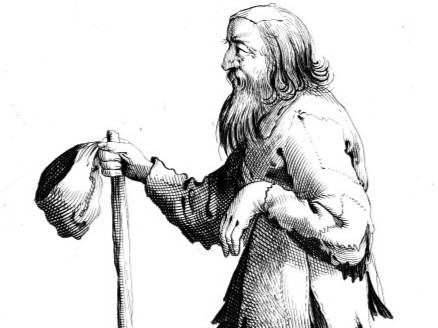
    Vagrant, by Pieter Quast, 1634. Etching: Rijksmuseum Amsterdam.
    Vagrant, by Pieter Quast, 1634. Etching: Rijksmuseum Amsterdam.

    Further commanding him that he shall tolerate no collections, whether by strangers or residents, unless they be provided with a proper note or attestation from the officer or, in the absence of the stadtholder of this Lordship; and to allow those so provided to pass and repass freely and unhindered. Furthermore, in the event that the voogd [warden] or deputy warden should require him, Willem Hondarp, in any exploit and should call or have him called for that purpose, he shall immediately go with said warden or deputy warden and obey and assist him to the best of his ability. Furthermore, to pass through the neighbourhoods from time to time and take care that no nuisance is caused to the husbandmen by any person; further to apprehend and bring in, if possible, all foreign and unauthorised hunters hunting in this Lordship, and should he know any whom he could not bring in, to report them to the officer or his stadtholder, and further to do all that a faithful and orderly Vagrant Hunter is obliged to do, and to take care as much as possible that no complaints arise from the husbandmen.

    However, should it happen that the same Willem Hondarp should fall short in any matter and should request proper assistance from the husbandmen, and such assistance be refused him, he shall give notice of that refusal to the officer or to his stadtholder.

    All this until our revocation. Given at Walfort House, the 10th of March 1768, and signed by my own hand as Drossard of this Lordship and confirmed with my customary seal.

    Signed: Ad. de Pallandt”

    Legal Proceedings

    On 20 February 1804, a court case was held in Bredevoort against Jan Willem Brusse(n), vagrant hunter. On 23 December, at the house of Goormans in Barlo, he had ‘murderously assaulted’ Willem Beskers. Brusse had struck him on the elbow with a sabre, wounding him so severely that he could no longer use that arm. Brusse confessed but claimed that when he asked Willem Beskers for proof that he was permitted to collect alms, Beskers attacked him. Brusse maintained he had acted only in self-defence. Fine: 25 guilders.

  • The execution of Klaas Nijman

    The execution of Klaas Nijman

    Klaas Nijman was baptized on January 16, 1698, in Dinxperlo as the son of Fredrik Nijman and Berentjen Eppink. At the age of fifteen, he left his parental home and began a wandering existence as a ‘beggar and vagabond’. In 1722, he was sentenced in Rhenen to a stay in a house of correction for violence and theft. His release was followed by banishment from the province of Utrecht.

    Nijman then returned to the Achterhoek, where he sowed fear among the population, particularly in the vicinity of Dinxperlo and Aalten. He begged and stole, threatened people, and did not hesitate to use brute force. In 1729, he set fire to several houses and was arrested.

    On October 3, 1729, following a trial in Bredevoort at ‘t Zand, Klaas Nijman was sentenced to death. He was taken to the Hollenberg, where he was strangled and subsequently set on fire. This gruesome punishment served as a deterrent to others. Nijman was 32 years old at the time.

    Sentence

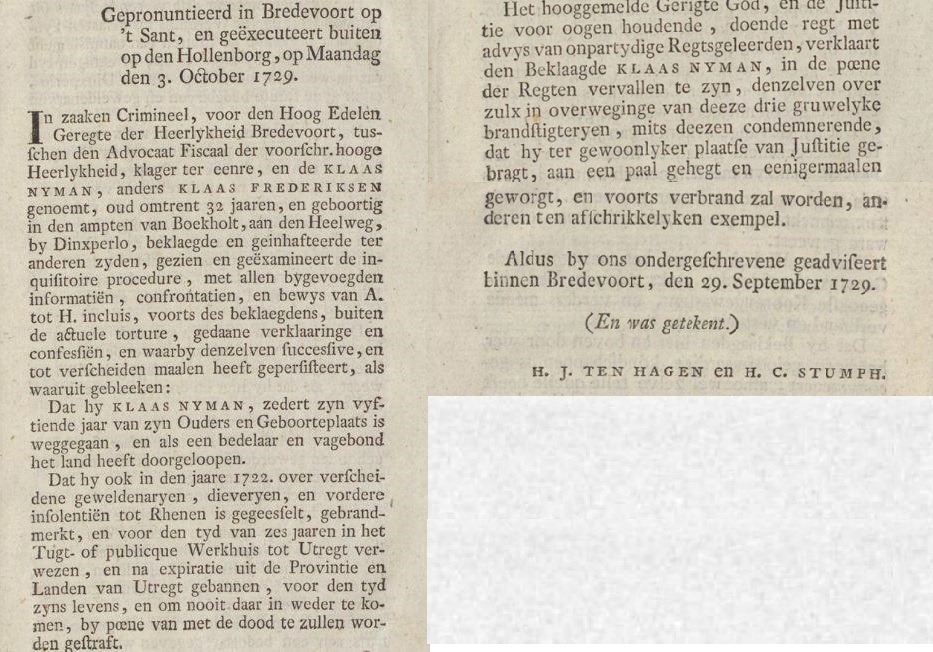
    The following 18th-century text describes his crimes and sentence:

    Pronounced in Bredevoort at ’t Sant, and executed outside on the Hollenberg, on Monday, October 3, 1729.

    In Criminal cases, before the Most Noble Court of the Lordship of Bredevoort, between the Advocate Fiscal of the aforementioned High Lordship, complainant of the one part, and KLAAS NYMAN, otherwise called KLAAS FREDERIKSEN, aged about 32 years, and born in the district of Bocholt, at the Heelweg, near Dinxperlo, defendant and prisoner of the other part, having seen and examined the inquisitorial procedure, with all attached information, confrontations, and evidence from A. to H. inclusive, furthermore the defendant’s declarations and confessions made outside of actual torture, and in which he has successively and at various times persisted, from which it has appeared:

    That he, KLAAS NYMAN, since his fifteenth year has left his Parents and Birthplace, and has wandered the land as a beggar and vagabond. That he was also in the year 1722, for various acts of violence, thefts, and further insolences at Rhenen, flogged, branded, and committed for the term of six years to the House of Correction or public Workhouse at Utrecht, and after expiration banished from the Province and Lands of Utrecht for the term of his life, and never to return therein, upon pain of being punished with death.

    That having been released from the aforementioned House of Correction or Workhouse about three-quarters of a year ago, yet the penalties of banishment remaining in force, he thereupon, or some time thereafter, returned to Dinxperlo, and continued in his bold beggaries and acts of violence. That he there, for a trifle on the public road near Dinxperlo, cut open the mouth of one DIRK WENSINK with a knife.

    That he likewise, after his aforementioned release, again committed various thefts, such as of ironwork and an axe, and of linen, such as a pillowcase or sheet on the other side of Doesburg at the Steege; and also a shirt from the garden at HENDRIK te Loo or Kistershuis, between Dinxper and the Bredenbroek, and further as by the Reformations. That he, KLAAS NYMAN, has also for years past been notorious and held in suspicion by many inhabitants under Dinxperlo and Aalten, as being of no good and committing much evil.

    That he also, following the . . . . of the sentence at Rhenen, was held suspect there of having committed very grave offenses. That the defendant, through his . . . . and malicious conduct and questionable language which he used here and there, has kept the good husbandman and the inhabitants in the countryside, and especially around Dinxperlo and Aalten and the surrounding area, in a state of constant anxiety and fear. That when he came to beg, he was not satisfied with what is ordinarily given to a beggar, although he was often given even more, and went away from the houses muttering to himself.

    That this anxiety and fear among the inhabitants has doubled and reached its peak since fire broke out in the Parish of Aalten in this year 1729, and that further and even more burnings of houses close by followed. Such that several inhabitants ordered their people that, if KLAAS NYMAN came to their houses, they should just give him whatever he wanted, to gain his friendship and not to anger him, and that several people, out of fear of arsons, had to keep night watches at their houses during the night, whereby even some hamlets were placed in a state of near alarm.

    That he, the defendant KLAAS NYMAN, is also the one who has come to such exceedingly wicked crimes that in the past Summer in the Parishes of Aalten and Dinxperlo, of this same year 1729, from June 13 to August 29, and thus within the span of a quarter-year, he has set fire to three houses, one after the other, and by no means the smallest, which houses were also totally burned down, and of which the corpora delictorum are known.

    Namely, on June 13, the house at Lensink, under Aalten on the Esch at Yserlo, where he set a piece of white or spongy peat on fire by means of a tinderbox, flint, and tobacco pipe, and with that burning peat at the back on that side of the house where the wind was blowing against the house at the time, caused the fire. That eight days prior he had also set the same house Lensink on fire, and that it had already been burning, but that it was then still extinguished by the occupants.

    Secondly, the house at Welink, also under Aalten on the Esch at Yserlo, on June 20, where he carried out the fire in the same manner as at Lensink with a piece of ignited spongy peat, and therewith set the house on fire from behind. That for both his arsons, at Lensink and Welink, he gives as his reason that he had done so to create anxiety and terror in the neighborhood, or among the people.

    Thirdly, the house at Grevink, at ‘t Rexwinkel in the hamlet of Heurne, under Dinxperlo, on August 29, in the evening around 10 o’clock, when he caused the fire there with an ignited fuse made of linen rags, in the straw that lay at the back on the corner partition of the house. That in this aforementioned house Grevink, when it caught fire, a young woman in childbed, who had not yet been in childbed for two days, lay on the bed, and who by great fortune still having the strength to get off the bed, still escaped the fire. That he, KLAAS, gives as his reason for this arson at Grevink that he had done so because the same aforementioned woman in childbed, a long time ago when she was still unmarried, had given him a piece of pancake that had been too small for him.

    That at Welink and at the last-mentioned Grevink, several pieces of live Cattle, harvested Grain crops, and further items were also burned and consumed.
    That he, the Defendant, is furthermore convicted by four sworn credible witnesses, although he himself has tried to deny it telle quelle, that on August 31 last he spoke those grim words at the house of ARENT OOSTENDORP, in the hamlet of Heurne, under Dinxperlo, that this or that corner would shortly be a poor corner.

    That he furthermore has threatened to set fire to the house of the drummer boy within Dinxperlo, and has stood by and persisted in this, that if he had not been captured, he would indeed have done it, and similar terrible threats and dangerous utterances of the Defendant, as the information and confessions herein further set forth.

    The highly-mentioned Court, keeping God and Justice before its eyes, doing right with the advice of impartial Legal Experts, declares the Defendant KLAAS NYMAN to have incurred the penalty of the Law, condemning him for the same in consideration of these three gruesome arsons, that he be brought to the usual place of Justice, fastened to a stake and somewhat strangled, and furthermore shall be burned, as a terrifying example to others.

    Thus advised by us undersigned within Bredevoort, September 29, 1729.

    (And was signed.)

    H.J. TEN HAGEN and H.C. STUMPH

    Source


    • Legal Treatises on Corporal Crimes by a prominent Legal Expert (Jan Jacob van Hasselt), published in Amsterdam by Hendrik Gartman, 1781 (link)
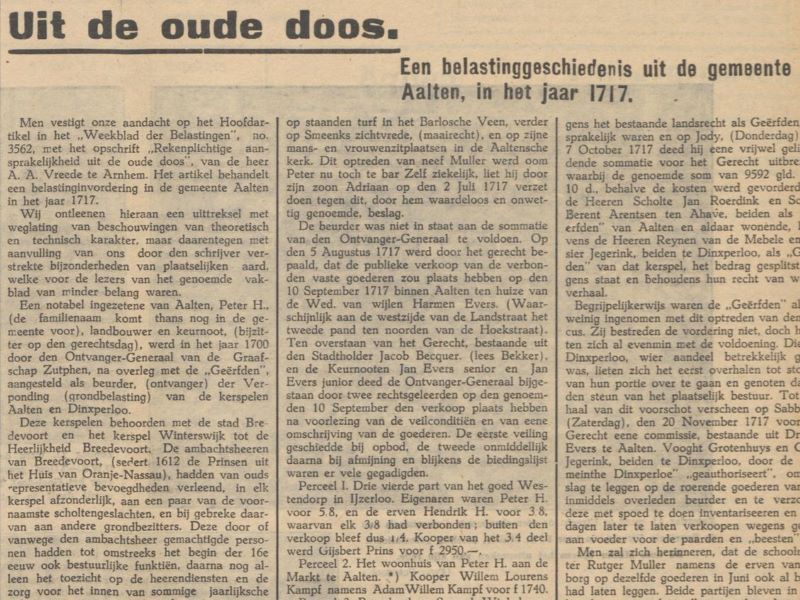
  • A tax history from the year 1717

    A tax history from the year 1717

    Aaltensche Courant, February 28, 1941

    Our attention has been drawn to the lead article in the “Weekblad der Belastingen,” no. 3562, titled “Accountable liability from the old days,” by Mr. A. A. Vreede of Arnhem. The article discusses a tax collection in the municipality of Aalten in the year 1717. We have derived an excerpt from this, omitting considerations of a theoretical and technical nature, but conversely supplementing it with details of a local nature provided to us by the author, which were of less interest to the readers of the aforementioned trade journal.

    A notable resident of Aalten, Peter Huijninck, farmer and lay judge (assessor on the court day), was appointed in the year 1700 by the Receiver-General of the County of Zutphen, after consultation with the “Heirs,” as collector (receiver) of the Verponding (land tax) for the parishes of Aalten and Dinxperloo.

    These parishes, along with the town of Bredevoort and the parish of Winterswijk, belonged to the Lordship of Bredevoort. The lords of the manor of Bredevoort (since 1612 the Princes of the House of Orange-Nassau) had traditionally granted representative powers, in each parish separately, to a few of the most prominent bailiff families, and failing that, to other landowners. These persons authorized by or on behalf of the lord of the manor also held administrative functions until approximately the beginning of the 16th century; thereafter, they only oversaw the corvée labor and the collection of certain annual revenues, which later included some liability for the receipt of the land tax. Related to this was the fact that the appointment of a receiver took place in consultation with these authorized persons, referred to above as “Heirs,” and that the provision of security by an appointee was required in the deeds of guarantee of that time for the benefit of the Receiver-General and for the service of the Heirs.

    These documents, like all other voluntary deeds as well as judicial deeds, were established by a declaration in a court session. The court, consisting of the bailiff (judge) or the Stadtholder (deputy judge), two lay judges (assessors), and a Landsschrijver (clerk), was seated in Bredevoort, but held sessions alternately in each parish where necessary. Upon the appointment of Peter Huijninck as collector, his brother Hendrik Huijninck acted as guarantor, and in the deed of guarantee, various fixed assets of both were pledged as security for the administration.

    For several years things went well, but gradually the collector became negligent with the collection, and an increasing backlog arose in the remittance of funds to the office of the County in Zutphen. At the repeated insistence of the Receiver-General, temporary improvements occurred occasionally; for instance, the lay judge Peter Huijninck, in his capacity as collector, requested on Mercury (Wednesday) April 21, 1717, at the Court Day in Aalten, to seize the real estate of Jan ten Heetbrink the Younger and of Mechtelt Brethouwer, widow of Derk Nachtegaal, due to overdue land tax, but no lasting improvement followed.

    It was common knowledge in Aalten that this situation could not continue and that legal action against the negligent collector was inevitable. It is therefore understandable that the heirs of the since-deceased guarantor Hendrik Huijninck feared that the real estate pledged by him would also be targeted. As a result, on Venery (Friday), June 18, 1717, the collector Peter Huijninck and his spouse Geesken Locken appeared before the court, stating that the aforementioned heirs were bothering them daily by insisting on measures to keep them indemnified, and hereby pledged a one-fourth share in the estate and property Westendorp in IJzerlo and two-thirds in the Snoejenbos, located on the Haart, as far as Arent Snoejenbos has it under lease, so that the heirs could recover any damages from it.

    This happened just in time, for only ten days later on Luno (Monday), June 28, 1717, a representative of the Receiver-General Hendrik van Essen appeared before the court to issue an executory summons against the collector Peter Huijninck, inviting him to settle a sum of 17,134 guilders, 1 stiver, and 10 deniers at the office of the County within ten days, as arrears for the years 1713–1716, and threatening a judicial sale of the fixed assets pledged in the guarantee deed. A copy of the summons was served the following day by the bailiff (court officer or bailiff), Jan Keunen, to the collector, speaking with his wife Geesken Locken.

    Now the heirs of the guarantor, who did not yet feel safe despite the deed of June 17, were truly struck with fear, for that very same day, schoolmaster Rutger Muller of Aalten, son-in-law of the deceased Hendrik Huijninck, appeared before the court on their behalf to seize the movable property of Peter Huijninck, as well as the crops and the manure rights of lands leased by him, also his peat pond and the peat standing on it in the Barlosche Veen, furthermore on Smeenk’s mowing rights, and on his men’s and women’s seats in the Aalten church. This action by nephew Muller was finally too much for uncle Peter. Being ill himself, he had his son Adriaan file an objection on July 2, 1717, against this seizure, which he called worthless and illegal.

    The collector was unable to comply with the summons of the Receiver-General. On August 5, 1717, the court determined that the public sale of the pledged fixed assets would take place on September 10, 1717, in Aalten at the house of the widow of the late Harmen Evers. (Probably on the west side of the Landstraat, the second building north of the Hoekstraat). In the presence of the Court, consisting of the Stadtholder Jacob Becquer (Becker, ed.) and the lay judges Jan Evers senior and Jan Evers junior, the Receiver-General, assisted by two legal experts, conducted the sale on the aforementioned September 10 after reading the conditions of sale and a description of the properties. The first auction was by bidding, the second immediately thereafter by Dutch auction, and according to the bidding list, there were many interested parties.

    • Lot 1. Three-fourths part of the Westendorp estate in IJzerloo. The owners were Peter Huijninck for 5/8, and the heirs of Hendrik Huijninck for 3/8, of which each had pledged 3/8; thus 1/4 remained outside the sale. The buyer of the 3/4 share was Gijsbert Prins for 2,950 guilders.
    • Lot 2. The home of Peter Huijninck at the Market in Aalten 1. Buyer Willem Lourens Kampf on behalf of Adam Willem Kampf for 1,740 guilders.
    • Lot 3. Farmland at Smeenk-Winkel, one and a half schepel. Buyer Derk Neerhof for 505 guilders.
    • Lot 4. A piece of farmland at Smeenk-Winkel, size not mentioned, buyer Willem Eppink for 480 guilders.
    • Lot 5. Six schepel of land, called the Wijntjesstuk, buyer Adam Willem Kampf for 465 guilders.
    • Lot 6. Four pieces of garden land in Smeenkgoorden, size not mentioned, buyer as before for 205 guilders.
    • Lot 7. The Dalshof, size not mentioned, buyer as before for 230 guilders.
    • Lot 8. The Horsterkamp in Linteloo, size not mentioned, buyer Jan Evers for 600 guilders.
    • Lot 9. The Grevincksweide near Aalten, size not mentioned, buyer Jan te Bokkel for 470 guilders.
    • Lot 10. The lease corn of the pledged separate lots, as well as the annual fee, the services, and the small leases owed by the farmer of Westendorp, all for the current year; buyer Jan Arentsen for 95 guilders.
    • Lot 11. The lease corn in sheaves of three-fourths of Westendorp stored in the farmer’s dwelling; buyers Wessel Broekhuys for 55 guilders and Jan Arentsen for 25 guilders. The owner of lots 2–7 was the collector Peter Huijninck, and of lots 8–9, the heirs of the guarantor Hendrik Huijninck.

    Immediately after the second auction, the final award followed, at least in name, for nearly five weeks later on October 14, the Receiver-General had it declared before the Court that a higher bid had been made for lots 3 and 4 at Smeenkwinkel by the Dowager van Nagell tot Ampsen, née Baroness van Coeverden, and that the first buyers could be dismissed. These men, the farmers Neerhof and Eppink, did not remain silent and filed a protest with the Court on October 18, along with the declaration that they faithfully followed the conditions of sale and would quietly continue to cultivate and sow the purchased land. It is to be hoped for them that they were not disappointed.

    The total proceeds amounted to 7,542 guilders, so that the initial backlog of over 17,134 guilders was reduced to over 9,592 guilders. It would be logical for the Receiver-General to attempt to recover this remainder from the collector’s other assets as much as possible and, if necessary, have it collected from the negligent taxpayers by means of a new collector. However, he followed another very unusual path. Since the so-called Heirs were also liable according to the manorial law of Bredevoort, he issued a summons to the Heirs of Aalten and Dinxperloo immediately after the auction, without specifying certain individuals, which summons was served to the bailiff as the judge of the common lands.

    Reinier Jurrien Baron van Coeverden and Walfaerdt 2 was at that time the representative of the Lord of the Manor with the titles of Hofrigter, Verwalter, Bailiff, and Judge. The Receiver-General then had it investigated which persons were liable as Heirs according to the existing national law, and on Jody (Thursday), October 7, 1717, he had a virtually identical summons issued before the Court, whereby the aforementioned sum of 9,592 gld. 1 st. 10 d., plus costs, was claimed from the Gentlemen Bailiff Jan Roerdink and Bailiff Berent Arentsen at Ahave, both as “Heirs” of Aalten and residing there, as well as the Gentlemen Reynen van de Mebele and Rosier Jegerink, both in Dinxperloo, as “Heirs” of that parish, the amount split according to the statement and subject to their right of recourse.

    Understandably, the “Heirs” were very little pleased with this action by the Treasury. They did not contest the claim, but they were in no hurry to pay either. Those from Dinxperloo, whose share was relatively small, were the first to be persuaded to pay their portion and enjoyed the support of the local administration. To recover this advance, a commission appeared before the Court on Sabbathy (Saturday), November 20, 1717, consisting of Dr. Jur. Evers of Aalten, Vooght Grotenhuys, and Garrit Jegerink, both of Dinxperloo, “authorized” by the “Gemeinthe Dinxperloe,” to seize the movable property of the meanwhile deceased collector and to request that it be inventoried urgently and sold two days later due to a lack of fodder for the horses and “beasts.”

    It will be remembered that schoolmaster Rutger Muller, on behalf of the heirs of the guarantor, had also had the same goods seized in June. Both parties continued to dispute each other’s rights in a lengthy procedure. The Court did go to the house of the Widow Peter Huijninck on Monday, Nov. 22, for the inventory, but the sale did not take place for the time being, although provision will have been made for the livestock. More than half a year later, on June 24, 1718, at the insistence of the aforementioned Muller, the Court ordered the Bailiff and the Under-Bailiff in Aalten to store the seized goods in a neutral place after inventory at the house of Jan Janknegt, one of the court officers. Furthermore, the Protocol contains no more details about this case.

    The Heirs of Aalten remained passive for the time being, so the Receiver-General deemed it advisable to put more pressure on them. After three months, on Jovis (Thursday), January 6, 1718, Hendrik Casper Stumph, “Doctor of Laws” in Aalten, appeared before the Court as the serving advocate for the Receiver-General and requested the setting of a “clear fixed day” for the judicial sale of their fixed assets.

    The deed mentions:

    • the windmill (in the Esch), held in fief from the Count of Bentem;
    • a part of the manorial estate Hunink;
    • a part of the estate Boeink (Winterswijk);
    • a part of the estate Bouwmeester, as well as some lots of the estate Rigterink;
    • a house and garden in Aalten;
    • the watermill;
    • the Hof te Ahave (the estate De Pol in Aalten) with subordinate properties;
    • a part of the estate Rikkert in Haart-Heurne;
    • a part of Bennink; two parts of Het Slaa in Haart-Heurne.

    The auction was set for March 8, 1718, again at the house of the Widow Evers, at two o’clock in the afternoon.

    Both Heirs now saw that the matter was becoming serious and that they would have to pay up. In the meantime, order had also been established from the official side. The old collector Peter Huijninck had died at the end of October, and another Aalten resident, Adam Willem Kampf (also written Campf and Cempf), was temporarily charged with the observation of the collector’s office. He moved into the house at the Market of his predecessor, which he might have already bought in advance at the judicial auction, and on March 12, 1718, he and his spouse Gesina Smits passed a deed of guarantee, in which the estate Bulsink in Linteloo and the lots purchased at the judicial sale of the late Peter Huijninck were also pledged, while Dr. Jan Casper Evers acted as guarantor, pledging the Busscher Kamp, located between Aalten and Bredevoort, for Kampf’s administration.

    The overdue tax was now collected with due speed as much as possible, and finally, Bailiff Roerdink and Bailiff Arentsen seem to have emerged without too much damage.

    After a few months, the temporary collector received a permanent appointment with the official title of “Receiver.” Beforehand, however, conditions had been set on both sides. The appointee had to take over the administration of his predecessor as it stood and pledge his guarantee to an amount of 1,000 guilders for the indemnification of the Heirs, should they so desire; on November 30, 1718, his guarantee deed was supplemented to that effect. In return, his minor son Seger Adolph became an assistant to his father with the prospect of later becoming his successor, so that on the same November 30, the receiver Kampf took an oath of office for himself and also for his aforementioned son. The young Kampf, however, later became a mayor elsewhere.

    Footnotes


    1. The property on the east side of the market square with an exit in the Peperstraat, bordering to the north on the plot where the café Keizer is currently located, and to the south adjacent to the house of Gijsbert Grevinck, which on the other side bordered the brewery with front garden of Lemmert Te Kavestede. According to an inscription on a gable stone, this last plot was renovated in 1799 by Lourens Becking and Willemina Geertruid Schaars into a home, distillery, and agricultural barn. ↩︎
    2. “Walfaerdt” is likely a variation of “Walvoort,” the name of the well-known manor house located between Aalten and Bredevoort. The spelling “Walfort,” which was later used officially and in surnames, is said to be incorrect, while the pronunciation “Walvoort” is correct. ↩︎

    Source


  • Bredevoort Castle

    Bredevoort Castle

    Bredevoort Castle, 3D impression by Paul van Druten

    Bredevoort Castle was a fortress in the heart of the eponymous town and former Lordship of Bredevoort in the County of Zutphen within the Duchy of Guelders. It was one of the most significant castles in Gelderland. During the 13th and 14th centuries, Bredevoort Castle played a major role in the struggle between Guelders and Münsterland.

    The castle was first mentioned in 1188 on a list of properties belonging to the Diocese of Cologne as “Castrum Breidervort“. At that time, the castle was a site of contention. Consequently, it had multiple owners, leading to a centuries-long struggle for control. In 1238, the castle came into the hands of Ludolf van Steinfurt and Herman van Lohn as a shared inheritance. The castle was to be fortified, with both parties sharing the costs. In 1278, the fortress was destroyed by Count Everhard I von der Mark during an act of revenge. Following this, the castle remained a ruin for 23 years. A deed of sale from 1284 refers to the “area castri Bredevort”.

    After years of conflict over Bredevoort between Münster and Guelders, the castle eventually returned to the hands of Count Herman van Lohn II in 1301. In that year, the bishops of Münster and Cologne pledged to assist Herman van Lohn with the restoration of the fortress. In the turbulent times that followed, the fortress frequently changed hands between Münster and Guelders through combat or sale. The bishops of Münster and Cologne were required to jointly fund the reconstruction of Bredevoort Castle.

    After centuries of fighting over the castle, the Bishop of Münster abandoned the struggle and sought peace negotiations. Following years of negotiation, peace was finally signed on June 28, 1326, with the Treaty of Wesel. This significant treaty was also signed by the cities of Zutphen, Groenlo, Emmerich, and Arnhem. As a result, Reinoud II of Guelders acquired the pledge of the jurisdictions in Winterswijk, Aalten, and Dinxperlo, as well as the County of Bredevoort. This move definitively incorporated the area into Gelderland.

    Floor plan

    In 1562, the lord of the manor of Bredevoort, Diederik van Bronckhorst-Batenburg, Lord of Anholt, commissioned a floor plan of the castle at Bredevoort. This plan also described the functions and structural condition of the various components. Measurements were recorded in Rhineland feet. A Rhineland foot is over 31 cm long. The castle was a rectangle measuring 42 m long and 36 m wide. The walls were approximately 65 cm thick. An earthen rampart surrounded the castle, with roundels at the corners. The rampart was approximately 2 m wide.

    Explanations of the descriptions on the floor plan (translated from old script):

    1. This vault will collapse if it is not repaired soon.
    2. Here is the staircase leading to the knights’ hall.
    3. This wall is dilapidated. The vertical beams are rotted at the bottom. This is a large hall: 47 feet long and 23 feet wide, measured from the inside. Beneath it is a cellar. The floor consists of beams and planks and is finished with floor tiles. There is only one attic above the hall.
    4. This is a staircase to enter the large hall.
    5. This is the kitchen, 21 feet long and 23 feet wide. Beneath it is a cellar of the same size as the cellar under the large hall.
    6. This shed was built by Drost Isendoorn. The walls are masonry set between beams.
    7. This is the rampart that runs around the castle.
    8. This is a very dilapidated shed, much like a pigsty.
    9. The prison tower. It is 38 feet square (measured from the outside). The walls are 8½ feet thick. [This tower was likely used later as a powder tower, Ed.]
    10. Here are two roundels.
    11. The Drost’s chamber (Maarschalcksekamer) above the gate. [The name ‘Maarschalckse kamer’ dates from the period 1534-1555 when Marshal Maarten van Rossum was Drost of Bredevoort, Ed.]
    12. This is the chapel.
    13. From here, the hearth of the knights’ hall is stoked.
    14. This is the knights’ hall. The room is 36 feet long and 19 feet wide. Below this are the rooms of the burgrave (castle warden) and the steward. The gate entrance is also located below here.
    15. This wall is in good condition, as far as it can be seen above the rampart.
    16. This wall is built between wooden beams and has a thickness of half a brick. [The bricks used were ‘kloostermoppen’ of approximately 14 cm in width, Ed.]
    17. A dilapidated spiral staircase.
    18. Another room. Below this is a laundry room. Because the rampart rests against the laundry room, the wall is rotted. The stones are loose.
    19. This wall is largely built between wooden beams and is very dilapidated.
    20. This contains the grain mill and the baking ovens. Above is the servant’s room, with two attics and a chimney.
    21. This is where the Drost sleeps. The room is 28 feet long and 23 feet wide. Beneath it is a meat cellar.
    22. This room is divided in two. The floor is made of wood. The meat cellar also lies beneath this area.
    23. This upper room is called the salon (state room, armory). Below it is the armor room.
    24. Here the rampart touches the wall, causing the wall to let in moisture and show defects. The wall is very thick, and if the water could be kept out, it would likely provide some improvement.
    25. These two rooms, as well as the granary, are located above the bakehouse and brewhouse.
    26. This drawing was made in Arnhem after everything was measured as accurately as possible. The drawing is fairly accurate. However, in reality, some parts are slightly larger than depicted here, such as the chapel, the spiral staircase in the courtyard, and the prison tower.

    External Appearance

    Not much is known about exactly how Bredevoort Castle looked. While drawings of the castle exist, they are partly based on assumptions and imagination.

    The castle was built on a sandy ridge of approximately 42 x 26 meters, making it one of the larger castles in the Netherlands. Old maps show the main fortress to be a typical concentric castle, featuring double moats and a thick curtain wall. It included an outer bailey with heavy corner towers and a rectangular castle wall equipped with four corner towers, three of which were later lowered to become roundels.

    The castle and the town were separated by a double moat. Access to the castle from the town was via a bridge. One had to pass through two gates, the second of which was equipped with a barbican, and finally a gatehouse in the curtain wall before reaching the inner courtyard. Within the fortress, various buildings stood around a spacious inner court. These depictions changed over time, and the appearance and stature of the castle would have been altered frequently throughout the centuries due to conflict, war, city fires, and other causes.

    Destroyed

    The castle was heavily damaged by the Gunpowder Tower Disaster in 1646. Following this, the castle dominated the cityscape as a ruin for over 150 years until around the end of the 18th century. The last known mention of a visible ruin dates to 1791, recorded in the Bredevoort church council minutes when William V viewed the remains during his visit to Bredevoort. The main building (excluding the outer bailey, roundels, and curtain wall) had dimensions of approximately 42 x 36 meters. This made it one of the larger castles in the Netherlands.

    Remains

    Today, the remains of the castle—in the form of foundations, vaults, tunnels, and rubble—lie beneath and around the ‘t Zand square and the Hozenstraat in the heart of the town. In the spring of 2009, during archaeological research around the former school on ‘t Zand, part of the foundations was uncovered. Wall remains between 2.5 and 4 meters thick were found. On ‘t Zand square, foundations of the barbican were discovered. The contours of this gatehouse have been made visible in the paving with brass-colored bands.

    Sources