
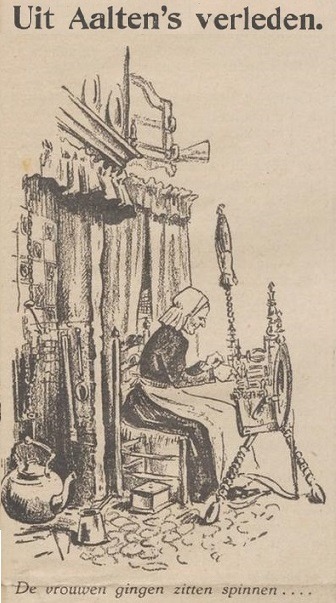
In 1937, G.H. Rots described in a series of articles what life in Aalten had been like in earlier times. The following passage gives an impression of women’s role in everyday life in those days:
“The wives of most village residents had a demanding task. They were expected to do a great deal of heavy work on the farm. As we have already mentioned, the wheelbarrow was the main means of transport in the village, and women were regularly seen bringing crops from the fields or gardens to their homes by wheelbarrow. If a woman had young children, they had to be taken to the fields in the wheelbarrow while she carried out the work that needed doing there. Women had to perform heavy labour, not only pushing the wheelbarrow but also helping to dig over the land.
In spring, when the winter stores had dwindled and buying concentrated feed was out of the question, some women went to ‘shake couch grass’. Because manure was poor and artificial fertilisers were unavailable, some plots were overgrown with this weed. The one advantage was that its roots had a certain nutritional value. They were therefore collected and taken by wheelbarrow to the stream, because the couch grass first had to be washed before it could be fed to the livestock.
Women had to work particularly hard during harvest time, and every journey had to be made on foot. Looking after the house did not require quite as much work. On Saturday afternoons they did a little housework. There were no mats to beat and no rugs to brush; those things were unknown. The living-room floor consisted of cobbles, later of floor tiles, and once it had been swept, a little white sand was scattered over it and the ‘room was done’. Saturdays were for scrubbing. A few buckets of water were thrown over the floor, the dirt was scrubbed loose with a birch broom, and everything was swept out through the drain hole, for every kitchen had such a ‘göttengat’. Different times, different customs: that was how people cleaned their houses in the old days. And yet it could be cosy — perhaps cosier than many more modern, well-furnished sitting rooms.
On winter evenings everyone had their own tasks. Once the livestock had been tended, there was other work to do. The woman sat down to spin, the man worked in the weaving room, and the older children had other household chores such as peeling potatoes and churning. Then, when mother felt like a ‘koffiesmodde’, a pot of coffee was made. If supplies allowed, a little lump of sugar went into the coffee; otherwise it was drunk without. Then the husband and father appeared, lit his pipe, and after the children had gone to bed, husband and wife chatted on for a while.”