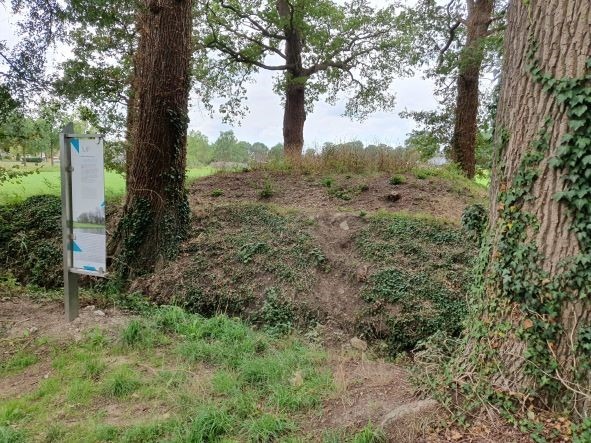
Walking into the „Nannielaantje” from the Haartsestraat (known to older residents of Aalten as „Smeeslaantje”) and crossing the narrow bridge, one sees on the left, roughly opposite the „Aalten’s Belang” bench in the meadow, a square mound. It is overgrown with several heavy oaks and surrounded by ditches, which have gradually become almost level with the surrounding land.
Most residents of Aalten will not know what this square mound actually is, and few are aware that it is an old burial mound, let alone any further details.
Having happened upon the „Deed of Foundation” for this cemetery recently, it seemed interesting to share some information with readers, for the well-known „hump” in the Nannielaantje is indeed a burial ground.
A former mayor of Aalten, C. C. Stumph, strongly disagreed with the continued practice of burying people in and around churches. Consequently, he created his own burial place in the „Smees meadows”. In the „Deed of Foundation”, dated 2 May 1818, everything is precisely described. The maintenance of this cemetery was arranged and the compensation for it established.
Including the entire „Deed of Foundation” would require too much space. A few passages follow here:
„After my death, I wish and desire to be of no harm to my fellow man. However, as our National Government remains backward in—as in Germany, France, Italy, and elsewhere—ceasing burials within Churches and in Churchyards within towns and referring them to more spacious burial grounds outside: I have, so that my earthly remains may be entrusted to the Earth undisturbed! and my Bones may rest in Peace, already for several years, caused a Private Outdoor Cemetery to be prepared for myself in one of the Smees meadows, specifically the one against Smees Hoflanden.
This small plot of ground, my property, I will and desire that after my death, it shall be respected and honoured as a Sanctuary in a certain respect, by whomsoever, be it my Heir or Heirs, or legal successor! Declaring the same hereby as forever inalienable and untransferable.
And so that this Cemetery, in the order it currently is, or shall be at my passing, be continuously maintained annually in the future, I attach and bind to it (for and to settle the costs of that maintenance) that dagmat [day’s mowing] of land in which it is situated.
With the maintenance and upkeep after my death, the resident or residents of the dwelling house standing on Smees shall be and remain charged! who shall also for this purpose enjoy the annual proceeds of that dagmat of land or the (…), and the meadow on both sides along the ditches belonging to that dagmat and along the stream growing soft-wood timber, free of charge; also with the promise to be allowed to cut and use the grass on that Cemetery, and also of the ditches belonging thereto and to that dagmat, twice a year, however, sparing the
weeping willows or other shrubs or flowers thereon, these being an exception to the aforementioned soft-wood timber, and furthermore the right to allow two cows to graze in that meadow after the grass has been mown, in the aftermath or late grass, with the Beasts brought therein by or on behalf of the Owner of that meadow, also to be grazed free of charge.”
In the remainder of the document, the minister of the Reformed Church was charged with supervision. „The Minister or Ministers of the Reformed Congregation of Aalten at the time are invited and urgently requested to kindly take upon themselves the Supervisions! Granting for that purpose the faculty, in the event of no proper maintenance and supervision: without any consultation or notice, to entrust that maintenance with the attached enjoyment thereof to a more diligent and vigilant subject!”
After several further provisions, the deed ends as follows: „Thus disposed and drawn up this second of May 1818, following his signature, was signed: C. C. Stumph.” This Mayor Stumph, who passed away a few years later, is not the only person buried here.
Information regarding this was received from a relative who still possesses the old Bible and other family papers:
A sister of Mayor Stumph, Christina Petronella, born in 1786, was married to one Johan Christiaan Rost, born 15-12-1766. (This Rost originally came from Germany. He lived at „’t Smees”, which was later sold to Mr Slicher van Bath). They died in 1827 and 1835 respectively and were both buried at „’t Smees”.
The Rost-Stumph couple had 4 children:
- Henriette Willemina Christina Theodora, born 21-6-1817 (she later married Dr Servaas van Leuven, the father of the late Dr Adriaan van Leuven).
- Willemina Johanna, born 11-06-1819
- Louisa Benjamina
- Elisa Charlotte, born 13-03-1823
Two of these children, namely Willemina Johanna and Elisa Charlotte, died in 1835 and 1826 respectively and were both buried at „’t Smees”. Dr Servaas van Leuven had 10 children. He lived in the building on Bredevoortsestraat where the Volksslagerij (People’s Butchery) is now located. Of these 10 children, two died at a very young age and were also buried at „’t Smees”. These were:
- Johannes Adrianes, born 23-03-1839 and died 06-04-1840
- Karel, born 10-01-1861 and died 18-08-1862
These were therefore two brothers of Dr Adriaan van Leuven.
It is therefore known with certainty that 7 people are buried at the „’t Smees” cemetery. It is understood that there are plans to provide a fence for this old burial mound, which is now often used as a playground by the youth.