Overview
Mayor (1811–1818)
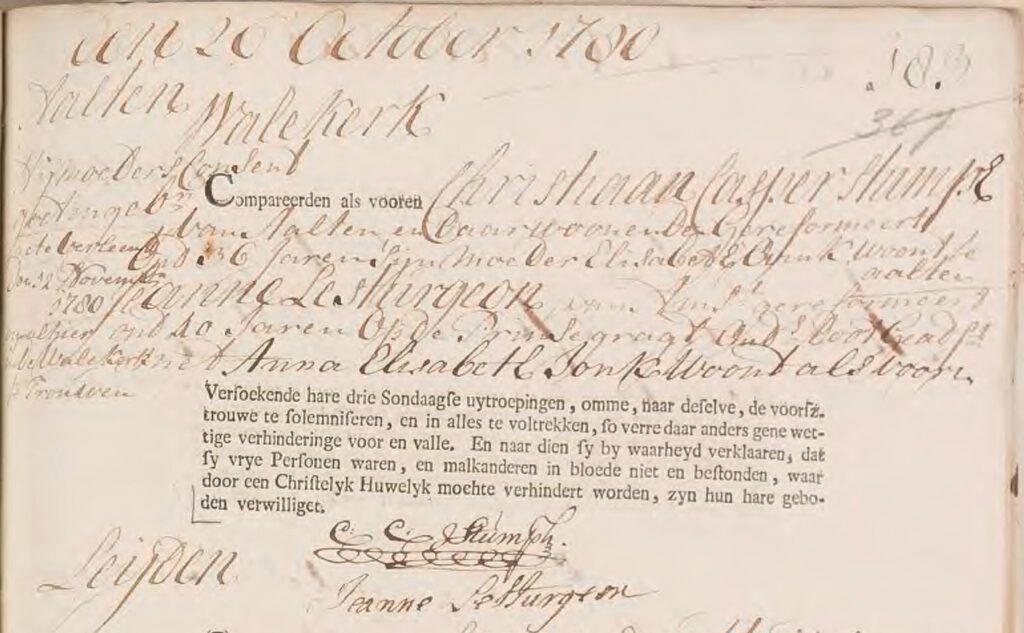
Christiaan Caspar Stumph was baptized in Aalten on February 14, 1745, as the son of Abraham Stumph and Elisabeth Ovink. On November 12, 1780, he married Jeanne Lesturgeon. They had at least one child, Abraham Antoni. This son drowned in the Slingebeek at the age of 34. Popular belief held that his death was related to a broken heart.
In 1795, Stumph was accused of the attack on Ten Holte and imprisoned. He was released a month later as his guilt could not be proven.
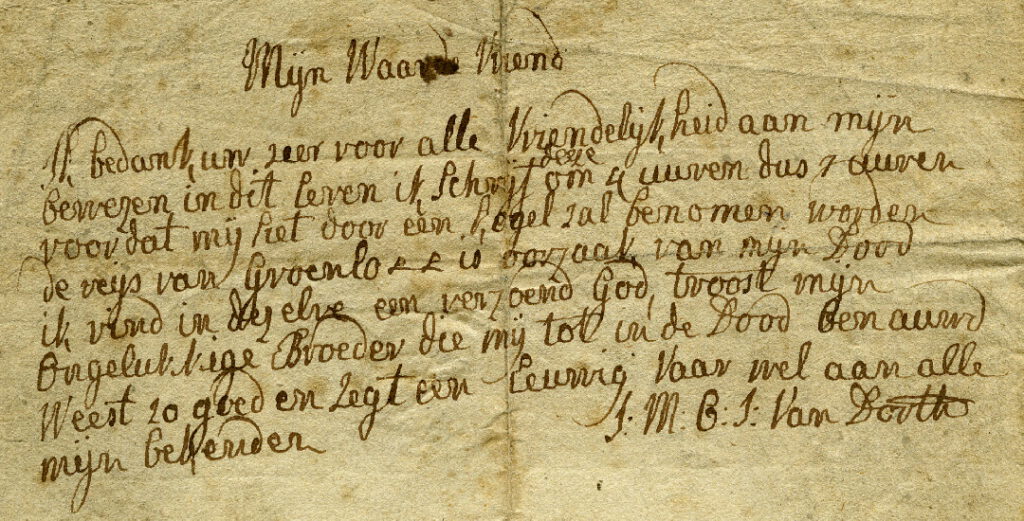
Stumph was a close friend of the Freule van Dorth, who was executed in Winterswijk in 1799. Seven hours before her death, she wrote him a letter: “My Dear Friend, I thank you very much for all the kindness shown to me in this life. I write [this] at 4 o’clock, thus 7 hours before [life] shall be taken from me by a bullet. The journey from Groenlo etc. is the cause of my death. I find in the same a reconciled God; comfort my Unfortunate Brother who is distressed for me until Death. Be so kind as to say an Eternal Farewell to all my acquaintances. J.M.C.J. van Dorth.”
The first mayor of Aalten
Following the annexation of our country by France on July 10, 1810, the entire administrative power was restructured and centralized according to the French model. A departmental organization was established, headed by a prefect for the departments, a sub-prefect for the districts, and a maire (mayor) for the municipalities.
On March 12, 1811, Christiaan Caspar Stumph was appointed maire of the Canton of Aalten. He is therefore considered the first mayor of the municipality of Aalten. He held this position until January 1, 1818, when a new administrative regulation was established.
Stumph lived at the Smees. He was a person of independent means and an organist in Aalten, a man of integrity with many noble objectives. On May 14, 1819, at the age of 74, he married 30-year-old Caatjen Weversborg in Aalten. As far as is known, their marriage remained childless.
Christiaan Casper Stumph was a man who frequently endeavored to put an end to existing abuses. One of his greatest grievances was the practice of burial inside the church or in the churchyard within the village. Indeed, this often led to unimaginable situations. On several occasions, subsidences occurred in the church floor, and the owners of these graves failed to carry out the necessary repairs. For weeks, the pews near the hole in question would be uninhabitable. Consequently, a regulation was established stating that churchwardens, in cases of negligence, were permitted to contract out the necessary repairs, whereby the plot in question would revert to the church.
Burial mound at ‘het Smees’
The condition of the cemetery around the church was also frequently poor. Because burials had not been conducted at a “sufficient” depth for a long time, bones regularly came to the surface. A bone collector gathered these remains from time to time for two bushels of rye per year and threw them into the “Beenhalle,” a small building in the churchyard on the Market side. If the stock became too large, it was cleared out, and the walls were cleaned and repaired where necessary.
With the improvement of social conditions and higher hygiene standards, changes slowly but surely occurred in this area, including the obligation to make graves sufficiently deep. A law to prohibit burial within towns and villages, following foreign examples, could not yet find favor in our country. People could not bring themselves to take the major step of breaking with all traditions and leaving the dead “just anywhere in the ground” far outside the village.
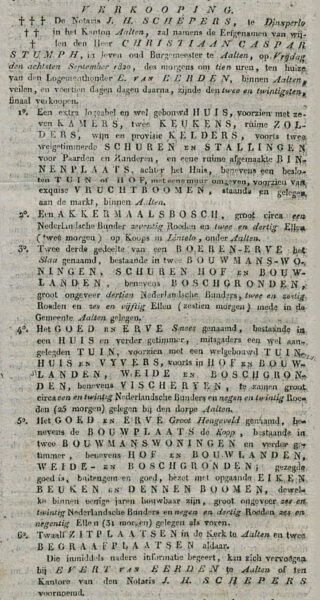
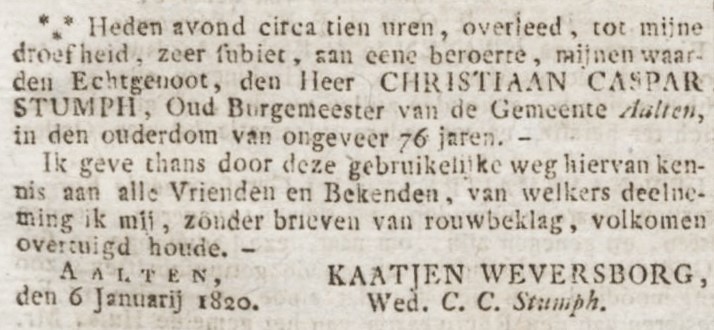
Stumph was a proponent of burial outside the village; he decided to have an “Outer Cemetery” created in one of the Smees meadows. In 1818, the foundation deed and will were drawn up. Christiaan Casper Stumph passed away on January 6, 1820. According to his last wish, he was buried at the old Smees. This site is still recognizable today as a burial mound, located on Nannielaantje.
Mayor Stumph was succeeded by Mr. Arnoldus Florentinus Roelvink.