
Profile
- Type
- Music society
Mixed choir, Aalten
This article is still a work in progress. Additional information, both text and photographs, is very welcome!
“Symphonia” was a mixed choir from Aalten, founded in November 1868.
Newspaper reports (1869–1941)
1 May 1869 – The first public performance took place in the spring of 1869. Thanks to the dedication of the members, the conductor and the committee, the event was a success. The audience went home highly satisfied, and the young society was thanked on their behalf by the Reverend Pape, who expressed the hope that it would continue to develop and flourish. A ball concluded the celebration and kept the singers together in good spirits until late into the night.
4 August 1875 – Last night’s public performance by the Symphonia choral society was, on the whole, a success. Almost all the pieces were sung well and were clearly appreciated by the audience, which was larger than usual. We congratulate the society on the successful performance and hope its members will continue to devote themselves diligently to an art that can have a highly beneficial influence on the cultivation and refinement of mankind. As usual, the concert was followed by a ball.
29 November 1884 – On Thursday evening, the Symphonia choral society gave a public performance. As always, the programme offered plenty of variety and was warmly received. It was therefore regrettable that attendance left much to be desired. We hope that at the next performance not only will the audience be larger, but that Symphonia will also be strengthened further by attracting new singers.
4 June 1885 – Symphonia gave a public performance on Tuesday evening. The singing and playing were spirited, and most pieces were warmly applauded. Attendance was better than on some previous occasions, although even greater interest would have been welcome. May that interest continue to grow and encourage the society to keep practising an art that brings an uplifting pleasure both to its own members and to others. For many, it was undoubtedly a pleasant surprise to hear Symphonia’s former conductor, Mr Van Voorst, sing several solo numbers. After the performance, most of those present remained together sociably for another few hours, and many took the opportunity to dance.
22 November 1893 – The celebration held yesterday by our Symphonia choral society to mark its 25th anniversary was a very pleasant occasion and attracted many interested visitors. The hall of the society had been attractively decorated with greenery for the occasion. The society’s president, Mr Ter Weel, welcomed those present. The programme contained twelve pieces, which were listened to with great interest and received well-deserved applause. The valued participation of Mr Maurik of Terborg and Miss Goossens of Nijmegen, who among other things performed several solos with distinction, contributed greatly to the success of the evening. After the concert, almost everyone stayed on sociably for several hours. Many enthusiastically took the opportunity to dance, while an unannounced duet for soprano and tenor provided a pleasant diversion for those who did not. The society may look back with satisfaction on the period behind it. May its members, under the direction of Mr Cöllen, continue with renewed enthusiasm to practise an art that offers uplifting enjoyment and thereby serves a worthy purpose.
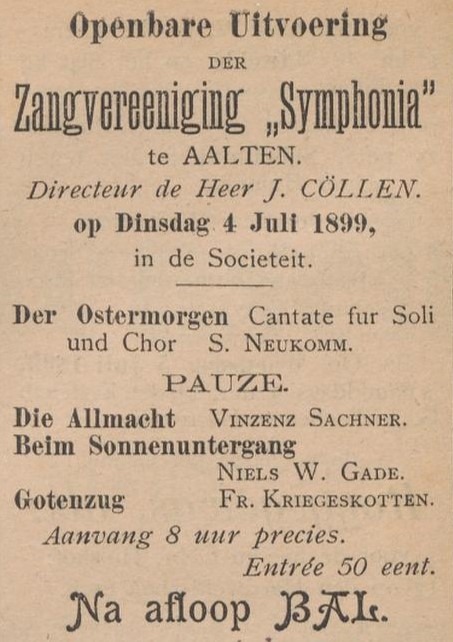
2 December 1908 – The 40th anniversary of the local Symphonia choral society was celebrated last night by members and former members. In the decorated society hall, the choir, conducted by J. Cöllen, performed four choral pieces, after which the festivities continued with recitations, music and singing.
17 January 1916 – The mixed choir Symphonia of Aalten, conducted by W.J. Knuvers of Terborg, gave a performance last night in the De IJssel concert hall. The large hall was full. The audience enjoyed a fine evening of music. Although the society’s president, Mr Peters, asked for the audience’s indulgence because the soprano and tenor had suddenly been prevented from appearing by family circumstances and replacements had to step in without preparation, the substitutes acquitted themselves well. The principal work on the programme was Schiller’s Das Lied von der Glocke, set to music by Romberg, a lengthy piece presenting many technical difficulties. The choir produced many fine moments, while the male and female soloists performed beyond reproach. The soloists included Mr Veldkamp of Frankfurt, bass, and W.H. ten Braak of Rotterdam, tenor. It was a pleasure to hear them, particularly the bass with his magnificent, broad tone; the tenor too deserved nothing but praise for his beautiful voice. The powerful applause at the end of the work was therefore directed in no small part towards these gentlemen. The accompaniment also performed excellently. At the conclusion, a storm of applause broke out and continued for several minutes, clear evidence of how highly the performance was appreciated. The remainder of the programme was also executed with great care, and Ten Braak sang several additional solos that were warmly applauded. We can therefore readily agree with the closing words of Mr Peters, who stated that Symphonia had become what it was under its present conductor, Mr Knuvers, and invited the audience to join him in a rousing ‘Long live the conductor’. The evening ended with another few pleasant hours of dancing.
1918 – In February 1918, L.J. van Mechelen was appointed conductor in place of W.J. Knüvers of Terborg, who found it difficult to continue in the role because of the reduced train service. In November 1918, Symphonia celebrated its 50th anniversary.
1919 – In February 1919, H. Rijks of Winterswijk was appointed conductor.
12 November 1927 – Last night, the Symphonia choral society, under the direction of Hendrik Veldkamp, gave a highly successful concert at the society hall on ’t Blik. The programme included two substantial new works: Die Nacht, a ballad for mixed choir, soloists and orchestra by Julius Otto, and scenes from Gluck’s Orpheus. Both were beautifully performed, in the choral sections as well as the solos. The solo parts were in experienced hands. Miss Günder of Bocholt was no stranger here and, as always, her fine soprano voice made a strong impression. The Lengkeek ladies from Apeldoorn also sang beautifully, while the Langheinrich orchestra from Bocholt completed the performance.
March 1930 – The mixed choir Symphonia, which had been dormant for several years because of a shortage of male members, decided to resume rehearsals after renewed interest from male singers. As before, Hendrik Veldkamp of Frankfurt am Main, well known throughout the area as a conductor, would take charge of the choir. Efforts to breathe new life into Symphonia proved successful: rehearsals resumed last night under Veldkamp’s direction with a large number of both former and new members.
23 September 1941 – On Friday evening, news reached us that Hendrik Veldkamp had died in hospital in Borken, Germany. Veldkamp, a concert singer and choral conductor, was born in Aalten in 1875. His musical talent and strikingly beautiful voice became apparent at an early age. He received his first piano and singing lessons from Limbach in Aalten and later attended the state teacher-training college in Nijmegen, where Leon C. Bouwman taught him music and Miss M. den Hoek gave him singing lessons. In 1900, he began his formal musical studies at the conservatoire in Frankfurt am Main, where he soon distinguished himself. After completing his studies, he became a soloist at the Frankfurt Opera and sang in a number of German cities, including Berlin, Hamburg, Mannheim and Basel. The First World War prompted him to return to the Netherlands and settle once more in Aalten. He soon established a strong reputation as a choir conductor and singing teacher. Symphonia and the Christian Oratorio Society in Aalten found in him a conductor capable of achieving almost anything with his singers. In 1933, despite the Oratorio Society being relatively small, he even succeeded in staging Bach’s St Matthew Passion, an overwhelming success for both conductor and choir. For many years he also conducted the operetta society in Winterswijk. A stomach illness from which he had suffered during his final months, and for which he underwent an operation in Münster, led to his death in the hospital at Borken. He was 66 years old. His remains were to be buried in Wiesbaden. The sad news of his death will undoubtedly have been received with sorrow by all who sang under his direction and knew Veldkamp as an invariably good-humoured conductor.
Corrections and additions
Have a correction or addition? Leave a comment below. We incorporate relevant information into the profile and then remove comments that have been processed. Your email address will not be published.
Leave a comment