During the Eighty Years’ War, the population of East Gelderland was regularly plagued by roaming armies. Plundering, extortion, and rape drove the farmers and villagers to despair. Jan Holstein was the Bailiff of Aalten at the time, and although he was largely powerless, he did stand up for the people of Aalten and did his best to put an end to the looting.
In 1588, peace negotiations were underway between the Duke of Parma and Queen Elizabeth of England, the latter of whom also attempted to involve the States. Referring to this, Holstein wrote to Gotfried Gerardi, advisor to the lady of the manor of Anholt: “I only hope that the long-desired peace may be established; then these poor sheep might find courage again. For the most part, they plow the land with the cows they have left and work like mules. We are deep in debt and can no longer obtain money; my credit has also run out. May God grant us a solution before the harvest, so that the grain can be safely gathered. Otherwise, I would not know what to do.”
G.H. Rots wrote in 1938 about how Jan Holstein lost his life:
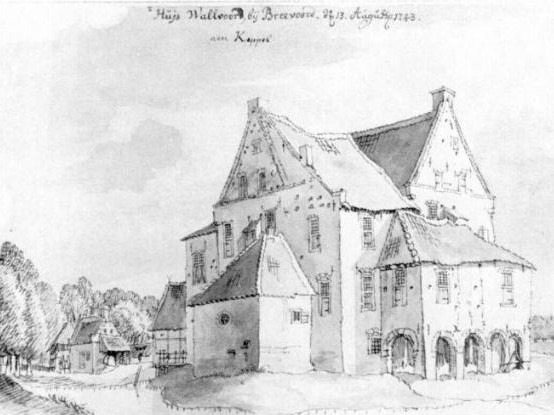
“The Bailiff of Aalten, Jan or Johan Holstein, who repeatedly stood up for the population of Aalten, died in a peculiar manner. We read in ‘Het Oude Kerspel Winterswijk’ that on June 11, 1589, a christening feast was held at the home of a certain Grevink at ‘t Walfort near Aalten, where the Bailiff of Aalten was present, serving as the child’s godfather. Also present were the Lords of ‘t Walfort and Lintelo (the Lords of Lintelo were also the owners of ‘t Walfort).
The Bailiff of Aalten had received a promotion; following the death of ‘Hendrik van den Bungard’, he had become the Land Clerk of the Lordship of Bredevoort. This appears to have been a thorn in the side of the Lords of Lintelo; at any rate, a dispute began on the subject, during which Holstein noticed that the Van Lintelo brothers were not easy men to deal with.
Holstein attempted to leave the banquet table unnoticed and slipped under the table. He crawled on hands and knees toward the door and made a quick escape. However, Diederik van Lintelo noticed this, pursued Holstein, and hurled all sorts of insults at him. The argument escalated. Holstein maintained that the Lady of the Manor had the right to appoint Land Clerks, while Diederik van Lintelo attributed that right to the Nobles of the Lordship. This resulted in a physical altercation, during which Diederik van Lintelo drew a short sword and wounded Holstein. The injury was so severe that the Bailiff died three days later.”
This case was brought before the Bredevoort court on August 5 of that year. The accused was not present. He had fled to Bocholt and was hiding there. He was sentenced to death in absentia and ordered to pay a fine of 1,000 guilders to the Lady of the Manor. To collect this money, the tenants of Diederik van Lintelo were informed that they had to pay their rent to the Lady’s steward until the sum of the fine was collected.
Those tenants were ‘Ruwenhoeven’, Hendrik Penmenger, ‘Winkelhorstinck’, ‘Swijtinck’, ‘Lanckhof’, ‘den Herinck’, and ‘den Poll’. Through the mediation of several influential persons, including the Prior of Schaer Monastery, Johanna van Dort, and Hendrik and Clara van Lintelo, efforts were made to obtain a pardon. That pardon was granted, but he was still required to pay the fine.
Herman Poelhuis, the bailiff of Dinxperlo, was appointed as the bailiff of Aalten. It appears this was a temporary appointment, as in 1605, Lubbert Spaltman is mentioned as the bailiff of Aalten.”

Leave a Reply