Old Aalten

Category: Biography

  • Willem Massen

    Willem Massen

    Willem Johan Marinus Anton Massen, known as Willem, was born on 2 March 1908 at Köstersbulte in Aalten, the son of Marinus Massen and Johanna Heinen. Before Willem’s first birthday, the family moved to Prinsenstraat 25.

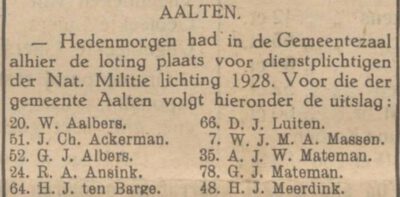
    He had a difficult childhood; his parents had been stripped of their parental rights. Willem’s father passed away on 4 March 1926. In August 1927, Willem was selected by ballot to carry out his military service in the Dutch army (the National Militia) in 1928.
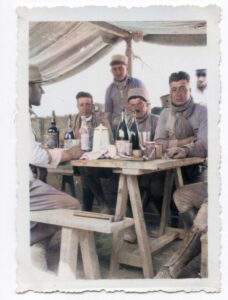
    French Foreign Legion

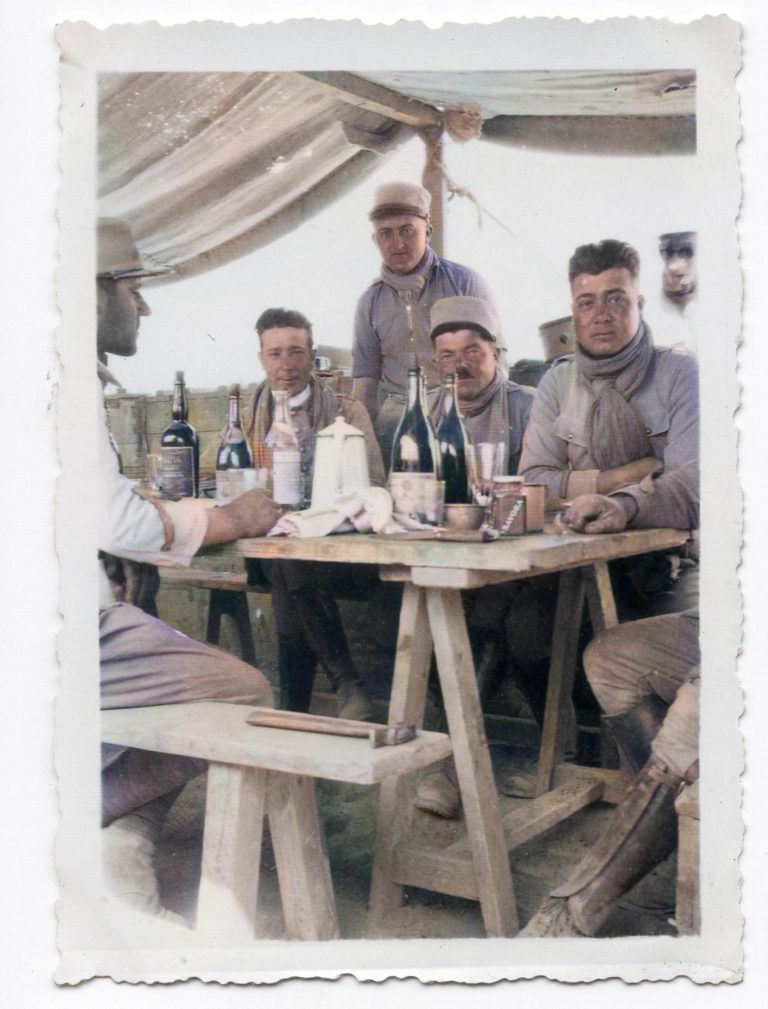
    Willem Massen evidently had adventurous blood, and he allowed an acquaintance to persuade him to sign up for the French Foreign Legion—an elite branch of the French Army consisting of military mercenaries from all over the world. At that time, when a Dutchman enlisted in the Foreign Legion, he lost his Dutch nationality and became stateless.

    Willem served in the Legion from 1930 to 1935, a period during which the unit was primarily deployed for ‘pacification’ and border patrols in the French colonies of North Africa, specifically Morocco and Algeria. The Legion was a melting pot of international volunteers, often seeking to escape their pasts, who led a harsh, disciplined existence under new identities in the rugged desert and mountain landscapes.

    Return to the Netherlands
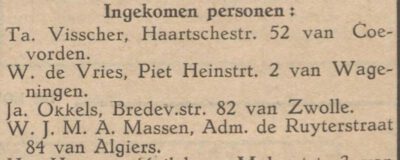
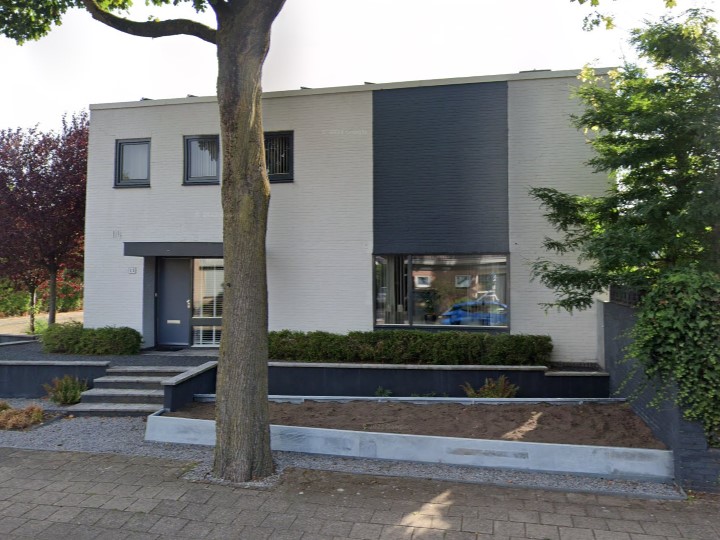
    It is likely that Willem Massen completed his five-year contract, as he returned to the Netherlands in 1935. On 10 January 1936, the Aaltensche Courant reported in the ‘Arrivals’ column that Willem Massen had arrived from Algiers. He settled at Admiraal De Ruyterstraat 84, his mother’s address.

    On 22 March 1943, the Twentsch Nieuwsblad reported that Willem had to appear in court for purchasing textiles without the legally required rationing coupons—a criminal offence under the rationing system controlled by the German occupier.

    AALTEN

    Without coupons. — On Friday, the Aalten tuckpointer W. J. M. A. Massen was summoned before the economic judge in Zutphen because he had purchased 1 tablecloth, 3 bedsheets, 3 pillowcases, and 47 towels without points. The Public Prosecutor demanded 4 months’ imprisonment, in addition to a fine of ƒ 200. The judge sentenced Massen in absentia to 1 month’s detention plus a ƒ 200 fine or 40 days’ detention, and forfeiture of the seized items, with acquittal of intent.

    „The Terror of the Achterhoek”

    Under this headline, the following report of a session at the Zutphen District Court appeared on 1 April 1947 in the Zutphensch dagblad voor Achterhoek en Veluwezoom:

    In the summer of 1946, the Achterhoek was repeatedly unsettled by burglaries and thefts. This changed when a pair of Aalten residents, known as “heavy boys” (hardened criminals), were caught and, in October, remanded in custody at the Zutphen House of Detention. On Friday, this duo had to answer to the Zutphen District Court, presided over by Mr A. H. van der Giesen. The summons charged them with acting together and in concert to steal a quantity of fabric—totalling some 600 metres in length—approximately 700 rolls of peppermint, 20 packets of fat, a quantity of yarn, and two coupons of corduroy (manchester), respectively belonging to N.V. Bontweverij in Bredevoort, F. J. W, J. D. Meijnen, and N.V. Confectiefabriek v/h D. Kamphuis and J. H. Platter.

    M. had confessed to the thefts immediately and continued to maintain before the court that he had acted alone. His comrade, B. K., likewise insisted that he had not taken part in these thefts. However, there were many indications that K. had also played a role.

    Firstly, there was the statement from Sergeant Klein Geltink that one man could not possibly have transported 600 m of fabric alone. Furthermore, the buyer of this fabric, J. S. from Aalten, stated that M. had been accompanied by B. K. And the man who had concealed the goods, J. A. K. from Aalten, stood by the statement he gave to the police: that M. and K. had brought the 600 m of fabric to him together, and that one or the other would subsequently come to collect portions of the stock. He had received 50 guilders for his trouble. The Public Prosecutor, Baron Mr Van der Feltz, demanded a prison sentence of 3 years for M. and K.; 1/2 year (with credit for time served) for J. S.; and 1 year for J. A. K., taking into account as an aggravating circumstance that the goods were intended for the black market. Jhr. Mr W. H. de Jonge appeared as defence counsel in the first two cases.

    In his [the counsel’s] view, legal proof of theft by K. had not been established. Undoubtedly the man had played a role in the matter, but in his view, he could be accused of nothing more than receiving stolen goods. For him, the defence requested an acquittal.

    The defendant M., who made a frank confession (ruiterlijke bekentenis), does not, in his [the counsel’s] view, deserve the heavy sentence demanded by the Prosecutor. The advocate outlined the man’s life story. His youth had been very difficult; his parents had been stripped of their parental rights. He had attended a weaving school, but evidently possessed adventurous blood and had been persuaded by an acquaintance to sign up for the Foreign Legion. The man had served in Morocco for five years and consequently lost his Dutch citizenship. He had found it very difficult to secure work in this country. The counsel understood that the court would impose a heavy sentence, but he requested, firstly, that the time spent in pre-trial detention be deducted and, furthermore, that a milder sentence be imposed than the one demanded by the Prosecutor.

    The Public Prosecutor felt that the defence should not present the case more favourably than it was. This man was known as “the terror of the Achterhoek”. He has 12 convictions on his criminal record. The Prosecutor was, however, willing to consider the request made by Mr De Jonge to allow the court-imposed sentence to be served in a State Labour Institution (rijkswerkinrichting). Verdict in 14 days.

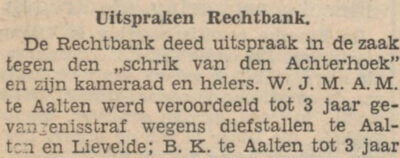
    Earlier, on 27 March 1947, the Algemeen Handelsblad had published a shorter report of this session under the headline “The Terror of the Achterhoek before the court”. It mentioned that M. was 39 years old and came from Aalten. Based on his traceable year of birth and place of origin, M. was therefore indeed Willem Massen.

    This was confirmed by the court’s verdict published 14 days later, which this time included all the initials of Willem Massen’s forenames.
    Naturalisation

    In 1965, Willem Massen submitted a request for naturalisation. His explanatory memorandum stated:

    17 Massen, Willem Johan Marinus Anton, born in Aalten (Gelderland) 2 March 1908, jointer, residing in Aalten, province of Gelderland:

    Willem Johan Marinus Anton Massen, nominated under 17, was born a Dutch citizen in Aalten in 1908. He lost his nationality by enlisting in the French Foreign Legion in 1930 without Royal consent. He has lived in the Netherlands again since 1935. His wife and children hold Dutch citizenship. As a jointer, he provides for himself and his family.

    In 1967, he lived at Haartsestraat 56 in Aalten. No further information is currently available regarding his family or the date of his death. If you have more information, please let us know!

    Ale Douma

    Willem Massen was not the only resident of Aalten to serve in the French Foreign Legion. In 1950, Ale Douma, then living in Aalten, submitted a request for naturalisation. Douma was born on 10 August 1908 in Dronrijp (Friesland), the son of Sjerp Douma and Elisabeth Schuurmans. He served in the Legion during the same period as Willem Massen (1930–1935).

    During World War II, Douma stayed in Germany, where he was imprisoned in concentration camps twice due to his assistance to French prisoners of war. In 1967, he lived with his wife Else on the ground floor of a duplex house on Huygensstraat, at number 49.

    Ale Douma passed away on 12 January 1986 and is buried at begraafplaats Berkenhove.
  • The Thomson-van Hopbergen family

    The Thomson-van Hopbergen family

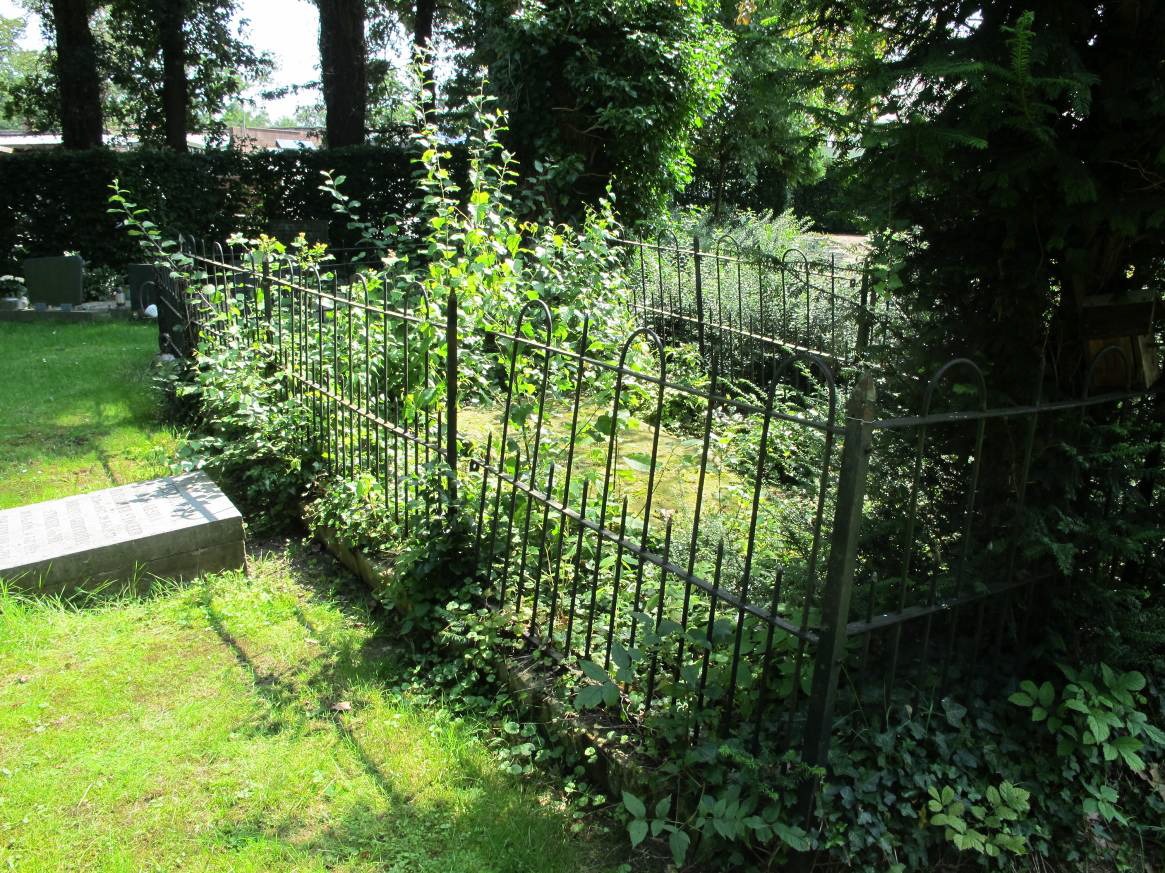
    The family grave of the Thomson-van Hopbergen family is located at the General Cemetery on the Prins Mauritsstraat in Bredevoort. Although the tombstone has been marked by erosion, the monument is a reminder of a family that played a prominent role in Dutch military history, national politics and literature.

    The legacy of the Scottish Brigade

    The family’s roots lie in the Scottish Brigade, a unit of British soldiers hired by the United Provinces in the 17th and 18th centuries. After their military service, many of them settled permanently in the Netherlands, including James Thomson. He was married to Mary Rinck; their children were baptized in Tournai and Breda at the beginning of the 18th century. The military tradition in the family continued into the 20th century.

    Location in Bredevoort

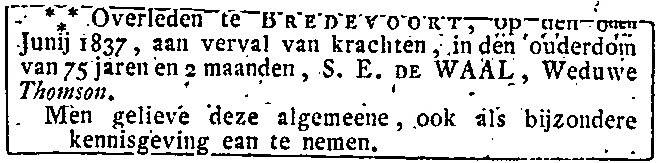
    The bond with Bredevoort arose in the early nineteenth century through a grandson of the ancestor, also named James . This retired captain, born in 1759 in Nijmegen, lived there on the Prinsenstraat with his wife Susanna Elisabeth de Waal. James died in 1828 and Susanna in 1837. The house with its contents was valued at ƒ 3,805,-.

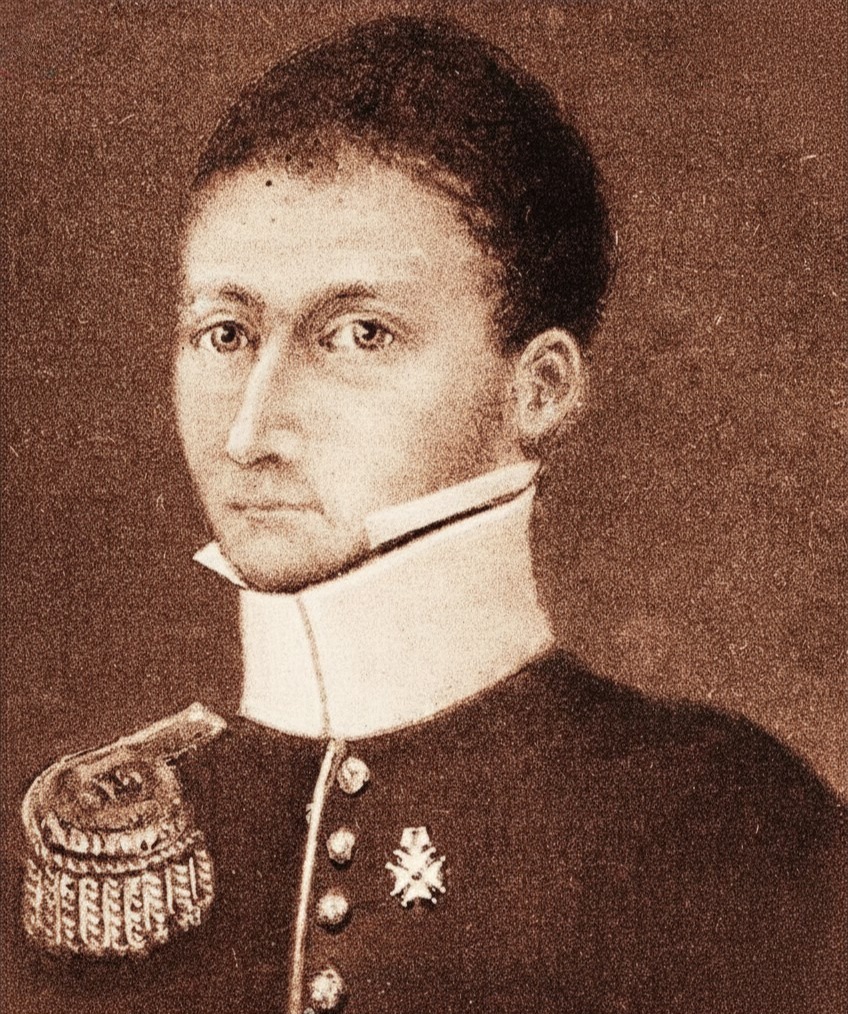
    Their son, Jan Jacob Thomson (1784–1858), born in Maastricht and living with his family in Fort Crèvecoeur near ‘s-Hertogenbosch, was the sole heir. Jan Jacob was a lieutenant colonel and had made a career during the Napoleonic Wars. For his efforts during the Battle of Waterloo in 1815, in which he was wounded, he was made a knight in the Military Order of William.

    In 1837 Jan Jacob entered into a second marriage with the 26 years younger Louiza Wilhelmina van Hopbergen (1810–1906) from Bredevoort. She was a daughter of the retired lieutenant Diederik Christoffel Hendricus van Hopbergen, also living on the Prinsenstraat. The family settled in Bredevoort.

    Jan Jacob Thomson died on 11 October 1858 and was buried in the family grave in Bredevoort. Louise also found her final resting place there.

    Louise’s brother Jacobus Wilhelmus van Hopbergen was also a lieutenant colonel and lived at Markt 18 in Aalten after his retirement.

    Offspring and social functions

    Several family members born in Bredevoort held social functions:

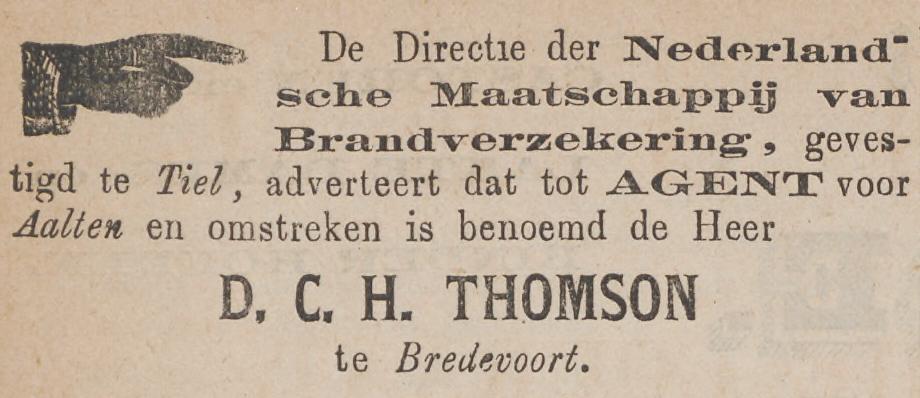
    Diderik Christoffer Hendrikus Thomson (1840–1891) became a letter collector (holder of the local post office) in Bredevoort and will also have been buried in the family grave.

    His son Jan Jacob Thomson (1882–1961) gained fame as a ‘poet-minister’. He was a pastor at the Dutch Protestant Union in Varsseveld and left behind an extensive oeuvre of poetry collections and literary-historical studies. After a turbulent and poetic life, he died in Baarn in 1961 and was buried there.

    Jacque Willem Lodewijk Thomson (1846–1914) was mayor of the municipality of Appeltern from 1877 until his death.

    Louis Thomson: Soldier and statesman

    One of the most striking descendants of the family is Lodewijk Willem Johan Karel Thomson (1869–1914), a grandson of Lieutenant Colonel Jan Jacob. Lodewijk was a military cartographer, was sent to Batavia and Aceh, was a military attaché during the Boer War in South Africa and a member of the House of Representatives.

    In 1914 he was sent to Albania, where he was killed in action in Durrës on 15 June 1914. Thomson was the first Dutch soldier to die during a peacekeeping mission. He was buried in Groningen.

    Heritage in decline

    Today, the funerary monument on the Prins Mauritsstraat is in a state of disrepair. Due to erosion and overdue maintenance, the inscriptions on the stone are becoming increasingly difficult to read. However, the grave is a monument to the connection of small Bredevoort with the great world history.

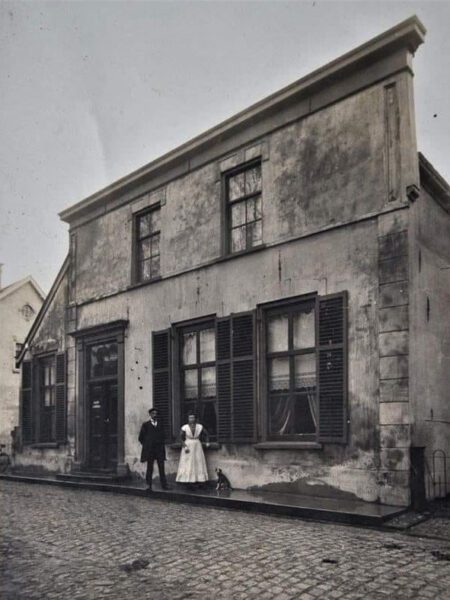
    Post Office Bredevoort, 1918, with Hendrik Christiaan den Hartogh and Antonia Theodora Krosenbrink
    Post office Bredevoort, 1918

    Sources


  • Rev. Tjeerd Radsma

    Rev. Tjeerd Radsma

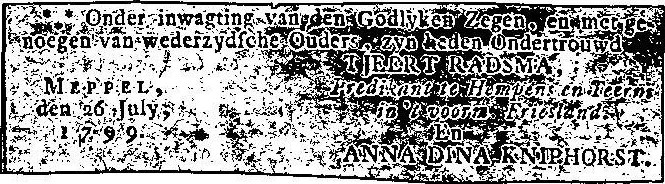
    Tjeerd Radsma was born on 20 February 1772 in Harlingen, the son of Hermanus Radsma and Aafke Steffanij. He married Anna Dina Kniphorst on 11 August 1799 in Meppel. Following her death in 1805, Radsma remarried on 6 October 1808 in Leeuwarden to Doedtje Nieuwenhuis, who had previously been married to Heert Jans Kingma.

    In 1812, Tjeerd Radsma was registered as a resident of Hempens, near Leeuwarden. He was the minister of Hempens and Teerns at the time. It is also noted that he had four children at that point. Three have been identified, all from his first marriage:

    1. Johanna (Hempens, 1800 – Aalten, 1847)
    2. Aafke (Hempens, 1801 – Aalten, 1824)
    3. Anna Dina (Hempens, 1805 – Meppel, 1806)

    To Aalten

    In 1817, at the age of 45, Radsma moved to Aalten as a minister. Five years later, on 11 August 1822, he commemorated his 25th anniversary in the ministry. On this occasion, he delivered a sermon based on 2 Corinthians 5:9. The opening sentence of the sermon read: “Every individual’s life presents times and days that are more remarkable than others and to commemorate these – provided their multitude does not weaken the impression too much – can be very useful.”

    Radsma lived in the Old Reformed Parsonage on the Wehmerstraat.

    Death and Grave

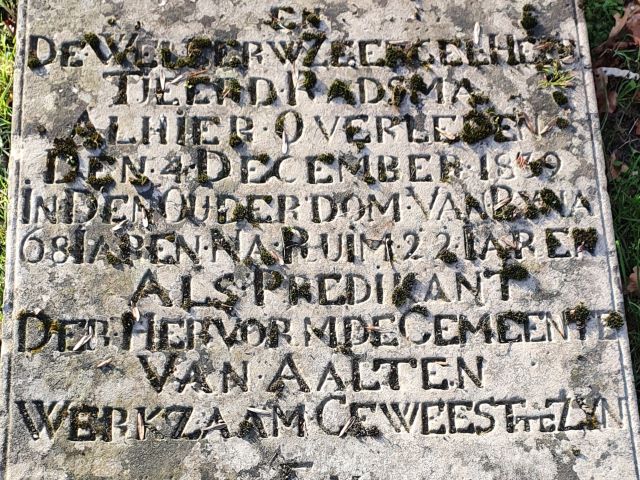
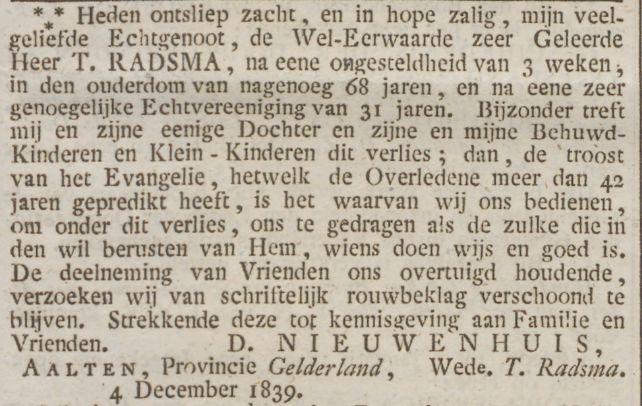
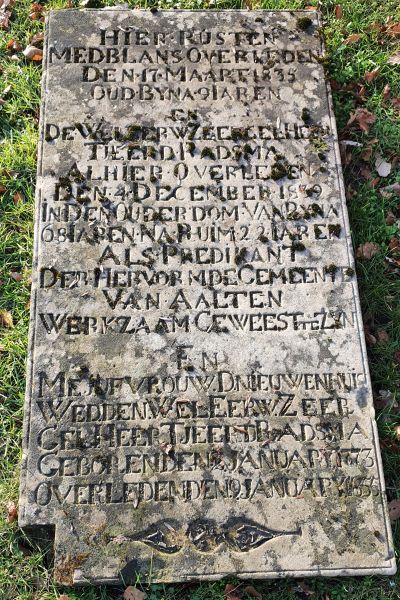
    Tjeerd Radsma passed away on 4 December 1839 in Aalten, at the age of 67. He was buried in the Old Cemetery on the Varsseveldsestraatweg. His gravestone is one of the oldest remaining funerary monuments there. Also interred in the same grave are his widow, Doedtje, who died in 1855, and her granddaughter, Maria Elizabeth Dodina Bianka Lans, who died in 1835 at the age of eight. Maria’s mother was Janke Kingma, a daughter of Doedtje from her first marriage.

  • Toni Stapelkamp

    Toni Stapelkamp

    Toni Stapelkamp was a farmer’s son from the Heurne in Aalten. He served in the National Militia and was decorated for his participation in the Ten Days’ Campaign and the defence of the Citadel of Antwerp.

    Toni (also spelled Tonij and Antonij) Stapelkamp was born on 30 July 1807, during the French period. He was the third son of Hendrik Willem Stapelkamp and Johanna Elisabeth Slotboom, and the great-great-grandfather of our current mayor, Anton Stapelkamp. Toni was the last Stapelkamp born on the farm of the same name in the Aalten Heurne.

    In 1814, when Toni was only seven years old, his father passed away. This likely caused the family’s financial circumstances to deteriorate significantly, especially during a time when people were already suffering under the negative consequences of French rule. Stadtholder William V, the Lord of Bredevoort, had lost his rights, and consequently, Drossaard Van Palland had lost his position. The Stapelkamp farm was sold during this period.

    Profession

    As the youngest son, Toni had to find employment elsewhere at a very early age. Without the breadwinner, the small-scale Stapelkamp farm could not have fed so many mouths.

    According to the 1809–1823 population register, he lived and worked at that time as a farmhand for Derk Jan Haartman on the Haartman farm in the Haart. He was at most fifteen years old then and may have left home as early as age twelve or thirteen. His older sister, Engelina, also lived and worked there as a maid.

    It is notable that this Haartman sold his farm to the Te Roele family and emigrated with his family to the US in 1846 on the SS Hector. The Te Roele family still lives on the farm in 2022.

    In the 1823–1838 population register, Toni is listed, still as a farmhand, with Jan Hendrik Drenthel on the Drenthel farm, also in the Haart, but now without his sister Engelina. In the population registers of 1838–1861, Toni is first listed as a labourer and later as a farmer (1860–1890).

    Military Service and Awards

    According to the Decree of 15 February 1827 published in the Provinciaal Blad van Gelderland, Toni was summoned to appear as a reservist of the National Militia at the ‘Government Building’ in Arnhem on 27 February at 08:00. Together with 223 other men—including five other men from Aalten—he had to serve in the 7th Infantry Division.

    He had to report to his corps on 1 March. Municipal authorities were required to ensure that they were provided with leave passes. In addition to this 7th Infantry Division, 373 other men from Gelderland were called up for a 13th Infantry Division, also including five men from Aalten, a 4th Artillery Battalion with 59 men, and a 1st Field Artillery Battalion with 28 men.

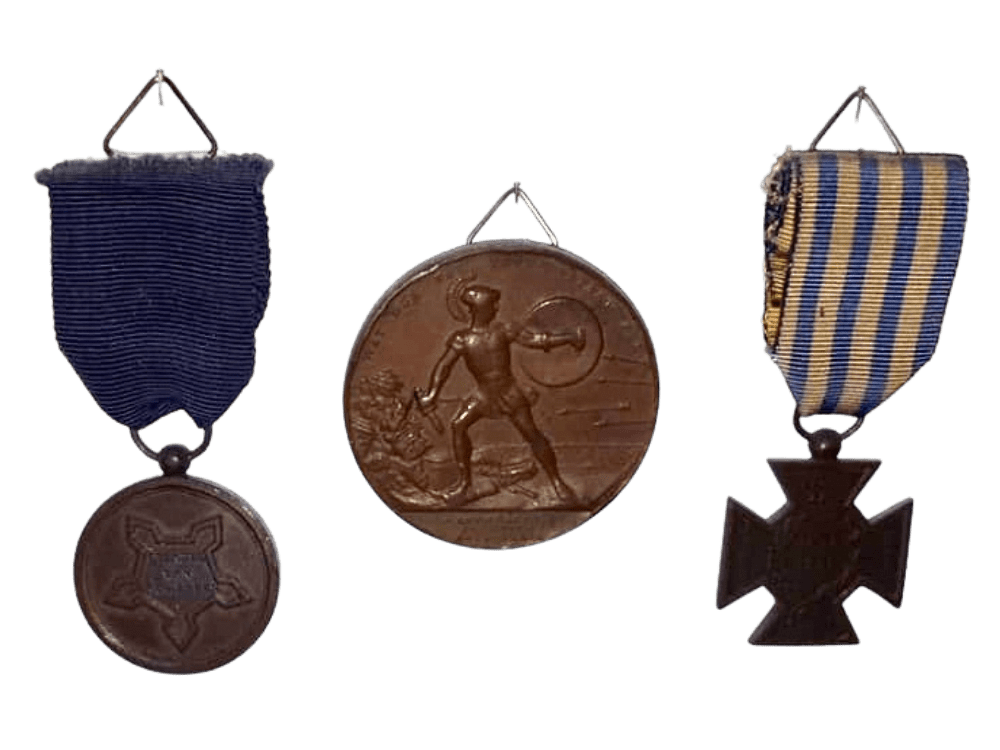
    Toni received decorations for his service during the Belgian Revolt: specifically, his participation in the Ten Days’ Campaign in 1830 (the Bronze Cross) and the defence of the Citadel of Antwerp against French troops in 1832 (the Citadel Medal and the Medal of the Commission of Merit).

    Marriage and Family Life

    After his military career, Toni settled on the Lichterink farm in Barlo, where he worked as a farmhand. In 1839, he moved to the Wissink farm in Miste, also as a farmhand. He married the nearly 33-year-old Janna Geertruid Westerveld (1809–1887) from Dinxperlo on 7 May 1842, at the age of nearly 35. She was the widow of Derk Lammers.

    The marriage certificate, drawn up by Mayor Roelvink, states that Toni and Janna were farmers. The certificate also notes that Toni, Janna, and three of the four witnesses—including his brother and Garrit Hendrik—could not read or write, “having never learned to do so”, as was the case for many in those days.

    Toni moved in with her in 1842 at the residence on the Hogestraat (currently number 26). In addition to Toni and Janna, two daughters and a son from Janna’s first marriage were registered at this address: Aleida, Rebekka Berendina, and Evert Hendrik Lammers. Furthermore, Janna’s former mother-in-law, Elisabeth Loos, and Aleida Klompenhouwer, a seamstress, were listed as residents.

    Toni and Janna had three children: Dora Willemina (1843–1924), Gerrit Jan (1846–1848), and Gerrit Jan (1849–1935), the great-grandfather of our mayor. In 1855, a stillborn child was born. From 1875, his daughter-in-law Hendrika te Sligte lived with them, as did the first three children.

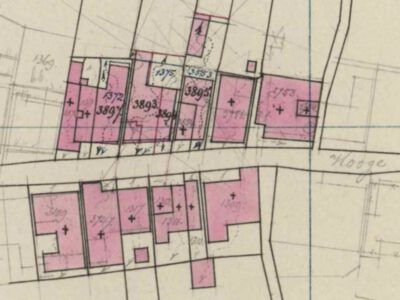
    In 1853, Janna had a will drawn up. A private deed shows that in 1862, Toni purchased “a small house with grounds, standing and situated on the Hoogestraat within the village of Aalten and known there cadastrally in Section I number 1372, one rod and thirty ells in size” for 150 guilders. One of the sellers was Jan Hendrik Schepers, who was imprisoned in Leeuwarden at the time. The mentioned plot concerns Hogestraat 26.

    Later Life and Death

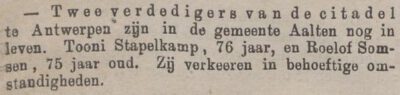
    In a report dated 30 November 1882, Toni was mentioned as one of the last two surviving defenders of the Antwerp citadel. It is noted that both were living in “needy circumstances.” This is remarkable, given that his thirty-three-year-old son, Gerrit Jan, was living with him with his wife, and he surely must have had an income.

    Toni outlived all his brothers and passed away on 8 December 1889, at the age of 82. The death registration was carried out by his naobers (neighbours) Derk Jan Heusinkveld (Hogestraat 28) and Berend te Slaa (Hogestraat 24). His wife, Janna, had already died in 1887 at the age of 78. Despite their late marriage, they still celebrated their golden wedding anniversary. That was something not many were granted in the nineteenth century on the impoverished Achterhoek countryside.

    Toni must have heard about the ecclesiastical developments surrounding the Secession and the first seceded congregation in 1843. In the 1838–1851 population register, he was listed as Reformed, but in all subsequent records until his death, as Dutch Reformed. Around 1850, several Stapelkamp family members left with other seceded Achterhoekers for Iowa, Wisconsin, and Michigan in the United States.

  • Jacobus Wilhelmus van Hopbergen

    Jacobus Wilhelmus van Hopbergen

    Jacobus Wilhelmus van Hopbergen was born on July 16, 1817, in Ravenstein (municipality of Oss), son of retired lieutenant Diederik Christoffel Hendricus van Hopbergen and Maria Wilhelmina Frank. His parents presumably settled at Prinsenstraat 10 in Bredevoort around 1820.

    After his training and compulsory military service in the 3rd Infantry Regiment in Leeuwarden, where he reached the rank of titular lieutenant colonel, he married Adriana Pieternella Dillié (1816–1888) in Leeuwarden in 1848. They had four daughters; a son died shortly after birth.

    His older sister Louiza Wilhelmina (1810–1906) had married Lieutenant Colonel Jan Jacob Thomson (1784–1858) in 1837. They lived in his parental home in Bredevoort.

    Settling in Aalten

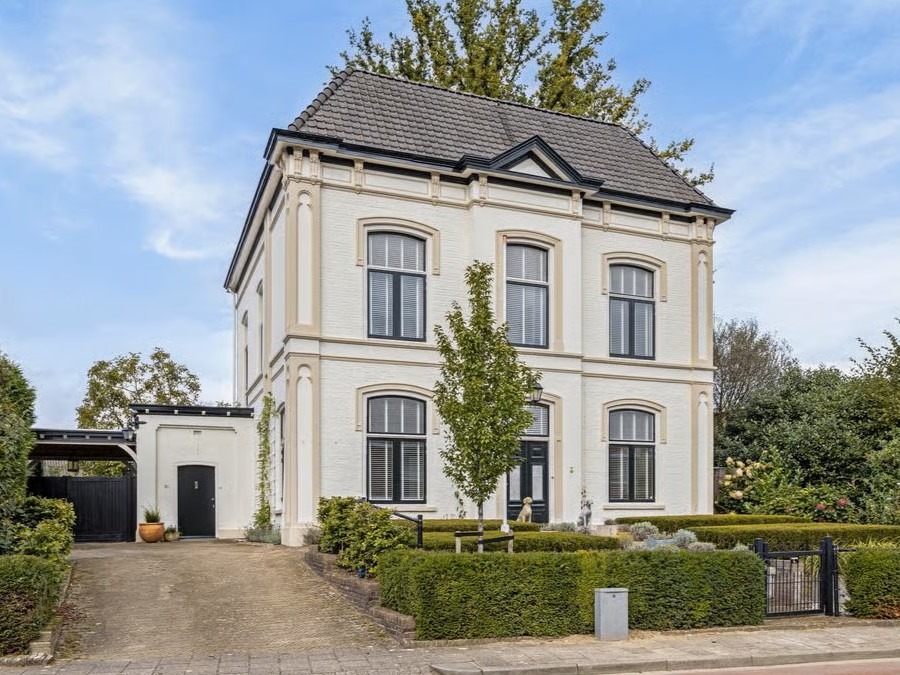
    In 1869, the Van Hopbergen family settled in Aalten, at the beginning of the Hogestraat. Shortly thereafter, Van Hopbergen purchased the plot at Markt 18 in Aalten and had a stately villa in eclectic style built there, including outbuildings for a carriage and staff.

    He derived his social status not only from his military career but also from his role as a representative of the Aalten electoral district in the Provincial Council of Gelderland.

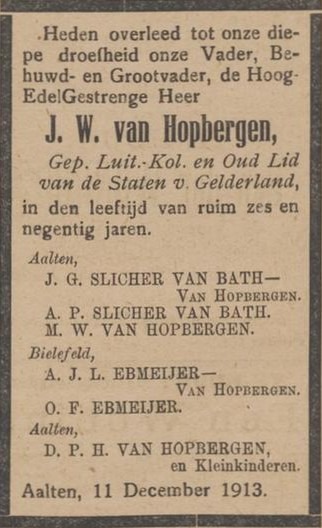
    On December 11, 1913, Jacobus Wilhelmus van Hopbergen passed away at the age of 96 in his villa at Markt 18 in Aalten. He found his final resting place at the Old Cemetery on the Varsseveldsestraatweg in Aalten.

    Obituary

    On December 13, 1913, the Aaltensche Courant wrote:

    Yesterday, the Right Honorable Jacobus Wilhelmus van Hopbergen, retired Lieutenant Colonel of the Infantry in this country, born July 16, 1817, in Ravenstein, passed away here at a great age. He thus reached the age of over 96 years. We do not wish to provide a biography of this eminent man, as that would require a more refined pen than ours, but we merely wish to speak a brief word upon his passing.

    After his retirement, he settled in Aalten with his family approximately 50 years ago and very quickly earned the respect of all residents; he became a full citizen of his place of residence and worked diligently toward the progress of this town.

    Many who knew him in the prime of his life and learned to respect him have already departed from the earthly stage, yet a small circle remains who remember the straightforward, sincere Colonel. It was no wonder that he served for many years on the Provincial Council and the Municipal Council, and was a Churchwarden of the Reformed Congregation until he was forced to resign due to advanced age.

    Devoted heart and soul to liberal principles, he was always a diligent but honest fighter. What Mr. A. Willink was to Winterswijk, Mr. Van Hopbergen was to Aalten. He was very charitable toward the poor and the sick, supported in this by his family. We shall hold his memory in honor. A good and distinguished citizen has departed from us.

  • Jans Betting

    Jans Betting

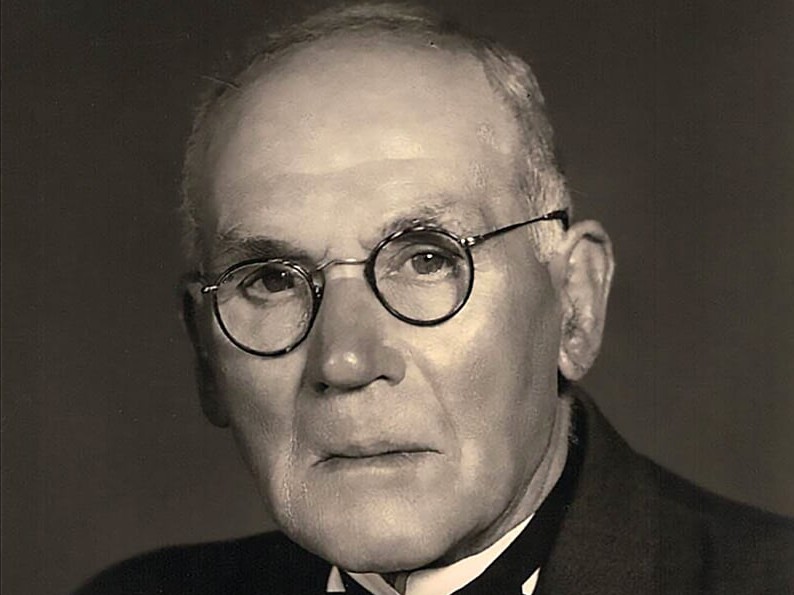
    Johannes Josephus (“Jans”) Betting was born on 15 May 1871 at ‘house no. 139’ in Bredevoort, the son of Johannes Josephus Betting (a weaver) and Johanna Willemina Gördes. On 4 June 1903, he married Grada Hendrika Ubbink in Aalten. The couple went to live with her parents at ’t Zand. At that time, Jans worked as a ‘packer’ at H. van Eijck & Zoon in Bredevoort. Jans passed away on 28 January 1956 in Winterswijk.

    A Life Devoted to Faith and Music

    The Roman Catholic faith was a constant thread throughout Jans’ life. He was a deeply religious man: a faithful churchgoer, choir singer, and organist. He attended Mass every Sunday without ever missing a single service—even when he was ill.

    From the age of fourteen, he sang in the men’s choir of the Roman Catholic church in Bredevoort. In addition, he served as the church organist for many decades. In the past, playing the organ required the use of bellows that were operated manually. This task was often performed by young boys who occasionally lost concentration… When the organ music faltered, Jans would whisper: “Keep treading, boys!”

    Papal Decoration

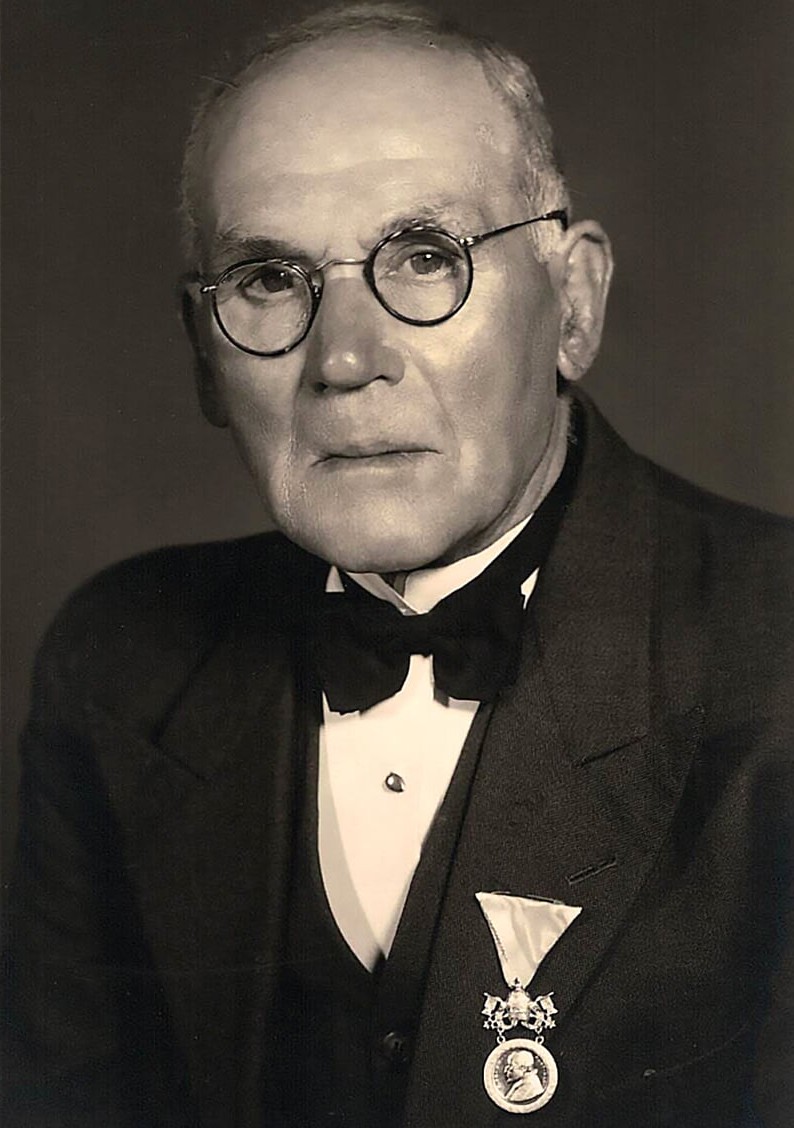
    In May 1949, Jans Betting received a Papal decoration. The Aaltensche Courant reported:

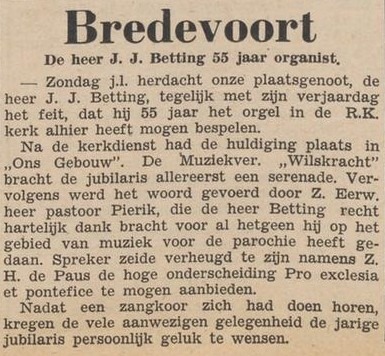
    Last Sunday, our fellow townsman, Mr J. J. Betting, commemorated both his birthday and the fact that he has been permitted to play the organ in the Roman Catholic church here for 55 years.

    Following the church service, a ceremony took place in „Ons Gebouw”. The „Wilskracht” wind band first performed a serenade for the jubilarian. Subsequently, the Reverend Father Pierik took the floor, expressing his heartfelt gratitude to Mr Betting for everything he has done for the parish in the field of music. The speaker said he was delighted to be able to present the high decoration Pro Ecclesia et Pontifice on behalf of His Holiness the Pope.

    After a performance by a choir, the many attendees were given the opportunity to personally congratulate the jubilarian on his birthday.

    J.J. Betting, Bredevoort – Aaltensche Courant, 17 May 1949
    Aaltensche Courant, 17 May 1949

    Burglaries

    After Jans’ death, the family kept the decoration in a safe. They cherished the valuable heirloom with a sense of fitting pride. Thirty or forty years later, three burglaries occurred. During one of these incidents, the safe was stolen, containing approximately ƒ1,500 and several securities. However, the family’s greatest sorrow was the loss of their grandfather’s Papal decoration.

    Years later, a suspicious car was stopped during a check in the west of the country. The occupants confessed to several burglaries, including the one at the Betting residence in Bredevoort. They also admitted to having taken a safe and stated that they had thrown it into the Rhine from a bridge near Arnhem.

    A diving team managed to recover the safe from the water. Although the money and papers were gone, grandfather Jans’ Papal decoration was, miraculously, still inside! The family was exceptionally overjoyed at the return of this precious treasure.

  • Johan (Hans) Pruim, LL.M.

    Johan (Hans) Pruim, LL.M.

    Johan (known as Hans) Pruim was born in Hilversum in 1931. From 1959 to 1987 he was a corporate lawyer, and from 1987 to 1990 he practised as a solicitor in The Hague. Subsequently, from 1990 to 1997, he held the position of cantonal court judge in Terborg. He lived with his wife, Loeki, at Beekhuize, the former residence of textile manufacturer Driessen on Dijkstraat in Aalten. Loeki ran a hotel there.

    After his retirement as a judge, he and his wife moved to Hozenstraat 2 in Bredevoort. There, they opened a bookshop and antiquarian bookstore.

    In Bredevoort, Mr Pruim was active as a board member of the Hameland Bookbinders’ Guild (Boekbindersgilde Hameland). In 1997, he wrote a booklet entitled ‘Een spijl in het hek’ (A Bar in the Fence). This booklet details the history of the recapture of Bredevoort from the Spaniards by Prince Maurice in 1597. During the Eighty Years’ War, Bredevoort was surrounded by marshes. By utilising cork mats, Prince Maurice and his troops managed to recapture Bredevoort. During the presentation of the booklet, several copies featuring a cork cover were presented to Councillor Udo-van Helden and the honorary bailiff (eredrost) of Bredevoort, former Mayor Bekius.

    Mr Pruim also rendered outstanding service to the elderly care organisation Stichting Zorgcombinatie Marga Klompé. From 1993, he was involved in guiding the merger between the care homes in Winterswijk, and from 1995, he served as Chairman of the Supervisory Board. In that role, he dedicated himself with great devotion to the well-being of those who live and work within Zorgcombinatie Marga Klompé. Following his retirement in 2006, he continued to support the foundation as Honorary Chairman.

    After a period of declining health, Hans Pruim, LL.M., passed away on 4 May 2014 at the age of 83. He was buried at the Berkenhove cemetery.

    Source


  • Cato Kothuis

    Cato Kothuis

    Catharina Cecilea (Cato) Kothuis was born on November 23, 1908, at house no. 8 in Aalten (Landstraat 4), as the daughter of brushmaker Johannes Kothuis and Helena Theodora Vultink.

    Cato Kothuis (1908–2001)

    Cato Kothuis lived with her sister at Landstraat 4. Both sisters remained unmarried. Cato was known as a remarkable woman: deeply religious, yet simultaneously broad-minded. For many years, she was a teacher at the St. Jozef Roman Catholic School, where she taught generations of children. During lessons, she would accompany the class singing on a heavy electric organ, which produced a rather wailing sound.

    Cato Kothuis passed away on 30 March 2001. She was buried at Berkenhove Cemetery.

    Further information would be welcome!

  • Jan Brill

    Jan Brill

    Municipal Overseer and Architect

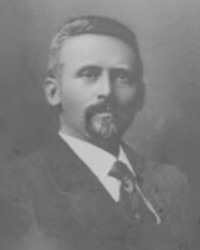
    Jan Brill (1878–1924) served as the municipal overseer and architect in Aalten from 1906 to 1924. He designed various residential and commercial buildings throughout the municipality and was remembered after his passing as an honest, sincere, and humane individual who enjoyed great trust and appreciation.

    Jan Brill was born on 23 April 1878 in Wildervank, the son of Cornelis Jacobus Brill and Roelfina Fennechina Prummel. On 6 July 1909, he married Anna Imke Oostingh in Winschoten. The couple had two daughters and one stillborn child.

    Career

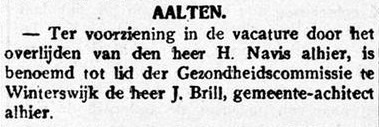
    In 1903, Brill was appointed municipal architect of Winterswijk. His appointment as municipal overseer and architect of Aalten followed in 1906. Additionally, in 1922, he was appointed a member of the Health Commission in Winterswijk, and in early 1924, he became the secretary-treasurer of the Oude IJssel Water Board, Slingebeken Section.

    Brill initially lived at Prinsenstraat 42. Following his marriage, he and his wife moved to Ormelstraat 23 (Klein Beth San). During his years in Aalten, he designed several characteristic buildings in and around the town, including various private houses and shop premises.

    Illness and Death

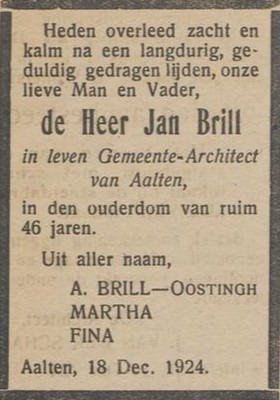
    Brill struggled with health problems for a considerable time, during which his duties were temporarily assumed by others. A few months before his death, he returned from Arnhem, where he had presumably been receiving medical care. He lost consciousness the evening before his passing and died in Aalten on 18 December 1924, aged 46.

    There was a large turnout for the funeral: attendees included the mayor and aldermen, the town clerk, council members, municipal police, administrative officials, and municipal workers, as well as many friends and local residents. Tributes were paid at the graveside by Rev. J. Thomson (Varsseveld), Mayor A.J.W. Monnik, and H.J.G. ten Dam.

    According to reports, Brill was remembered for his honest and sincere conduct, being highly valued by his superiors and humane in his interactions with staff; his irreproachable integrity and the courage with which he bore his illness were explicitly noted.

    Brill found his final resting place at the Old Cemetery on the Varsseveldsestraatweg in Aalten.


    Designs

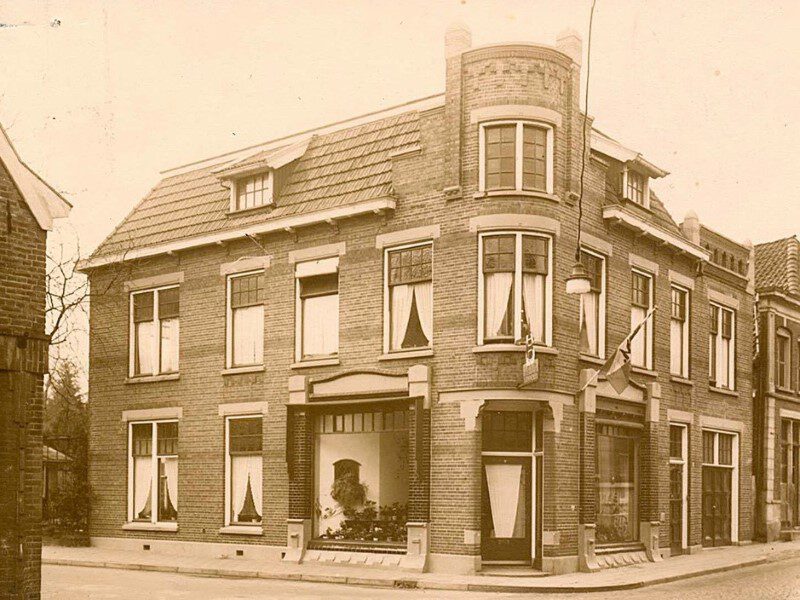
    As municipal architect of Aalten, Brill’s designs included:

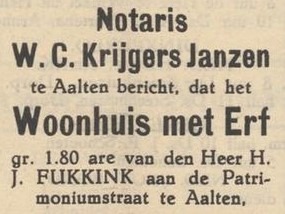
  • Willem Catharinus Krijgers Janzen

    Willem Catharinus Krijgers Janzen

    Notary

    Willem Catharinus Janzen was born on 21 October 1899 in Est en Opijnen (Gelderland), the son of Ernst Janzen and Catharina Krijgers. In 1929, he had his surname officially changed to Krijgers Janzen.

    On 5 June 1929, he married Gerria Noteboom from Rhoon in Amsterdam. As far as is known, four children were born from this marriage, one of whom was stillborn.

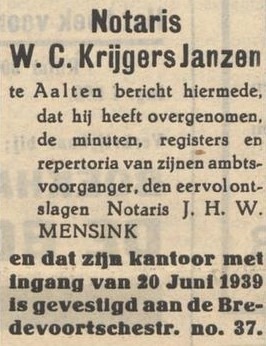
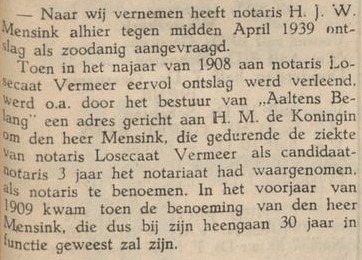
    In 1939, he succeeded J.H.W. Mensink as a notary in Aalten.

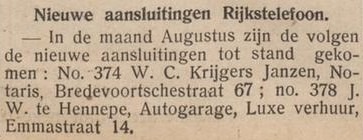
    Krijgers Janzen lived with his family at Bredevoortsestraatweg 67 in Aalten.

    He passed away on 3 April 1991 and is buried at Berkenhove Cemetery.

    Sources


  • Lourens Navis

    Lourens Navis

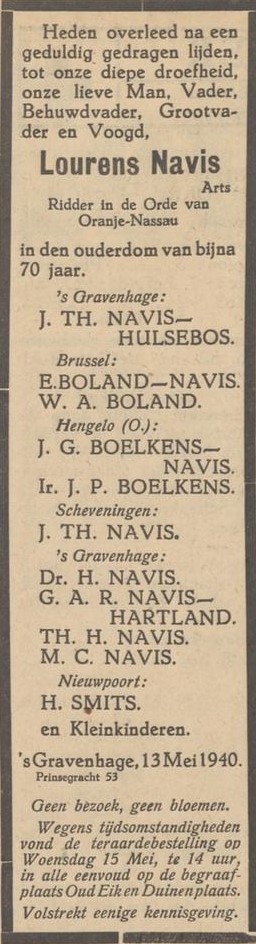
    Lourens Navis was born on 28 May 1870 as Lourens Schokkin at the Borninkhof farm in the rural district of Haart (Aalten), son of the unmarried Janna Geertruid Schokkin. A few months later, on 12 August 1870, his mother married the schoolteacher Hendrik Navis, who recognised Lourens as his child, thereby legitimising him as his son. They went to live on the Kattenberg in Aalten, currently Lichtenvoordsestraatweg 11. The family later moved to the corner of Landstraat/Markt.

    In 1900, Navis established a practice as a GP at Prinsegracht 53 in The Hague. On 30 January 1902, he married Johanna Theodora Hulsebos. Six children were born from this marriage: Elisabeth (1903), Janna Geertruid (1904), Johanna Theodora (1906), Hendrik (1909), Thomas Haulog (1913), and Margaretha Catharina (1919).

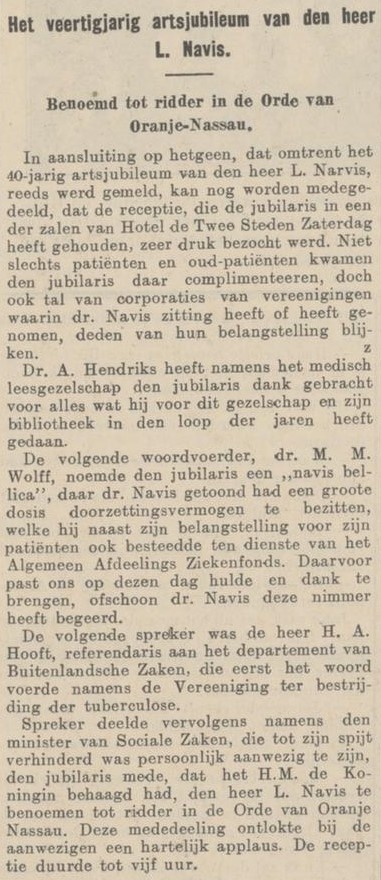
    On his 40th anniversary as a doctor, he was appointed Knight of the Order of Orange-Nassau in recognition of his extensive services to society.

    Lourens Navis passed away on 13 May 1940 in The Hague and was buried there at the Oud Eik en Duinen cemetery.

    Career

    • 1 July 1875–1 July 1882: Primary education;
    • 1 July 1882–1 July 1885: Pupil teacher;
    • 1 September 1885–1888: H.B.S. (3-year course), Winterswijk;
    • 1888–1890: H.B.S. (5-year course), Zutphen;
    • 1890: Graduation diploma;
    • September 1890–19 June 1897: Medical student, University of Amsterdam;
    • 19 June 1897: Medical qualification examination;
    • 1 October 1897–1 March 1899: Assistant doctor, Wilhelmina Gasthuis, Amsterdam;
    • Until 1 February 1900: Second physician at the “Bloemendaal” asylum, Loosduinen;
    • Since 12 February 1900: General Practitioner (GP), The Hague;
    • 1 January 1911–1 July 1935: Medical examiner, Netherlands Railways (NS);
    • Since 1 January 1911: Railway medical officer;
    • Roles held: Board member, later Chairman, General Health Insurance Fund for The Hague;
    • Roles held: Founder and Chairman of the Board of Directors, N.V. “Het Nieuwe Ziekenfonds”;
    • 1917–1932: Co-founder and Chairman of the general regional health insurance fund for the The Hague and surroundings branch of the Dutch Medical Association;
    • 1930: Honorary board member of the above;
    • 15 January 1914–15 February 1919: Second Secretary of the The Hague and surroundings branch of the Dutch Medical Association;
    • 1914: Co-founder and board member of the Association for the Medical Reading Museum and Library;
    • 1916–1936: Treasurer of the above;
    • 1930: Honorary member of the above;
    • 1903: Member of the Advice and Assistance Bureau of the The Hague Association for the Fight Against Tuberculosis;
    • 1 January 1910: Executive Board member of the above;
    • Since 1 January 1932: Treasurer of the above;
    • Multiple terms: Board member of the Dutch Association of Railway Medical Officers;
    • 1935 and 1937: Chairman of the above;
    • 1927: Co-founder and Chairman of the “H.A.M.E.A.” Association (The Hague Doctors and Pharmacists);
    • Roles held: Board member of The Hague Association of General Practitioners;
    • 1916–1919: Chairman of the above;
    • Until dissolution in 1921: Member of the committee for the distribution of coupons for emergency rations (World War);
    • Roles held: Representative of the Central Organisation for Health Insurance Funds of the Dutch Medical Association for the The Hague and surroundings branch;
    • Roles held: Member and rapporteur of the Committee on Medical Professional Secrecy;
    • For 25 years: Member of the Advisory Council, Workmen’s Association (The Hague branch of the Christian National Workmen’s Union);
    • 13 March 1928: Secretary of the Pension Fund Foundation for officials of the Dutch Central Association for the Fight Against Tuberculosis;
    • Since October 1936: Secretary-Treasurer of the above;
    • 1932: Board member of the Dutch Central Association for the Fight Against Tuberculosis;
    • 1916–1919: Member of the Regional Council for the The Hague and surroundings branch of the Dutch Medical Association;
    • Subsequently until dissolution: Member of the District Council of the above.
    Publications

    • “Obstructed labour of a child with a large encephalocele”
    Lourens Navis – Haagsche Courant, 21 June 1937
    Haagsche Courant, 21 June 1937
    Lourens Navis – Aaltensche Courant, 21 May 1940
    Aaltensche Courant, 21 May 1940

    Sources


  • Pieter Hendrikus Boer

    Pieter Hendrikus Boer

    Pieter Hendrikus Boer was born on 2 September 1862 in Hollandscheveld, in the municipality of Hoogeveen. On 1 April 1899, he married Margaretha Dorothea Harjes, who was twelve years his junior. He passed away on 22 January 1927 and was buried at the Old Cemetery on the Varsseveldsestraatweg.

    Although his surname appeared in the official archives as ‘Boer’, he named his printing business in Aalten ‘De Boer’. Perhaps because this name is much more common and everyone referred to him that way regardless?

    Obituary

    It had already been known for some time that Mr P.H. de Boer was seriously indisposed, yet it must have come as an unexpected shock to many when it was announced on Saturday evening that the patient had passed away. Mr De Boer, known locally as “De Boer van de Krante” (De Boer of the Newspaper), was a highly prominent and well-known figure in our town and the neighbouring municipalities.

    In October 1894, he and his brother started the first printing business in Aalten on a very modest scale in the Ormelstraat. Originally, they only published a small church service notice sheet (Predikbeurtenblaadje), but in 1896 the Aaltensche Courant appeared for the first time. A few years later, this newspaper was also published under the titles Dinxperlosche-, Lichtenvoordsche- and Varsseveldsche Courant.

    From the Ormelstraat, the business was relocated to the house where Mr Wagterveld currently resides. Later still, it moved to the Kruisstraat, the current premises, where manual power eventually had to make way for motorised power. In 1902, a branch was established in Winterswijk, and the Nieuwe Winterswijksche Courant began publication. Meanwhile, the bookshop also flourished increasingly, transforming a small enterprise into a substantial business.

    In his family life, Mr De Boer was not so fortunate. The passing of his wife and his only daughter affected him deeply. It was perhaps due to these circumstances that an outsider might have gained the impression of a quiet, reserved personality. However, those who knew Mr De Boer more closely knew that beneath it all beat a warm heart for his children, his staff, and various institutions in which the deceased took an interest. With the passing of Mr De Boer, Aalten has lost a fine citizen.

    Sources


    • De Graafschapbode, 22 January 1927 (Delpher)
  • Dirk Stegeman

    Dirk Stegeman

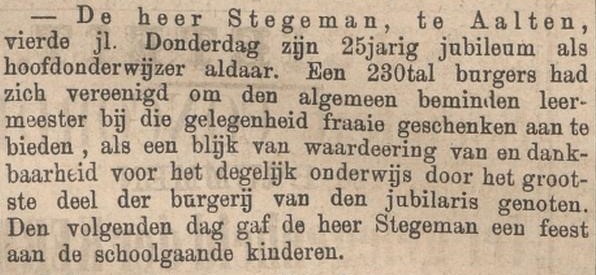
    During the second half of the 19th century, Dirk Stegeman served as headteacher at the Public Primary School for 45 years, first on Landstraat and from 1886 on Herenstraat in Aalten.

    Dirk Stegeman was born on July 4, 1830, in the rural district of Tonden near Brummen, as the son of shoemaker Johannes Stegeman and Johanna Evers. He married Hendrietta Engelina van Heuven on November 25, 1854, in Ruurlo. No fewer than 11 children were born from this marriage, two of whom died at a young age.

    Dirk Stegeman passed away on June 6, 1910, in Deventer at the age of 79.

    Please note: Dirk Stegeman should not be confused with Reverend Jan Derk Stegeman, after whom the Stegemanschool was later named.

    In 1937, G.H. Rots described how things were in Aalten in former times in a series of articles. Regarding the school, he wrote:

    “In the village of Aalten, all children attended a single school. There was no division. Children of all religious backgrounds sat side by side on the school benches. The school was located in a building on Landstraat next to the Reformed Church. The guardroom was downstairs and the school was on the upper floor. Master Stegeman ruled the roost there. Together with two assistant teachers, the youth of Aalten were educated. With six children to a bench, there were about 60 to 70 pupils per teacher in the winter. Every morning the classroom doors were opened, and the head of the school offered a prayer.

    Order in the classroom was maintained with the rod, for those who would not listen were disciplined with a piece of wood. And Master Stegeman kept them in awe. But he was a hardworking man and spared no effort to ensure the education was as good as possible. Evening school provided a good opportunity to impart some knowledge to children who had to leave school early. Then the master had a smaller class and the teaching was more informal.”

    Newspaper reports

    Vacancy for assistant teacher, Aalten - Opregte Haarlemsche Courant, 1857-05-01
    Opregte Haarlemsche Courant, May 1, 1857
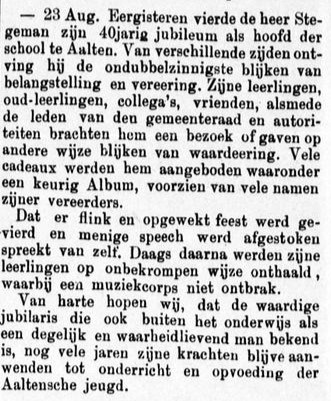
    Anniversary of headteacher Stegeman, Aalten - Zutphensche Courant, 1879-08-26
    Zutphensche Courant, August 26, 1879
    Dirk Stegeman - Graafschapbode, 1894-08-25
    De Graafschapbode, August 25, 1894
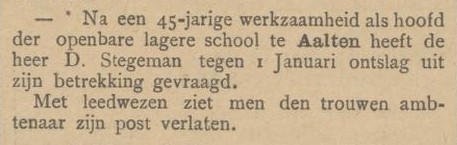
    Resignation D. Stegeman, Public Primary School Aalten – Arnhemsche Courant, 24 October 1899
    Arnhemsche Courant, 24 October 1899

    Sources


    • Opregte Haarlemsche Courant, May 1, 1857 (Delpher)
    • Zutphensche Courant, August 26, 1879 (Delpher)
    • De Graafschapbode, August 25, 1894 (Delpher)
    • Arnhemsche Courant, October 24, 1899 (Delpher)
    • Aaltensche Courant, November 19, 1937 (Delpher)
  • Willem Hebly

    Willem Hebly

    Architect

    Willem Hebly was born on October 17, 1908, in Rotterdam. At the end of 1934, he established himself in Aalten as an architect. Hebly was responsible for the design of a large number of homes, retail properties, commercial buildings, farms, and schools, and so forth, in Aalten and the surrounding area. Many of these buildings continue to enhance the streetscape today.

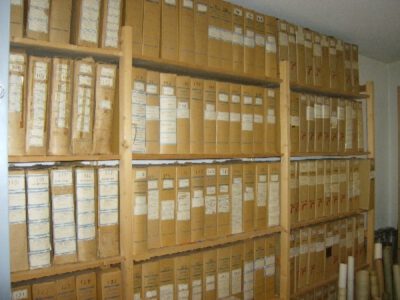
    The architectural firm founded by Willem Hebly was dissolved in 1995. In early 2011, his son Just Hebly, successor to his father Willem and himself a retired architect, decided to entrust his architectural archive to the Erfgoedcentrum Achterhoek en Liemers (ECAL) in Doetinchem. He was requested to write a brief historical overview regarding this. Portions of this account are presented below:

    Willem Hebly’s Establishment in Aalten

    In 1934, Willem Hebly graduated as an architect from the Academy of Architecture in Rotterdam. During those years of crisis, it was very difficult to establish oneself as an architect in Rotterdam, as existing firms strictly protected their market against newcomers.

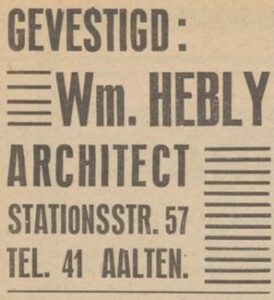
    A brother of Willem, Gon Hebly, was in Aalten at that time as an employee of an accounting firm to audit the books at the Dutch Button Works in Bredevoort. In the local newspaper he read at his hotel, he discovered a recruitment notice for a qualified architect in Aalten. He clipped the advertisement and took it home for his brother Willem.

    After consulting with his family and fiancée, Willem decided to travel to Aalten and report to the secretary of the then Aalten contractors’ association, Mr. Vreeman on the Meiberg in Aalten. It was he who had placed the notice. He was very surprised that an architect from Rotterdam responded to the advertisement in the local Aalten newspaper. He explained that the notice had actually been a ‘spite advertisement’ aimed at a former carpenter colleague who had recently started posing as an architect and was correcting his deficiencies at the expense of former contractor colleagues.

    Willem was surprised by this information but did not let it discourage him. From a close acquaintance of his father, to whom he conveyed greetings, he received more information about Aalten. Indeed, there was no graduated architect in Aalten, while there were regular high-quality clients, particularly for better-quality housing in the private sector. Regarding the character of the people of the Achterhoek, he was informed that it differed considerably from that of Rotterdammers. However, once you had won the trust of the population, you could do no wrong in the eyes of the people of Aalten.

    First Commission

    Through this acquaintance, he also obtained an address where he could potentially find temporary board and lodging, namely with the widow Mrs. Lammers on the Stationsstraat. He reported there immediately. Besides being able to rent a room with full board, she also put him in touch with Jan Ackerman, who had purchased a plot of land next to her home on which he wished to build a residence with commercial premises. The day could not have ended better. Delighted, he returned home to his family and his fiancée, Lenie Bosman.

    He did not have to think long about a final decision after receiving his first commission from Jan Ackerman to establish himself in Aalten as an architect. It became a very modern house by Aalten standards of the time, which has been a National Monument since 2002. Apparently, the design of Jan Ackerman’s home appealed to many residents of Aalten, given the many commissions that followed.

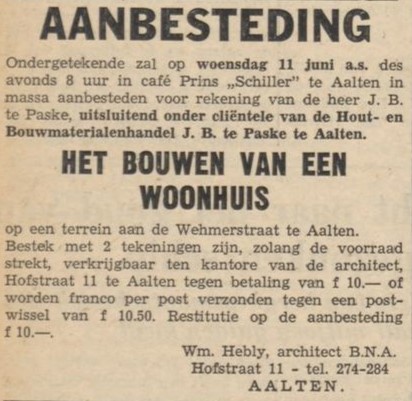
    Soon he also received a commission for the construction of a home for Henk te Paske at Plein Zuid. He was a building materials merchant and a friend of Jan Ackerman. Shortly thereafter, he also commissioned the construction of two semi-detached homes on the Whemerstraat in Aalten. Willem was able to rent one of those houses (Whemerstraat 7). He married in 1936 and lived there until 1967, raising a family with nine children. In the early years, he used the largest bedroom as his office.

    Reconstruction

    After the years of crisis and war, there was plenty of work to be done, including much reconstruction of bombed homes and farms. The office space soon became too small, which is why it was moved to the upper floor of a large home on the Bredevoortsestraat belonging to Mrs. Manschot. Soon there was employment for three to four staff members, including architectural draftsmen and supervisors.

    Willem Hebly belonged to the era when the architect functioned as the pivot in the construction process. He therefore saw himself not only as the designing architect for his clients but also as their technical advisor and confidant in all matters concerning construction: following the design, the specifications with technical drawings, the cost estimation, the tendering process, the working drawings, the project management, and supervision of the execution.

    Willem Hebly - Nieuwe Winterswijksche Courant, 28-05-1958
    Nieuwe Winterswijksche Courant, May 28, 1958

    In 1957, Willem’s eldest son Just Hebly joined the now new office on the Hofstraat in Aalten as an apprentice draftsman. After a year, Just left for Rotterdam to gain experience and continue his studies. After obtaining his HTS diploma, Just did not yet feel inclined to return to his father’s employment, but chose to work for the Nicolai architectural firm in Emmen.

    Construction System for Schools

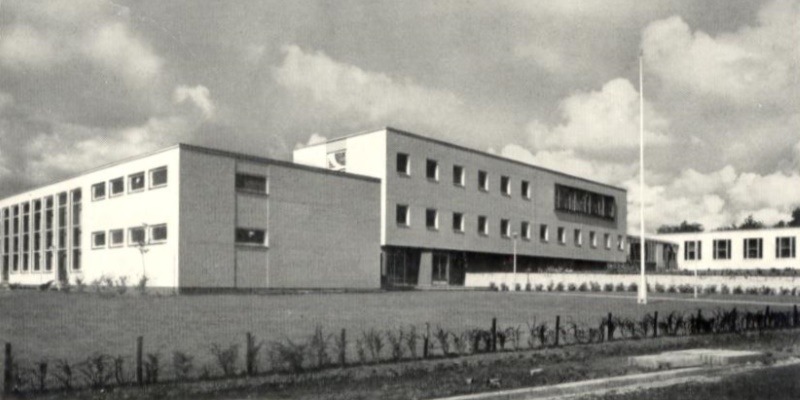
    In the mid-sixties, there was plenty of work. The baby boomers from 1946 were entering the workforce. Every village and town was working on expansion plans. Construction systems were developed for housing and school building. Willem Hebly had already achieved significant results in the field of school construction in Aalten: the LTS (Lower Technical School), the HBS (Secondary School) in collaboration with the Geels firm from Arnhem, and the lower agricultural school. The first and last schools have since been demolished. The latter school was the pride of the Ministry of Agriculture; the school was visited by foreign guests from The Hague.

    During that time, Willem Hebly came into contact with the Nuyt and Heikens architectural firm in Vlaardingen. They had developed a construction system for kindergartens and primary schools using the so-called Simplex element. This was an element made of aerated concrete, 60 cm wide and the height of a classroom. In 1964, both firms entered into a partnership under the name Buro Rationeel Bouwen, or BRB.

    Soon Willem Hebly was entirely occupied by the activities of BRB. During that time, it was also decided to expand the existing architectural firm with a branch office in Beilen (Drenthe).

    In the mid-sixties, Willem Hebly approached his son Just, who was enjoying his time in Emmen, with the request to become a partner in his architectural firm. After careful consultation within the family, the firm ‘Architectenbureau Wm en M.J. Hebly’ was established.

    Son Just Joins the Firm

    Just Hebly joined as a partner in 1965, in what some outsiders considered an ‘easy ride’. In reality, he had to buy in at a high price so that Willem Hebly could fund his retirement provision. Furthermore, Willem did not want to disadvantage his other eight children by favoring his eldest son. It was therefore hard work for Just, combined with studying in the evenings for his architect’s diploma. One of Just Hebly’s first designs was the home for his parents on the Bonifaciusstraat in Aalten.

    In 1972, Willem Hebly suffered a heart attack, resulting in Just Hebly taking over his activities in BRB as well.

    At the end of the 1970s, the Bureau Rationeel Bouwen (BRB) was dissolved. During the course of the 1980s, employment in the construction industry continued to decline. The Hebly architectural firm moved from Aalten to Winterswijk in 1986. In the second half of the 1980s, employment in the construction world deteriorated even further. Redundancy procedures had to be initiated for a number of employees.

    In the early 1990s, Just completed the remaining commissions on his own. Sixty years after its founding, the Hebly architectural firm closed its doors in 1995.

    Willem Hebly passed away on January 7, 1996, at the age of 87. He and his wife are buried at Berkenhove cemetery in Aalten.

  • Rev. Derk Breukelaar

    Rev. Derk Breukelaar

    Chr. Reformed Minister

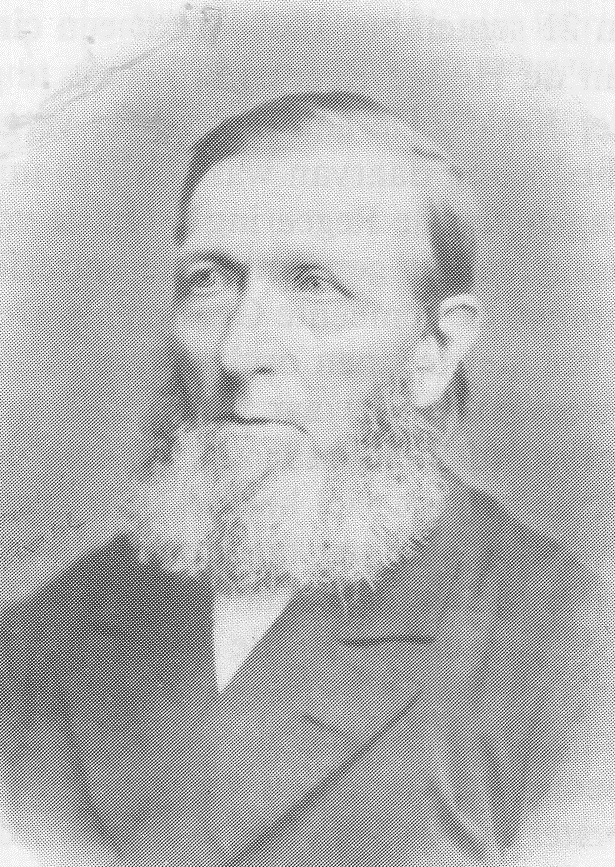
    Derk Breukelaar was born on 28 December 1814 in Varsseveld, the son of ‘chair turner’ Wessel Breukelaar and Grada Johanna te Rietstap. In 1847, he married Janna Hendrika Pennings (born in Aalten, 12 November 1825) in Aalten. Nine children were born from this marriage.

    Following the foundation of the Christian Secession Congregation (Christelijke Afgescheidene Gemeente) in Aalten in July 1843, the young faith community sought to call a minister. On the advice of Reverend Brummelkamp, the young Derk Breukelaar from Varsseveld was invited. He accepted and moved to Ommen to study under Rev. A.C. van Raalte (1811–1876)—one of the first Secessionist ministers in the country.

    Minister in Aalten

    After completing his studies, Breukelaar was ordained on 24 September 1846 as the minister of the congregation in Aalten. This would remain his only parish; he served there for 44 years until his retirement in 1888. When Rev. Wildenbeest of Varsseveld passed away suddenly in 1852, that congregation extended a call to him. Initially, he accepted, but—realising he was then the only Secessionist minister in the Achterhoek region—he eventually declined and remained committed to the church in Aalten, though he also worked extensively in the surrounding areas.

    ’t Grotenhuis

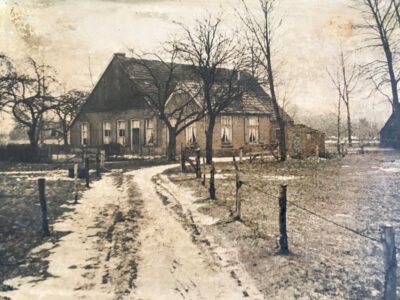
    Breukelaar lived with his family in a small farmhouse called ’t Grotenhuis, located on present-day Hessenweg just outside the village. Here, he grew his own food to supplement his modest stipend of 225 guilders, which later rose to 600 guilders per year. Parishioners also contributed in kind by bringing food, such as meat and potatoes, to his home. Catechism classes were also held at ’t Grotenhuis, as there was no room for them in the church. During busy periods, such as the harvest, his wife took over the teaching of these classes.

    Evangelism and Youth Work

    Evangelism was very close to the minister’s heart. This was the reason Derk Breukelaar took the initiative to establish several Sunday schools, through which he reached not only the children but also their parents. For children in the outlying hamlets, Sunday school was held at someone’s farmhouse so that the children did not have to travel all the way to the village. Later, long after Breukelaar’s death, various Sunday school buildings would be erected in the rural districts surrounding Aalten.

    In 1868, Breukelaar founded the Reformed Young Men’s Association „Uw Koninkrijk kome” (Thy Kingdom Come).

    Difficult Years and Recognition

    The late 1870s were not the easiest years for the minister. In 1876, his wife passed away, and a few years later, he became involved in the “School Struggle” (schoolstrijd) in Aalten as the chairman of the school board.

    Nevertheless, Breukelaar received much appreciation. On his fortieth anniversary in office in 1886, his congregation presented him with a States Bible on a beautifully crafted wooden lectern. On the same joyous occasion, the classis (regional church council) presented him with an engraving depicting ‘Golgotha’. When he retired in 1888, his catechism pupils gave him a tea service and a cake set as a gift.

    Death and Legacy

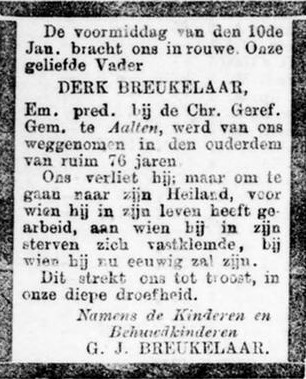
    Reverend Breukelaar passed away on 10 January 1891 in Aalten at the age of 76. He was buried at the Old Cemetery on the Varsseveldsestraatweg. The church council honoured him with a funerary monument. The inscription on the gravestone, which is now barely legible, is noteworthy for its curious use of the church name ‘Christian Secession Congregation’ (instead of ‘Christian Reformed Congregation’).

    Three of his sons followed in his footsteps and also became ministers: Gerrit Jan, Willem, and Johannes. The latter is regarded as the founder of Christian education in Aalten. In June 1918, Johannes himself opened the Breukelaar School on Piet Heinstraat, which was named after him.

  • Bernard Manschot

    Bernard Manschot

    Comb Manufacturer

    Barend Johannis (Bernard) Manschot was born on 17 August 1850 in Prinsenstraat in Aalten, the son of Gerrit Willem Manschot (a blacksmith) and Johanna Geertruid Becking. On 18 July 1878, Bernard married Maria Harting (born in Breda, 4 December 1848) in Utrecht. A son and a daughter were born from this marriage.

    In 1871, Bernard Manschot and his brother-in-law Abraham (Bram) ten Dam founded a comb factory on Damstraat in Aalten. Bernard and Bram lived opposite each other on Bredevoortsestraatweg; Bernard in the white villa at number 51, and Bram across the road, in the house that now characterises the Van Panhuis physiotherapy clinic.

    Bernard Manschot passed away on 27 June 1920, at the age of 69.

    Funeral

    On Wednesday afternoon, the mortal remains of Mr B. J. Manschot were carried to the grave. Once the coffin had been lowered, Mr Slicher van Bath spoke a brief word of farewell and gratitude. “You now enjoy the rest,” the speaker noted, “which you so richly deserve. Yet we would have so gladly kept you in our midst a little longer, where you were driven by such noble principles in all your deeds.

    We have learned much from your wisdom and benefited from the goodness of your heart. We shall have to miss all of this now. But we will not forget you. The spiritual seeds you have sown will remain within us, and we shall endeavour to follow your example in all the noble and grand things you have done.

    We have not come here to proclaim your praises. You would not wish to accept them here. You were too humble for that. However, we must not forget to express our gratitude for what you have done for the Departement tot nut van ’t algemeen (Society for the Public Good). For more than 30 years, you served as its secretary, devoting your utmost strength and devotion to this institution.

    For more than 30 years, you ran the nursery school. Through your dedication, it has become what it is today. We shall sorely miss you there as well. Yet we will not lose heart, but will continue to walk in your footsteps, hoping to do so with your life’s motto: Excelsior, excelsior!

    Once again, our heartfelt thanks on behalf of the Department, also on behalf of the children of the nursery school who have now grown into adulthood, and on behalf of the parents of the children for all the kindness you have shown. We would no longer wish to be without the institution founded by you. Sleep peacefully!”

    Visibly moved, Mr Ten Dam then thanked everyone, also on behalf of his niece, including the workmen who had paid their final respects to the unforgettable deceased.

    De Nieuwe Aaltensche Courant, 2 July 1920

  • John Bernard William Maitland

    John Bernard William Maitland

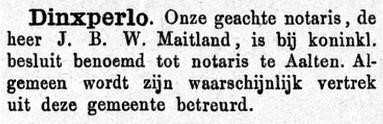
    John Bernard William Maitland (1826–1894) was, among other roles, a notary in Dinxperlo and, from 1882 to 1894, in Aalten. In addition, he served as a deputy cantonal court judge and was a member of the Provincial States of Gelderland.

    John Bernard William Maitland was born on 7 May 1826 in Vorden, the son of retired captain John Maitland and Catharina Willemina Mellink. On 28 October 1862, he married Bernarda Aleida Schepers in Dinxperlo. This marriage produced three sons and a daughter, all born in Dinxperlo.

    All three sons passed away at a young age, also in Dinxperlo; one died after just 15 days (Bernard), while the other two reached the ages of only 8 (John) and 17 (Dirk). Only their daughter, Catharina Antoinette Bernarda, reached adulthood, married and had children of her own.

    Profession and residence

    On 16 December 1859, Maitland was appointed notary in Dinxperlo by Royal Decree. Up to that point, he had been working as a candidate notary (kandidaat-notaris) in Vorden. Two months later, on 16 February 1860, he was additionally appointed deputy cantonal court judge in Aalten. He held this position until the Aalten cantonal court was abolished in 1877.

    On 18 July 1882, Maitland was appointed notary in Aalten, succeeding notary B.A. Roelvink, who had passed away earlier that year. Together with his wife and daughter, he moved into the house of the late notary Roelvink on Gasthuisstraat (now Haartsestraat). Around 1886, they relocated to a stately house on Landstraat, which is today number 41.

    Public and civic roles

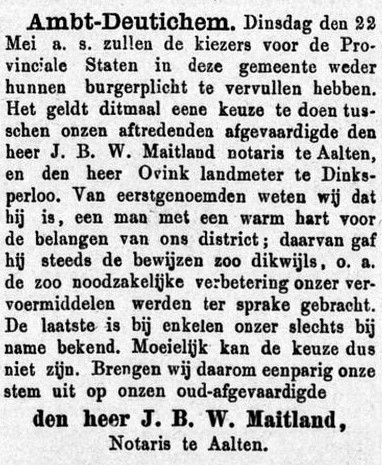
    Alongside his profession, Maitland was also active in civic life. In Dinxperlo, for instance, he served as the director of the ‘Aurora’ choral society. From 1877 to 1885, Maitland was a member of the Provincial States of Gelderland, representing the electoral district of Aalten.

    Furthermore, in 1892, Maitland invited ‘a number of residents’ of Aalten to the sociëteit club to exchange ideas about establishing a local tourist board (VVV). To achieve this goal, it was proposed that “photographs would be taken of the most beautiful spots and walking maps would be created”. However, we have been unable to find any evidence that this actually took place.

    Passing

    John Bernard William Maitland passed away on 11 October 1894 in Aalten. He was buried at the Old Cemetery on Varsseveldsestraatweg.

    He was succeeded by P. Losecaat Vermeer, who until then had been a candidate notary in Nijmegen.

    Sources


  • Bernard Andries Roelvink

    Bernard Andries Roelvink

    Bernard Andries Roelvink was born on 22 November 1818 in Bredevoort, the son of Mayor Arnoldus Florentinus Roelvink and Elzabé Maria Theodora ten Cate.

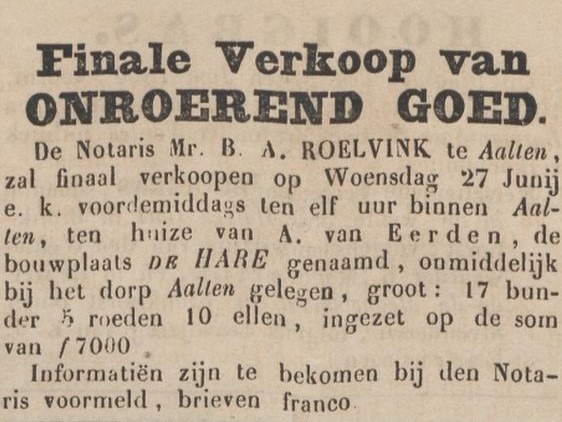
    From 1843 to 1852, Roelvink served as clerk of the cantonal court in Aalten; prior to this, he was a deputy public prosecutor at the district court (arrondissementsrechtbank) in Zutphen. On 6 April 1852, he was appointed notary in Aalten by Royal Decree, succeeding his father in the role.

    From 8 March 1853 until his death, Roelvink was also a member of the Provincial States of Gelderland, representing the electoral district of Aalten.

    Bernard Andries Roelvink remained unmarried and passed away on 17 April 1882 at house number 385 in Aalten (Haartsestraat 10).

    Following his death, he was succeeded by J.B.W. Maitland, who until then had been a notary in Dinxperlo.

  • Jan Hendrik Willem Mensink

    Jan Hendrik Willem Mensink

    Jan Hendrik Willem Mensink (1869–1943) was a notary in Aalten from 1909 to 1939.

    Jan Hendrik Willem Mensink was born on 19 March 1869 in Miste (Winterswijk), the son of farmer Hendrik Jan Mensink and Hanna Catharina Tenkink.

    On 21 October 1926, at the age of 57, Mensink married Grada Gesina Wensink in Aalten, who was 11 years his junior.

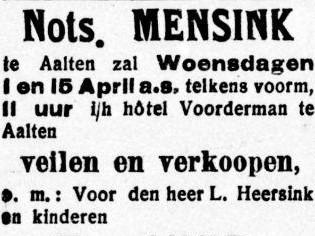
    In 1909, he succeeded P. Losecaat Vermeer as notary in Aalten. By that time, he had already been serving as acting notary for three years due to Losecaat Vermeer’s illness. Mensink tendered his resignation in 1938 at the age of 69. He was succeeded in 1939 by W.C. Krijgers Janzen.

    Notary Losecaat Vermeer initially lived and worked at Hogestraat 2a (later known as the premises of saddler Gerstmann) and, from around 1930, at Markt 18 (which later became the ABN-AMRO bank).

    Jan Hendrik Willem Mensink passed away on 4 February 1943 in Aalten. He was buried at Berkenhove Cemetery.

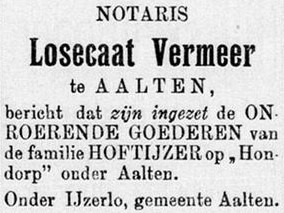
  • Pieter Losecaat Vermeer

    Pieter Losecaat Vermeer

    Pieter Losecaat Vermeer (1856–1909) served as a notary in Aalten from 1894 to 1908.

    Pieter Losecaat Vermeer was born on 8 January 1856 in Beek (Ubbergen), the son of Pieter Anthoni Jacobus Losecaat Losecaat Vermeer and Ephraïma Bartha Johanna De Jong.

    At the end of 1894, he was appointed notary in Aalten, succeeding notary J.B.W. Maitland, who had passed away shortly before. At the time of his appointment, he was working as a trainee notary (kandidaat-notaris) in Nijmegen.

    Notary Losecaat Vermeer lived and worked at various addresses in Aalten, successively: Landstraat 23-25 (now Kuypers Florist), Markt 1 (now the police station on Köstersbulte) and Hogestraat 2a (later known as the premises of saddler Gerstmann).

    On 18 May 1905, at the age of 49, Pieter Losecaat Vermeer married Paulina Cornelia Johanna Antoinetta de Wilde from Schoonhoven, who was 21 years his junior, in Haarlem.

    Illness

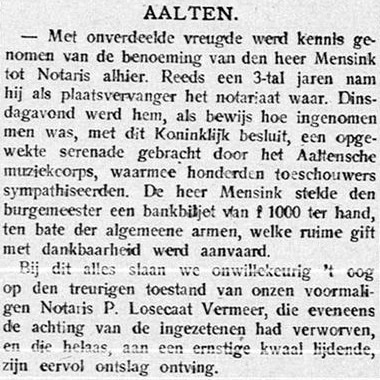
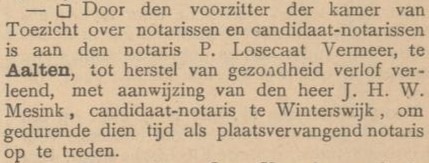
    In early 1906, illness forced him to step down from his duties. J.H.W. Mensink, until then a trainee notary in Winterswijk, was appointed as deputy notary. Unfortunately, Losecaat Vermeer did not recover from his illness. In November 1908, he was granted an honourable discharge by Royal Decree, and Mensink was appointed as his successor.

    At the end of November 1908, Pieter and his wife moved to Haarlem. Just a few months later, on 20 March 1909, Pieter Losecaat Vermeer passed away there. He was buried at the General Cemetery in Schoonhoven.