Trouw, 25 July 1953
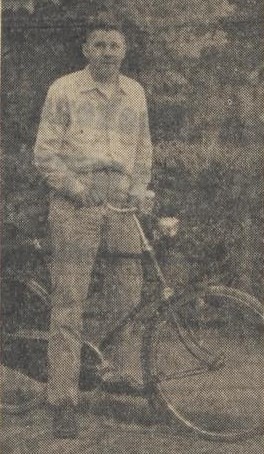
HARRY KRAAYENBRINK from Sioux Center in America, one of the most solidly built corporals in the American army of occupation in Germany, is a farmer in civilian life. Before he joined the company, he worked on his father’s farm (160 ha) in Sioux Center. In the American army there will be more soldiers who are well in the hands of the team, but there will not be many who, like Harry Kraayenbrink, can have a chat with a colleague from the Achterhoek without any difficulty.
That’s how it is with Harry: Forty-one years ago, Hendrik Kraayenbrink and Leide Nijman emigrated from Sinderen near Varsseveld. The couple had seven children, five boys and two girls and father Kraayenbrink believed that there would be no work for his boys in the Netherlands, at least if they wanted to become farmers.
That is why he had been planning to emigrate to America for years, but his wife opposed this intention. Until 1912. Then she could no longer cope and gave in: the Kraayenbrink family was going to America. Mother Leide (born in IJzerlo) was not at all happy with it. She went to America because her husband wanted it and because she wanted to stay with her children, but she didn’t feel like it at all.
Dialect
Once they arrived in America, father Kraayenbrink and his family were doing well. Over the years, they had their own company. But, no matter how prosperous it went, mother Leide could not forget Sinderen and the Achterhoek. For her, there was no better country than the Netherlands and no more excellent region than the Achterhoek in Gelderland. Mother Leide resolved never to forget her beautiful Achterhoek, nor the Achterhoek dialect. She also resolved never to learn to speak English and she held on to that until her death – now four years ago.
Mother Kraayenbrink continued to speak the Gelderland dialect. Anyone who wanted to talk to her had to learn Achterhoeks and otherwise… Well, then the conversation didn’t go on.
Benjamin
The youngest son of the Kraayenbrink family was about sixteen months old when they left Sinderen. It was born as Bernard Willem Kraayenbrink, but he was called Benjamin or Ben.
Benjamin had to go to school in America with his brothers and sisters. It was a school where lessons were taught in English. So the children started to speak English, but that did not stop mother Kraayenbrink from continuing to speak Achterhoeks at home. That is why the children spoke two languages: English and Achterhoek dialect.
Benjamin Kraayenbrink became a man. Then the day came that Benjamin asked his parents for permission to marry Jeanette van Roekel. Jeanette was a girl whose parents lived in America, but whose ancestry came from the Netherlands. The latter contributed in no small way to mother Leide giving permission for the marriage. Jeanette was in any case of Dutch descent.
The years came one after the other. Benjamin and Jeanette, who had started their own farm not far from Hendrik Kraayenbrink’s farm, had a family: seven children were born there: four girls and three boys. Harry Kraayenbrink was the oldest.
Especially the eldest children often went to their grandmother and she told her grandchildren of the Netherlands, of the Gelderse Achterhoek, of Sinderen and of Aalten, where family lived. But grandmother continued to speak Achterhoeks, also to her grandchildren, who gradually also learned the Gelderland dialect during “private lessons” that they received unnoticed from their grandmother from their grandmother.
The grandchildren thought they spoke the Dutch language, but they sometimes noticed that grandmother also spoke another language. They heard that when she read from the Bible.
Four years ago, grandmother died and when the eldest grandchildren think of her, they think of the Achterhoek dialect and of the beautiful forests and the beautiful cornfields in the Gelderland Achterhoek, about which she has told so often and so beautifully.
In Germany
The previous year, Harry had to go into service. He was sent to Germany and thanks to the fact that an aunt – aunt Hanne – had maintained the relationship with the family in Aalten and Sinderen through correspondence, Harry was given addresses. Who knows, maybe he had the opportunity to go to the Netherlands. That opportunity came. Harry was given a leave of thirteen days. He boarded the train in Frankfurt and via Arnhem he traveled to Aalten, where he arrived with the last train, in the middle of the night. He thought it was too strange to visit his family so late. Harry spent the night in a hotel and the hotel owner made sure that one of the family members, Mr . H.A. Nijman from Aalten, was called, who came to pick Harry up.
In the past few days, Harry has been looking at the Achterhoek. He has seen where his grandparents lived and where they went to church, where his father was baptized and where his grandmother worked in the fields. Harry has also discovered that he does not speak Dutch, but the Achterhoek dialect. He has had a lot of ease from the fact that his grandmother stubbornly held on to her own regional language.
Amsterdam
Harry thinks the Achterhoek is beautiful, just as beautiful as his grandmother always said. Next week he will go to Amsterdam for a few days. He wants to see the capital of the Netherlands, where, as grandmother has always said, it is just as busy as in the big cities of America…
Another six months and then Harry will have finished military service. He is not sorry. “I don’t want to go back to my house and help my father on the farm”. But first, Harry wants to see Amsterdam. He just hopes that he can understand the people there, because of course they don’t speak Achterhoek and Harry doesn’t understand Dutch very well, but he will try to get by in Amsterdam with the Achterhoek dialect.
“Maybe she laughs at me in Amsterdam and thinks, what kind of farmer is that, who can’t speak Dutch. She still has a lot of fun, because I’m also a farmer, an American farmer…”
Biography of Harry Lester Kraayenbrink
Harry Lester Kraayenbrink was born on February 20, 1930 in Sioux Center, Iowa, the son of Ben and Jeanette (Van Roekel) Kraayenbrink. He grew up on a farm near Sioux Center and graduated from Sioux Center High School in 1947.
On February 26, 1952, Harry enlisted in the U.S. Army during the Korean War and was stationed in Germany. After his honorable discharge on February 9, 1954, he returned to his birthplace.
On 20 April 1956, Harry married Wilma Cleveringa. He worked at the Sioux Center Co-op and the Sioux Center Lumberyard. In 1959, the couple moved to Maurice, where Harry farmed for six years before moving to a farm north of Sioux Center. This is where Harry and Wilma raised their four daughters.
In 1988, Harry retired. He had many hobbies and interests, including woodworking, carpentry, golf, fishing, biking, pool, and playing cards at the Senior Center. He and Wilma also enjoyed trips to visit family and trips to the lakes.
Harry passed away on December 15, 2017 at the age of 87 at the Royale Meadows Care Center in Sioux Center. He was buried in Memory Gardens Sioux Center Cemetery.