
Schoolmaster became world traveler and inventor
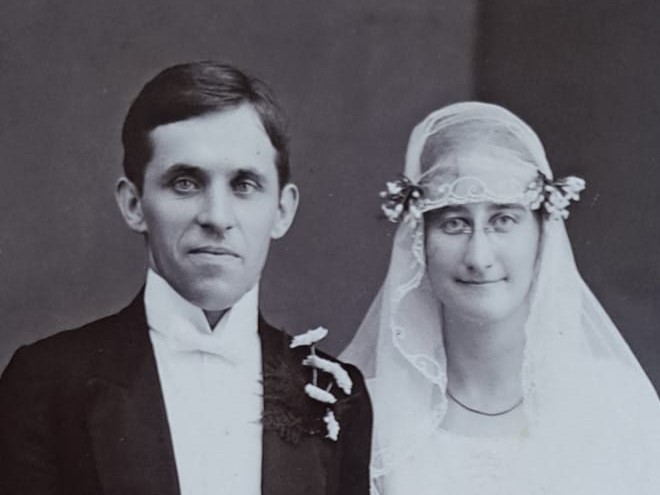
Gerrit Johan Kaemingk was born on November 2, 1890, at Overbeek in IJzerlo, son of Theodor Johann Kaemingk and Johanna Hendrika Pennings. In 1917, the then 27-year-old teacher left the Netherlands to work in the ‘far Indies’.
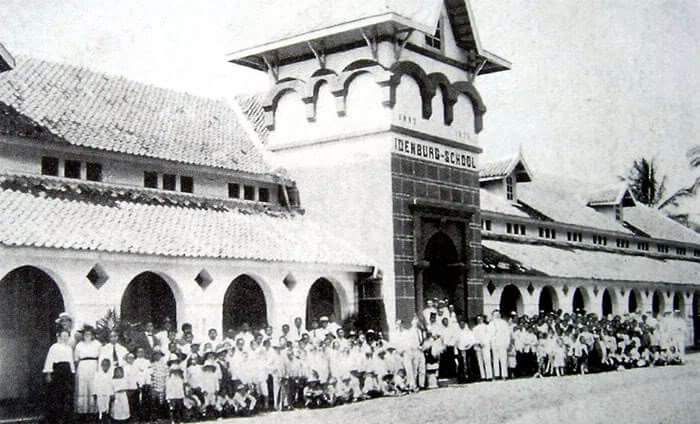
The journey was indeed very long, as World War I had blocked the normal travel routes. After a four-month journey via Iceland, America, Honolulu, Japan, and China, he finally reached his ideal. There, he became, among other things, head of the Idenburg School in Solo (Surakarta).
Kaemingk married Geertruida Johanna Sophia (Truus) ten Boom in 1921.
After twenty years, he retired and set out on another journey. On his way to the Netherlands, he wanted to see South Africa. He arrived there in 1937. And because he did not yet consider himself ‘worn out’, he became a temporary teacher there. Before he could realize his plan to return to the Netherlands, World War II broke out.
As a result, it was not until the summer of 1953 that he saw his native country again. The twice-retired teacher stayed temporarily in Hoogeveen with his brother Gerrit Willem Kaemingk (1887-1979), who was then chairman of the Christian Emigration Center in Drenthe.
Invention of electric education, the ‘Elucator’
Once back in the Netherlands, Kaemingk presented his invention, namely ‘electric education’. He called his method “Elucator“, a combination of electricity and educator (or educator). He had applied for a patent for his invention in South Africa. It worked as follows:
Using a battery, a low-voltage current is passed through two insulated pointing sticks. With one stick, a location is pointed out on a map, and with the other, one of the place names listed in a row on the right of the map. If the correct location is pointed out, this is signaled by a light or sound signal. Conversely, one can also search for the correct location for a given place name.
In addition to geography, Kaemingk had also designed maps for subjects such as drawing, language instruction, reading lessons, botany, and history. In total, about 50 maps could be compiled. The Elucator and its accessories could be carried in a handy box that easily fit into a briefcase. With this, he had developed an educational method that was said to have several advantages. For instance, the teacher would have become (virtually) redundant. The child could study alone at home or in class, and any error was immediately corrected.
The Elucator was considered particularly suitable for (countries such as) South Africa, where children living in remote areas found it difficult to attend a school. However, a number of educational experts in Utrecht, who were introduced to Mr. Kaemingk’s invention, were also enthusiastic. Children found the Elucator to be ‘a relatively inexpensive parlor game with many possibilities’. The visual connection, which was directly established here between an object and a word, a plant and its name, or a sum and its result, seemed to ‘have a very favorable effect on the child’s comprehension’.
Back to South Africa
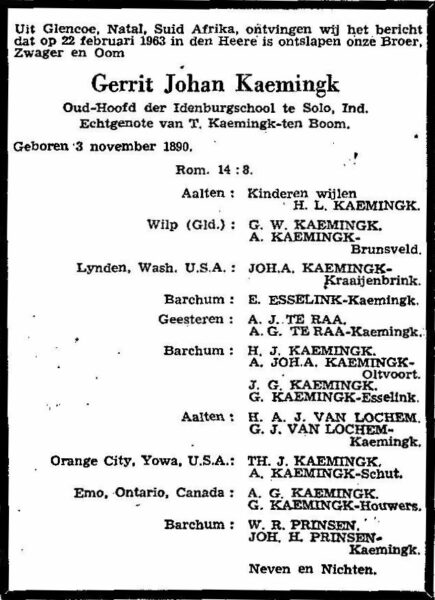
After his visit to the Netherlands, he returned to South Africa, where two of his sons-in-law had a farm. He passed away on February 22, 1963, in Glencoe, Natal, South Africa.