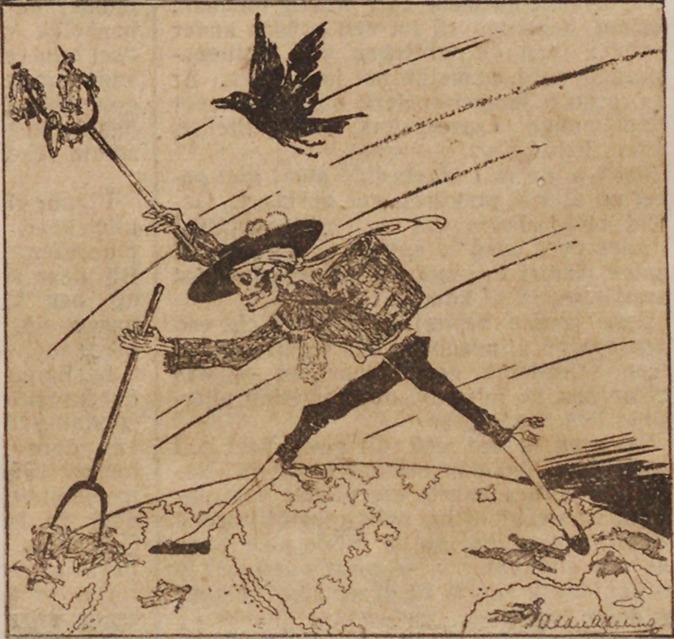
At the end of May 1918, the first reports appeared in Dutch newspapers regarding a ‘mysterious illness’ in Spain. Although its origins likely lay elsewhere, it was soon referred to as the Spanish Flu. This pandemic held the country in its grip for nearly two years and claimed 38,000 lives. In 1920, the disease vanished as enigmatically as it had arrived.
The municipality of Aalten did not escape the Spanish Flu either. The number of fatalities here is estimated at approximately 60, out of a population of roughly 10,000 at the time.
Newspaper reports
Aalten, 16 October 1918 – “The Spanish sickness is increasing in scale in Aalten. In many households, one or more family members are confined to bed. It is also markedly noticeable in schools, where many children are absent. Consequently, the Christian school on Breedevoortsestraat has been closed. Fortunately, the illness has not yet taken a malignant course. Lung conditions have only occurred in a few individuals.”
De Standaard
Aalten, 29 October 1918 – “The Spanish flu, which at first was sometimes spoken of jestingly, is now appearing alarmingly in places. So too here in our municipality. Among the very numerous cases, several have resulted in death, sometimes so suddenly that people pass away within a few days. Indeed, the number of reported deaths at the town hall here has never been as high in a single day as was the case yesterday, when no fewer than eleven death certificates were filed. There is general widespread sympathy for the households where death has made such an unexpected entrance.”
Bredevoort, 29 October 1918 – “Whereas until now the Spanish flu was actually only known by name here, as people were recovered within a couple of days, it has now become quite different and has taken on a more serious character. Already several victims have died of this illness, while many are seriously ill. The public school was closed yesterday (Monday morning).”
Aaltensche Courant
Aalten, 5 November 1918 – “The flu continues to rage here with the same severity and claim its victims. Yesterday, four persons in this municipality died of the disease.”
De Graafschapper
Aalten, 20 February 1919 – “In the municipality of Aalten, the Spanish flu has now broken out for the third time. The illness has been confirmed in many families, with some cases already resulting in death.”
Arnhemsche Courant
Aalten, 22 February 1919 – “Several cases of Spanish flu are occurring again in Aalten. Six have already proved fatal.”
Provinciale Geldersche en Nijmeegsche Courant
Aalten, 5 March 1919 – “The Spanish flu continues to demand sacrifices in Aalten. The number of cases remains significantly high, while numerous deaths occur.”
Arnhemsche Courant
Miracle Cures
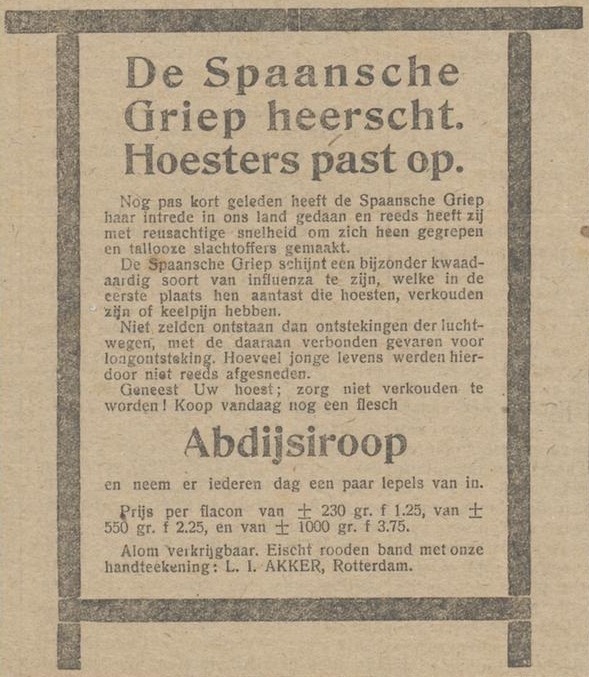
Entrepreneurs also saw commercial opportunities and sold all kinds of remedies for the flu, such as ‘Abbey Syrup’, which was essentially nothing more than sugar water with cinnamon. Other promoted treatments included “sublimate injections, fumigations with nitrous acid, eucalyptus oil, sugar beets…”