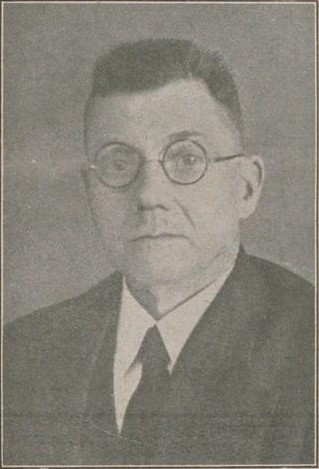

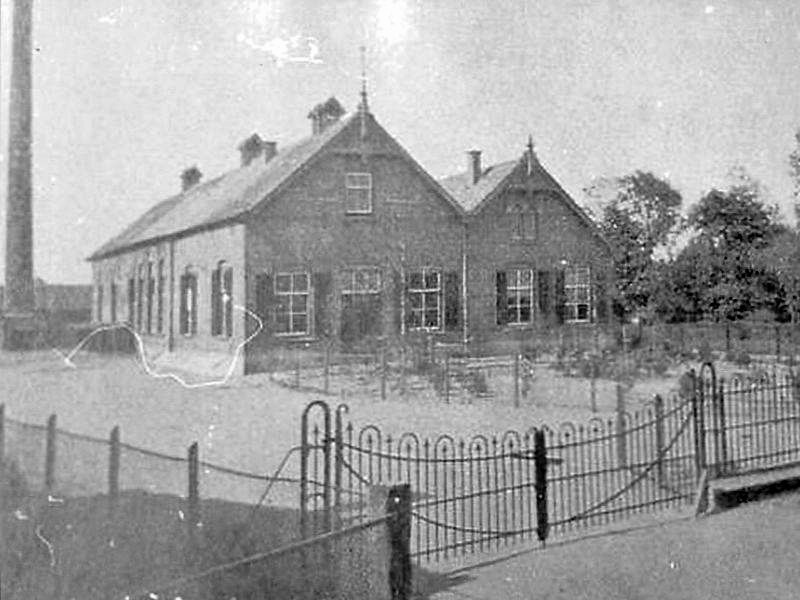
AALTEN, 6 mei 1920 – Het was een drukke dag voor de heer G. de Vries, directeur van de plaatselijke boterfabriek. Samen met zijn assistent, de heer Kempink, had hij ƒ 14.094,40 in zakjes afgepast en in de brandkast opgeborgen. Het geld was bedoeld om de melkleveranciers de volgende ochtend te betalen. Aan het eind van de dag verliet De Vries als laatste het kantoor en sloot de deur achter zich. De brandkast stond echter nog open, met de sleutel in het slot.
The next morning, the money had vanished. The only sign of a break-in was a curtain cord hanging outside the window. Although the director had locked the office door, the windows facing the street could easily be slid open from the outside.
On 7 May, the Nieuwe Aaltensche Courant reported on the theft: “Last night, a sum of ƒ 14,000 was stolen from the safe of the Aaltensche Coöp. Zuivelfabriek (Dairy Factory). At the request of the police, we are not sharing further details.”
Investigation
In the months that followed, the media remained silent. Behind the scenes, however, intense work was being carried out on this sensational case. The marechaussee in Winterswijk conducted an investigation and arrested several suspects, who later had to be released due to a lack of evidence. Subsequently, the case was reinvestigated by the national, municipal, and military police, without success. Even a national constable-detective (rijksveldwachter-rechercheur) returned home empty-handed.
Finally, the investigation was assigned to Sergeant of the Marechaussee Woerts from Zutphen. Woerts went undercover, wandering through Aalten for a time as a vagrant, staying in a lodging house, and working at a factory. After gathering a wealth of information, secret agent Woerts—Evert Jan Woerts—travelled to Germany and managed to arrange for himself to be locked in a prison alongside a person who knew more about the matter…
This also yielded valuable information, leading to the arrest of two suspects: Gerrit Jan W. (29, a bricklayer’s labourer) from Enschede, formerly a resident of Aalten, and Hendrikus P. (28, a clog maker) from Aalten.
Gerrit Jan W. from E.
Several newspapers reported on the trial, which took place in December 1920 at the court in Zutphen. Gerrit Jan W. was the first to stand trial. He testified that he and co-defendant P. had climbed in through a window and stolen the bags of money from the safe. Once outside, they placed the bags into a large jute sack and went to W.’s house to count the money. There, P. gave the defendant ƒ 110 and left with the rest of the loot, approximately ƒ 14,000. P. was supposedly going to hide the remainder in the “Schaapsche hei” (perhaps referring to the Schaarsheide?). W. had burnt the bags that previously held the money.
The defence counsel, Mr C.C. de Jonge, pointed out that the defendant was an epileptic—the defendant actually suffered a seizure during the defence—and requested an evaluation of his mental faculties. According to him, P. was the primary perpetrator and had likely enticed W. At any rate, he urged for a lighter sentence.
The Public Prosecutor praised Wachtmeester Woerts, whose investigations and tactical approach had brought this defendant to a confession. In his view, it had been shown that this accused was the least guilty. Therefore, his sentence could be lighter; the Prosecutor demanded 1½ years’ imprisonment, with time served in pre-trial detention deducted.
Hendrikus P. from A.
Next, Hendrikus P. stood trial for complicity in the same case. P., however, denied everything. He stated that he had not been at W.’s house that evening, though he had been there eight days prior. P. had an alibi for the night in question: he had been home between 10:00 and 11:00 and was asleep. The following morning, he had cycled to “Heersen” (?). P. maintained that he had nothing to do with the burglary and that W. had cast suspicion on many people in this case. He also claimed that W.’s wife was unreliable.
Witness Hendrika Geessink, W.’s wife, testified that on the evening of 6 May, co-defendant P. came to fetch her husband, saying: “Gerrit, come with me, there’s something to be had at the butter factory,” or words to that effect. Her husband had initially refused, but after P. persisted, W. eventually went along. Whether it was exactly a quarter past eleven when P. arrived and one o’clock when they returned, the witness could no longer say for certain. When they returned, the witness was in bed, but she did see money and paper bags. She did not know the exact amount.
The witness confirmed that after 6 May, the whole family went to Enschede by car. German and Dutch currency was seized from her on 17 September. She denied that it amounted to 4,000 marks. It also appeared that she had purchased various items worth ƒ 800 after 1 May. Her husband had not told her everything, because: “no husband does that!” On 16 May, she had deposited 10,000 marks at a bank in Enschede. The witness claimed that this was money honestly earned by her husband.
Despite this, the Public Prosecution Service considered it proven that P. was the most guilty in this case and demanded three years’ imprisonment. The defence, however, contested the evidence; he deemed the testimony of W.’s wife unreliable. Furthermore, he pointed out the large expenditures made by the W. family after 6 May, arguing that nothing proved P.’s guilt. Since W. was constantly working on the factory grounds, it was more likely that W. would have gone to P. to fetch him. The defence therefore requested an acquittal for P.
Verdict
On 5 January 1921, the Court in Zutphen sentenced Hendrikus P. to 2 years and Gerrit Jan W. to 6 months’ imprisonment, with pre-trial detention deducted, for theft by climbing into the Aalten butter factory.
Notably, the defendants were not ordered to repay the stolen sum. Consequently, the butter factory had to bear the loss itself. Member of Parliament Weitkamp found this peculiar and asked the Minister of Justice if he was willing to “indemnify the owners of the butter factory on behalf of the State for the great financial disadvantage suffered due to the peculiar views of a judicial official?”
The Minister, however, was of the opinion that “it has not been shown that the owners of the stolen funds suffered financial loss due to any negligence by the judicial authorities” and therefore saw no reason to consider compensation.