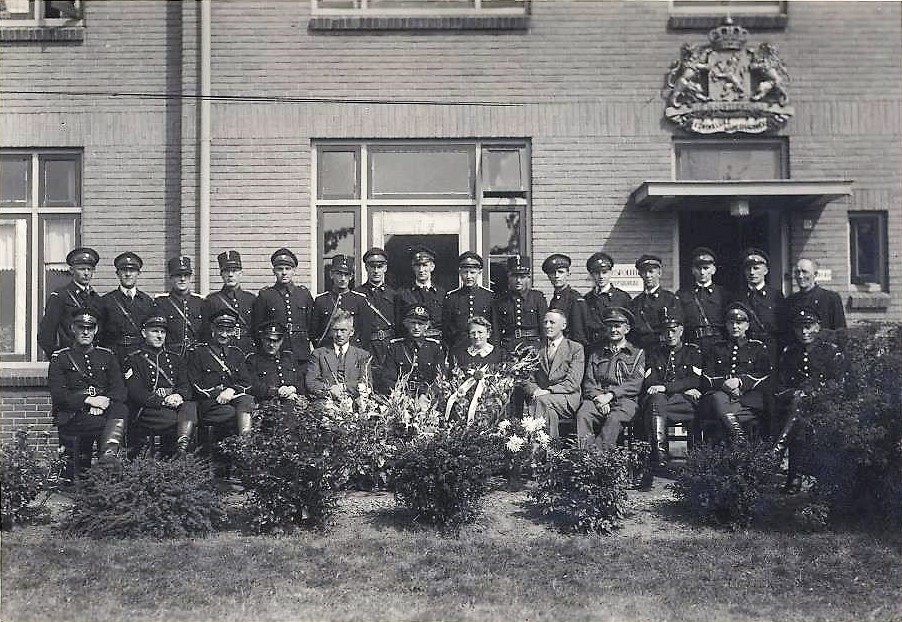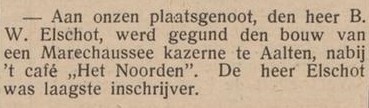
The Aalten Marechausseekazerne (Royal Military Constabulary barracks) was built around 1937. Previously, the constabulary had been stationed at the Heurne-Hemden border crossing. The premises contained three houses intended for the families of the constabulary and a service section, which was larger than the residential parts. There were also additional rooms for unmarried officers. These men were required to serve a certain number of years with the Marechaussee before they were permitted to marry, and therefore lived on-site.
The service section contained two holding cells, and all three houses were equipped with a ‘gas cellar’ to provide shelter in the event of a war involving gas attacks. During World War II, a V-1 flying bomb landed next to the barracks; however, given the sturdy construction typical of military objects, the building suffered virtually no damage.
World War II
When war broke out on 10 May 1940, Sergeant (wachtmeester) Sijbring—who was on night duty—warned the officers of the German advance. A number of them fled by bicycle via the Wolboom towards Bronkhorst, where they crossed the IJssel. From there, they could be deployed in the defence of the Netherlands.
If people were arrested during the war, they were taken either to the Town Hall, where the NSB (Dutch Nazi Party) was based, or to the Marechaussee barracks. A number of constabulary officers were still stationed there. On one occasion, the resistance leader ‘Ome Jan’ Wikkerink was arrested and brought to the barracks. The resistance quickly devised a plan to liberate him. They made an arrangement with the guard, the younger Officer Bruggeman, that they would give him a black eye and stun him with chloroform. In this manner, Ome Jan was freed. When the SD (German security service) arrived shortly after and found the guard with a black eye and barely conscious, they believed his story, and he avoided any repercussions.
Residences
The barracks were closed on 1 March 1968. Subsequently, the building was transferred to the Government Buildings Agency. In 1989, the houses were sold to the tenants and passed into private ownership.
Archives
Address directory 1967
Ringweg 39
Constabulary barracks