
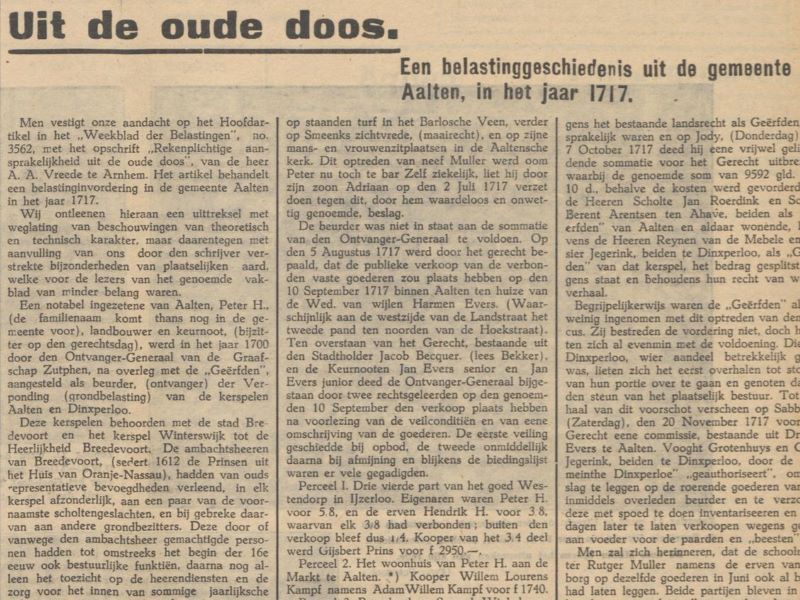
Aaltensche Courant, February 28, 1941
Our attention has been drawn to the lead article in the “Weekblad der Belastingen,” no. 3562, titled “Accountable liability from the old days,” by Mr. A. A. Vreede of Arnhem. The article discusses a tax collection in the municipality of Aalten in the year 1717. We have derived an excerpt from this, omitting considerations of a theoretical and technical nature, but conversely supplementing it with details of a local nature provided to us by the author, which were of less interest to the readers of the aforementioned trade journal.
A notable resident of Aalten, Peter Huijninck, farmer and lay judge (assessor on the court day), was appointed in the year 1700 by the Receiver-General of the County of Zutphen, after consultation with the “Heirs,” as collector (receiver) of the Verponding (land tax) for the parishes of Aalten and Dinxperloo.
These parishes, along with the town of Bredevoort and the parish of Winterswijk, belonged to the Lordship of Bredevoort. The lords of the manor of Bredevoort (since 1612 the Princes of the House of Orange-Nassau) had traditionally granted representative powers, in each parish separately, to a few of the most prominent bailiff families, and failing that, to other landowners. These persons authorized by or on behalf of the lord of the manor also held administrative functions until approximately the beginning of the 16th century; thereafter, they only oversaw the corvée labor and the collection of certain annual revenues, which later included some liability for the receipt of the land tax. Related to this was the fact that the appointment of a receiver took place in consultation with these authorized persons, referred to above as “Heirs,” and that the provision of security by an appointee was required in the deeds of guarantee of that time for the benefit of the Receiver-General and for the service of the Heirs.
These documents, like all other voluntary deeds as well as judicial deeds, were established by a declaration in a court session. The court, consisting of the bailiff (judge) or the Stadtholder (deputy judge), two lay judges (assessors), and a Landsschrijver (clerk), was seated in Bredevoort, but held sessions alternately in each parish where necessary. Upon the appointment of Peter Huijninck as collector, his brother Hendrik Huijninck acted as guarantor, and in the deed of guarantee, various fixed assets of both were pledged as security for the administration.
For several years things went well, but gradually the collector became negligent with the collection, and an increasing backlog arose in the remittance of funds to the office of the County in Zutphen. At the repeated insistence of the Receiver-General, temporary improvements occurred occasionally; for instance, the lay judge Peter Huijninck, in his capacity as collector, requested on Mercury (Wednesday) April 21, 1717, at the Court Day in Aalten, to seize the real estate of Jan ten Heetbrink the Younger and of Mechtelt Brethouwer, widow of Derk Nachtegaal, due to overdue land tax, but no lasting improvement followed.
Het was in Aalten van algemeene bekendheid, dat deze toestand niet kon voortduren en dat een gerechtelijk optreden tegen den nalatigen beurder niet kon uitblijven. Het is dus begrijpelijk dat de erfgenamen van den sedert overleden borg Hendrik Huijninck vreesden, dat ook het door dezen verbonden vastgoed zou worden aangesproken. Als gevolg hiervan verschenen op Venery (Vrijdag), den 18 Juni 1717 de beurder Peter Huijninck en zijne echtgenoote Geesken Locken voor het gerecht, deelden mede, dat de genoemde erfgenamen hen dagelijks lastig vallen door aan te dringen op maatregelen, waardoor zij schadeloos zouden worden gehouden, en verbonden mits deze een vierde aandeel in het erve en goed Westendorp in IJzerlo en twee derde in het Snoejenbos, op de Haart gelegen, voor zoover Arent Snoejenbos dat in pacht heeft, opdat de erven daarop eventueele schade zouden kunnen verhalen.
This happened just in time, for only ten days later on Luno (Monday), June 28, 1717, a representative of the Receiver-General Hendrik van Essen appeared before the court to issue an executory summons against the collector Peter Huijninck, inviting him to settle a sum of 17,134 guilders, 1 stiver, and 10 deniers at the office of the County within ten days, as arrears for the years 1713–1716, and threatening a judicial sale of the fixed assets pledged in the guarantee deed. A copy of the summons was served the following day by the bailiff (court officer or bailiff), Jan Keunen, to the collector, speaking with his wife Geesken Locken.
Nu sloeg de erfgenamen van den borg, die zich door de acte van 17 Juni nog niet veilig achtten, eerst recht de schrik om het hart, want nog denzelfden dag verscheen namens hen de schoolmeester Rutger Muller te Aalten, schoonzoon van den overleden Hendrik Huijninck, voor het gerecht om beslag te leggen op de roerende goederen van Peter Huijninck, alsook op de vruchten en het mestrecht van door dezen gepachte landerijen, eveneens op diens veeneplas en den daarop staanden turf in het Barlosche Veen, verder op Smeenks zichtvrede, (maairecht), en op zijne mans- en vrouwenzitplaatsen in de Aaltensche kerk. Dit optreden van neef Muller werd oom Peter nu toch te bar. Zelf ziekelijk, liet hij door zijn zoon Adriaan op den 2 Juli 1717 verzet doen tegen dit, door hem waardeloos en onwettig genoemde, beslag.
De beurder was niet in staat aan de sommatie van den Ontvanger-Generaal te voldoen. Op den 5 Augustus 1717 werd door het gerecht bepaald, dat de publieke verkoop van de verbonden vaste goederen zou plaats hebben op den 10 September 1717 binnen Aalten ten huize van de Wed. van wijlen Harmen Evers. (Waarschijnlijk aan de westzijde van de Landstraat het tweede pand ten noorden van de Hoekstraat). Ten overstaan van het Gerecht, bestaande uit den Stadtholder Jacob Becquer (Becker, red.), en de Keurnooten Jan Evers senior en Jan Evers junior deed de Ontvanger-Generaal bijgestaan door twee rechtsgeleerden op den genoemden 10 September den verkoop plaats hebben na voorlezing van de veilconditiën en van eene omschrijving van de goederen. De eerste veiling geschiedde bij opbod, de tweede onmiddellijk daarna bij afmijning en blijkens de biedingslijst waren er vele gegadigden.
- Lot 1. Three-fourths part of the Westendorp estate in IJzerloo. The owners were Peter Huijninck for 5/8, and the heirs of Hendrik Huijninck for 3/8, of which each had pledged 3/8; thus 1/4 remained outside the sale. The buyer of the 3/4 share was Gijsbert Prins for 2,950 guilders.
- Perceel 2. Het woonhuis van Peter Huijninck aan de Markt te Aalten 1. Kooper Willem Lourens Kampf namens Adam Willem Kampf voor f 1740.
- Lot 3. Farmland at Smeenk-Winkel, one and a half schepel. Buyer Derk Neerhof for 505 guilders.
- Lot 4. A piece of farmland at Smeenk-Winkel, size not mentioned, buyer Willem Eppink for 480 guilders.
- Lot 5. Six schepel of land, called the Wijntjesstuk, buyer Adam Willem Kampf for 465 guilders.
- Lot 6. Four pieces of garden land in Smeenkgoorden, size not mentioned, buyer as before for 205 guilders.
- Lot 7. The Dalshof, size not mentioned, buyer as before for 230 guilders.
- Lot 8. The Horsterkamp in Linteloo, size not mentioned, buyer Jan Evers for 600 guilders.
- Lot 9. The Grevincksweide near Aalten, size not mentioned, buyer Jan te Bokkel for 470 guilders.
- Lot 10. The lease corn of the pledged separate lots, as well as the annual fee, the services, and the small leases owed by the farmer of Westendorp, all for the current year; buyer Jan Arentsen for 95 guilders.
- Lot 11. The lease corn in sheaves of three-fourths of Westendorp stored in the farmer’s dwelling; buyers Wessel Broekhuys for 55 guilders and Jan Arentsen for 25 guilders. The owner of lots 2–7 was the collector Peter Huijninck, and of lots 8–9, the heirs of the guarantor Hendrik Huijninck.
Dadelijk na de tweede veiling volgde de toeslag, althans in naam, want bijna vijf weken later op 14 October liet de Ontvanger-Generaal voor het Gerecht verklaren, dat er voor de perceelen 3 en 4 op Smeenkwinkel een hooger bod was gedaan door de Douairière van Nagell tot Ampsen, geb. Barones van Coeverden, en dat de eerste koopers konden worden bedankt. Dezen, de landbouwers Neerhof en Eppink, lieten zich echter niet onbetuigd en dienden op 18 October bij het Gerecht een protest in benevens de verklaring, dat zij de veilconditiën getrouw opvolgden en rustig zouden voortgaan met het gekochte te bebouwen en bezaaien, ’t Is voor hen te hoopen, dat zij niet zijn teleurgesteld.
The total proceeds amounted to 7,542 guilders, so that the initial backlog of over 17,134 guilders was reduced to over 9,592 guilders. It would be logical for the Receiver-General to attempt to recover this remainder from the collector’s other assets as much as possible and, if necessary, have it collected from the negligent taxpayers by means of a new collector. However, he followed another very unusual path. Since the so-called Heirs were also liable according to the manorial law of Bredevoort, he issued a summons to the Heirs of Aalten and Dinxperloo immediately after the auction, without specifying certain individuals, which summons was served to the bailiff as the judge of the common lands.
Reinier Jurrien Baron van Coeverden en Walfaerdt 2 was toen ten tijde vertegenwoordiger van den Ambachtsheer met de titels van Hofrigter, Verwalter, Drossaert en Rigter. De Ontvanger-Generaal liet vervolgens nagaan, welke personen volgens het bestaande landsrecht als Geërfden aansprakelijk waren en op Jody (Donderdag) den 7 October 1717 deed hij eene vrijwel gelijkluidende sommatie voor het Gerecht uitbrengen, waarbij de genoemde som van 9592 gld. 1 st. 10 d., behalve de kosten werd gevorderd van de Heeren Scholte Jan Roerdink en Scholte Berent Arentsen ten Ahave, beiden als „Geërfden” van Aalten en aldaar wonende, benevens de Heeren Reynen van de Mebele en Rosier Jegerink, beiden te Dinxperloo, als „Geërfden” van dat kerspel, het bedrag gesplitst volgens staat en behoudens hun recht van wederverhaal.
Understandably, the “Heirs” were very little pleased with this action by the Treasury. They did not contest the claim, but they were in no hurry to pay either. Those from Dinxperloo, whose share was relatively small, were the first to be persuaded to pay their portion and enjoyed the support of the local administration. To recover this advance, a commission appeared before the Court on Sabbathy (Saturday), November 20, 1717, consisting of Dr. Jur. Evers of Aalten, Vooght Grotenhuys, and Garrit Jegerink, both of Dinxperloo, “authorized” by the “Gemeinthe Dinxperloe,” to seize the movable property of the meanwhile deceased collector and to request that it be inventoried urgently and sold two days later due to a lack of fodder for the horses and “beasts.”
It will be remembered that schoolmaster Rutger Muller, on behalf of the heirs of the guarantor, had also had the same goods seized in June. Both parties continued to dispute each other’s rights in a lengthy procedure. The Court did go to the house of the Widow Peter Huijninck on Monday, Nov. 22, for the inventory, but the sale did not take place for the time being, although provision will have been made for the livestock. More than half a year later, on June 24, 1718, at the insistence of the aforementioned Muller, the Court ordered the Bailiff and the Under-Bailiff in Aalten to store the seized goods in a neutral place after inventory at the house of Jan Janknegt, one of the court officers. Furthermore, the Protocol contains no more details about this case.
The Heirs of Aalten remained passive for the time being, so the Receiver-General deemed it advisable to put more pressure on them. After three months, on Jovis (Thursday), January 6, 1718, Hendrik Casper Stumph, “Doctor of Laws” in Aalten, appeared before the Court as the serving advocate for the Receiver-General and requested the setting of a “clear fixed day” for the judicial sale of their fixed assets.
The deed mentions:
- de windmolen (in den Esch), leenroerig aan den Graaf van Bentem;
- a part of the manorial estate Hunink;
- a part of the estate Boeink (Winterswijk);
- een part van het goed Bouwmeester, alsmede van eenige perceelen van het goed Rigterink;
- a house and garden in Aalten;
- de watermolen;
- den Hof te Ahave (het goed De Pol te Aalten) met onderhoorige goederen;
- een part aan het goed Rikkert in Haart-Heume;
- een part aan Bennink; twee parten aan Het Slaa in Haart-Heurne.
The auction was set for March 8, 1718, again at the house of the Widow Evers, at two o’clock in the afternoon.
De beide Geërfden zagen nu, dat de zaak ernstig werd en dat zij over de brug zouden moeten komen. Inmiddels was er ook van ambtelijke zijde orde op zaken gesteld. De oude beurder Peter Huijninck was einde October overleden en een andere Aaltensche ingezetene Adam Willem Kampf (ook wel geschreven Campf en Cempf) werd tijdelijk belast met de waarneming van het beurdersambt. Hij betrok het huis aan de Markt van zijn voorganger, dat hij misschien al bij voorbaat op de gerechtelijke veiling gekocht had en den 12 Maart 1718 passeerden hij en zijne echtgenoote Gesina Smits eene acte van borgstelling, waarbij tevens werden verbonden het goed Bulsink in Linteloo en de perceelen op de gerechtelijke verkooping van wijlen Peter Huijninck aangekocht, terwijl als borg optrad Dr. Jan Casper Evers, die den Busscher Kamp, tusschen Aalten en Bredevoort gelegen, voor het beheer van Kampf verbond.
The overdue tax was now collected with due speed as much as possible, and finally, Bailiff Roerdink and Bailiff Arentsen seem to have emerged without too much damage.
After a few months, the temporary collector received a permanent appointment with the official title of “Receiver.” Beforehand, however, conditions had been set on both sides. The appointee had to take over the administration of his predecessor as it stood and pledge his guarantee to an amount of 1,000 guilders for the indemnification of the Heirs, should they so desire; on November 30, 1718, his guarantee deed was supplemented to that effect. In return, his minor son Seger Adolph became an assistant to his father with the prospect of later becoming his successor, so that on the same November 30, the receiver Kampf took an oath of office for himself and also for his aforementioned son. The young Kampf, however, later became a mayor elsewhere.
Footnotes
- The property on the east side of the market square with an exit in the Peperstraat, bordering to the north on the plot where the café Keizer is currently located, and to the south adjacent to the house of Gijsbert Grevinck, which on the other side bordered the brewery with front garden of Lemmert Te Kavestede. According to an inscription on a gable stone, this last plot was renovated in 1799 by Lourens Becking and Willemina Geertruid Schaars into a home, distillery, and agricultural barn. ↩︎
- “Walfaerdt” is likely a variation of “Walvoort,” the name of the well-known manor house located between Aalten and Bredevoort. The spelling “Walfort,” which was later used officially and in surnames, is said to be incorrect, while the pronunciation “Walvoort” is correct. ↩︎