On July 19, 1963, the Tubantia newspaper reported:
Brown rat, photo for illustrative purposes
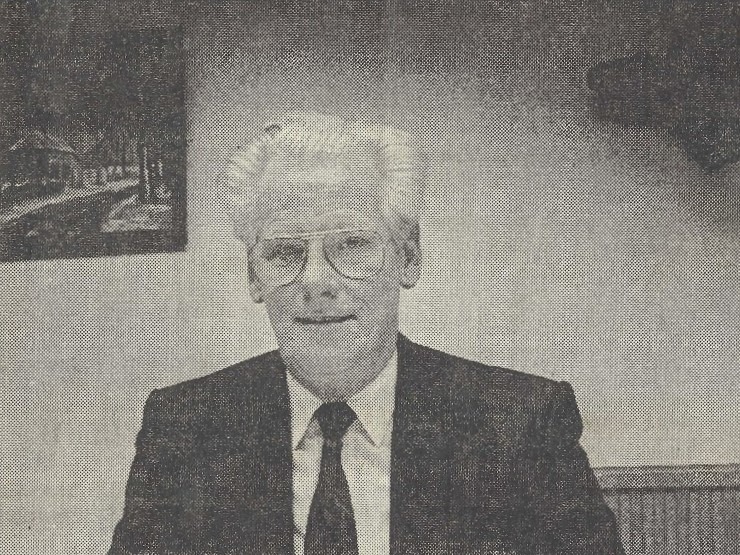
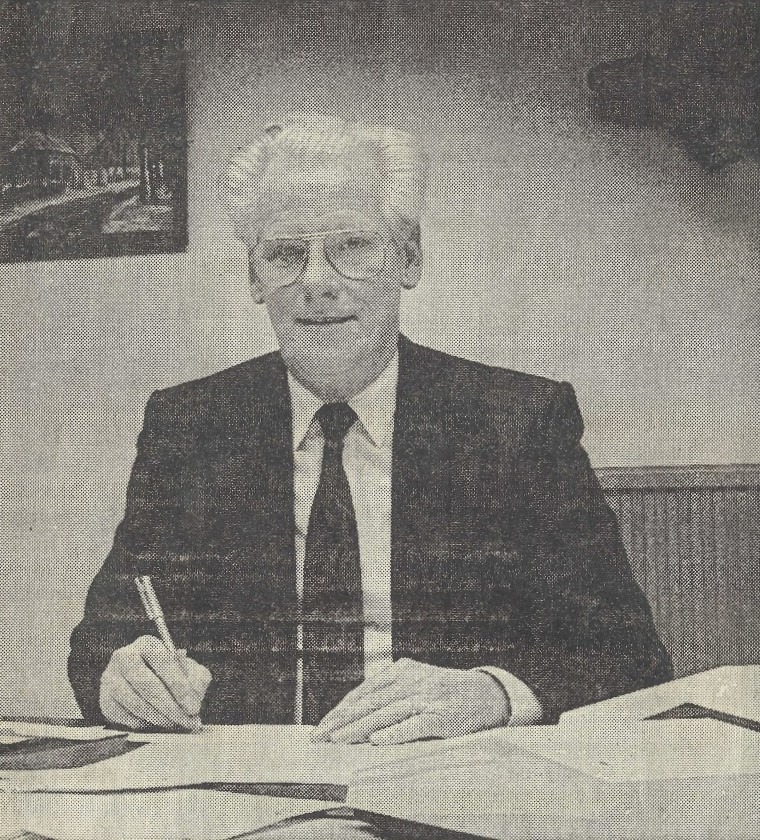
“Today, Mr. S. Douma officially retires from the public works department in Aalten. Thus far, Mr. Douma has been unwilling to be ‘persuaded’ to appear at the customary farewell gathering of the staff association. Out of modesty. With Mr. Douma, one of the most striking figures of the street scene is disappearing. He is particularly well-liked by the farming community. It was he, after all, who served the municipality of Aalten in the profession of rat-catcher.
However, this departure does not mean that the Aalten rats now have free rein. On the contrary, Mr. Douma is leaving everything behind except for the rats. For the time being, he will continue to handle this part of his duties at the request of the municipality. The hunt will likely become even more intensive, as the time is now available for it. The ‘rat-catcher’, who was in municipal service for over 30 years, has handled 1,172 pest control cases since the rat hunt began. How many rats he has killed is difficult to estimate, but it is certain that there are thousands. Mr. Douma hopes to add many more to that number.”
On Thursday, October 22, 1964, Douma, ‘the retired rat-catcher from Aalten’, was a guest on the NCRV radio program ‘Samen uit samen thuis’.
If you have more information or photos to supplement this article, please respond below or send us a message.
Several theories circulate regarding the origin of the name Aalten. But what are they based on and how credible are they? Old Aalten delved into history to discover more about this.
We begin with the oldest historical mentions of Aalten, as these may contain clues about the origin of the name. Next, we examine what toponomy (the study of place names) can teach us about this. We then discuss several theories regarding the origin and meaning of the name Aalten and conclude with our findings.
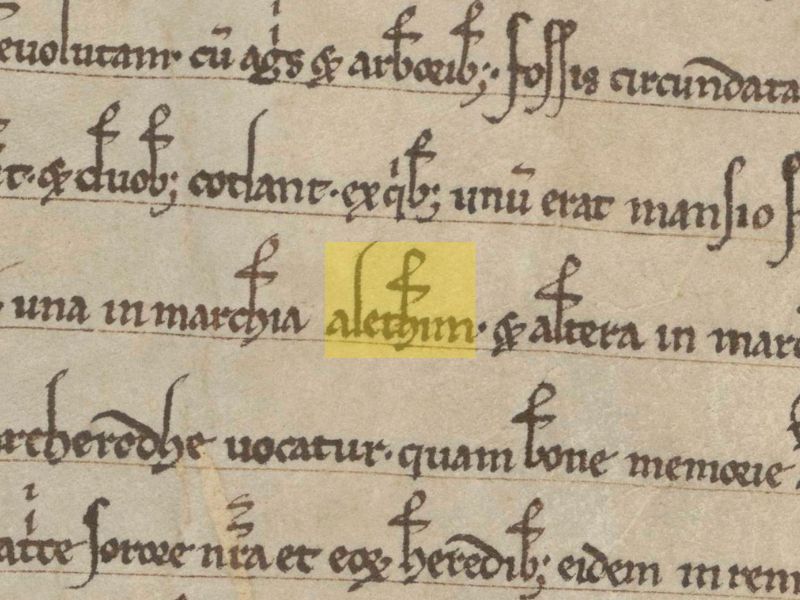
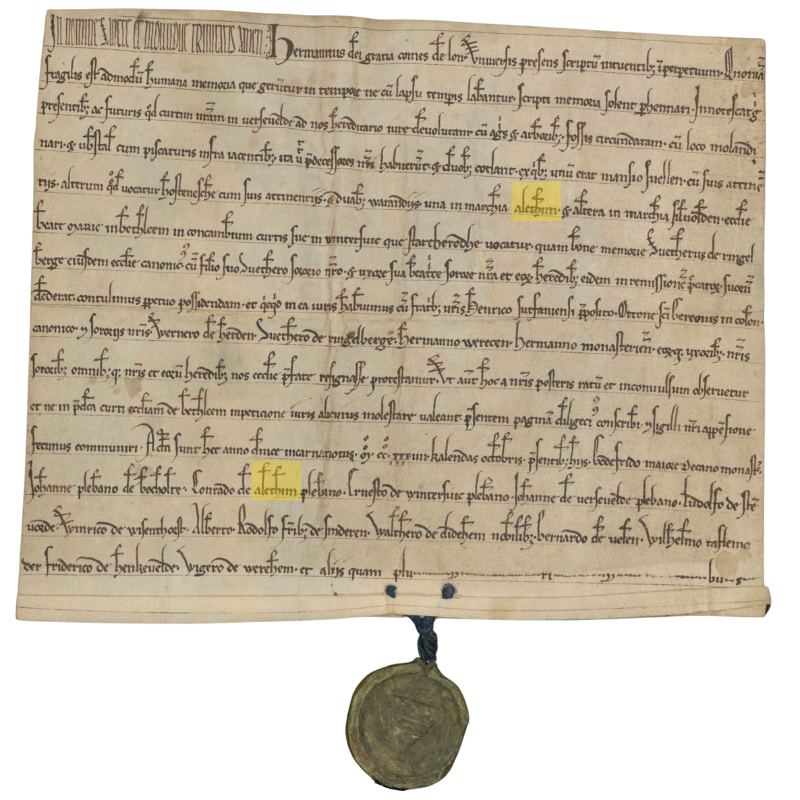
Deed from 1234, in which Aalten is mentioned twice as ‘Alethim’
Earliest mentions
There are several medieval documents containing a reference to Aalten, with varying spellings. The best-known mentions are Aladna and Aladon, after which the Aladnaweg and a school are named. Below is an overview of historical mentions, including a reference to the oldest known source.
828
A charter from 828 describes how a certain Geroward donated all his possessions, including those in Aladna, to the St. Martin’s Church in Utrecht on February 7 of that year. Little is known about Geroward’s identity, but he was presumably a Frankish nobleman in the service of the Carolingian Emperor Louis the Pious, son of Charlemagne.1
1138/ 1139
In 1138 or 1139, Godschalk of Versnevelde (Varsseveld), with the consent of his brother Count Gerhard (II) of Lohn, enters into an exchange agreement with the canons of the St. Mary’s Church in Rees. He transfers an estate in Megchelen near Gendringen, including associated hunting rights, two fields, a meadow, and nine serfsof both sexes. In exchange, he receives a property in Alethnin, with all yields and seven serfs.2
1152
In 1152, Count Godschalk (II) of Lohn, son of Gerhard II, reached a settlement with Bishop Frederick II of Münster. Godschalk claimed authority over the parishes of Lon, Winethereswik, Aladon, Versnevelde, Selehem, and Hengelo on the basis of his comital title. The bishop held a different view, after which it was formally established that Godschalk did not hold these territories in his own right, but was to administer them as a liegeman of the bishop.3
1188
In 1188, during the reign of the Holy Roman Emperor Frederick I, priest Everhardus, chaplain to Count Henry of Dalen and Diepenheim, compiled an inventory of Henry’s feudal (vassal) and allodial (free) possessions. The feudal properties were recorded under the parishes to which they belonged, including Ecberghe, Gronlo, Winterswic, Nehde, Ghesterne, Lochem, Almen, Dotinchem, Zelhem, and Althen.4
1234
In 1234, Count Herman (I) of Lohn, Lord of Bredevoort, together with his brothers Henry, provost of Zutphen, and Otto, canon of St. Gereon in Cologne, as well as his brothers-in-law Werner van Herden, Sweder van Ringelberg, Herman Werecen, Herman van Munster and their spouses, and all their further heirs, entered into an exchange with the Bethlehem Monastery. In this agreement, the monastery receives from the count, among other things: duabus warandiis, una in marchia Alethim et altera in marchia Silvolden (two hunting grounds; one in the mark of Aalten and the other in the mark of Silvolde). Witnesses include the parish priests Johannes from Bocholte, Conradus from Alethim, Ernestus from Winterswic, and Johannes from Versevelde.5
1254
In 1254, mention is made of the “curtis Grevinkhof sita in parochia Alethe“ (the estate Grevinkhof, situated in the parish of Aalten): Gotscalco de Reme receives from Otto van Loon in castle-fief the curtis Grevinkhof in Aalten, with the mill and further appurtenances, with the exception of the timber court. Present here Gerardus Canoninicus “frater domini G. de Reme”.6
1313
In a register of churches belonging to the Diocese of Münster from the year 1313, the following parishes, currently located in the Netherlands, are mentioned: Alten, Dinxperle, Eiberghe, Gheesteren, Grolle, Hengelo, Neede, Seelfwalde, Selehem, Versevelde and Wynterswik.7
1386
Derich Willemssoen van Lyntloe has been granted Varenvelde in parish Alten, sabbato na Briccii ep. (17 November) 1386.7
1409
Derk van Linteloe and his children Derk and Herman, declare to have sold to Johan Rensynck the estate ten Nygenhues, located in the hamlet of Lynteloe under Aelten and held in fief from the Lordship of Borculo, 1409 July 24 (in vigilia beati Jacobi apostoli maioris).8
Toponymy and sound development
Toponymy, or the study of place names, is a branch of linguistics that studies place names and seeks to explain their origins.9 A generally accepted principle within toponymy is that the sound development of a name is more reliable than its spelling, as written mentions in pre-modern times were inconsistent and influenced by scribes, dialects, and time-bound conventions. The sound of a name, by contrast, usually remains more consistent and therefore offers better insight into the original pronunciation and meaning.
Now, we are not toponymists, but when we view the sound development of the earliest mentions of Aalten chronologically, we believe we recognize a pattern:
For a period of four centuries (9th-13th century), these mentions consist of three syllables, starting with ‘ala’ or ‘ale’, followed by a d or t, and in most cases ending with an n. Although the spelling varies, the sound structure remains largely consistent. From the 13th/14th century onwards, we see that the second syllable gradually disappears and that the name corrupts into Althen/Alten/Aelten/Aalten.
Theories on origin and meaning
Below we discuss the best-known theories regarding the origin and meaning of the name Aalten.
Place on a hill
A frequently cited theory states that the name Aalten is derived from the Latin altus, meaning ‘height’. This explanation seems primarily based on the fact that Aalten originated on a hill and the phonetic similarity between altus and Aalten. However, there is no historical or linguistic evidence for this theory. Furthermore, this explanation does not take into account the sound development in the oldest known mentions of the name.
Homestead by the altar
Another theory suggests that Aalten was inhabited around 150 BC by Angles from the area that is now Berkelland. According to this explanation, the name is derived from the Anglian ael (altar, place of sacrifice) and thun (garden, enclosed yard). This would lead to Aelthun, or ‘homestead by the altar.’10 This explanation is also speculative and does not fit the sound pattern of the medieval mentions of the name.
Plant or tree name
In Gelderse plaatsnamen verklaard, Gerald van Berkel states that the name Aalten may be related to a plant or tree name and refers to the Old Norse alað (nourishment, food), aldin (edible tree fruit), or alda (fruit-bearing oak).11 Although there is no direct evidence for this explanation, it does fit the sound pattern of the medieval mentions.
Place by the water
In Prehistorische waternamen Maurits Gysseling suggests that the name Aalten is derived from the Indo-EuropeanAlatanā, meaning “situated in a bend of a stream”.12 In the case of Aalten, this would refer to the Slingebeek. Van Berkel, however, calls this theory far-fetched in Gelderse plaatsnamen verklaard.
Place name researcher Bas Kloens disagrees. In his study on place names and their origins, Valkuilen in de Plaatsnaamkunde, he states that it is actually “abundantly clear” that Aalten, like many other similar place names, owes its name to its location on a watercourse or stream.13
Conclusion
No single theory regarding the origin of the place name Aalten can be supported with hard evidence or completely ruled out. It remains, therefore, largely a matter of speculation. Nevertheless, we lean towards the theories of Gysseling and Kloens, who state that Aalten owes its name to its location on a watercourse, namely the Slingebeek.
Furthermore, despite Van Berkel’s skepticism, a connection with the Indo-European Alatanâ, which bears a strong resemblance to Aladna, seems plausible to us.
In short, although not scientifically proven, our nomination for the most plausible explanation for the origin and meaning of the name Aalten goes to Place by the water / situated in a bend of a stream.
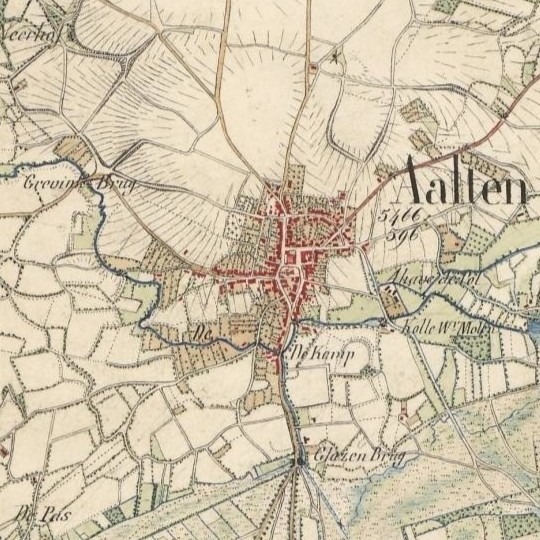
The village of Aalten, situated on a hill by the Slingebeek (fragment of a topographical map from 1845)
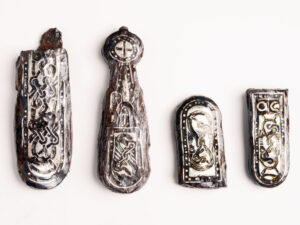
Archaeological finds indicate that the early inhabitants of Aalten were already burying their dead around 800 AD in a burial field on the current Damstraat. During excavation work in the late 19th and early 20th centuries, traces of a Merovingian-Frankish burial field were discovered there. Notable finds, such as spearheads, stirrups, a shield boss, and silver belt links, suggest that a warrior may have been buried here.
On De Hoven, traces of habitation from the same period have been found, consisting of various so-called sunken huts – rectangular pits that served as work or storage spaces. Pottery fragments found here correspond with the finds from the burial field on the Damstraat.
The Christianization of Aalten
Following the subjugation of the Saxons by Charlemagne around 785, the Christianization of Aalten and the surrounding area began. Missionary Liudger, later Bishop of Münster, played a significant role in the founding of churches in the region, presumably including the first church in Aalten.
This church, originally likely a simple wooden chapel, was founded on a strategic and symbolic site: the elevated location where the current Old St Helen’s Church stands today. This site became the religious and social center of the community.
Archaeological research has shown that the residents of De Hoven abandoned that site around the year 1000. It is possible that, after converting to Christianity, they decided to live closer to the recently founded church to enjoy the protection of the faith. From that time on, the deceased were also presumably buried in and around the church.
Churchyard
A churchyard developed around the church, which played an important role in the life of the community during the Middle Ages. The churchyard in Aalten was originally much larger than the current plot surrounding the Old St Helen’s Church. It served not only as a burial ground but also as a place for social and religious gatherings. In those days, people even lived around or on the churchyard, often officials such as sextons or clergy who were directly involved with the church.
In recent centuries, skeletal remains have been frequently encountered during excavation work in the ground around the church, such as on the Köstersbulte, the path along Elim, and also on the Kerkstraat, where buildings now stand. The original burial ground around the church was therefore much larger than the current site on which the church stands.
Until the 19th century, the deceased were primarily buried in and around the church. Burial inside the church itself was reserved for people of status, such as clergy, nobles, and benefactors. It was believed that a grave within the church guaranteed a better position in the afterlife. However, most people were buried in the churchyard surrounding the church. Individual tombstones were rare in the Middle Ages; many people were buried in unmarked graves.
Health Risks
However, burial inside the church brought significant problems. A lack of space and the decomposition of bodies led to health risks; churchyards became overcrowded, and the situation became untenable.
Subsidence in the floor occurred regularly within the church, and the owners of the respective graves often failed to carry out the necessary repairs. The odor of decay in the pews near the hole in question was sometimes unbearable for weeks, especially during the summer months.
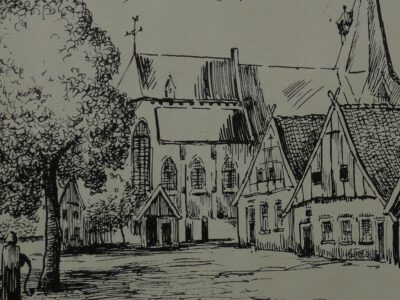
Aalten Market with church and ‘bone hall’, ca. 1740 – drawn by Piet te Lintum
Epidemics such as the plague exacerbated this problem. Consequently, a regulation was established stating that churchwardens, in cases of negligence, were permitted to contract out the necessary repairs, whereby the respective plot would revert to the church.
The condition of the burial ground around the church was also often poor. Because burials had not been conducted at a sufficient depth for a long time, bones frequently came to the surface. A bone collector would gather these remains from time to time, for two bushels of rye per year, and cast them into the bone hall (also known as a charnel house), a small building in the churchyard on the Market side. When the supply became too large, it was cleared away.
Royal Decree of 1827
In 1827, King William I decreed by law that, from 1829, cemeteries had to be established outside built-up areas. For many people, this was a major step—to break with all traditions and leave the dead outside the village “just anywhere in the ground.”
The practice of burial in and around the church symbolized an era in which religion, death, and community were closely intertwined. The ban on this practice was a turning point that not only benefited public health but also marked a shift in how death was handled: individual graves were given more space, more funerary monuments appeared, and cemeteries were landscaped.
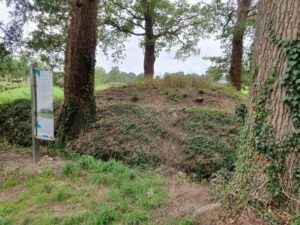
Christiaan Caspar Stumph, Mayor of Aalten since 1811, was annoyed by burials within the village. In 1818, he therefore had an ‘outside cemetery’ created for himself and his family on his estate, Het Smees. His son Abraham Anthony was the first to be buried here, followed by Stumph himself in 1820. In total, seven people rest on this unusual burial mound, which is still visible on the Nannielaantje in Aalten.
Following the royal decree of 1827, a site on the Varsseveldsestraatweg in Aalten was designated as a cemetery. Due to the growth of the village, this cemetery became increasingly enclosed by the early 20th century. In 1923, the Berkenhove cemetery was put into use. Although the Old Cemetery has since taken on the function of a memorial park, it is still sporadically used for the interment of the deceased in existing graves.
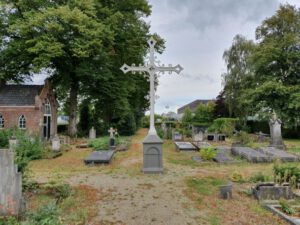
When the cemetery on the Varsseveldsestraatweg was established, the Catholic community was given its own section across the street, on the corner with the Molenstraat. This cemetery became full after only thirty years, after which a new Roman Catholic cemetery on the Piet Heinstraat was put into use in 1868. The small old cemetery later took on the function of a public green space.
On the Haartsestraat in Aalten, just outside the village, lies the Jewish cemetery of Aalten. Although the site officially became the property of the Jewish community in 1852, there are indications that the cemetery had been in use since approximately 1820. There are about seventy tombstones on the site, varying in age and design. At the entrance on the Haartsestraat stands a metaheer house, a ritual building used for the cleansing of the deceased according to Jewish traditions.
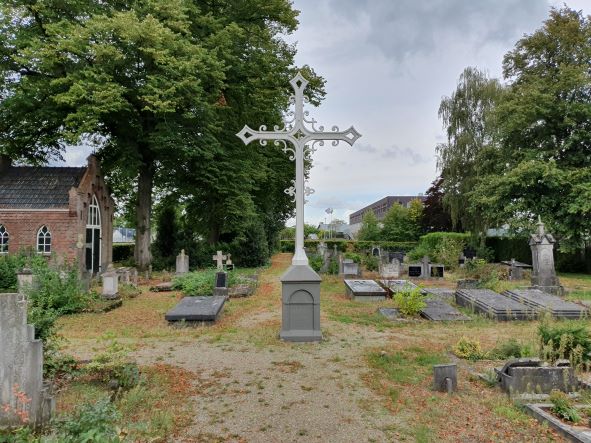
When the Catholic cemetery on the Varsseveldsestraatweg became full, textile manufacturer Anton Driessen donated a piece of land on the current Piet Heinstraat in 1868 to be laid out as a cemetery. He also donated an iron Calvary cross and an iron gate. The bier house dates from 1888. A century later, this cemetery also became full. From 1960 onwards, Catholic deceased were therefore buried in the new Roman Catholic section of the Berkenhove cemetery.
After the Old Cemetery on the Varsseveldsestraatweg became full, the ‘Berkenhove’ cemetery on the Romienendiek was put into use in 1923. The original section is enclosed between the Romienendiek, the Barloseweg, and the Koningsweg. Over the years, the cemetery has been regularly expanded. In 1960, a Catholic section was added because the Roman Catholic cemetery on the Piet Heinstraat was full. A modern funeral center and crematorium are located at Berkenhove.
The Old Cemetery on the Prins Mauritsstraat was established around 1830, simultaneously with the adjacent Jewish Cemetery. The site became available after the dismantling of the fortifications on the eastern side of the town. In 1925, a new entrance gate was installed, and a bier house was built a few years later.
Bredevoort once had two Jewish cemeteries. The oldest was located on the former castle grounds behind Hozenstraat 5. In 1953, this site was sold to the municipality of Aalten for housing construction. The remains and tombstones were then transferred to the second cemetery on the Prins Mauritsstraat.
The Jewish Cemetery on the Prins Mauritsstraat was established around 1830, simultaneously with the adjacent general cemetery. The last Bredevoort Jews to be interred in this cemetery were brother and sister Levi and Sara Sander. Both died in 1938, shortly after one another. The cemetery is not accessible to the public.
The Kloosterhof cemetery on the Kloosterdijk in Bredevoort was established in 1862-1863 and originally served as a Roman Catholic cemetery. The oldest, centrally located part has a symmetrical layout with a characteristic entrance gate, a bier house, and a Calvary cross. In the 1980s, the cemetery was expanded with a general section. A mortuary was also erected in 1989.
In 2011, Aalten made national headlines due to a remarkable story: a small religious community had settled at the Rensink farm in Lintelo, awaiting the Apocalypse. They called themselves the ‘Wachters van de Nacht’ (Watchers of the Night).
At their farm, they were preparing for survival during the end times. According to them, the Apocalypse would soon arrive with a tsunami, causing large parts of the Netherlands to be submerged underwater. Higher-lying Aalten would, as a result, find itself located on the coast.
Jokers posted satirical videos on YouTube in which Aalten-on-Sea was presented as a sunny seaside resort, where the local retail sector had effortlessly adapted to the demand for beach entertainment. However, according to the Watchers themselves, anyone who ignored their warnings would have to face the consequences. A drowning death awaited them. In the meantime, the Watchers stocked up on large food supplies for the refugees they expected to arrive from the Randstad (the major urban area in the west of the Netherlands).
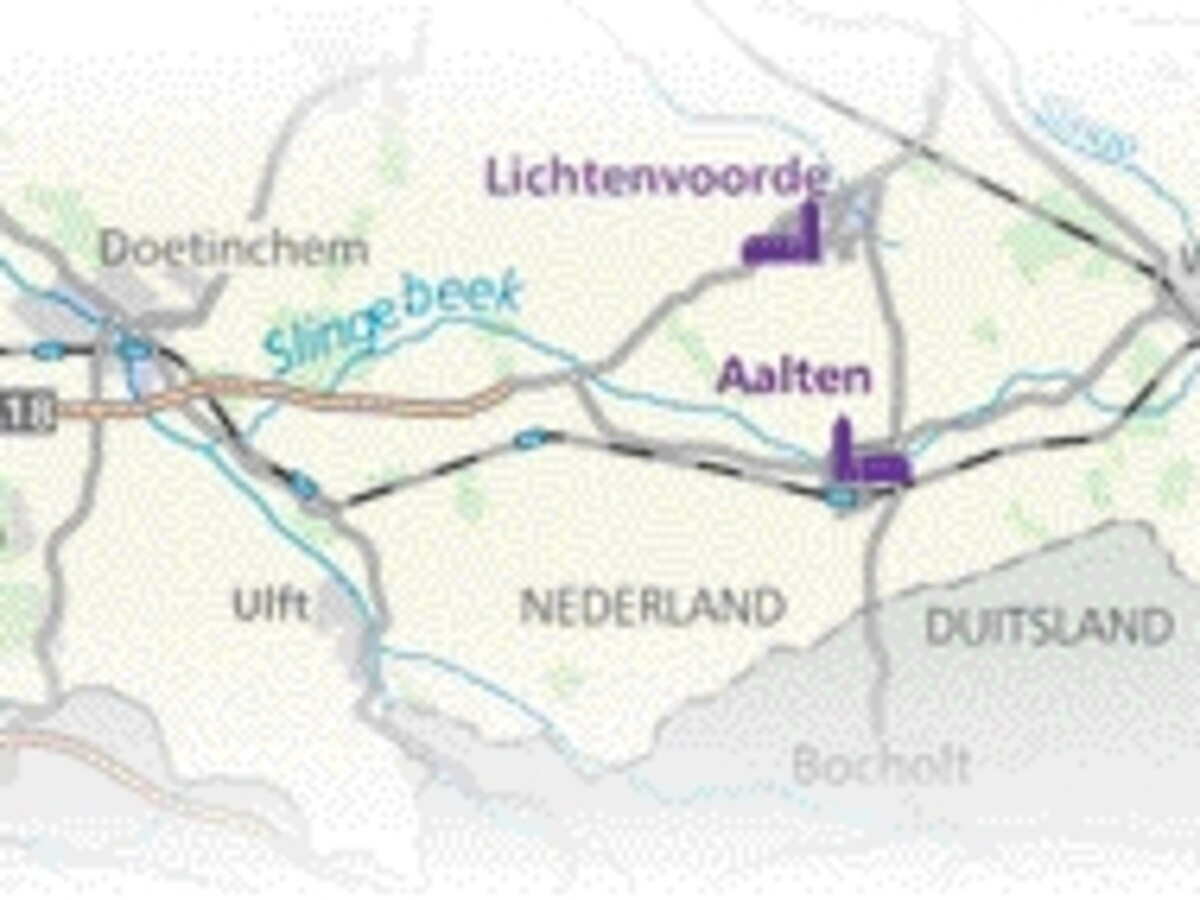
Two neighboring villages: one Catholic, the other Protestant. Does rivalry still exist? Trouw investigates. Today part 2: Aalten and Lichtenvoorde. Aalten is known as the ‘Jerusalem of the Achterhoek’ thanks to its many Reformed churches. Neighboring Lichtenvoorde, by contrast, lies in a Roman Catholic enclave.
Achterhoekers are not known for being pedantic. Except in Aalten. Those terraces on the Market in front of the Old St Helen’s Church? “That would have been considered blasphemy in Aalten in the past,” says Hans de Graaf. He was born in 1943 into a Roman Catholic family in neighboring Bredevoort. He has lived and attended church in Aalten for years. “As a child, you felt like you were a second-class citizen,” he recalls.
In the 1950s and 60s, Protestants dominated Aalten, divided into ‘de fienen’ (the fine) and ‘de groffen’ (the coarse). The Dutch Reformed were not as strict. They lived Biblically according to the ‘coarse’ line. The seceded Reformed, numerous in Aalten, however, followed orthodox dogmatics with ‘fine’ precision.
Jerusalem of the Achterhoek
‘Fienen’. You pronounce it with a long, drawn-out ‘ie’. Frits van Lochem does so too. In 1946, he was born into a Dutch Reformed family in Roman Catholic Lichtenvoorde, eight kilometers from Aalten. Between the two villages lies a rolling no-man’s-land. If you speak of Aalten in Lichtenvoorde, the conversation quickly turns to ‘those fienen’ and ‘the Jerusalem of the Achterhoek’. “We are more oriented towards Groenlo,” says Van Lochem.
A folk faith prevails in the Achterhoek. In daily life, it does not matter whether your ancestors remained Roman Catholic or eventually converted to Protestantism. The Achterhoek tradition of naoberschap (neighborliness) transcends the dogmas of Rome and Protestant synods. The area is divided like a checkerboard pattern into villages with slightly more Roman Catholics and those with slightly more Protestants.
Neighboring enclaves
Two neighboring enclaves form a major exception: the Reformed Aalten and the Roman Catholic strongholds of Groenlo and Lichtenvoorde. How did this come to be and what is their relationship? Hans de Graaf and Frits van Lochem can draw from their experiences as members of a religious minority. They do not know each other. Yet they once cycled past each other daily—one on the way to the Protestant secondary school in Aalten, the other to the Roman Catholic one in Lichtenvoorde.
The Johanneskerk (PKN) of Lichtenvoorde
Van Lochem enjoys being active for the community. He was once an alderman in Lichtenvoorde before the municipality merged with Groenlo to become Oost Gelre. Now he manages the administration of the Johanneskerk. As a Reformed boy, he had a pleasant childhood, he says. “Of course, you had a Protestant and a Roman Catholic school,” he says. “For secondary education, you had to go to Aalten. You simply went to a school of your own religion.”
For a time, there was a separate Protestant football club and gymnastics association. The Protestant drum band did not play at Lichtenvoorde festivities on Sundays, he remembers. But in Lichtenvoorde, where 90 percent of the people were Roman Catholic, people interacted normally. “My father was an upholsterer,” says Van Lochem. “The monastery was an important client. He wouldn’t have earned a living from Protestants alone.”
Protestants ‘determined everything’
As easily as the people of Lichtenvoorde bridged the pillarized differences, the dividing lines in Aalten must have been difficult. “Very little was allowed,” says De Graaf. “Dancing was impossible. As Roman Catholics, we had our own youth club. Many marriages resulted from that. You thought in the 1950s: those Protestants determine everything here. And then the swimming pool issue arose. A massive row! People cut open the barbed wire around the pool to be able to swim on Sundays. Nowadays, everything is different. A worldly wind blows through Aalten. Still.”
Lichtenvoorde and Groenlo were synonymous with a pleasant life for a Roman Catholic boy from Aalten. “There were the assembly days and the processions,” De Graaf remembers. Lichtenvoorde is frivolous with its flower parade, and Groenlo is known for its carnival. But for him, those places remained far away. In Aalten, during his youth, about 18 percent of the people were Roman Catholic. The Reformed identity weighed on everyone. The Roman Catholicism of ‘the enclave Groenlo and Lichtenvoorde’ was the subject of study for history teacher Thielen from Boxtel in 1966. Two developments explain how an enclave could arise, according to his book on ‘the enclave’.
Religious struggle
The struggle between the dioceses of Utrecht and Münster for control over this region lasted until 1823. The Bishop of Münster asserted himself quite strongly in the eastern Netherlands. Furthermore, around 1600, the Achterhoek had been the battlefield between the State armies of the House of Orange and the Spanish rulers. That struggle had left its religious marks.
In 1597, the army of Prince Maurice conquered the towns of Bredevoort and Groenlo from the Spaniards on behalf of the (Protestant) States-General in The Hague. But in 1606, the ‘States’ lost the fortress again. Although Prince Frederick Henry recaptured Groenlo in 1627, he could no longer win over most of the inhabitants to Protestantism. The Roman Catholic movement of the Counter-Reformation had taken root there. Nearby Lichtenvoorde, which had its own chapel since 1496, also remained loyal to Rome. And Münster.
Monumental
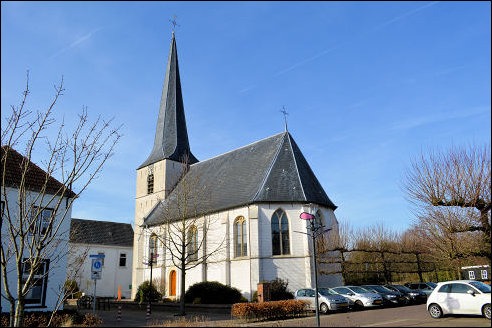
Frits van Lochem shows the white-plastered Johanneskerk from 1648. It is monumental. The church stands on the foundations of the Roman Catholic chapel from 1496. “It is one of the oldest Protestant churches in the Netherlands,” he says. The chapel fell into the hands of the Dutch Reformed minority after 1627, who were aligned with the new State authority. They wanted a less dilapidated house of worship. “Collections were held throughout the country for this church,” says Van Lochem. “Frederick Henry also paid. Donations came from as far as Amsterdam and its surroundings.”
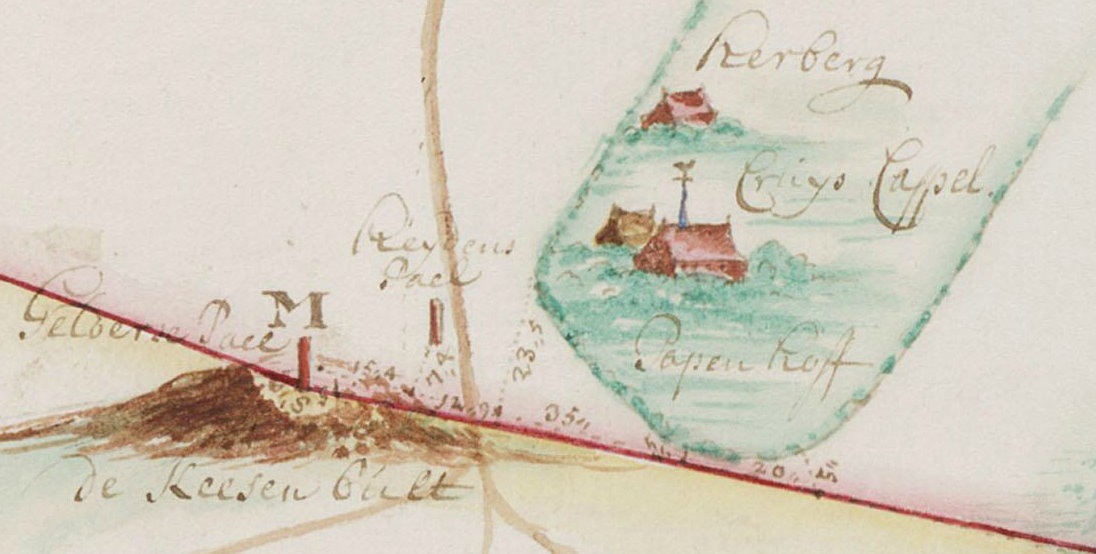
Old map with the Cross Chapel at Hemden, just across the border near Aalten
The Roman Catholics who remained in large numbers in Groenlo and Lichtenvoorde, as well as an Aalten minority, became dependent on the Kreuzkapellen (Cross Chapels) that were built in border villages like Zwillbrock, Hemden, and near the city of Bocholt. The ‘papists’ walked to the border of the Republic with the Münsterland. But in large parts of the Achterhoek, including Aalten, the priest suddenly became a minister and solemnly renounced all Roman ‘superstitions’. His flock then became Protestant as well, though not immediately with full conviction.
The nature of the Achterhoeker
The nature of the Achterhoeker is, as Reformed minister J.H. Jansen wrote in 1957, seemingly quite easy-going. They tend to wait and see, he stated in a sociological study of religious life in the Achterhoek. The community takes precedence over the individual, he observed. Scribe Flip de Bruijn of the Protestant Congregation of Lichtenvoorde can still identify with that observation in 2010. “The community here is so interwoven and there are so many mixed marriages,” he says. “There are no sharp contrasts. People accept each other without conflict.”
What then makes Aalten such an exception? In 1845, following the example of the Groningen minister De Cock, a portion of the Dutch Reformed in Aalten seceded. Subsequently, the Doleantie (1886-1892) found resonance in the Achterhoek, particularly in Aalten. From both schisms, the village gained the Christian Reformed and the Reformed Church. “The cause was that a beloved preacher ‘went along’ and was deposed by the classical board,” Jansen explained regarding the Doleantie in Aalten. “He took many families with him.”
Ecclesiastical diversity
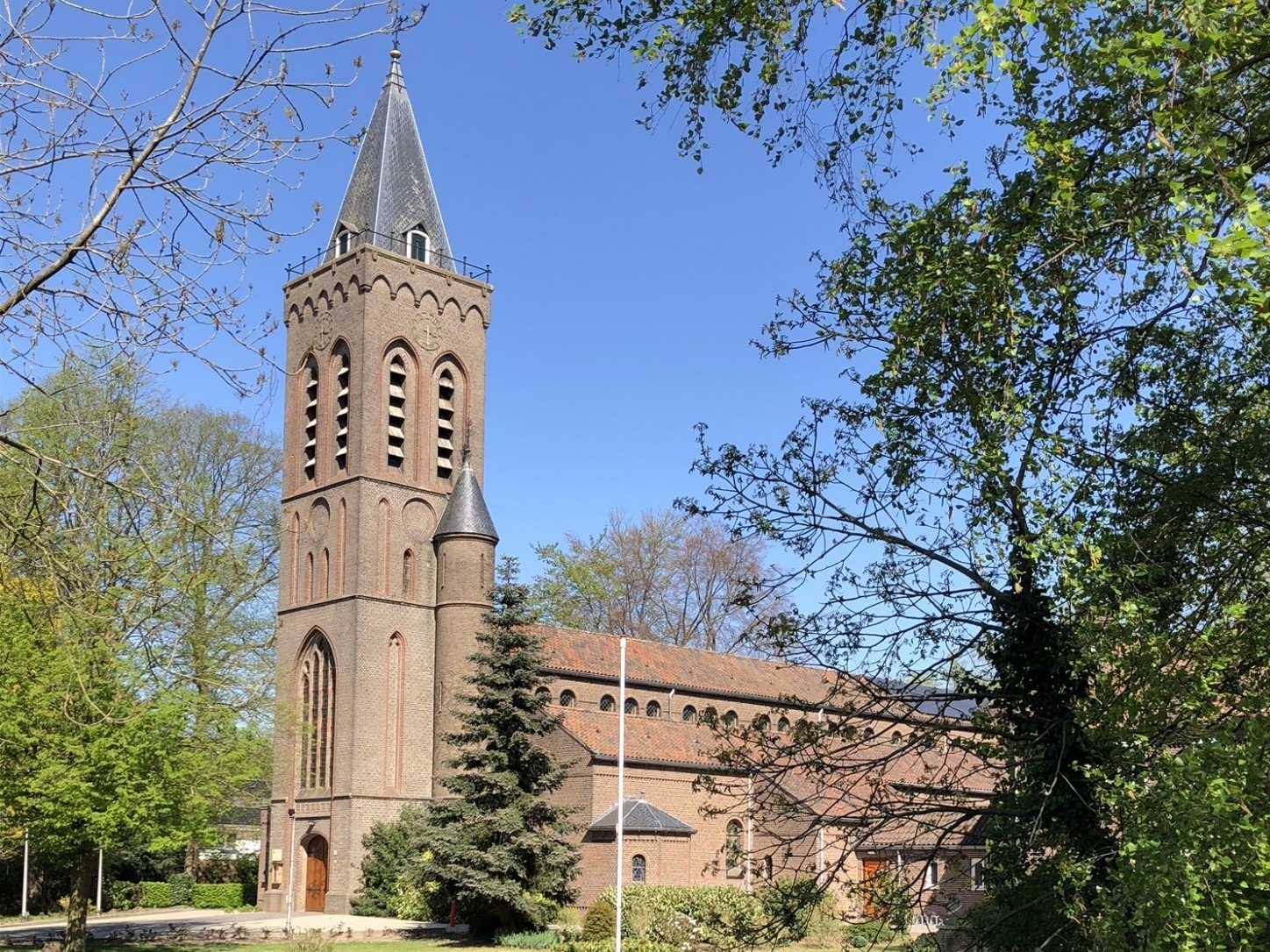
The Roman Catholic St Helen’s Church in Aalten
Most Achterhoek Protestants remained mildly Dutch Reformed. Aalten possesses an orthodoxy that now fits better with the ChristianUnion than the SGP. Members of the Reformed Association or the Restored Reformed are scarce in the Achterhoek, and the Reformed Congregations even more so. But the growing religious differences between Aalten and the rest of the region led to the nickname ‘Jerusalem of the Achterhoek’.
Hans de Graaf is familiar with that nickname. “What do they mean by it?” he wonders. If it refers to the ecclesiastical diversity of Aalten, he can imagine it. He himself delved into the Roman Catholic church history of the region. Aalten owes the survival of its Roman Catholic community to the arrival of the spinning and weaving mill of the German Driessen family in the nineteenth century, he is firmly convinced. “Our church community stands on the shoulders of a small group of pioneers,” he says.
Change
Anyone driving into Aalten today is alerted by black billboards on the access road to the fact that ‘God is love’ and that ‘He loves you too’. In the village, you will find a unique church: a bilingual evangelical congregation for Germans and Dutch people known as the Euregiokerk. ‘Two nations, one faith’ reads the large text on the facade of the formerly Reformed Westerkerk.
Hans de Graaf notices that Aalten is changing. “You can now easily organize something on a Sunday,” he says. “That is no longer an obstacle.” What has remained is the non-relationship with Lichtenvoorde. “The Aalten community does not look to the north,” he says. Yet, ecclesiastically, that will now be necessary. The Diocese of Utrecht recently merged nine parishes into one, so that Aalten now belongs with Lichtenvoorde and Groenlo. The Ludger Parish.
“As Roman Catholics in Aalten, we have a strong self-awareness,” says De Graaf. “That stems from the idea: ‘we are still here too!’ The small Catholic pillar made itself clearly heard in society. In Lichtenvoorde, almost everyone is Catholic. There is a different attitude there.” De Graaf misses that resilience in the large parish. He is taking on new projects himself. Together with Catholics and Protestants, he is developing a walking route from Zutphen to Münster, following in the footsteps of the ninth-century evangelist Ludger. After all, he brought the gospel to all Achterhoekers, didn’t he?
Ecumenism
It is a language that Frits van Lochem and Flip de Bruijn in Roman Catholic Lichtenvoorde would understand. To their great regret, the once lively ecumenical tradition is disappearing there. Less and less is done together. “Ecumenism is fading,” says De Bruijn. “We want to. But Rome does not prioritize ecumenism. Now that the parishes have been merged, you notice there is less time for it.”
Modern life in Lichtenvoorde largely exists without church attendance. On Sundays, you can shop there peacefully. Residents even shrug their shoulders at the Sunday opening of the supermarket, Van Lochem notes. No one here thinks of Aalten. There is more rivalry and at the same time kinship with ‘d’n Grolschen’ (Groenlo). The Protestant Congregation of Lichtenvoorde is now also looking in that direction for closer cooperation with the Dutch Reformed. “No, there are no ecclesiastical contacts with Aalten,” says De Bruijn.
There is little affinity with Protestant orthodoxy in Lichtenvoorde. Yet it is precisely those believers from Lichtenvoorde who want to work the Achterhoek, an ‘ecclesiastical white spot’, through their Christian bookstore ‘Licht’. It is closed today. “That belongs to the Reformed-Liberated, doesn’t it?” De Bruijn and Van Lochem ask each other. “They aren’t from here. They probably think there’s some evangelizing to be done here.”
‘Keislöppers’ and ‘de fienen’
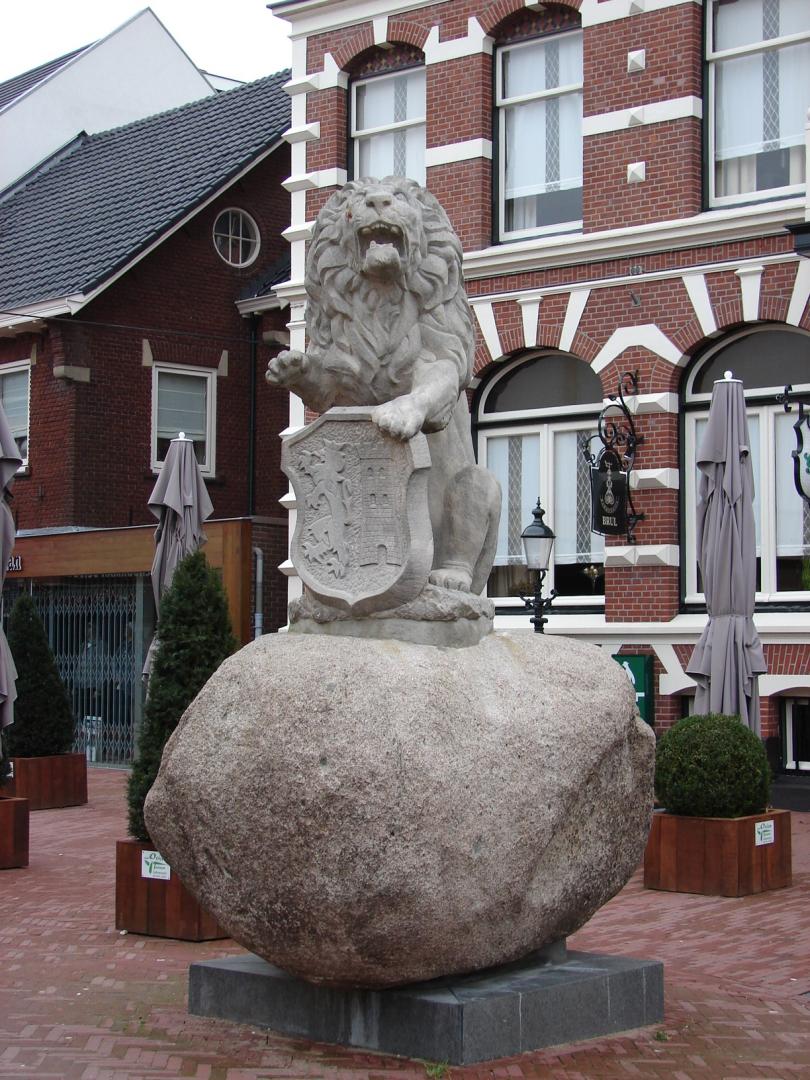
The boulder with the lion statue on the Market of Lichtenvoorde (photo: achterhoek.nl)
Lichtenvoorde is traditionally Roman Catholic. In 1496, the Lord of Bronckhorst founded a chapel there. On its foundations, the few Protestants built a new church in 1648 with ‘State funds’. In the nineteenth century, the town (now 13,000 inhabitants) received many migrant workers from Brabant for work in the shoe industry. To honor King William III’s 25th anniversary in office in 1874, these Roman Catholic shoemakers dragged a 20,000-kilogram boulder to the center and decorated it with a proud lion. They earned the people of Lichtenvoorde the nickname ‘keislöppers’ (boulder draggers).
Aalten grew over the past century from a small village into a central town with nearly 13,000 inhabitants. Since the nineteenth century, Aalten distinguished itself through church secessions that were almost non-existent elsewhere in the Achterhoek. Many proved sensitive to a more ‘fine’ (fijnzinniger), Reformed faith, which earned the people of Aalten the nickname ‘de fienen’. The village still has a relatively large number of Protestant and Evangelical churches. The ecclesiastical variety on such a small scale is unique in this border region. This gave Aalten the name ‘the Jerusalem of the Achterhoek’.
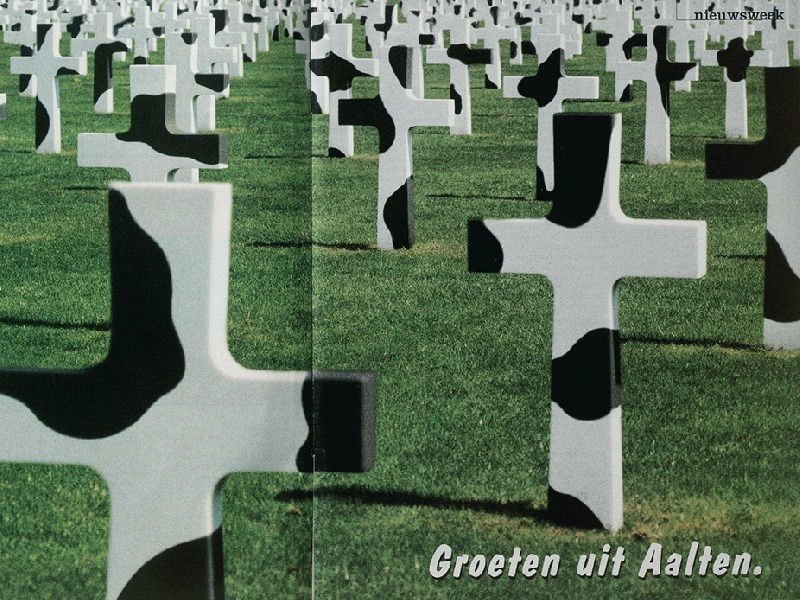
On 11 April 1996, Aalten was briefly global news. At the Kropveld-Schipstal Aalten (KSA) abattoir, 64,000 British calves were to be culled. This was carried out by order of the Ministry of Agriculture due to the potential contamination with ‘mad cow disease’, or BSE.
Never before in Dutch history had calves been transported to the abattoir with such spectacle as the first 108 head of cattle brought to Aalten from the Veluwe that day. The operation, which was to last six weeks, caused a great stir in the Netherlands and beyond.
For KSA, the slaughter of the 64,000 calves was a massive, and certainly financially attractive, job. The company normally slaughtered 2,000 calves weekly for the Japanese market. Those operations were suspended for six weeks for this special commission, during which approximately 10,000 calves had to be slaughtered per week.
Image: KesselsKramer, Amsterdam
Demonstrations
The lorries in which the animals made their way to the slaughterhouse were escorted by two riot police control vehicles. Upon arrival at KSA, they were met by a crowd of activists and curious onlookers. Members of animal welfare organisations, such as the Vegetarian Association, Lekker Dier, and PETA, had taken up positions at the abattoir fence with banners and sandwich boards. A funeral wreath hung on the metal gate, wooden crosses lay on the street, and the protesters wore black clothing.
As the first three lorry combinations carrying calves approached the iron gate of KSA, the jeering of the crowd swelled. “Murderers, murderers”, chanted a motley mixture of animal rights activists and local teenagers towards the drivers. Half a minute later, the gate slammed shut again. The slaughter could begin.
The private security service hired by the KSA management after a bomb threat had been received at the company the day before ensured that none of the protesters could enter the abattoir grounds. When the gate was closed again, a young PETA sympathiser collapsed and gave free rein to her tears. A group of locals reacted indifferently to the silent grief. Pointing at the piercing the girl had had placed through her lower lip, a corpulent Aalten resident lisped: “A piece of rope through that ring and she wouldn’t look out of place among those calves…”
Press conference
On the day of the arrival of the first British calves, a press centre was set up in café De Driesprong. Mayor Tijme Bouwers presided over the press conference. The municipality of Aalten provided logistical measures to clear the way for the dozens of lorries delivering thousands of calves daily. KSA director H. Swinkels emphasised that stringent safety measures had been taken regarding the potential risks of contamination.
To see for themselves that the slaughter was painless for the animals and, due to the measures taken, risk-free for the staff, journalists were allowed a look inside the abattoir later that afternoon. Wearing special overalls that were destroyed after use, the tour led past the slaughter hall and the specially refrigerated storage silos for the blood. This viscous mass—a total of 450,000 litres—was transported by tanker to Rotterdam to be incinerated. The carcasses were sent daily in sealed containers to companies in Son and the Frisian town of Bergum.
After a number of hectic days, peace returned to Aalten.
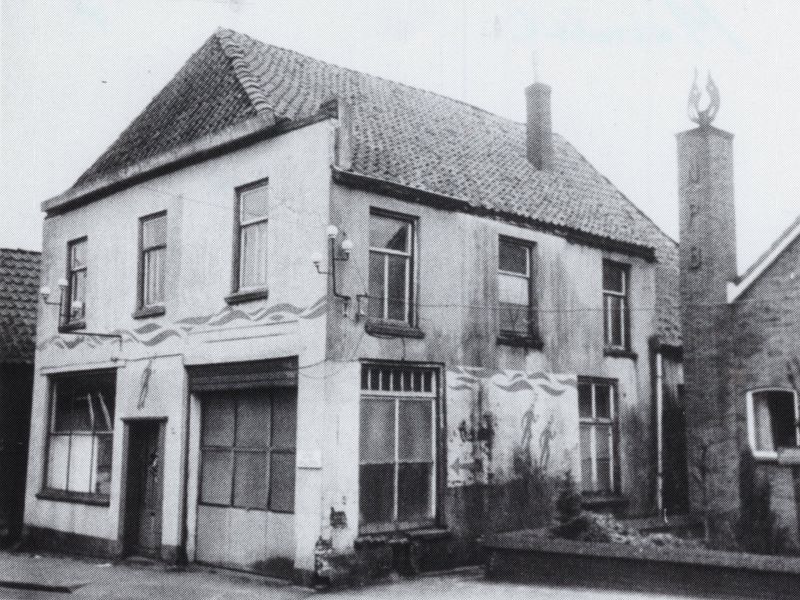
The old house in Prinsenstraat, next to the building of the Dutch Protestant Union (Nederlandse Protestantenbond), has been demolished. It was a very old house that had seen a great deal of joy and sorrow. It stood somewhat askew in relation to the street. One corner of the property stood more than half a metre closer to the street than the corner opposite it.
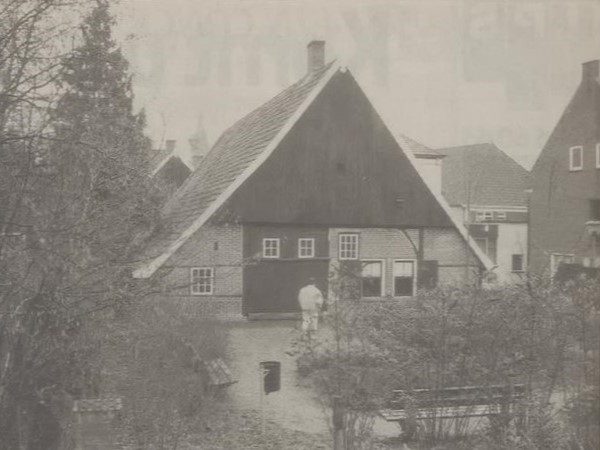
The old house was later extended with an additional storey and demolished in 1989. (Photo: H. ten Dam).
Now, a new building has taken its place. The street has undoubtedly taken on a more attractive appearance due to this redevelopment. The old house was in a state of severe disrepair. It must have stood there for around two centuries and was occupied by the Manschot blacksmith family from the end of the eighteenth century onwards.
Jacob Manschot and his family lived there in Achterstraat, which was then number 193. His wife, Elizabet Arentzen, was a sister of Roelof Arentzen, who later became the assessor of Aalten. Their son Gerrit Willem, born in 1802 and addressed in daily life by his second name, learned the blacksmith’s trade from his father at an early age and subsequently joined his father in the smithy. An older son in the family, Hendrik Jan, who was also a blacksmith, had a smithy elsewhere in the village.1 Then there was also a daughter named Elisabeth.
Double wedding
On 17 December 1833, celebrations took place in the house. Son Willem married Johanna Geertruijt Becking, known simply as Janna. Elisabeth also entered into marriage on that same day, wedding B.D.G. Muller. Muller was a merchant, and his trade was extensive. In addition to drapery and haberdashery, it encompassed grain, paint, hardware, religious books, musical instruments, hay, and straw.
Apart from the Manschot family, the Beckings and Mullers were also related to the most prominent residents, who, as assessors, municipal tax collectors, or “co-judges”, were able to exert a great deal of influence.
Schaars’s inn
Elisabeth left the house on Achterstraat, and Janna moved in with her parents-in-law. It was then number 228. Janna Becking was born on 24 November 1809. She was a daughter of Lourens Becking, a farmer originally from Varsseveld, and Willemina Geertruijd Schaars, the daughter of an Aalten innkeeper. Following his marriage in 1799, Lourens Becking had become the innkeeper there.
Schaars’s inn was located at the beginning of Peperstraat, on the corner of the Markt. It was run by a member of the Schaars family as early as 1748 and currently, after nearly two hundred and fifty years, still serves the very same purpose. Janna grew up there. She would have attended the village school next to the church, where schoolmaster Schotman taught.
Church organists
As mentioned, Jacob Manschot was a blacksmith, but on Sundays, he played the organ during services in the church on the Markt. When the Zelhem congregation had to appoint a new organist in 1829, Jacob was appointed to act as a judge. He had to assess the playing of the three applicants. In his report on the matter, he wrote: “…having given each of them the same Psalm and hymn, it appeared to me that the last to play possesses the greatest aptitude. Done at Zelhem the 24th of July 1829. J. Manschot”.
However, by 1842, he wished to step down, being 73 years old by then. In a petition to King Willem II, he requested that his son Gerrit Willem succeed him as organist. From that time onward, Willem Manschot served as the organist.
The family
Joy and sorrow alternated in the lives of Willem and Janna. Their eldest infant son, Jacob, passed away at the age of two. Their eldest daughter, Louiza, had been born in 1836. Elisabeth (Betje) followed in 1838. Two years later, Willemina Geertruijda (Mina) saw the light of day, and in 1842, a son followed who was again given the name Jacob. In 1844, Hendrika Johanna (Heintje) was born, and in 1847, Hendrik Jan, who was addressed by his second name. The youngest was Barend Johannis in 1850, or Bernard in daily life. Janna’s father had already passed away in 1830, prior to her marriage. Her mother survived her husband by twelve years and died in 1842.
When grandfather Jacob turned 78, his ten-year-old granddaughter Louiza came to him with a poem: “To greet you with my prayers, On this joyful day of today. Day on which it is your birthday, Grandfather, to me so dear and valued! Day on which I must reflect, What Heaven continued to grant me In possessing you, who always Stands by my side so affectionately.” The verse continued for a bit longer, followed by the signature: “Your loving Granddaughter Louiza”.
The girl also composed a poem on the occasion of her mother’s birthday: “Oh what a joy, dear Mother, Since today is your birthday. Grateful to the Preserver of All, I am gladdened on this day.” This daughter also knew how to express her wishes in poetic form for the New Year, composing a “New Year’s Wish to our highly esteemed Grandfather and dear Parents”. She decorated her wishes with borders of vines, flowers, garlands, or ornaments.
The elderly Jacob Manschot passed away in 1850 at the age of 82, after having been a widower for six years. Willem’s brother had also died by that time.
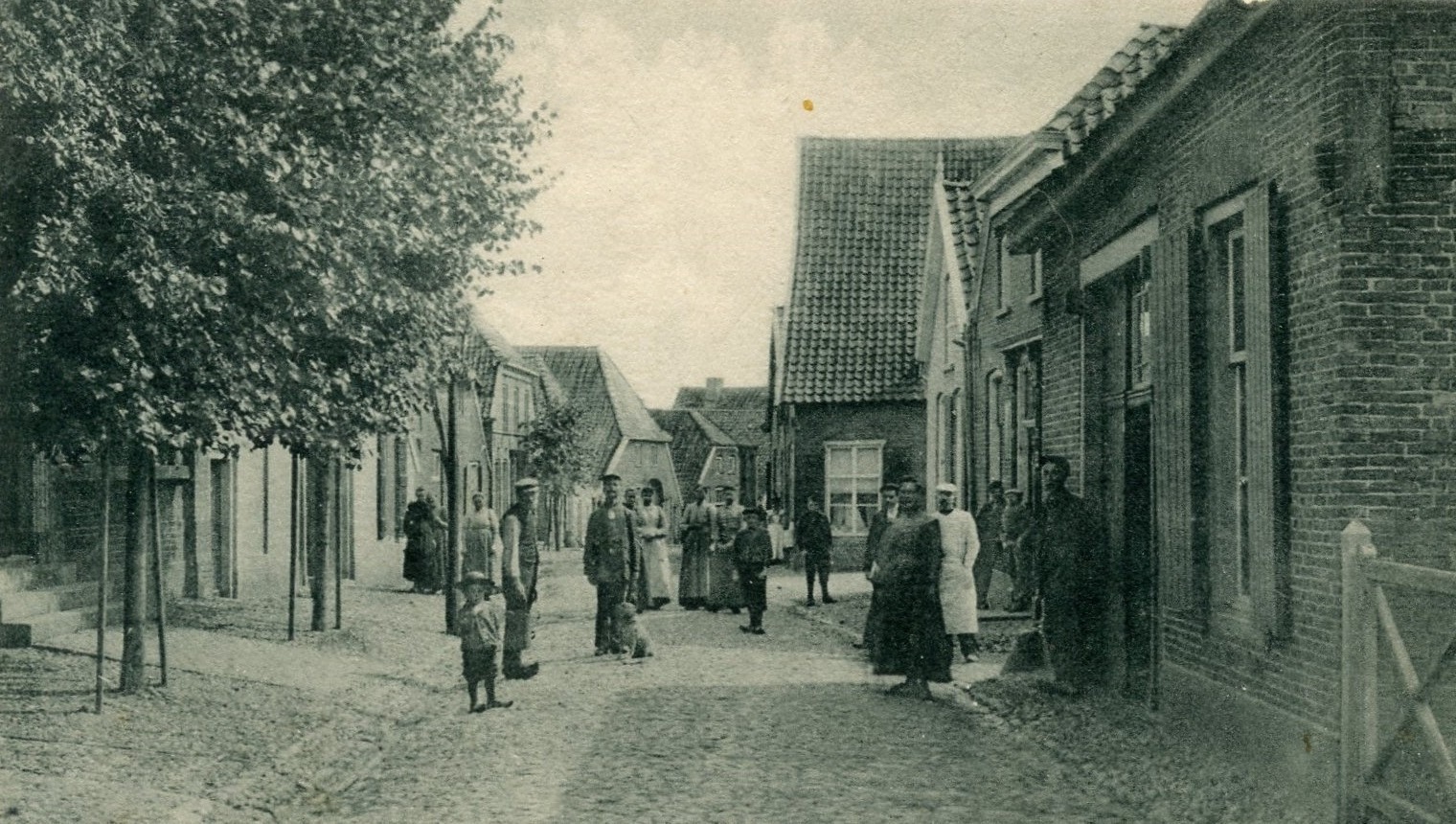
At the time the Manschots lived in Achterstraat, the house had a pointed roof. (Collection: E.M. Smilda).
Willem’s smithy
Willem Manschot dedicated himself diligently to his work in the smithy. For Kobus Prins, he made “a blade for the hoe”. He forged a “haar”, which is a small anvil used to sharpen a scythe or sickle, known as a haarspit. He made a “grepe” (manure fork), repaired the “rear axle of a wagon”, and fitted iron bands around the rims of wagon wheels. He delivered a “knife for cutting bread”, riveted “an iron onto a plate at the hearth”, and manufactured “an oven door” for L. Prins.
In between all these blacksmith duties, Willem also managed his property portfolio of lands and farms, which he leased out. Repairs had to be carried out there from time to time as well. In one place, “4 brass handles with their fittings” were installed; in another, the “latch was repaired, and a new plate bolt with a new catch” was made for the windows.
Sometimes customers paid him in kind, such as Kobus Prins who, for the benefit of Willem’s livestock, collected a few loads of hay from the Ruiterij, the pasture near De Pol. Others transported the harvested rye “from the Esch”. For Willem also ran a small farming operation of his own and owned a barn for his livestock on the opposite side of the street. Like every resident, he kept one or two cows; those of lesser means kept a goat, ‘the poor man’s cow’. In the slaughter month, a home-fattened pig would be hung on a ladder, which a day later was cut into pieces and placed into the salting tub, and even later hung from the kitchen ceiling, the ‘wieme’ (bacon rack). For the daily chores associated with this, he likely employed a farmhand or day labourer. Well-to-do citizens also kept a horse and had a carriage as a means of transport when going visiting.
Horses were no strangers to Willem either. How many had he not provided with new horseshoes in his smithy. Yet on one occasion, this proved fatal to him when he was kicked by a horse. The blow hit very hard. Severely injured, he was placed into his box bed in an unconscious state. His wife nursed him for two weeks, after which he died. Janna had become a widow, the children fatherless, and the church council had to look for a new organist.
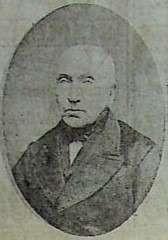
The blacksmith and church organist G. Willem Manschot, who died in 1853 following a blow from a horse. (Collection: H. ten Dam).
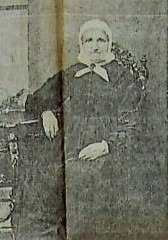
J.G. (Janna) Manschot-Becking (1809-1892) lived in Achterstraat for nearly sixty years. (Collection: H. ten Dam).
Extensive possessions
Now Janna suddenly stood alone with her seven, still young children. The eldest daughter, Louiza, was only seventeen years old, and little Bernard was just three. Initially, attempts were made to keep the business running with the help of a journeyman, but this proved impossible. Janna was forced to close the smithy.
It was fortunate that there were substantial property holdings. This enabled her to provide for her livelihood from the income they generated, and furthermore, to pay for her children’s education. None of the boys had been in a position to learn the blacksmith’s trade from their father. Consequently, this profession never occurred in the family again.
Since the passing of her husband, Janna kept the accounts for the leased lands and smallholdings. She maintained these records in a folio-sized “Land Lease” (Landhuur) book. In it, the lands were categorised into garden land, arable land, pasture, and uncultivated plots.
Garden land for vegetable plots
By garden land (hofland), Janna meant the relatively small plots situated close to the village that were used as vegetable gardens. In her accounts, she notes the names of plots, some of which are still known today. Most pieces of the garden land were divided into various parcels, and each parcel had its tenant.
There were four parcels on the “Boskerhof”. This may have been near ’t Boske, at the end of Richterinkstraat and on Varsseveldsestraatweg. The plot in “den Kraayenboom” likewise consisted of four parcels. That name is still known today for the land opposite the agricultural school on Lijsterbeslaan. Hendrik Jan Meinen was a tenant for ƒ 3.50, as was Lammert Prange. Willem Kasseler and Lammert Klompenhouwer clearly had a smaller piece, as they paid ƒ 2.00 and ƒ 1.50 respectively. Later, Janna used a garden there herself, as did Willem Huls, Mrs Hoftijzer, and Abraham ten Dam.
Then mention is made of the Knibbelweide, which must have been located on the Kemena. There were six parcels there. The total yield from this was ƒ 14.20 per year, though this had risen to ƒ 19.70 after 1883. Furthermore, there was a parcel in the Paardeweide leased by a man named Laak. The Paardeweide was also located on the Kemena, where the building of the Christian Comprehensive School stands today.
Finally, Janna’s bookkeeping records thirteen parcels of garden land on Het Smees. Gardening there were, among others, Berend Prins, Jan Kappers nicknamed “Hompele”, and Hendrik-Jan Schaapveld. Later tenants included Jan de Wikker, Kris Veldboom, Jan te Hoonte, and “the wife of the Wildeboer”.
The gardens on Het Smees frequently changed tenants. The names of Willem Walvoort, Jan Neerhof, and H.H. ter Beest also appear, the latter later leased to Fles, as well as D.J. Hoitink, G.J. Rots, and Hendrikus te Hennepe.
Until 1862, the garden land generated an annual rental income of ƒ 81.70. From 1863 to 1882, this was leased out through the mediation of notary B.A. Roelvink. The yield was then significantly higher, namely ƒ 98.05. When this notary passed away in 1882, he was succeeded by notary Maitland, but from then on, Janna made the lease agreements herself again. However, the income was then a few guilders less per year.
Not everyone paid their rent on time. It had been agreed that payment would be made on St Martin’s Day, which is 11 November, but some did not bring the money until the following year. Janna sometimes had to wait until May. In a number of cases, when the rental debt kept mounting, the tenancies of those involved were terminated. Some were three years in arrears.
The leased arable land
In addition to garden land, Janna also owned arable land that she leased out. These were often plots of one or more schepelzaad (an old unit of land area) in size. This arable land was located “at the front of the Esch”, by which is meant the plot where the Sonoco factory stands today on Damstraat. On the Smees lay 64.50 ares, and on the Boskeres 55.10 ares. In the Giezenbos “a molderszaad” (another old land measure), furthermore 50.90 ares were located there; the Draaiom arable land was 28.70 ares, which she sold in 1872 to the “Reformed Poor” (Hervormde Armen); the Holland 58 ares; the Neerhoffer Delle 42.50 ares; Smachtschot 65.10 ares, as well as another “molderszaad”. Then mention was made of Langevoren, nine schepelzaad in size, or 1.27.70 ha. Behind the Linde, Janna held more arable land, as well as the Peereboom piece, measuring 38.40 ares, and four pieces of Kempink, five schepelzaad on Prinsenkamp, and another plot located “on the Nes”.
Janna owned several of these lands jointly with her two brothers. Most plots were leased for a sum of money, but a few were also leased against the “third sheaf” (derde garf). This meant that the tenant owed a third of the yield as rent in kind. For the tenant, this had the advantage that if the harvest yielded little, the rent was also less.
The third sheaf concerned the rye crop, while sometimes the landlord/landlady (lessor) was entitled to some fruit from the orchard. In later years, the third sheaf was abolished on “Smachtschot”, which had been leased under those conditions by Lievers. The latter subsequently “bought the sheaves for 8 guilders”.
Janna also made use of services in return on multiple occasions. In 1880, “Derk Hoftijzer brought back a new water bucket from Bocholt”, and a year later, he sowed for her “a schepelzaad of spurrey … a schepelzaad of turnip seed… two schepelzaad of rye… carted soil for a day and two carts”. For all that work, ƒ 7.77 was deducted from the rent.
A certain Heuzinkveld manufactured 23 ells of coarse linen cloth for Janna in 1866. She had likely supplied the flax (or yarn). The service was worth ƒ 2.75, so Heuzinkveld still had to pay the remainder of the rent, being ƒ 1.75.
Pastures
As previously noted, a pasture behind the Pol, called Ruiterij, belonged to the assets of the Manschots. Janna also owned 1.14.84 ha of pasture on the Smees, which was (probably) sold in 1870 for ƒ 1390.00. Another pasture measuring 1.82.40 ha was located on Boterdijk in the Goor, which was also sold in 1870. The proceeds from this were considerably less, namely ƒ 600.00. From the estate of her brother Jan, Janna obtained a pasture “on the Broek”, while she also owned pasture and woodland in the Giezenbos.
Turf and peat land
The woodland and peat lands were not leased out. However, the produce from them could be sold privately or by public tender, such as standing timber. This also occurred with peat lands. The field would first be mown, and the top sod containing reed stubble and roots cut away. These were schadden (peat sods), which were dried and used as fuel. Turf (plaggen) was also cut from the heath-covered plots, which often ended up in the deep litter barn or stable and, mixed with animal excrement, was used as manure on the fields.
Janna owned woodland in the Goor, half of which was owned by her sister-in-law Elisabeth, who was married to Muller. Later, following the death of these parents, the half-ownership passed to the five children, the Muller Heirs.
Then mention is made of two pieces of woodland in the Schaarsheide, of woodland on the Kieftsheide, on the Hollenberg, near the Smeesweide (pine forest, coppice, and heath), and “copses in the Barloschen Esch”, peat land in Varsseveld, and peat sod land in ’t Goor, as well as in “Stapelkamps Bosch”, which she had inherited from her late brother Jan and had to share with her brother H.J. Becking.
In the year 1880, Janna sold ƒ 17.90 worth of turf and peat sods. Shortly beforehand, she had “sold wood to the Prange from Lintelo for 260 Guilders” from one of her smallholdings.
The smallholdings
The property of Janna and partners also included a number of smallholdings. The first mentioned is the Neerhof in Dale, of which D.J. Neerhof was the tenant. The tenancy was terminated in 1866 when the farm was sold.
Then there is the Lubbers smallholding in Barlo (Meinenweg), which was initially leased to J.H. Lubbers, but from 1867 to G.J. Mierdink for “sixty guilders and 96 eggs”. In 1877, the farm was sold to the tenant for ƒ 13,370.00.
Next is the Pennings smallholding (Hofstedeweg). Gerrit Jan Pennings is the tenant, who must yield annually for it “the sum of 48 guilders, 8 rent chickens, 96 eggs, and 4 pounds of flax”. In 1872, Pennings “departed for America”, and the farm was leased to Roelof Somsen for “56 guilders and 96 eggs”. Every now and then, Somsen performed services in return by collecting peat sods for Johanna, earning him ƒ 7.65, which was deducted from the rent.
The Slaa in the Heurne was also, together with her brothers, part of Janna’s property. Until 1868, G.J. Huitink was the tenant, followed by Jan de Breukelaar “Who must pay annually 40 Guilders and 60 eggs”. From 1880, the Slaa was leased to Wensink, who had to put down ƒ 48.00 and sixty eggs for it. In those years, Janna also notes: “sold a calf to Wensink for ƒ 5.50”.
Then there is the Slaa Schoppe, which was leased from 1852 to 1867 by J. Weggelaar, and thereafter by Evert Jan Beernink. The rent was ƒ 20.00. In 1874, Beernink scutched flax for Janna, which earned him 75 cents.
When her brother Jan died childless, he left Janna shares in three smallholdings, namely “Brijzak”, leased by farmer Smees, and “De Scheper” on the Haart, which was leased to Hendrik Jan Rensink for ƒ 65.00. This farm was sold in 1890, however. The third smallholding is Bekker on the Haart, which was leased for ƒ 40.00. This farm was also sold and, together with De Scheper, fetched ƒ 12,600.00. Finally, the Grevengoed in Barlo is mentioned, which consisted mainly of arable land. It must have been a large estate, located “next to Zwietink” and “near Wolterink“, thus on the Markerinkdijk.
In conclusion
Finally, a few notes on Janna’s children. Mina married J.G.H. Martens in Eibergen. She was widowed early and later, with those of her children who were still at home, moved back in with her mother on Achterstraat, after recovering over a period of six years from a nervous breakdown brought on by the death of her husband followed by that of her two youngest children.
After her mother’s passing, she moved to a property on the Markt, currently number 12. Louiza married Hendrik Beukenhorst, a goldsmith and silversmith in Winterswijk. At the same time, Betje also entered into marriage, wedding Abraham ten Dam, who later became a comb manufacturer. Her son Jacob suffered a very deep depression, presumably as a result of unrequited love, for which he had to be admitted to an institution in Zutphen for many years. He died unmarried in 1873. His brother Jan became a doctor in Winterswijk and married A.G. Tenkink of “Meenk” in Miste. Daughter Heintje became the wife of her second cousin B.H. Becking, who owned a ham smokery and wholesaled salt. He was consequently known as “Salt-Becking”.
The youngest son, Bernard, managed the Ten Dam & Manschot comb factory alongside his brother-in-law. He had a house built on Bredevoortsestraat, currently number 51. The Ten Dams lived across the street at number 40.
Janna continued to live on Achterstraat until her death and passed away on 22 January 1892. She was 82 years old.
The above is a summary adaptation of a family chronicle, derived in large part from the “Land Lease Book”, compiled by Henk ten Dam in Zwolle, entitled “Johanna Geertruyt Manschot-Beckings Landhuurboek vertelt (1799-1892)”, volumes I and II, 1985, available for consultation in the archives of the municipality of Aalten.
Footnote
This appears to be incorrect. Gerrit Willem’s older brother Hendrik Jan (*1799) did indeed also become a blacksmith, but he died a bachelor in 1839 in the house on Prinsenstraat, which was then number 228 (sources: ecal.nu and wiewaswie.nl). There was, however, another blacksmith named Hendrik Jan Manschot who lived on Kerkstraat, but he was a brother of Jacob and thus an uncle of Gerrit Willem. ↩︎
Kolossale pilaren ondersteunen in Aalten het gewelf van de NH St. Helenakerk, die met zijn gigantische omvang het centrum van het dorp moeiteloos beheerst. Koster A.J. Heusinkveld gaat mij voor naar het koorgedeelte en wijst naar de plafondschilderingen hoog boven hem. Ik zie Maria met het Kind, het hoofd van Christus, engelen, koningen en een voorstelling van de Heilige Geest. Ze sluiten niet op elkaar aan.
Large patches of white interrupt the paintings, which were discovered and exposed around 1900 and, according to Heusinkveld, were applied in 1471. He points upward again: “Look, it may say 1411 there, but do not let that mislead you. The man who painted that was probably drunk at the time and painted a ‘1’ instead of a ‘7’. At least, that is what my predecessor always used to say.”
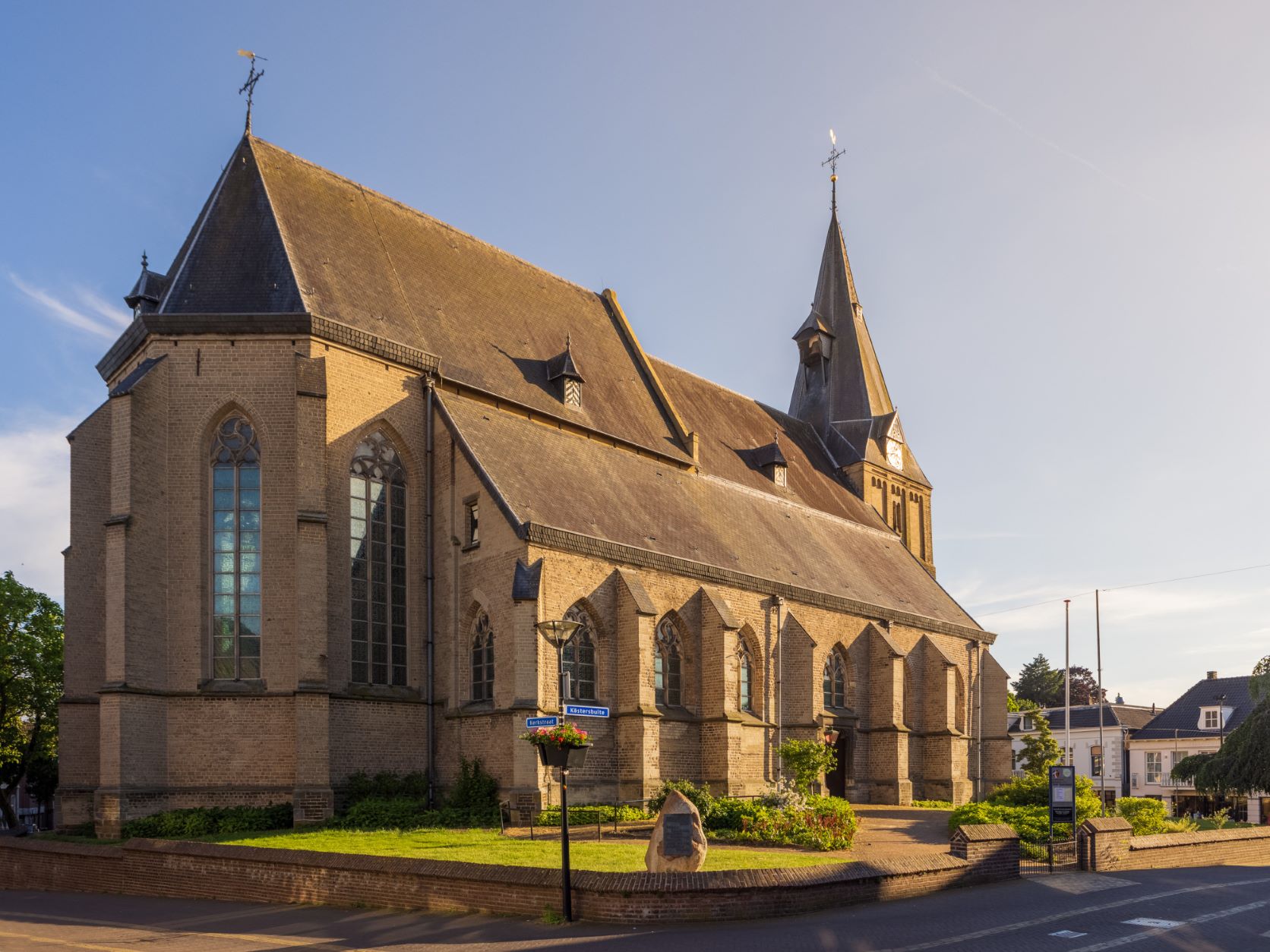
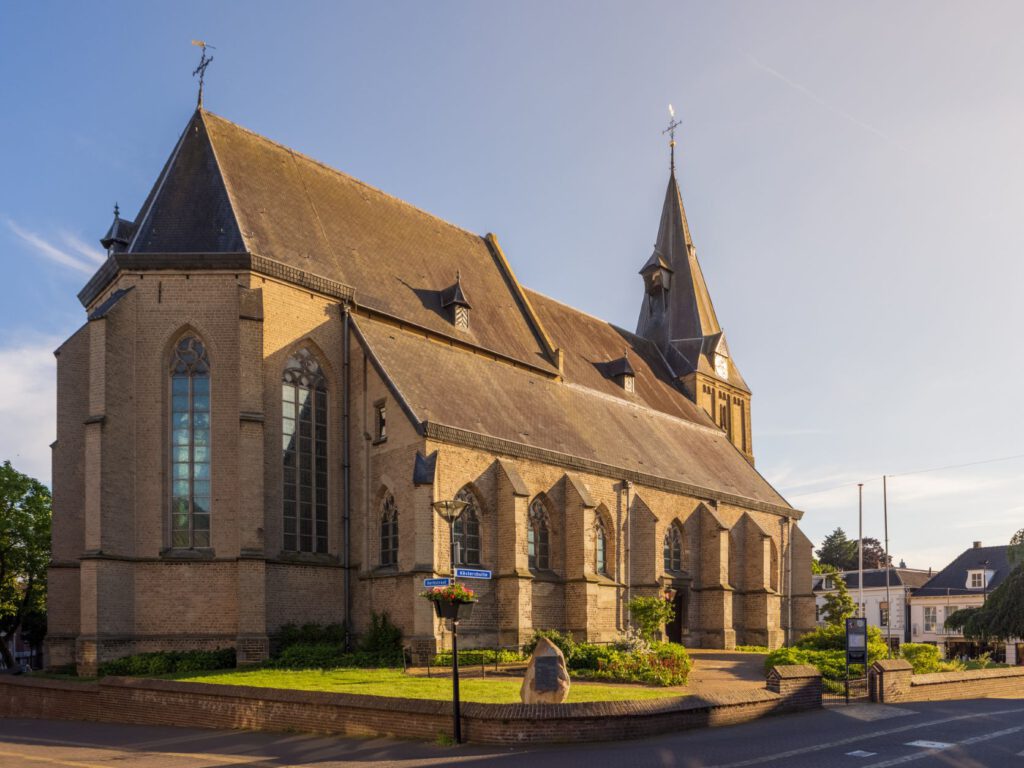
Old St. Helena Church, Aalten
Last Judgment
At the end of November last year, the centuries-old paintings on the wall of the Consistory were also uncovered and restored. They depict the Last Judgment, and it is quite a sight: angels lead the righteous to Jerusalem, while the wicked among us are taken to purgatory. Some are already sweating there in enormous iron cooking pots.
The church, featuring beautiful chandeliers, is packed with pews. “On Sundays — when we have three services — these are often all occupied,” says the sexton. “There is room for 1,000 people. Indeed, with three Reformed churches, one Roman Catholic church, our Dutch Reformed church, and a synagogue, many believers live in Aalten. Our village is also known as the Jerusalem of the Achterhoek.”“It is sometimes more than full here,” agrees Evert Smilda, chairman of the Aalten Antiquities Society, who is showing me around. “I was once running a bit late and asked the man by the aisle to move over a little. He did so, but with reluctance. ‘We are frugal with shifting,’ he said.”
Calling the sexton
The building, founded in 1100 and later altered in Gothic style, is open for viewing. Anyone who calls the sexton — 05437-72896 — or knocks on his door at Kerkstraat 2, will be assisted. “As long as people do not call me during dinner.” Aalten (11,000 inhabitants) is quite a pleasant village, with a Market square crowded with cars that was the first in Gelderland to be declared a protected village view. The square owes this primarily to the St. Helena Church and two old buildings that now form the town hall, with a rather unexciting piece of new construction next to it.
Old in years is Restaurant Stegers across the street. A centuries-old stone, originally part of the facade, is built into the terrace wall by the sidewalk. A deer can be vaguely seen standing on its hind legs. A word of 26 letters accompanies it. No one knows what it means. “We are facing the mystery of Aalten here,” says Smilda. “We do know, however, that such a standing deer was a symbol for the administration of justice. Well, justice may have been administered here in the inn in the past.” We continue through the village (a true regional center) with several old buildings such as Huize Ahof and the beautiful 19th-century mansion (now a guesthouse) Beekhuize.
The 18th-century Freriksschure behind the Frerikshuus museum is one of the few preserved farmhouses in the center of Aalten. Those who walk past it will soon find themselves on the car-plagued Market square, with the impressive Dutch Reformed St. Helena Church. (Photo Peter Drent bv)
Frerikshuus
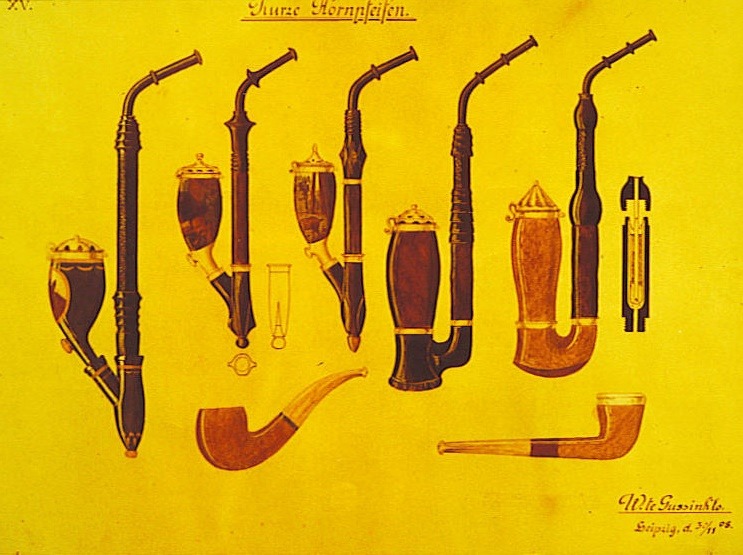
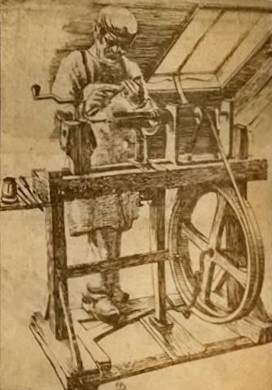
Finally, we arrive at the fascinating Frerikshuus museum on the Market square, which is filled with everyday objects: costumes, silverware, porcelain, and much more. One room is entirely dedicated to the horn industry, which occupied a unique position here for a century until the 1970s. Beautiful pipes, combs, and whatever else could be made from buffalo horns can be seen there.
In the large barn behind the beautiful house, various crafts are depicted, such as wheel-making. The museum is currently open on Mondays, Wednesdays, and Fridays from 2:00 PM to 5:00 PM. From March 31 to May 12, there is a special exhibition about the occupation and the liberation. Many people in hiding successfully sought refuge here in Aalten during World War II.
The village lies within the eternal charm of the Gelderse Achterhoek, with plenty of woods, thickets, enclosed fields and meadows, and quiet lanes.
Bredevoort
Two kilometers from Aalten lies the thousand times more beautiful town of Bredevoort, with its tower mill beckoning from afar, its ancient St. George’s Church, its quiet streets, its endearing old buildings, and its sense of nostalgia. At the last moment, I renew my acquaintance with baker Ben Helmink, the chairman of the local tourist office (VVV), who tells me that restoration work is still ongoing. “Huize St. Bernardus”, he says, “that large building from 1764 on our square ‘t Zand, has just been completed. You won’t believe your eyes. It is truly beautiful now. And so dignified! Bredevoort becomes more beautiful every year. That is it.”
BREDEVOORT – If you do not know him, it would never cross your mind for a single moment that this man’s profession might be that of a bank manager. Bank managers are generally expected to walk around with permanent pound signs in their eyes, but Jan Elferink certainly does not fit that mould. He is witty, always up for a laugh, a fast talker, and never caught off guard. Yet the residents of Bredevoort who deal with Jan Elferink on a business level know that beneath this jovial friendliness lies a sharp businessman—a man who truly knows what he is talking about when it comes to financial matters.
Jan Elferink: “Here, you are engaged both financially and socially”
He certainly learned that over the course of his 42-year banking career. This year, Jan is stepping down. As of 1 September, after he has shown his successor, G.W. te Brinke, the ropes, he will take early retirement. “I am 60 now, and the years beyond sixty are precious. That is why I am bowing out. I still have plenty to keep me occupied. I’ve already told my wife: if I do the work during the day that I currently do in the evenings, I will at least have a few evenings a week to myself,” Elferink says, explaining his departure.
It was 42 years ago when, at the age of 18, he started at the Raiffeisenbank in Lichtenvoorde. “I had always wanted to do that. But when I finished secondary school (ulo) in 1943, my father told me I had to help out in his painting business. Both of my brothers had been conscripted for forced labour in Germany, so I had no choice.”
However, the war was barely over when Jan saw his chance. The post-war monetary reform meant that banks had to take on extra staff. On 1 October 1945, he was hired, and exactly a year later, he transferred to the bank in Bredevoort. “When I first arrived here, I thought: I’ll gain a few years of experience and then move on to another town. But it never came to that. We feel very much at home here in Bredevoort. Happily, we were fully accepted into the community.”
For twelve years, Jan cycled back and forth between Lichtenvoorde and Bredevoort every day, until he married in 1958 and became a true Bredevoorter. You can certainly call him that when you see how deeply integrated he has become in the Bredevoort community.
A hardheaded business
In 1963, Jan was appointed manager of the bank in Bredevoort. “Banking is a hardheaded money business. That really consumes your time. Perhaps that is why, as a counterweight, I took on all those pleasant and social activities outside of my work.”
When Jan begins to list the activities he is or has been involved in, he takes quite some time. The local folk festival, the gondola pageant, the ice rink, board member of the school association, board member of St Bernardus, and so the list goes on. And that is leaving aside all the “ad hoc things” he occupies himself with, such as conducting charity auctions, organising carnival gatherings for the Zonnebloem charity, acting as a compere for the traditional brass band in Lichtenvoorde, and performing as a buutreedner (comic orator) during the carnival season.
“I wanted to call it a day when my partner, Bonekamp from Lichtenvoorde, stopped. But so many requests came in from all sides that I still write a new comic monologue every year. All of that keeps you going. From a young age, I’ve loved being a bit of a rebel. That was already the case at school, and later at the amateur dramatics society, which I joined when I was only fourteen.” His penchant for fun is also well known among his fellow bank managers, who know him affectionately as “Enerink from Smallevoort”.
Elferink makes no secret of the fact that the work of a bank manager in a small community like Bredevoort is rather different from that in a large city. “Here, you are not just engaged financially, but socially too.” Elferink has seen the banking world change dramatically in over forty years: from a small room with a single desk and a safe where savings books were updated by hand, to an exceptionally modern, automated office building where the entire money trade takes place, but where holidays, insurance, and securities are sold as well.
G. te Brinke now manager
BREDEVOORT – As of 1 July, G.W. te Brinke from Lochem will join the Rabobank in Bredevoort as its new manager. Te Brinke was born and raised in Zelhem and is 41 years old. He began his banking career in Doetinchem in 1966 and has been working in Lochem since 1977.
A new wandering editor encounters remnants of Achterhoek nationalism.
Villa ‘Beekhuize’, Aalten
By HENRI BEUNDERS — “The world ended at Arnhem! Long after we came to live here in 1969, friends who called to say they wanted to visit us would ask: ‘Can we bring anything for you?’” Mrs. Pruim says it with a mocking smile, but an indignation that has still not faded shines through.
For two months now, she and her husband—once a lawyer in The Hague and for many years a subdistrict judge in Terborg—have been running a guesthouse in their grand 1826 building “Beekhuize” in Aalten. They never want to return to the west. “The people of the Achterhoek are very tolerant, warm, and hospitable. Here, many cases end in a settlement,” says Pruim while serving breakfast.
Is the IJssel a greater barrier than the national border they live so close to? Anyone walking through the Heelweg in Dinxperlo for a while—left sidewalk Netherlands, right sidewalk Germany—would almost think so. People walk, cycle, and shop across the border as if it does not exist. Mrs. Pruim gets her small breakfast rolls in Bocholt. The customs officers hardly even come out of their booths for the passers-by anymore.
The subdistrict judge therefore never has to deal with border problems. “Well, never—recently a trunk had to be opened. There was a woman inside. ‘I always lie in the trunk when I go out for a drive with my husband,’ she had said. She simply didn’t have a passport. She certainly got a fine for that.”
Backward
However, people in Aalten do not have much regard for the Germans. The exchange of information does not amount to much. In Aalten, an advertising flyer from Bocholt drops through the letterbox; in the “Grenspost” corner, De Graafschapbode reports that the Anholt windmill has sails again. Whether this is because Aalten is Protestant-Reformed and Münsterland is Catholic? No one knows. Perhaps, as some Aalteners believe, it is the mentality reflected, for example, in the placard the Germans hung at the Heurne-Aalten border crossing before the football final in Mexico: “Jetzt betreten Sie das Land des Weltmeisters”. A Dutch customs official gleefully recounts how they were quick to scribble the word “vice” in between afterwards. “Everyone thought it was wonderful that they had lost.”
Except for those from the west, the IJssel also remains a border to another world for many residents of the Achterhoek. The appreciation for that other world has changed significantly lately. “In the past, everything that came from the west was beautiful. Without three apartment blocks, you were considered a backward village. Because of that, much beauty was destroyed,” Mrs. Pruim believes. That time seems to be over. The wave of nostalgia that hit the banks of the IJssel after the storm surge of modernization managed to save some old beauties just in time. Driving around here, you see how people everywhere are busy relaying winding and sloping streets with cobblestones in the village centers, and how the cultural regional renaissance is in full swing.
“We’ll put barbed wire by the IJssel. The people from the west aren’t coming in anymore!” Little more is heard from the Achterhoek “Nationalists” who uttered this threatening language a few years ago—it was the breeding ground for the success of the pop group Normaal. At the harvest festival in De Heurne, a hamlet between Aalten and Dinxperlo, an occasional individual nevertheless walks around with a “paspoart” issued by the Road voor Achterhooks Belang in their pocket. But for most, this disguised sense of inferiority seems to have long since given way to a firmly anchored pride in their own identity.
In the maize landscape, half a hectare of rye has been grown on the small field for demonstrations of mowing with a scythe, binding sheaves, flail threshing, plowing, and harrowing. People laugh and make jokes when even some elderly farmers appear to have almost forgotten these old techniques. Only the hands of the basket and cap maker still move quickly and routinely; they never gave up their craft. The countless telephoto lenses, video, and Super-8 cameras with which the more than 1,500 locals and tourists are filming each other suggest that the harvest festival in De Heurne is already in the dubious transition phase from genuine folk fun to tourist attraction.
Klootschieten
“One must watch out better when a throw is made, because a kloot can hit hard.” (Photo NRC Handelsblad/Vincent Mentzel)
Searching for an expression of revived folklore not yet discovered by the masses, one of the countless colorful tree posters (fair, motocross, variety show—you name it, it’s announced on a beech or oak) points to the border south of Winterswijk. There, almost the entire rural district, more than 80 men, women, and children, has turned out to participate in the klootschieten competitions.
Two teams of 5 or 6 members each try to complete the four-kilometer course through the beautiful ‘bocage landscape’ between Woold, Kotten, and Achterwoold in as few shots as possible. It is not difficult to see why ”t aole spel’ (the old game) is regaining popularity so quickly.
Anyone who can throw can play klootschieten. A rake is placed across the road, one takes a short run-up to that point, and throws the wooden, lead-weighted ‘tennis ball’ of about half a kilogram as far as possible down the street. The others run after it shouting “Astubleef” (if you please); one cheers over his throw of at least 80 meters. “You’re just throwing your hat at it,” calls another who has to search for his predecessor’s kloot in the maize on the other side of the ditch.
At the Esselinkhaar farm, the thermoses are ready on a kitchen table. They are halfway through, time for a break. Organizer Massop of the Winterswijk Klootschieters Association addresses the enthusiastic but inexperienced newcomers warningly once more. “This course is insured, but one must watch out better when a throw is made, because a kloot can hit hard.” As proof, he shows his shin where six months ago a kloot, bouncing over this same stretch of brick road, slammed into it. He is still troubled by it. That is why only coffee is served. “In the past, it was ‘boozing and more boozing,’ which invariably led to trouble.” That was also, he explains, the reason why this cheap entertainment of the ‘common folk’ was often banned in the past.
The fact that the word has since mainly provoked laughter—“there’s no balls to it” the subdistrict judge had assured—no longer bothers Massop. “It is a serious sport. Our federation therefore refused to give in to the Dutch Sports Federation, which wanted us to call it ‘shot put’.” And he presses a flyer and a sticker into one’s hand. ‘Klootschieters do it on the road’. Next year, the national championships, in the cradle of Twente, will be held in the Achterhoek for the first time. For the Kotten border residents, it is primarily a Sunday game. “The weather is nice, you see each other again, it’s sociable,” says one of the women serving coffee. “Next week we have horse teams here.”
Tyrolean Evening
The small amount of alcohol is more than made up for in the evening at the Tyrolean evening organized by the Winterswijk branch of “Jong Gelre” at camping Nieuw Beusink. A good 40 barrels of Grolsch, 200 glasses per barrel, have been brought in for the expected 800 visitors. People sit at long tables, they dance, they drink, the noise gradually swells, but it remains convivial. The Grensland Muzikanten play the Egerländer music by Ernst Mosch that is so popular here. Young and old dance to it. The Achterhoek formation Free Sense plays something more modern and louder for the second half of the evening. Shortly after midnight, the group starts Bob Marley’s “Stir It Up”. “The beer is gone! Oh, how I’m gutted, the beer is gone,” the singer sings. A normal summer weekend along the Achterhoek border is over.
“One must watch out better when a throw is made, because a kloot can hit hard.” (Photo NRC Handelsblad/Vincent Mentzel)
Thanks to the research activities of the Aalten historian E.M. Smilda, many historical details regarding mail delivery in the municipality of Aalten have come to light. A look back at the history of the postal system reveals that in the early 19th century, couriers and messengers were responsible for delivering letters and messages for both the government and private individuals.
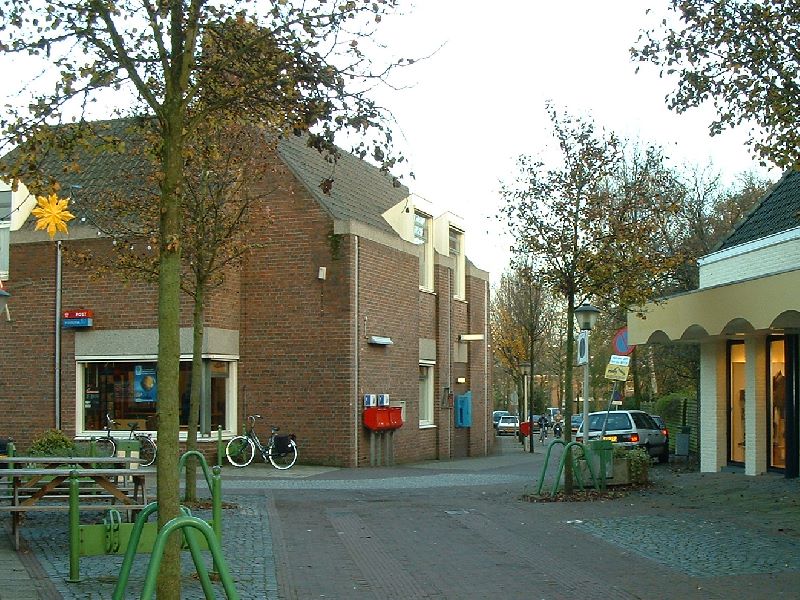
At the exact location where the then-new post office opened on the Peperstraat in 1986, Hendrik Jan te Gantvoort and Garret Jan Hoopman started a “mail coach service” to Zutphen in 1812.
Cart driver
The ‘old’ post office on the Haartsestraat
It is known that in 1742, a certain Hendrik Hoopman was a “cart driver” and drove to Zutphen twice a week. At that time, Hoopman also lived in the Peperstraat, a location that has played an important role in the local postal system throughout the centuries. In 1784, there is mention of a “mail coach” that traveled via Zutphen to Aalten, Bocholt, and Borken twice a week. On two other days, the route was traveled in reverse. Letters were carried for a stuiver and delivered to “Roelof Arentzen in De Klok.”
The aforementioned Te Gantvoort drove his mail coach via Zelhem and Hengelo to Zutphen. In 1827, Jilles van Buul was the first “distributor of letter mail” appointed by the municipal council. In 1832, the council appointed Jan Berend Lohuis as the first messenger. He handled the mail to Groenlo. Gerrit Schotman was his successor in 1843. Gerrit Jan te Tuunte was tasked with the mail route to Winterswijk.
With the introduction of the Postal Act in 1850, the municipality’s involvement with the postal system ceased. Schotman lost his job, and Te Gantvoort emigrated to America with his family in 1854, at the age of 60.
Frequent moves
The ‘new’ post office on the Peperstraat
The Aalten postal service would move numerous times. For instance, operations were conducted from a shed in the Dijkstraat, from the Landstraat (later Ebbers shoe store), the corner of Kerkstraat-Peperstraat (later fashion house De Postiljon), and from 1922 in the former mayor’s residence, the so-called Tackshuis, on the Haartsestraat. On June 26, 1986, the postal services exchanged that location for a new building on the Peperstraat.
Approximately 20 years later, the post office in Aalten was closed. Since then, the residents of Aalten have been able to visit the Primera on the Bredevoortsestraatweg for their postal matters.
In the early 1980s, Poland was in the midst of a severe economic crisis. There were great shortages, and many basic necessities were rationed. Under the motto ‘Help the Poles through the winter’, aid campaigns were set up throughout the Netherlands. One of these was the ‘Pak van je hart’ (A Load off your Mind) solidarity campaign, in which lorry drivers collaborated with churches to provide the Polish population with food and clothing parcels. Aalten was not to be left behind and organised several aid shipments to the small town of Koronowo.
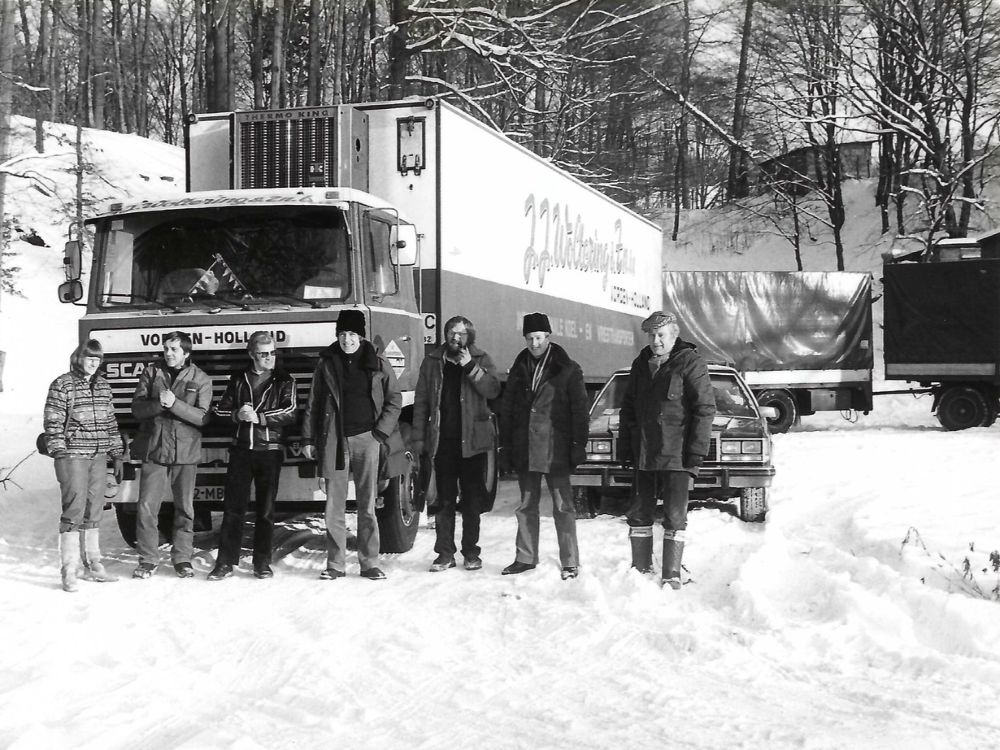
The Aalten team that travelled to Poland, photographed at the side of a road in the snowy landscape. From left to right: Mrs De Bruijne, T. Westerveld, H. Neerhof, J. Epema, D. Kuiperij; P. van Meggelen, and Rev. C. Gros. The photo was taken by Mr W. Hofs.
In December 1981, the following article appeared in a newspaper:
Tonny Westerveld, of Bevrijding 49, was one of the people who took part in the transport to Poland as a relief driver. The drivers of the first two lorries were Dick Kuiperij and Henk Neerhof. For Tonny Westerveld, who despite having ten years of experience as an international haulage driver, it was the first time he had driven to Poland.
On Saturday 18 December, the convoy departed at three o’clock in the morning, and seven hours later, they arrived at Helmstedt at the border between the Federal Republic of Germany and the GDR (East Germany). The formalities there took quite some time, as it was about two o’clock in the afternoon before they were able to leave.
Approximately three hours later, they reached the Polish border. Things went much faster there. The officials were required to open parcels, which they did with a few, but otherwise they finished very quickly—perhaps partly due to the many official documents with municipal stamps that could be shown, as Westerveld surmised.
The journey through Poland was hindered by heavy snowfall during the final few hundred kilometres. About 50 kilometres across the border in Łagów, they stayed overnight, but not at the location previously agreed upon; when they reported to the police, they were told they could spend the night at a different establishment.
On Sunday afternoon at around half past four, the convoy arrived in Bydgoszcz, where they were joined by a female guide, Mirca. The committee members had already been in contact with her a few weeks earlier, and she was well-informed about the situation.
In Koronowo
It was around eight o’clock on Sunday evening when they arrived in Koronowo. The priest they reported to was stunned when he saw the two large lorries; he could hardly believe his eyes, thinking that no one was allowed to enter the country.
The Aalteners requested help for the following morning. “You do wonder how long it will take to unload,” says Westerveld. Both vehicles were carrying 34 tonnes of cargo: 12 tonnes of clothing and 22 tonnes of foodstuffs. Of this, 28 to 29 tonnes were to be unloaded in Koronowo. The remainder was to be unloaded in Bydgoszcz. However, by the next morning, 12 Poles were ready to help, and by ten o’clock, that number had grown to about thirty.
Residents of Koronowo help unload the lorries. The goods were stored in a church building, and the priest would personally oversee the distribution.
“The people there were busy with something they didn’t quite understand,” as Westerveld put it. They were utterly amazed. By twelve o’clock, the goods destined for Koronowo had been unloaded, and the return journey via Bydgoszcz could begin. There, they met the minister of the Evangelical congregation, who looked at the Aalteners with no less astonishment than the priest from Koronowo. He had not yet expected any aid, and with increasingly bewildered looks, he watched the items being removed from the vehicles and piled up before his eyes. Finally, the medicines and syringes they had brought were delivered to the Warminsky Hospital in Bydgozcz.
The Return Journey
For the drivers, the question now was: how do we get out of the city as quickly as possible? But hospital staff were already waiting with a car to guide the Aalteners along the shortest route out of the city towards Poznań. They spent the night in their vehicles at a car park somewhere. It was very cold—about 23 to 24 degrees below zero.
On Tuesday morning, the journey continued after breakfast. They had brought various food supplies for the road. When visiting the homes of Polish residents, the meals they brought were heated up, but they could also fry an egg or make coffee themselves along the way if necessary.
About eighty kilometres from the border, they discovered an English motorist whose car had broken down. However, the Aalteners were unable to help him. To their great surprise, they saw a vehicle from the Dutch roadside assistance (ANWB) passing by. The situation was explained to the occupants, and the problem was subsequently resolved. The roadside assistance officers belonged to the large convoy that had returned to the Netherlands earlier, but they had been in Poland for about nine days because some had lost their passports and had travelled to Warsaw to make arrangements.
When asked: “What is the atmosphere like in Poland?” the answer was: “Fearful.” The people are unimaginably afraid. But it was immediately added: “They are also exceptionally hospitable.” On Wednesday 23 December at one o’clock in the afternoon, the two lorries and their occupants arrived safely back in Aalten.
Aalten is de enige plaats in Nederland waar een hoornindustrie was gevestigd. Men maakte hier producten van buffelhoorn, zoals pijpen, kammen, knopen, seinfluitjes, naaldenkokers en messenheften.Buffels werden niet gedood of speciaal gefokt voor het hoorn.Vrijwel al het materiaal werd gebruikt en wat overbleef ging over de akkers. Met de intrede van kunststof en massaproductie na de Tweede Wereldoorlog verdween deze industrie.
Horn turners
Family ties had a strong influence on the emergence of the horn industry. From 1855, five horn turners began in Aalten: Bernard Vaags, Gerrit Peters, Abraham ten Dam, Willem te Gussinklo, and Wessel Becking.
Bernard Vaags ging op Wanderschaft naar Duitsland en kwam in Ruhla (Thüringen) in de leer bij een hoorndraaier. Toen hij in Aalten was teruggekeerd kocht hij een eenvoudige voetdraaibank en begon de allereerste hoorndraaierij. In een opkamertje in de schoenmakerij van zijn ouders ‘in den Dijk aan de beek te Aalten’ (Dijkstraat 9) maakte hij onderdelen voor Duitse pijpen van buffelhoorn. In 1860 trouwde Vaags met Dora Willemina Prins. Zij werd ook hoorndraaier en werd Piepen Deurken genoemd. Zij gingen wonen naast Bernards oudershuis (Dijkstraat 7).
Pipe turning was manual, pedal-operated, and skilled craftsmanship. Here is an example of an Aalten treadle lathe from 1880.
German pipes
Gerrit Peters, zoon van een leerlooier, ging na Bernard Vaags ook in de leer in Thüringen. Hij werkte vanaf 1863 aan de Hogestraat. In 1866 trouwde Gerrit met de welgestelde Josina Aleida te Gussinklo en trok bij haar in. Het pand besloeg de hele lengte van de Köstersbulte, van het woongedeelte aan de Markt tot aan de Landstraat, waar hij zijn hoornwerkplaats vestigde. Hij maakte lange pijpenstelen en onderdelen voor de Duitse pijp. In Duitsland werden porseleinen pijpenkoppen aan de stelen bevestigd en de pijpen verhandeld.
Combs
Comb factory Ten Dam & Manschot
Na het overlijden van Vaags in 1868, pakte zijn opvolger Abraham ten Dam de zaken grondig aan. Het huisindustrietje werd een echte fabriek, aan de Stegge. In 1871 stichtte hij samen met zijn zwager Bernard Manschot kammenfabriek Ten Dam & Manschot aan de Damstraat.
It was the first and only factory in the Netherlands to make combs: white, black, and naturally coloured decorative combs, Mexican combs, nit combs, and moustache combs. These were made from buffalo horn, imported from countries including Brazil, India, and Thailand (then known as Siam). The manufacturing process generated even more dust and stench than pipe making.
A revolutionary development in the production process was the switch to steam power, replacing traditional hand and foot power. In local parlance, it became known as ‘d’n Kamstoom’ (the Comb Steam). By 1920, the comb factory employed about 200 people, including women and children.
Handles and knife hilts
German pipes, W. te Gussinklo
Willem te Gussinklo en Wessel Becking leerden de kneepjes van het vak bij Gerrit Peters. Zij werkten korte tijd samen, maar gingen in 1884 apart verder. Na de mislukte samenwerking ging Wessel Becking in 1880 verder met Bernardus Gerhardus Vaags, neef en naamgenoot van Bernard Vaags. Becking & Vaags maakte pijpenstelen en later ook messenheften. Toen de verkoop van de Duitse pijpen terugliep, produceerde de fabriek korte bruyèrepijpen. De pijpenfabriek in de Hoekstraat staat er nog steeds!
Johannes Peters verliet de werkplaats van zijn vader aan de Köstersbult en sloot in 1896 een vennootschap met Marcus Gans, een Joodse koopman. Gans financierde de firma genaamd PEGA (Peters & Gans). De pijpenfabriek stond naast Peters’ woning aan de toenmalige Gasthuisstraat (nu Haartsestraat). Naast Duitse pijpen voor Duitse reservisten werden wandelstokken met hoornen handvaten vervaardigd. Nadat de fabriek in 1917 totaal uitbrandde, vestigde Johannes Peters zijn pijpenfabriek aan de Admiraal de Ruyterstraat. In plaats van Duitse pijpen werden er vooral bruyèrepijpen gemaakt.
Buttons
Dutch Button Works, Bredevoort
Na de mislukte samenwerking met Wessel Becking maakte Willem te Gussinklo Duitse pijpen en handvatten voor wandelstokken en paraplu’s. In Duitsland en Engeland waren rond 1900 bedrijven ontstaan die uit hoorn knopen produceerden. Met dat voorbeeld voor ogen begon Willem in het jaar 1905 met het maken van hoornen knopen, een primeur voor Nederland. Al snel kwam zoon Willem te Gussinklo jr. (Piepkes Willem) in de firma, die zich ontwikkelde als innovatief ondernemer.
De eerste fabriek van Te Gussinklo stond aan ‘t Dal in Aalten, de tegenwoordige Willemstraat. Vanwege de toenemende vraag naar knopen verhuisde het bedrijf in 1924 naar de oude weverij van Van Eijck in Bredevoort. Daar ging de productie van knopen van start. Het internationale bedrijf N.V. Dutch Button Works (DBW) exporteerde naar Engeland, Ierland en Amerika en was ook de grootste (hoorn)onderneming in Aalten.
After World War II, the production of horn buttons declined. In 1976, this last branch of horn processing was forced to close down. This marked the definitive end of 120 years of the horn industry in Aalten.
Video
Source: Euregionetwerk Industriecultuur
It rained pipe stems
Paulien Andriessen, a great-granddaughter of Gerrit Peters, became curious about her great-grandfather’s craft. He was the second horn turner in Aalten. Where had he learned the trade, and to whom did he sell those pipe stems? How did the Aalten horn turners and their successors fare?
“When I passed my final exams, my uncle gave me a pipe as a gift. My mother and my sisters smoked pipes, so I didn’t find it strange at all. It was a ladies’ pipe with a slender stem, a small white porcelain bowl, and a horn mouthpiece. I had to smoke it a few times, my uncle explained, and then a beautiful picture would appear on the pipe bowl. So, I started smoking quite heavily, as I was curious about that picture. It took a few pipes, but to my delight, my smoking habit was rewarded. A picture appeared. It was a little bird, a dove.”
In 2011, a book she authored was published by Fagus Publishers, titled ‘Het regende pijpenstelen, Honderd jaar hoornindustrie in Aalten’ (It Rained Pipe Stems: One Hundred Years of the Horn Industry in Aalten) (ISBN: 9789078202806)
At the end of 1973, the Netherlands was in the grip of the oil crisis. The crisis was caused by a number of Arab oil-producing countries raising the price of oil by 70% and reducing oil production, causing the price per barrel to skyrocket. The oil crisis had a major impact on the global economy. In the Netherlands, a number of car-free Sundays were announced from November 1973 to January 1974. Furthermore, petrol was rationed. Car owners were issued petrol coupons which they had to hand in when refuelling. (Source: Wikipedia)
“Oiled”
The oil crisis inspired several residents of Keizersweg in Aalten to dress up as oil sheikhs in early 1974 and wish their fellow villagers a Happy New Year. Eventually, the group headed home in high spirits, quite “oiled”:
The textile industry in Aalten was deeply rooted in the centuries-old tradition of domestic weaving and flax processing. In the 19th century, this craft grew into a flourishing industry, partly thanks to the establishment of German textile families such as the Driessens.
For centuries, flax was cultivated in the Achterhoek and the adjacent Westphalia region, from which linen was woven on farms. This cottage industry led to a lively cross-border trade in woven fabrics.
Numerous farm and street names in Aalten still recall this era, for example: de Weversborg, de Pellewever, de Bleeke, the Vlasspreideweg, and—due to the pure water—the Zilverbekendijk.
The arrival of the Driessens
Import duties on foreign fabrics were increased in 1823 to protect Dutch industry. German textile companies, including the firms Gebrüder Driessen and Peter Driessen & Sohn in Bocholt, moved to the Achterhoek. In 1826, they established themselves in Aalten.
With their arrival in 1826, 56 looms and approximately twenty families from Prussia also came to Aalten. Most of them settled here permanently.
Growth of employment
The number of domestic weavers grew steadily. While the number was 292 in 1828, it had risen to 352 a year later, and in 1833 it was reported: ‘The fustian factories continued strongly, with the factories in Aalten typically employing approximately 630 weavers according to records. Both in this and in the surrounding municipalities of Winterswijk, Dinxperlo, Varsseveld, Lichtenvoorde, etc.’
Spinning flax on the spinning wheel
The first factories
In 1829, there were two cotton mills in Aalten ‘which provide work for about 40 people’, including that of the Driessen brothers. In 1830, there were three, with approximately sixty employees.
On August 15, 1829, Jan Gerard Kraak ten Houten, ‘licensed shopkeeper and merchant in Aalten’, informed the Governor of Gelderland of his wish to establish ‘a fustian factory, spinning mill, dye works, and bleachery’ in his hometown, for which he requested permission. The municipal council had no objections to this establishment, ‘considering that the petitioner’s intention is only to have fustian manufactured by weavers at their homes, without erecting a spinning mill, bleachery, or dye works. This ensures sufficient work for the craftsman’, while no other interests are harmed. Ultimately, the King had to decide on the matter. Favorable advice was given by all advisors. It is not known how long this company existed or where it was located.
Sources
Geweven goed, the textile history of Aalten and Bredevoort H. de Beukelaer, J.G. ter Horst – Fagus, 1992
GROENLO — The Groenlo cantonal judge, Mr H. J. Steenbergen, was confronted yesterday afternoon with a modern-day Robin Hood. The youthful J. P. from Bredevoort had turned back the clock centuries and had gone hunting in Aalten armed with a bow and arrow. But since the days of Robin Hood have long since passed and legislation today is entirely different, he came into conflict with the hunting laws.
With this primitive weaponry, P. had terrorised a plot of woodland between the Walvoortweg, the Stationsstraat, and the Bredevoortsestraat. The forest is named Het Zwarte Woud (The Black Forest) — a name that fitted wonderfully with the adventurous atmosphere in which historians have shrouded the gallant followers of King Richard the Lionheart.
The Bredevoort archer had set his sights on creatures walking through life on two or four legs and on anything winged soaring through the air, but he went from hunter to hunted when the police caught him in their sights. It then appeared that P. was no true follower of the great hero from the exciting story. He dropped the bow and made off. However, he lacked the cunning and the speed of Robin Hood, who was always too slippery for his pursuers, and so P. — after handing his arrows to a friend — fell into the trap. His adventure was over.
P. looked at the cantonal judge sheepishly when the latter made him understand that he had made himself guilty of illegal hunting. That his game would have such far-reaching consequences and also financial repercussions took him by surprise. Somewhat crestfallen, he managed to blurt out that it was not hunting he was after, but purely the sport. The sensation that shooting with a bow and arrow provided him pushed the rules and regulations far into the background. “You did shoot at animals with it, though,” asked Mr Steenbergen. “Tried to, but I wasn’t very successful,” P. answered. He had bought the bow in Germany.
The cantonal judge had put the weapon to the test and had come to the conclusion that it was a dangerous piece of equipment. “The heavy arrows, tipped with a metal point, whizzed hard through the air,” he said. Mr Steenbergen also inquired why P. had run away. “Didn’t you feel very well?” he asked. “I don’t know,” P. stammered.
The public prosecutor, Mr J. Punt, was of the opinion that someone roaming the fields with such hunting gear is clearly hunting. He felt this deserved no encouragement, and in order to deter other Wilhelm Tell figures, he demanded a fine of 60 guilders or 6 days’ detention, and the forfeiture of the bow and arrows. The cantonal judge declared that P. would have acted more wisely by joining an archery association, and if such an opportunity had existed in Aalten, he would have been inclined to let P. keep the bow and arrow. However, that possibility does not exist, and therefore Mr Steenbergen deemed it necessary to confiscate the weapon. He sentenced P. to a fine of 30 guilders or 3 days.
In 1965, Aalten enjoyed a national scoop. The Rabobank on Hofstraat opened that year and featured the very first drive-through counter in the Netherlands.
“That our bank knows how to keep up with the times is evident from this photograph, which depicts the modern, fully automatic outdoor counter—or, if you will, the drive-through counter.
This counter is located in the front façade under a canopy. Motorists no longer need to step out of their cars to come inside to settle their financial affairs. Sitting in their cars, they can handle their banking via a microphone and an ingenious switching system.
Here, it truly applies: one has the microphone, the other the steering wheel, and between them, the counter. This is how business is done at an outdoor counter. Naturally, non-motorists can also make use of this outdoor facility.”
Drive-through counter
From a conversation with former director J. Beun in April 2014, by Ina Brethouwer:
“Upon my arrival in 1959, the Coöperatieve Boerenleenbank was growing, but the Kerkstraat location was an old building. It either had to be renovated or replaced by a new building. There were plans for a merger with the Middenstandsbank, but we had to deal with two fierce opponents. Much attention was paid to these customers of the Middenstandsbank.
Behind the old bank, as seen from Kerkstraat, lay many small allotments. This is the land where the Rabobank on Hofstraat stands today. A long series of discussions with all the owners followed, and all the plots were bought up.
Developments continued, and construction of the new bank began in the early sixties. We could not find the specific flooring we wanted for the new building in the Netherlands, so we visited Germany several times. There, we repeatedly encountered the Autoschalter.
And so, Aalten secured the Dutch premiere of the Autoschalter, the outdoor counter for cars. You drove up in your car and were served via a drawer. You placed your items in the drawer, there was a speaker-and-microphone link, the drawer was pulled inside, and the requested items were then pushed back out to you.
The new bank building was constructed eight metres back from the road with a view to future expansion. During construction, provision was also made for a second automatic counter underground in the basement. However, that development did not proceed, not even in Germany, due to the advent of bank cards and other equipment.
The merger of the two Aalten banks went ahead. The new name became: Coöperatieve Aaltense Boerenleenbank Middenstandsbank. It all went well; it was a proportional distribution and never became a matter of prestige.”
On Monday, a group of ladies and gentlemen will gather at the sociëteit in Aalten who, although completely unknown to one another and coming from various parts of the country, need no introduction. For the simple reason that their names are identical. Short and sweet: Vaags. After years of genealogical research and months of administrative preparation, the Vaags reunion will finally become a reality. And where better to hold it than in Aalten, where the forefather of all those named Vaags first saw the light of day?
Chemist from Geleen established family tree
That was nearly two hundred and fifty years ago. We may accept this on the authority of someone who has investigated it all in meticulous detail. A Vaags, naturally. Specifically, a certain P.B. Vaags from Geleen, a 35-year-old chemist at the state mines. This Vaags from Limburg was able to make grateful use of the oldest data when constructing a family tree, as collected at the beginning of the last war by the late Mr A.A. Vreede, whose daughter currently resides in Dinslaken.
He was busy with it for years, making enquiries at home and abroad, obtaining and processing official data from municipal registries where available, and occasionally chatting with various individuals. Thus, a booklet gradually emerged that is interesting not only to the Vaags family. A briefly described family history that reaches back centuries.
Forefather Voogedes
The forefather of all those named Vaags originally lived in Bocholt, where he was born on 8 April 1693. After his marriage to the Aalten beauty Hanna Degenaar, the couple settled in Aalten. That forefather was actually named Voogedes. Their son Jannes Petrus, born on 23 January 1718, eventually came to be called Vaags after name changes to Voegts, Vaegts, and the like. All currently living members of the Vaags family descend from this later assessor and churchwarden.
From this Dutch forefather and his marriage to Berendina Lankhof, seven branches lead through the centuries to the current generation. Two of them have already died out. There are therefore five remaining. However, by human calculation, one of these will disappear again in the short term, as the last scion of the so-called G-branch is an unmarried man in The Hague.
Then there remain the P-branch, the H-branch, the J-branch, and the B-branch. According to the research by Mr Vaags from Geleen, a respectable number of branches or twigs have emerged from these lines. Currently, there are 232 living members of the Vaags family, of whom 153 live in Gelderland (63.4 per cent in the Achterhoek) and the rest are scattered across all parts of the country, as well as 14 in Canada, 7 in Rhodesia, 4 in Norway, and 1 in South Africa. They are people from all ranks and stations of life.
Planting trees
The group of reunionists who will gather next Monday at 11 o’clock in the morning for greetings and introductions will certainly be very diverse. Naturally, not all of them will attend. During the day there will be about 90, and in the evening approximately 120. After a communal lunch, four Vaags trees will be planted in the afternoon on the ‘t Walfort estate, one for each still growing and flourishing branch: these trees will be handed over to the municipal executive for maintenance. Afterwards, there will be an opportunity to walk around Aalten and, for example, take a look at the old “ancestral homes”. In the evening, there will be a more festive gathering.
Should any outsider feel the urge to infiltrate this reunion with a simple introductory murmur: “Vaags, pleased to meet you”, they should be advised that all reunionists wear a neat bow, differing in colour according to the branch to which they belong. Furthermore, Mr Vaags from Geleen has found something of a code to make the family tree clear. And that code can really only be deciphered if you are in possession of such a Vaags family book. But for that, of course, you must be a Vaags.
A week later, Dagblad Tubantia writes about the course of the reunion:
Vaags reunion became a pleasant family celebration
The reunion of the Vaags family in Aalten yesterday became a joyful and pleasant gathering. Most of the Vaagses and semi-Vaagses knew each other due to their various Achterhoek residences, yet several kinsmen had also come from afar. But soon after the reception, at eleven o’clock yesterday morning in the Sociëteit, they were what one calls “en famille”. The word “Vaags” was heard a hundred and one times during the mutual introductions. Then there was some searching and feeling amongst the foliage of the family tree to determine if they might be directly related. The bows worn by the reunionists, in the colours orange, red, white, and blue, were an excellently functioning aid in this regard.
Four trees planted at ‘t Walfort
One of the four Vaags trees, that of the orange branch, is planted near the remains of ‘t Walfort castle.
Yesterday, during mutual conversations at the table or over a drink, there was plenty of browsing through the family tree that the animator of this reunion, Mr P.B. Vaags from Geleen, has so solidly established. The fact that everyone was related to everyone else was not enough to satisfy everyone. People wanted to know to what extent that kinship went. And for this, the booklet by the Vaags from Limburg with its handy coding was indispensable.
Quite rightly, the chairman of the working committee, Mr J.B. Vaags (from Winterswijk), outlined the merits of that work in his welcoming speech. And it did not stop there. One of the Aalten reunionists had crafted a neat miniature family tree with the four main branches in colours, and this was presented to Mr Vaags from Geleen as a lasting memento of his work and the reunion that resulted from it.
A special word of welcome was extended to Mr and Mrs Brinkmann-Greeve, the clerical couple from Dinslaken. Mr Greeve had collected the first genealogical data on the Vaags family at the beginning of the war, and Mr Vaags from Geleen built upon this data in his later research. Mrs Vreede said in her response, also on behalf of her husband, that she considered it a great honour to be able to attend this reunion.
With that, the official part was temporarily at an end. People chatted for a while and then went to the lunch table.
In four groups
The afternoon began with the second official part, the planting of four Vaags trees on the ‘t Walfort estate. With this, the Vaagses hope to have given symbolic form to the memory of their reunion for a very long time. The approximately one hundred reunionists set off on foot, by bus, or by car to the (now) municipal estate. A better place could hardly have been chosen; after all, the resident of what remains of the old castle is also related to the Vaagses.
There, the saplings provided with an orange, red, white, or blue bow (one for each still vigorous branch of the family) received their destination, surrounded by the corresponding kinsmen. For a moment, the large Vaags family split into four groups. But after Mayor Van Veen had accepted the trees into municipal care with a few friendly words, unity was quickly restored. Afterwards, people walked pleasantly around Aalten, visited an old “ancestral home” here and there, and ate together. And in the evening, de Heikneuters entertained the family, which had by then become somewhat more numerous, for a few pleasant hours with a song, a chat, and some music.
“A small effort, I thought….”
P.B. Vaags from Geleen
The man who essentially made the reunion of the Vaags family possible through his genealogical research, Mr P. B. Vaags, may live in Geleen in Limburg, but is a true Achterhoeker by birth. His grandfather was from Aalten, and his father and he himself come from Eibergen.
“The name Vaags has intrigued me for a long time, especially because you hardly encounter it elsewhere in the country. I thought it would be a small effort to trace all family members. But I certainly underestimated that. I began by simply examining a series of old giro and telephone directories for the name Vaags – you have to start somewhere – and it soon became apparent that the tree was growing thicker and thicker. I wrote to various people, went to talk to baker Vaags in Aalten, and once I had got that far, the work would not let me go.”
All in all, it took a year and a half before the family tree, complete with all branches and twigs, stood tall and firm. Then the organisational work for the reunion could begin. But the Vaags from Geleen did not involve himself with that. That was more the work of the VVV secretary, who is very skilled in such matters.
Sunday, July 7, 1957, was a sweltering day. Consequently, many residents of Aalten wished to take a cooling dip in the ‘t Walfort swimming pool. At the time, however, it was not permitted to open the pool on Sundays. Hundreds of residents disagreed and marched to the pool that afternoon. The youth climbed over the fence, and older residents forced entry into the pool. Moments later, the crowd dove into the refreshing water, and the hastily summoned police were powerless to intervene!
Stampede at ‘t Walfort
Nieuwe Winterswijksche Courant, July 8, 1957
Aalten possesses a beautiful natural swimming pool, ‘t Walfort. However, swimming is not permitted on Sundays. The predominantly right-wing Christian municipal council recently decided, by a majority of a few votes, that the pool must remain closed on Sundays. This decision has greatly irritated a large portion of the Aalten population, who do not share the motives behind this resolution. This irritation was further exacerbated last Sunday by the extreme heat, which created a longing for a cooling bath.
On Sunday afternoon, young and old alike flocked to ‘t Walfort in great numbers, where they initially stood before the closed gate, protesting against the municipal executive for withholding this pool from the more liberal Protestant segment of the population, as well as Catholics, Jews, etc., while it was sweltering. Soon, the youth began climbing over the pool’s enclosure, and before long, older individuals were kicking in the wooden fences to force access to the pool. Moments later, the entire crowd—numbering in the hundreds—dove into the refreshing water.
When the hastily summoned police and several board members of the pool arrived, they were faced with a fait accompli! The police could do very little; it was impossible for them to get all those people out of the water. Finally, Alderman Obbink of the Anti-Revolutionary Party (A.R.) delivered a speech, which, however, fell on deaf ears. The people simply held fundamentally different views than the municipal executive and continued swimming calmly.
De Volkskrant, July 8, 1957
After several hours of swimming, the pool board made another appeal to the swimmers: they had had their chance, and the pool had to be closed again. This appeal was successful: in a sporting manner, everyone left the pool, and shortly thereafter, Sunday rest was restored to the swimming pool. However, the municipal executive of Aalten is faced with a problem; it is now clear that, regardless of how this matter is framed on principle, a large part of the population disagrees and believes that the interference with their freedom on Sundays goes too far.
Naturally, the municipal executive made its decision to keep the swimming pool closed on Sundays based on grounds that were serious to many council members. However, Alderman Obbink promised “to look into this matter once more” for those who cannot share the Council’s fundamental considerations.
Aalten Swimming Pool remains closed on Sundays
Tubantia, July 9, 1957
Archive photo of ‘t Walfort swimming pool, for illustration purposes
At the proposal of the Mayor and Aldermen of Aalten, this body met with the board of the “‘t Walfort” swimming pool to discuss the incidents of last Sunday, when the youth of Aalten stormed the pool. The pool board indicated that it fully respects the council’s decision to keep the pool closed on Sundays and that it condemns Sunday’s actions; the latter in contrast to rumors suggesting that the pool board had cooperated with the demonstration.
The municipality will issue a serious warning during the course of this week against entering the swimming pool on Sundays. The necessary measures will be taken. We further understand that the council factions of the K.V.P., P.v.d.A., and Gemeentebelangen will not submit a new proposal to open “‘t Walfort” on Sundays this season. Since no new proposal can be expected from other parties either, it is almost certain that the pool will remain closed on Sundays this season.
Warning
Tubantia, July 11, 1957
The acting mayor of Aalten, Alderman W.B. Obbink, has announced following the demonstration that took place on and around the swimming pool on Sunday that, should the disturbances recur, they will not hesitate to take criminal measures. This publication was issued following a statement from the board of ‘t Walfort. It reads as follows: “The board of the ‘t Walfort’ bathing and swimming facility, meeting on July 8, 1957, discussed the disturbances that occurred on and around the swimming pool last Sunday. It deeply regrets this reaction to a decision that was reached in a perfectly legal manner and unanimously expresses its disapproval of this subversive conduct. It strongly urges the population, especially the youth, to respect the Council’s decision, to refrain from vandalism, and to comply with the decision in a sporting manner.”
Aalten Council revises decision
Tubantia, April 16, 1958
This coming summer, residents of Aalten will be able to go swimming in their own ‘t Walfort pool at four o’clock on warm Sunday afternoons. Last night, the municipal council decided that the pool will be open from 3:00 PM to 7:00 PM on summer Sundays. A corresponding proposal, submitted on behalf of the K.V.P. and Gemeentebelangen factions, was adopted after a calm debate by 9 votes to 6.
The decision itself was not a surprise, but the relatively large majority the proposal received was. Unlike last June, when a similar proposal was rejected by 8 votes to 7, all three Christian Historical (C.H.) council members now voted in favor. The Anti-Revolutionary Party (A.R.) remained steadfastly opposed. As is well known, last summer, a few weeks after the council’s rejection, ‘t Walfort was stormed by hundreds of Aalten residents on a sweltering Sunday afternoon, after which swimming took place for several hours.
Disturbed peace of mind jeopardizes Sunday rest
Last night’s debate did not open any new perspectives. It was essentially a brief repetition of the arguments that were presented extensively and sometimes passionately on June 30 of last year. This time, the council finished its discussion within half an hour. Mr. Luiten, faction leader of the A.R., called it less than edifying that another proposal to open the swimming pool on summer Sunday afternoons has already been submitted.
If we were to make a different decision now, people might think we are giving in to opposition from the streets. He once again explained the pros and cons, admitting that mass swimming in the stream creates unacceptable conditions, but stated he did not see why, in a municipality like Aalten with its wealth of natural beauty, the swimming pool must also be open on Sundays. In his view, a piece of Sunday rest is lost because of it.
Mr. H.L. Obbink (C.H.) clarified why he would take a different position this time than last year. The events of that time proved that the peace of mind of the population can be so disturbed if the swimming pool remains closed that the Sunday rest itself could be jeopardized. This had led him to decide to revise his position. Mr. Huinink (Labor) again raised the argument of Sunday labor in the service of the police, railways, etc., which is also performed by Anti-Revolutionaries.
Archive photo of ‘t Walfort swimming pool, for illustration purposes
(“Only necessary labor,” Mr. Heinen stipulated), and called the attitude of the A.R. typically Aalten. In a municipality like Varsseveld, the situation is quite different. What was proclaimed 50 years ago no longer applies today. He believed that the Sunday rest would not be jeopardized by the opening of the swimming pool.
Not through resistance
Mr. Wijkamp (K.V.P.) stated that the irregularities of last summer were not the reason for bringing the proposal forward again; it was already certain then that another attempt would be made before the new swimming season.
After Mr. Brethouwer (C.H.) explained why he would vote in favor (“swimming in the stream at Lintelo certainly does not benefit the Sunday rest”), Mr. Heinen (A.R.) expressed his surprise at the changed attitude of Mr. Obbink and especially of the K.V.P., which a few years ago was even opposed to mixed swimming. Mr. Lurvink (K.V.P.) replied that moral welfare was certainly as important as the sanctification of the Sabbath. After brief replies, in which Mr. Wijkamp requested strict police action against swimming in the stream, the vote was taken.
After Mayor Van Veen announced the result, Mr. Ter Linde (P.v.d.A.) addressed the population over the heads of the council with a request to make appropriate use of the swimming pool and to prevent any excesses. The Mayor and Aldermen will now consult further with the swimming pool board regarding the implementation of the decision.
Sources
Nieuwe Winterswijksche Courant, July 8, 1957 (via delpher.nl)
German workers received a pound of coffee for Christmas; Dutch staff later received a rixdollar…
While one of the German girls employed at a textile factory in Aalten was recently the cause of a sensational incident (she defaced the Dutch flag with a swastika), German textile workers in Aalten have once again been the catalyst for an event that has caused quite a stir in the quiet village, as two textile factories were involved.
Sixteen German girls are employed at a textile factory in Dijkstraat. As Christmas approached, they began to ponder a surprise they could provide for their relatives across the border. It had to be coffee, was the general opinion!
Girls at work at the Driessen textile factory, Hofstraat. Photo for illustrative purposes.
The German girls enlisted the help of a staff member from Aalten, who knew just how to manage it. He, in turn, went to a businessman who proved able and willing to supply 16 pounds of coffee—one pound for each of the German girls. That evening, the girls cheerfully headed home by bus with their coffee. However, on that same bus were 19 female workers from a textile factory in Hofstraat.
Understandably, they were none too pleased that their friends could take coffee home for “Weihnachten” while they could not. The matter was promptly raised the following day with the management in Hofstraat. They felt they could do little else but promise each of their German workers a pound of coffee as well. And the 19 pounds of coffee indeed materialised.
But the difficulties did not end there! The Dutch staff had caught wind of the Christmas gift and now began to demand coffee too. After all, coffee is an item that has been very scarce in this country of late. The management of the Hofstraat factory restored industrial peace by giving every staff member a bonus of ƒ2.50. With that, the whole matter seemed to be settled.
However, with so many people involved, it was almost inevitable that the police and the C.C.D. (Central Investigation Service) would hear of the case. The latter has since launched an investigation, which has already led to an official report (proces-verbaal) being filed against the management of the textile factory in Hofstraat. A second report followed for the granting of a bonus without the permission of the Board of Government Mediators. An official report has also been filed against the shopkeeper involved.
We understand that the reason the German girls were able to export the coffee is that the Dutch customs, contrary to standing orders, allowed the coffee to pass; it was apparently assumed that it could be exported freely as long as its value was below ƒ15. The German customs had already promised the German girls that they would make an exception in view of the approaching Christmas holiday.
Deze website gebruikt cookies voor een optimale ervaring en analyse van bezoekgegevens. Ga je hiermee akkoord? Zonder toestemming werken sommige onderdelen van de site mogelijk minder goed.
Functioneel
Always active
De technische opslag of toegang is strikt noodzakelijk voor het legitieme doel het gebruik mogelijk te maken van een specifieke dienst waarom de abonnee of gebruiker uitdrukkelijk heeft gevraagd, of met als enig doel de uitvoering van de transmissie van een communicatie over een elektronisch communicatienetwerk.
Voorkeuren
De technische opslag of toegang is noodzakelijk voor het legitieme doel voorkeuren op te slaan die niet door de abonnee of gebruiker zijn aangevraagd.
Statistieken
De technische opslag of toegang die uitsluitend voor statistische doeleinden wordt gebruikt.De technische opslag of toegang die uitsluitend wordt gebruikt voor anonieme statistische doeleinden. Zonder dagvaarding, vrijwillige naleving door je Internet Service Provider, of aanvullende gegevens van een derde partij, kan informatie die alleen voor dit doel wordt opgeslagen of opgehaald gewoonlijk niet worden gebruikt om je te identificeren.
Marketing
De technische opslag of toegang is nodig om gebruikersprofielen op te stellen voor het verzenden van reclame, of om de gebruiker op een site of over verschillende sites te volgen voor soortgelijke marketingdoeleinden.