
On Friday, April 24, 1931, 24-year-old Anton Prinsen was found dead on the threshing floor of his parental home in ‘t Dal. The alerted physician soon suspected that foul play might be involved. The event caused a great stir in the village and was reported in the national press.
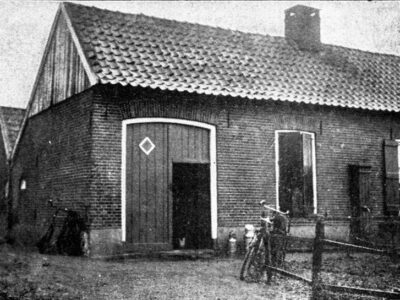
Anton Prinsen lived with his brother Derk Jan (1908) and their mother, the widow Mina Prinsen-te Kiefte (1873), in a farmhouse with the former address Aalten A160. Following the address change in 1934, this became ‘t Dal 14. It appears that violent disagreements frequently occurred within the Prinsen family. Both brothers were known to be very rough.
On that particular Friday morning at approximately half past seven, Dr. Hartman was alerted by a neighbor boy that Anton Prinsen had fallen on the threshing floor. Prinsen was supposed to bring a load of fertilizer to the fields that morning and was to borrow a horse from a certain V. for that purpose. When he failed to collect it, people went to check and found the body lying on the threshing floor. When the doctor arrived at the scene, Anton had already passed away.
As a tragic detail, it was also mentioned that the victim had entered into a notice of intended marriage on the Wednesday before his death.
Possible crime
Based on the position of the body and the visible external injuries, Dr. Hartman concluded that a crime may have been committed. The mayor and the chief constable were alerted and appeared at the scene. They immediately launched an investigation and interrogated the household members, mother and son, as well as the individuals who had been at the scene after the accident. Mother and son declared that Anton had fallen and hit his head on a handcart in such a way that he succumbed to his injuries. However, the investigation reinforced the suspicion of foul play, and the public prosecutor’s office in Zutphen was notified by telephone.
The body was temporarily seized and guarded by the police. Around half past two in the afternoon, the public prosecutor, Mr. Baron Speyaart van Woerden, the examining magistrate, Mr. Mees, the clerk of the court, Mr. Meindersma, and two doctors arrived for the autopsy. Later, a police expert, Dr. Hesselink from Arnhem, also arrived.
The examining magistrate interrogated the brother of the deceased, but he denied all guilt. After Dr. Hesselink took several photographs of the position of the body, the remains were transported to the Rest Home by police stretcher. Meanwhile, the experts and the chief constable searched for blood and other traces. These were discovered on the walls, the outer door of the threshing floor, and on several sacks of grain.
Arrest
An autopsy on the victim’s body indicated that he had died by strangulation. The brother of the deceased was arrested and placed in custody. The detainee was escorted to the police station on foot, watched by a large crowd discussing the case. This later led to parliamentary questions from Member of Parliament Mrs. Bakker-Nort. The Minister of Justice replied that “an investigation has shown him that on the evening of Friday, April 24, 1931, at approximately nine o’clock, the suspect in question was transferred unhandcuffed from his home to the police station in Aalten, and very shortly thereafter from that station to the detention cells, covering a total distance of approximately 750 m. Since no escape was feared, the public’s attitude was calm, and the suspect, instead of expressing any objection to the transfer on foot, showed great indifference, the police officers charged with the transfer apparently found no reason to seek a means of transport for that evening transfer over the relatively short distance. The minister believes that under the given circumstances, and since the use of a cellular van was naturally excluded, the manner in which the suspect was transferred can hardly be subject to well-founded objections.”
On Saturday morning at 8 o’clock, the suspect was transferred to Zutphen and placed at the disposal of the Public Prosecutor. At the tram station, he called out a “Mòjn” (local greeting) to all his acquaintances.
Confession
A few days later, the mother and brother finally made a full confession. According to them, the events unfolded as follows:
Early Friday morning, the widow Prinsen called her son Anton to milk the cows. This young man then used some very improper expressions toward his mother and began milking. When his mother called him to eat while he was milking the second cow, he replied: “Oh old woman, I’d rather slice you into strips.” Thereupon, the other son Derk attacked his brother, and a violent struggle ensued. Suddenly, Derk Jan noticed that he had squeezed his brother Anton’s throat too hard. He cried: “Mother, mother, I have killed him! Don’t say anything, don’t make me miserable!”
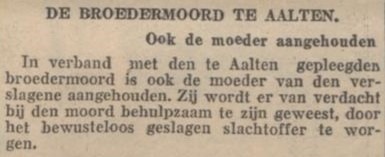
Both then agreed not to tell the truth and devised a false statement. It was to be presented as if Anton had fallen with his head against a wheel of a handcart and that this had resulted in his death. This is what they told Dr. Hartman, the mayor, and the chief constable on Friday morning.
The Limburgsch Dagblad reported on May 4 that the mother had also been detained for complicity and even for strangling the unconscious victim. This charge was presumably later withdrawn, as the court records mention nothing about it.
Court case
The District Court in Zutphen sentenced Derk Jan Prinsen by verdict of October 23, 1931, to 10 years’ imprisonment, with credit for time served in pre-trial detention. Both the suspect and the public prosecutor appealed this ruling. The defense counsel was Mr. H. Maten, a lawyer from Arnhem.
In the appeal case, a witness stated about the suspect: “He has limited intellect, is backward and shy.” The court report also mentions that the suspect “comes from a difficult background, that the family was not favorably known, and that repeated thefts etc. occurred.”
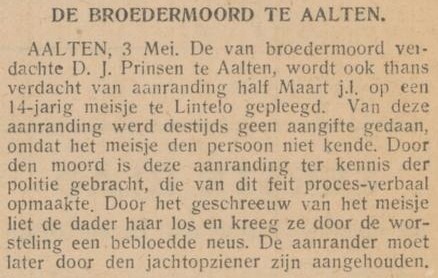
Shortly after the crime, the Arnhemsche Courant had reported that the accused was also suspected of assaulting a 14-year-old girl in Lintelo. However, nothing is mentioned about this in the court records.
On Thursday, February 4, 1932, the Court of Appeal in Arnhem ruled that the perpetrator did not have the intent to kill his brother, so that this was ‘merely’ a case of assault resulting in death. The maximum sentence for that offense was six years, and that maximum sentence was therefore imposed by the Court, without credit for time served. Prinsen served four years of this, after which the sentence was converted into a conditional one.
Anton Prinsen was buried at the Old Cemetery on the Varsseveldsestraatweg.
Perpetrator continues on the wrong path
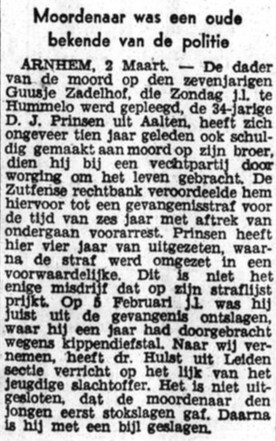
More than ten years later, on March 3, 1943, the newspaper Het Volk wrote:
“The perpetrator of the murder of seven-year-old Guusje Zadelhof, which was committed last Sunday in Hummelo, 34-year-old D.J. Prinsen from Aalten, also committed the murder of his brother approximately ten years ago, whom he killed by strangulation during a fight.
This is not the only crime on his criminal record. On February 5 last, he had just been released from prison, where he had spent a year for chicken theft.
As we understand, Dr. Hulst from Leiden performed an autopsy on the body of the young victim. It is not excluded that the murderer first beat the boy with a stick. After that, he was struck with an axe.”
The Arnhem court sentenced the now 34-year-old farmhand for this crime to 15 years’ imprisonment with credit for time served, followed by TBS (mandatory psychiatric treatment).
The boy was murdered after entering the barn at his parental home that Sunday morning to feed his rabbits. He had presumably disturbed Prinsen, who had spent the night there.
Sources
- Graafschapbode, 27 April 1931 (Delpher)
- Graafschapbode, 29 April 1931 (Delpher)
- Limburgsch Dagblad, 4 May 1931 (Delpher)
- Arnhemsche Courant, 5 May 1931 (Delpher)
- Graafschapbode, 1 June 1931 (Delpher)
- Graafschapbode, 23 October 1931 (Delpher)
- Graafschapbode, 5 February 1932 (Delpher)
- Graafschapbode, 19 February 1932 (Delpher)
- Dagblad van het Oosten, 2 March 1943 (Delpher)
- Het Volk, 3 March 1943 (Delpher)
- Dagblad van het Oosten, 9 June 1943 (Delpher)