GROENLO — The Groenlo cantonal judge, Mr H. J. Steenbergen, was confronted yesterday afternoon with a modern-day Robin Hood. The youthful J. P. from Bredevoort had turned back the clock centuries and had gone hunting in Aalten armed with a bow and arrow. But since the days of Robin Hood have long since passed and legislation today is entirely different, he came into conflict with the hunting laws.
With this primitive weaponry, P. had terrorised a plot of woodland between the Walvoortweg, the Stationsstraat, and the Bredevoortsestraat. The forest is named Het Zwarte Woud (The Black Forest) — a name that fitted wonderfully with the adventurous atmosphere in which historians have shrouded the gallant followers of King Richard the Lionheart.
The Bredevoort archer had set his sights on creatures walking through life on two or four legs and on anything winged soaring through the air, but he went from hunter to hunted when the police caught him in their sights. It then appeared that P. was no true follower of the great hero from the exciting story. He dropped the bow and made off. However, he lacked the cunning and the speed of Robin Hood, who was always too slippery for his pursuers, and so P. — after handing his arrows to a friend — fell into the trap. His adventure was over.
P. looked at the cantonal judge sheepishly when the latter made him understand that he had made himself guilty of illegal hunting. That his game would have such far-reaching consequences and also financial repercussions took him by surprise. Somewhat crestfallen, he managed to blurt out that it was not hunting he was after, but purely the sport. The sensation that shooting with a bow and arrow provided him pushed the rules and regulations far into the background. “You did shoot at animals with it, though,” asked Mr Steenbergen. “Tried to, but I wasn’t very successful,” P. answered. He had bought the bow in Germany.
The cantonal judge had put the weapon to the test and had come to the conclusion that it was a dangerous piece of equipment. “The heavy arrows, tipped with a metal point, whizzed hard through the air,” he said. Mr Steenbergen also inquired why P. had run away. “Didn’t you feel very well?” he asked. “I don’t know,” P. stammered.
The public prosecutor, Mr J. Punt, was of the opinion that someone roaming the fields with such hunting gear is clearly hunting. He felt this deserved no encouragement, and in order to deter other Wilhelm Tell figures, he demanded a fine of 60 guilders or 6 days’ detention, and the forfeiture of the bow and arrows. The cantonal judge declared that P. would have acted more wisely by joining an archery association, and if such an opportunity had existed in Aalten, he would have been inclined to let P. keep the bow and arrow. However, that possibility does not exist, and therefore Mr Steenbergen deemed it necessary to confiscate the weapon. He sentenced P. to a fine of 30 guilders or 3 days.
On Friday, another session of the Military Court was held in the council chamber of the town hall. Major Jhr. Mr. van Nispen tot Sevenaer served as president, while Mr. Arriëns acted as military prosecutor.
Behind closed doors, the case against H.A. v. T. was handled first; he was sentenced to 1 year in prison for a sex offense, of which 8 months were suspended with a probation period of 3 years.
Also behind closed doors, the case of F.K. Meijnen was heard, who was sentenced to 9 months in a reform school for looting. The defense counsel in this case was Mr. Voorink from Winterswijk. A. Meijnen, who had stolen cigars and tobacco while clearing rubble from a bombed house, was sentenced after a plea by Mr. Voorink to 3 months in prison with a probation period of 2 years.
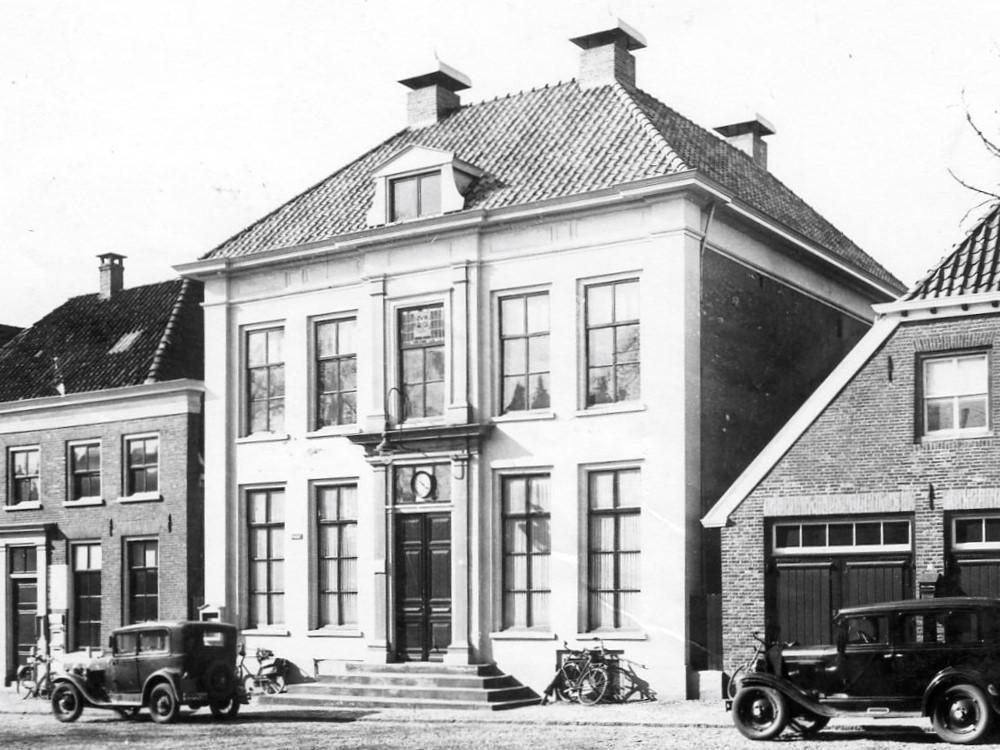
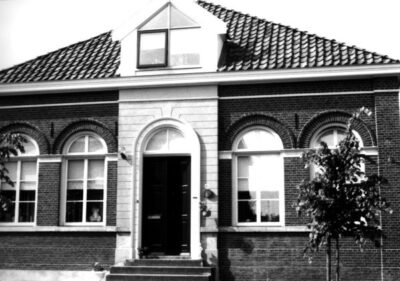
The Town Hall on the Markt in Aalten
E.J. ter Heurne is accused of having taken a lady’s bicycle belonging to Miss J.W. Wesselink. The defendant denies taking the bicycle. According to him, he stored the vehicle after it had been abandoned by an SS man. In view of the bicycle requisitioning, he removed the tires and the saddle. This occurred in October 1944. Miss D. Kuijntjes is heard as a witness for the defense, confirming the defendant’s account. She had even ridden the bicycle.
A debate ensued between the defense counsel and the court regarding the circumstances of this case. No clarity could be reached, as the stolen bicycle was only taken months after October. The case is therefore adjourned to hear several more witnesses.
Meanwhile, M. Wensink appears before the court to answer for the fact that he gave 4 kg of bacon for a stolen bicycle. The defendant denied knowing that the bicycle was stolen property, which the military prosecutor did not find very credible, given the demand: 3 months suspended with a probation period of 2 years and a fine of ƒ 500. The court, however, judged otherwise and acquitted the defendant.
A certain Melitz, an SS man, appeared to have stored a nice amount of fertilizer. Now that he has disappeared, a number of farmers examined the matter and brought the fertilizer to their lands. This brought them before the court, which sentenced them to fines ranging from ƒ 25 or 25 days, while one was acquitted. After mutual consultation, they immediately “opened their purses.” At least it wasn’t a black market price.
H.J. te Grotenhuis needed several items, including a bread knife, a pair of bloomers, and a few cow halters, and stole these from various people. This is the same person who recently attacked an N.B.S. man with a knife during his arrest after escaping. Te Grotenhuis did not make a very reliable impression and is apparently not fully accountable for his actions. The court evidently took this into account and sentenced him to 6 months in prison.
After this, the case of E.J. ter Heurne was resumed. The bicycle was wheeled in and examined by the owner, Miss Wesselink. She declared that it was indeed her bicycle. A.J. Wentink, heard as a witness, stated that he had seized the bicycle in question from ter Heurne. He also recognized the bicycle. The defense witness Miss Kuijntjes also came to view the bicycle and could only partially recognize it. The bicycle she saw at ter Heurne’s in October was in better condition. After the municipal supervisor R. Hoogeveen was also heard as a witness in this case, the military prosecutor demanded a prison sentence of 2 years. The court reduced it by half, so ter Heurne will have to serve 1 year for this offense. Arnoldus Florentinus Voorink also pleaded in this case.
The following defendants have quite a lot on their conscience. A sheep was stolen and slaughtered; about 50 eggs were snatched, as well as a number of chickens and a quantity of tobacco leaves still in the field. Suspected of this are the brothers A.H. and H.J. Bettink in association with H. Dibbets, who in turn, together with T.W. Jansink, stole sheep’s wool and, with one of the Bettink brothers, approximately 500 kg of potatoes.
Messrs. Bettink and Dibbets also worked for their own account. For instance, H.J. Bettink pilfered two shirts, a pair of socks, and a quantity of tobacco while clearing rubble at the house of F.J. te Linde; H. Dibbets took a watch, a shirt, a pair of socks, spools of sewing thread, and a deck of playing cards. Finally, the father of the brothers, H.J. Bettink Sr., was the underlying cause of the thefts of the sheep and the potatoes and had to answer for intentional incitement.
The boys readily confessed to the charges, but Bettink Sr. declared that everything was a lie. The claim that he had encouraged the thefts was pure fabrication. On the contrary, he had always set a good example for the boys and forbidden them to steal. This statement caused quite some hilarity, given the man’s record. The sentences were far from lenient. A.H. Bettink received 3 years, with credit for time served in pre-trial detention.
T.W. Jansink was sentenced to 6 months, while a report will still be issued regarding H. Dibbets on the possibility of placing him in a youth prison. A psychiatric report will be issued for H.J. Bettink Jr., as he was considered to have significantly diminished responsibility. H.J. Bettink Sr. reaped the bitter fruits of his good intentions and will not be able to keep his sons on the right path for the next few years. He was sentenced to 4 years.
Next to stand trial as a victim of his own good intentions was E.J. van de Lende, who, while clearing rubble from the house of F.J. te Linde, had taken a pair of men’s trousers, a piece of lining fabric, and a remnant to keep them safe and out of the hands of the Germans. This happened on 24 March. In the meantime, however, a skirt had already been made from the fabric, which the court took very seriously. He had also forgotten to return the items. The goods were only returned once the case was in the hands of the police. This forgetfulness cost him 8 months in prison, and the goods must be returned.
At the conclusion of the session, the president, Major Jhr. Mr. van Nispen tot Sevenaer, paid tribute to Sergeant Bruggeman, whose excellent work and very good official reports greatly facilitated the work of the court.
In 1941, a young lady from Aalten had to answer to the cantonal court in Apeldoorn for ignoring a red traffic light… Huh, a what…?
“The next defendant to appear before the bar proved to be a true ‘Unschuld vom Lande’ (an innocent from the countryside). It was a young lady, G.H.H., of no occupation, from Aalten, who had been staying with her aunt in Apeldoorn for about ten days. And then it happened: she had cycled down the Hoofdstraat and had not given a thought to stopping for the red traffic light. After all, such automatic traffic controllers are unknown in rural Aalten!
Still, it seemed somewhat unbelievable that, in the year 1941, a young girl would never have seen a traffic light, and so it was asked from behind the green table whether the defendant had truly never been to a city. “Yes, in Winterswijk,” the girl said, “but they don’t have them there either.” It turned out she had never made any further journeys, not even to Arnhem or Bocholt. In view of this, she got away with a fine of f 3.”
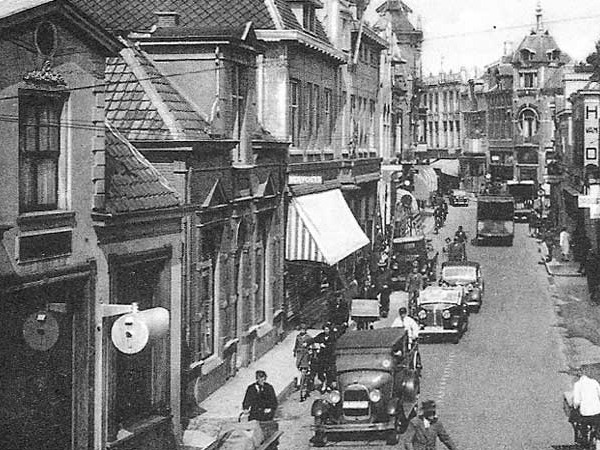
Hoofdstraat, Apeldoorn, with a traffic light in the bottom left.
Source
Nieuwe Apeldoornsche Courant, 6 November 1941 (Delpher)
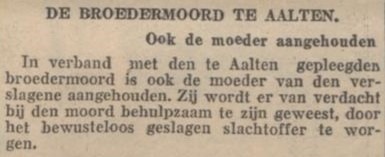
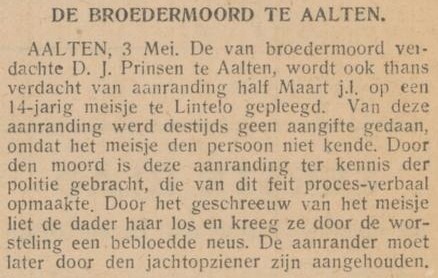
On Friday, April 24, 1931, 24-year-old Anton Prinsen was found dead on the threshing floor of his parental home in ‘t Dal. The alerted physician soon suspected that foul play might be involved. The event caused a great stir in the village and was reported in the national press.
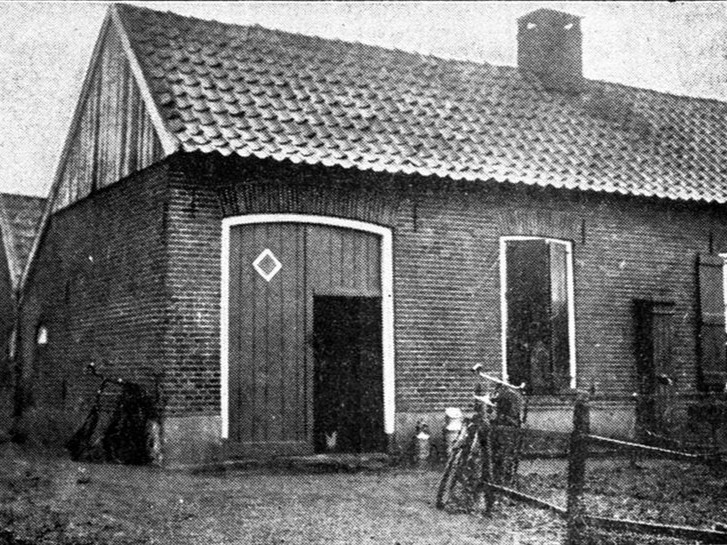
The farmhouse and barn where the tragedy unfolded.
Anton Prinsen lived with his brother Derk Jan (1908) and their mother, the widow Mina Prinsen-te Kiefte (1873), in a farmhouse with the former address Aalten A160. Following the address change in 1934, this became ‘t Dal 14. It appears that violent disagreements frequently occurred within the Prinsen family. Both brothers were known to be very rough.
On that particular Friday morning at approximately half past seven, Dr. Hartman was alerted by a neighbor boy that Anton Prinsen had fallen on the threshing floor. Prinsen was supposed to bring a load of fertilizer to the fields that morning and was to borrow a horse from a certain V. for that purpose. When he failed to collect it, people went to check and found the body lying on the threshing floor. When the doctor arrived at the scene, Anton had already passed away.
As a tragic detail, it was also mentioned that the victim had entered into a notice of intended marriage on the Wednesday before his death.
Possible crime
Based on the position of the body and the visible external injuries, Dr. Hartman concluded that a crime may have been committed. The mayor and the chief constable were alerted and appeared at the scene. They immediately launched an investigation and interrogated the household members, mother and son, as well as the individuals who had been at the scene after the accident. Mother and son declared that Anton had fallen and hit his head on a handcart in such a way that he succumbed to his injuries. However, the investigation reinforced the suspicion of foul play, and the public prosecutor’s office in Zutphen was notified by telephone.
The body was temporarily seized and guarded by the police. Around half past two in the afternoon, the public prosecutor, Mr. Baron Speyaart van Woerden, the examining magistrate, Mr. Mees, the clerk of the court, Mr. Meindersma, and two doctors arrived for the autopsy. Later, a police expert, Dr. Hesselink from Arnhem, also arrived.
The examining magistrate interrogated the brother of the deceased, but he denied all guilt. After Dr. Hesselink took several photographs of the position of the body, the remains were transported to the Rest Home by police stretcher. Meanwhile, the experts and the chief constable searched for blood and other traces. These were discovered on the walls, the outer door of the threshing floor, and on several sacks of grain.
Arrest
An autopsy on the victim’s body indicated that he had died by strangulation. The brother of the deceased was arrested and placed in custody. The detainee was escorted to the police station on foot, watched by a large crowd discussing the case. This later led to parliamentary questions from Member of Parliament Mrs. Bakker-Nort. The Minister of Justice replied that “an investigation has shown him that on the evening of Friday, April 24, 1931, at approximately nine o’clock, the suspect in question was transferred unhandcuffed from his home to the police station in Aalten, and very shortly thereafter from that station to the detention cells, covering a total distance of approximately 750 m. Since no escape was feared, the public’s attitude was calm, and the suspect, instead of expressing any objection to the transfer on foot, showed great indifference, the police officers charged with the transfer apparently found no reason to seek a means of transport for that evening transfer over the relatively short distance. The minister believes that under the given circumstances, and since the use of a cellular van was naturally excluded, the manner in which the suspect was transferred can hardly be subject to well-founded objections.”
On Saturday morning at 8 o’clock, the suspect was transferred to Zutphen and placed at the disposal of the Public Prosecutor. At the tram station, he called out a “Mòjn” (local greeting) to all his acquaintances.
Confession
A few days later, the mother and brother finally made a full confession. According to them, the events unfolded as follows:
Early Friday morning, the widow Prinsen called her son Anton to milk the cows. This young man then used some very improper expressions toward his mother and began milking. When his mother called him to eat while he was milking the second cow, he replied: “Oh old woman, I’d rather slice you into strips.” Thereupon, the other son Derk attacked his brother, and a violent struggle ensued. Suddenly, Derk Jan noticed that he had squeezed his brother Anton’s throat too hard. He cried: “Mother, mother, I have killed him! Don’t say anything, don’t make me miserable!”
Limburgsch Dagblad, 4 May 1931
Both then agreed not to tell the truth and devised a false statement. It was to be presented as if Anton had fallen with his head against a wheel of a handcart and that this had resulted in his death. This is what they told Dr. Hartman, the mayor, and the chief constable on Friday morning.
The Limburgsch Dagblad reported on May 4 that the mother had also been detained for complicity and even for strangling the unconscious victim. This charge was presumably later withdrawn, as the court records mention nothing about it.
Court case
Arnhemsche Courant, 5 May 1931
The District Court in Zutphen sentenced Derk Jan Prinsen by verdict of October 23, 1931, to 10 years’ imprisonment, with credit for time served in pre-trial detention. Both the suspect and the public prosecutor appealed this ruling. The defense counsel was Mr. H. Maten, a lawyer from Arnhem.
In the appeal case, a witness stated about the suspect: “He has limited intellect, is backward and shy.” The court report also mentions that the suspect “comes from a difficult background, that the family was not favorably known, and that repeated thefts etc. occurred.”
Shortly after the crime, the Arnhemsche Courant had reported that the accused was also suspected of assaulting a 14-year-old girl in Lintelo. However, nothing is mentioned about this in the court records.
On Thursday, February 4, 1932, the Court of Appeal in Arnhem ruled that the perpetrator did not have the intent to kill his brother, so that this was ‘merely’ a case of assault resulting in death. The maximum sentence for that offense was six years, and that maximum sentence was therefore imposed by the Court, without credit for time served. Prinsen served four years of this, after which the sentence was converted into a conditional one.
Anton Prinsen was buried at the Old Cemetery on the Varsseveldsestraatweg.
Perpetrator continues on the wrong path
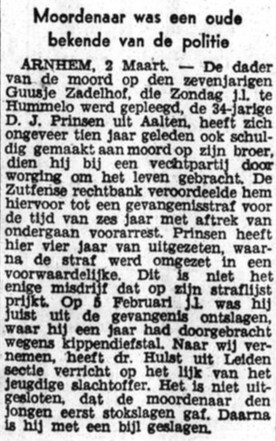
More than ten years later, on March 3, 1943, the newspaper Het Volk wrote:
“The perpetrator of the murder of seven-year-old Guusje Zadelhof, which was committed last Sunday in Hummelo, 34-year-old D.J. Prinsen from Aalten, also committed the murder of his brother approximately ten years ago, whom he killed by strangulation during a fight.
This is not the only crime on his criminal record. On February 5 last, he had just been released from prison, where he had spent a year for chicken theft.
As we understand, Dr. Hulst from Leiden performed an autopsy on the body of the young victim. It is not excluded that the murderer first beat the boy with a stick. After that, he was struck with an axe.”
The Arnhem court sentenced the now 34-year-old farmhand for this crime to 15 years’ imprisonment with credit for time served, followed by TBS (mandatory psychiatric treatment).
The boy was murdered after entering the barn at his parental home that Sunday morning to feed his rabbits. He had presumably disturbed Prinsen, who had spent the night there.
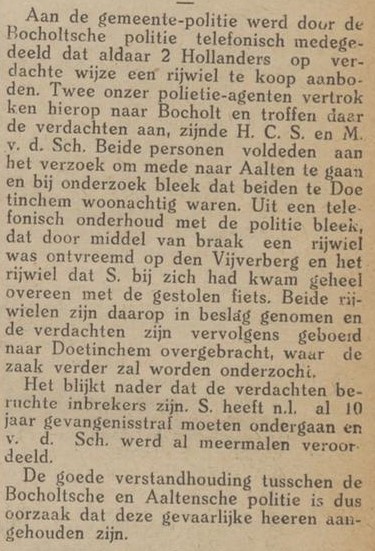
The municipal police were informed by telephone by the Bocholt police that two Dutchmen were suspiciously offering a bicycle for sale there. Two of our police officers subsequently left for Bocholt and found the suspects there, namely H. C. S. and M. v. d. Sch. Both individuals complied with the request to accompany them to Aalten, and an investigation revealed that both were residents of Doetinchem.
A telephone conversation with the police revealed that a bicycle had been stolen from the Vijverberg by means of a break-in, and the bicycle S. had in his possession matched the stolen bike exactly. Both bicycles were then seized, and the suspects were subsequently taken in handcuffs to Doetinchem, where the case will be further investigated. It further appears that the suspects are notorious burglars. S. has already served 10 years in prison, and v.d. Sch. has been convicted on several occasions.
The good relationship between the Bocholt and Aalten police is therefore the reason these dangerous gentlemen have been apprehended.
Source
Nieuwe Winterswijksche Courant, 19 March 1926 (Delpher)
In Aalten, during the night from Tuesday to Wednesday, a certain H.J. Jansen had his skull crushed with an axe by his brother-in-law S. while he was already in bed. Although his condition was nearly hopeless, he was transported to Arnhem by train. On the same train, his brother-in-law, who had been arrested in Winterswijk, arrived in Aalten in handcuffs. He was taken to the town hall by constable Blom from Aalten and state constable Hendriks from Winterswijk to be interrogated.
The victim passed away in Arnhem the following night. He leaves behind a widow and six children. The brother-in-law S., the suspected perpetrator, was transferred to Zutphen on Wednesday. He is unmarried. The causes of this tragedy are family disputes.
On August 24, 1921, the District Court in Zutphen heard the case against H.H. S., a laborer from Aalten, suspected of murdering his brother-in-law H.J. Jansen with an axe in his home on or about July 25, following a party, while he was lying in bed, as a result of which his skull was split and he died a few days later.
The defendant claims to remember nothing and says he was drunk. However, on the night in question, he told one of the witnesses, a certain P.: “I did something to H. He might die.” J. was found in a small side room about 15 meters from his bedroom. In the bedroom, blood spatters were visible on the wall and the bed. The Public Prosecutor demanded a 4-year prison sentence. The defense counsel, Mr. Wildervank de Blécourt, pleaded for clemency.
The District Court in Zutphen sentenced the suspect S. to 4 years in prison, in accordance with the demand, with credit for time served in pre-trial detention.
Scheveningen
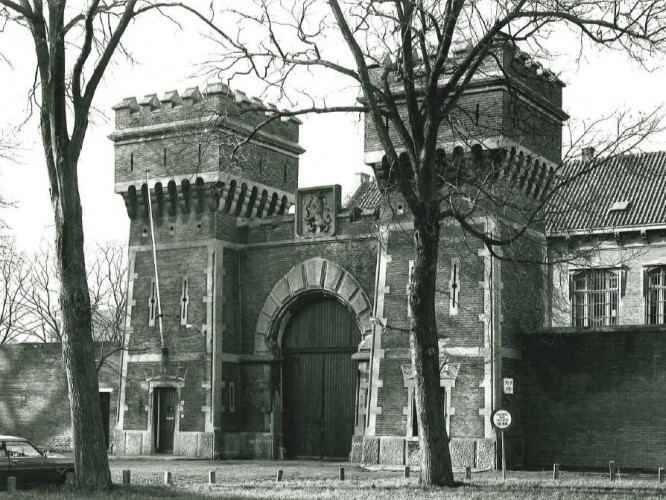
In 1922, we find H.H. S. in the penitentiary on Pompstationsweg in The Hague / Scheveningen, known for its striking gatehouse.
The striking gatehouse of the prison on Pompstationsweg in The Hague.
AALTEN, 6 May 1920 – It was a busy day for Mr G. de Vries, director of the local butter factory. Together with his assistant, Mr Kempink, he had counted out ƒ 14,094.40 into bags and stored them in the safe. The money was intended to pay the milk suppliers the following morning. At the end of the day, De Vries was the last to leave the office, locking the door behind him. However, the safe remained open, with the key still in the lock.
The next morning, the money had vanished. The only sign of a break-in was a curtain cord hanging outside the window. Although the director had locked the office door, the windows facing the street could easily be slid open from the outside.
On 7 May, the Nieuwe Aaltensche Courant reported on the theft: “Last night, a sum of ƒ 14,000 was stolen from the safe of the Aaltensche Coöp. Zuivelfabriek (Dairy Factory). At the request of the police, we are not sharing further details.”
Investigation
In the months that followed, the media remained silent. Behind the scenes, however, intense work was being carried out on this sensational case. The marechaussee in Winterswijk conducted an investigation and arrested several suspects, who later had to be released due to a lack of evidence. Subsequently, the case was reinvestigated by the national, municipal, and military police, without success. Even a national constable-detective (rijksveldwachter-rechercheur) returned home empty-handed.
Finally, the investigation was assigned to Sergeant of the Marechaussee Woerts from Zutphen. Woerts went undercover, wandering through Aalten for a time as a vagrant, staying in a lodging house, and working at a factory. After gathering a wealth of information, secret agent Woerts—Evert Jan Woerts—travelled to Germany and managed to arrange for himself to be locked in a prison alongside a person who knew more about the matter…
This also yielded valuable information, leading to the arrest of two suspects: Gerrit Jan W. (29, a bricklayer’s labourer) from Enschede, formerly a resident of Aalten, and Hendrikus P. (28, a clog maker) from Aalten.
Gerrit Jan W. from E.
Several newspapers reported on the trial, which took place in December 1920 at the court in Zutphen. Gerrit Jan W. was the first to stand trial. He testified that he and co-defendant P. had climbed in through a window and stolen the bags of money from the safe. Once outside, they placed the bags into a large jute sack and went to W.’s house to count the money. There, P. gave the defendant ƒ 110 and left with the rest of the loot, approximately ƒ 14,000. P. was supposedly going to hide the remainder in the “Schaapsche hei” (perhaps referring to the Schaarsheide?). W. had burnt the bags that previously held the money.
The defence counsel, Mr C.C. de Jonge, pointed out that the defendant was an epileptic—the defendant actually suffered a seizure during the defence—and requested an evaluation of his mental faculties. According to him, P. was the primary perpetrator and had likely enticed W. At any rate, he urged for a lighter sentence.
The Public Prosecutor praised Wachtmeester Woerts, whose investigations and tactical approach had brought this defendant to a confession. In his view, it had been shown that this accused was the least guilty. Therefore, his sentence could be lighter; the Prosecutor demanded 1½ years’ imprisonment, with time served in pre-trial detention deducted.
Hendrikus P. from A.
Next, Hendrikus P. stood trial for complicity in the same case. P., however, denied everything. He stated that he had not been at W.’s house that evening, though he had been there eight days prior. P. had an alibi for the night in question: he had been home between 10:00 and 11:00 and was asleep. The following morning, he had cycled to “Heersen” (?). P. maintained that he had nothing to do with the burglary and that W. had cast suspicion on many people in this case. He also claimed that W.’s wife was unreliable.
Witness Hendrika Geessink, W.’s wife, testified that on the evening of 6 May, co-defendant P. came to fetch her husband, saying: “Gerrit, come with me, there’s something to be had at the butter factory,” or words to that effect. Her husband had initially refused, but after P. persisted, W. eventually went along. Whether it was exactly a quarter past eleven when P. arrived and one o’clock when they returned, the witness could no longer say for certain. When they returned, the witness was in bed, but she did see money and paper bags. She did not know the exact amount.
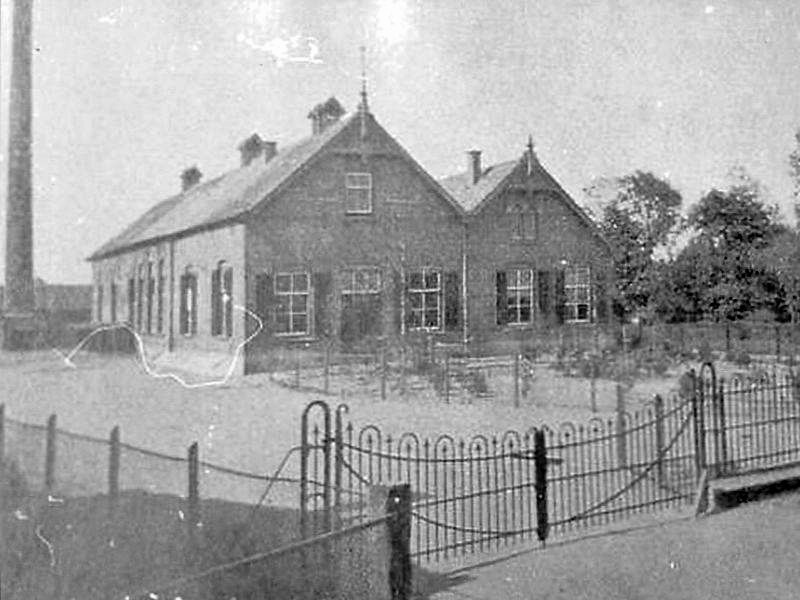
Butter factory Aalten, c. 1915
The witness confirmed that after 6 May, the whole family went to Enschede by car. German and Dutch currency was seized from her on 17 September. She denied that it amounted to 4,000 marks. It also appeared that she had purchased various items worth ƒ 800 after 1 May. Her husband had not told her everything, because: “no husband does that!” On 16 May, she had deposited 10,000 marks at a bank in Enschede. The witness claimed that this was money honestly earned by her husband.
Despite this, the Public Prosecution Service considered it proven that P. was the most guilty in this case and demanded three years’ imprisonment. The defence, however, contested the evidence; he deemed the testimony of W.’s wife unreliable. Furthermore, he pointed out the large expenditures made by the W. family after 6 May, arguing that nothing proved P.’s guilt. Since W. was constantly working on the factory grounds, it was more likely that W. would have gone to P. to fetch him. The defence therefore requested an acquittal for P.
Verdict
On 5 January 1921, the Court in Zutphen sentenced Hendrikus P. to 2 years and Gerrit Jan W. to 6 months’ imprisonment, with pre-trial detention deducted, for theft by climbing into the Aalten butter factory.
Notably, the defendants were not ordered to repay the stolen sum. Consequently, the butter factory had to bear the loss itself. Member of Parliament Weitkamp found this peculiar and asked the Minister of Justice if he was willing to “indemnify the owners of the butter factory on behalf of the State for the great financial disadvantage suffered due to the peculiar views of a judicial official?”
The Minister, however, was of the opinion that “it has not been shown that the owners of the stolen funds suffered financial loss due to any negligence by the judicial authorities” and therefore saw no reason to consider compensation.
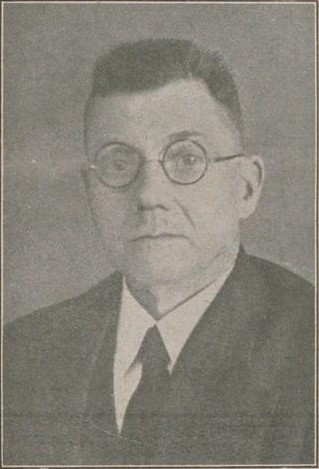
Gerrit de Vries, director of the butter factory in Aalten (1939)
Sources
De Nieuwe Aaltensche Courant, 7 May 1920 (Delpher)
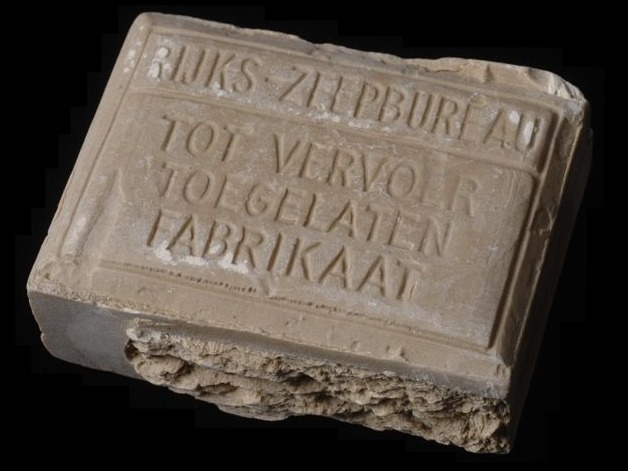
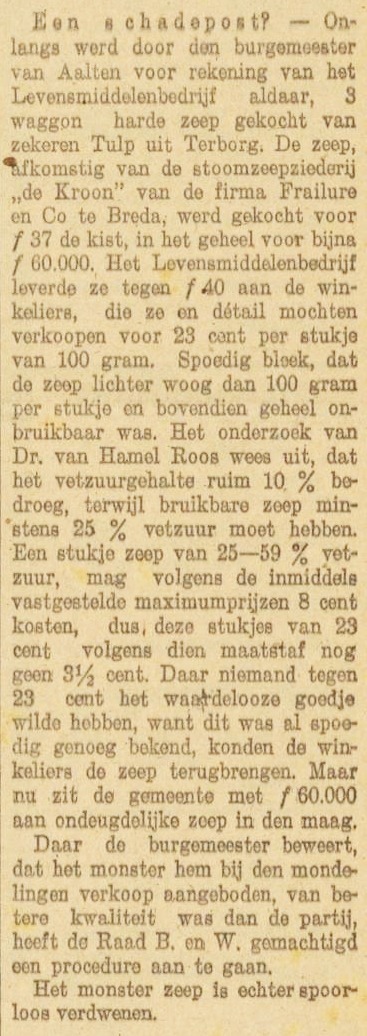
In 1918, the municipality of Aalten was defrauded of 60,000 guilders during the purchase of three wagons of hard soap that subsequently proved to be of worthless quality.
During World War I, the neutral Netherlands faced severe shortages of food, fuel, and numerous other goods. During the last two years of the war, a major shortage of soap also arose. Soap became scarce and expensive. The government intervened, partly because public health was threatened by the soap shortage. Soap factories were only permitted to produce so-called government soap. This could only be done sparingly, and therefore soap was rationed.
Sometimes fraudsters managed to pull off a major coup. The mayor of Aalten, A.J.W. Monnik, became a very naive victim of a well-known scam. On behalf of the municipal food company, he purchased three wagons of hard soap from a trader. The purchase price was ƒ 37 per crate. The local shopkeepers, who were to pay ƒ 40 per crate to the municipal food company, were then allowed to sell the soap for the retail price of 23 cents per 100-gram bar, which would have earned them a nice profit.
Worthless
But the plan fell through. It soon became apparent that the batch of soap had a very different composition than the sample the clever businessman had shown the mayor. The fatty acid content turned out to be only 10 percent, instead of the legally required minimum of 25 percent. According to the maximum prices established by the government in the meantime, such a bar of soap should only have cost 3½ cents.
It was no wonder that the housewives of Aalten left the shopkeepers stuck with their worthless goods en masse. The mayor had no choice but to take back the soap. The municipality bore the loss, which amounted to nearly ƒ 60,000.
Contradiction
Following this report, the firm De Fraiture & Co. in Breda, whose name was mentioned therein, declared that they knew neither the Mr. Tulp from Terborg mentioned as the seller nor the Food Company in Aalten. They also stated that they had never marketed bars of soap of approximately 100 grams and that, furthermore, they never manufactured soap with a fatty acid content lower than 20-25 percent. They were absolutely unaware of this matter. They suspected that a batch of their soap of the aforementioned quality or higher had been reprocessed into a poor quality by intermediaries.
Arnhemsche Courant, 6 July 1918
Sources
Soap scarcity in the Netherlands during World War I (1914–1918), by Rob Kammelar
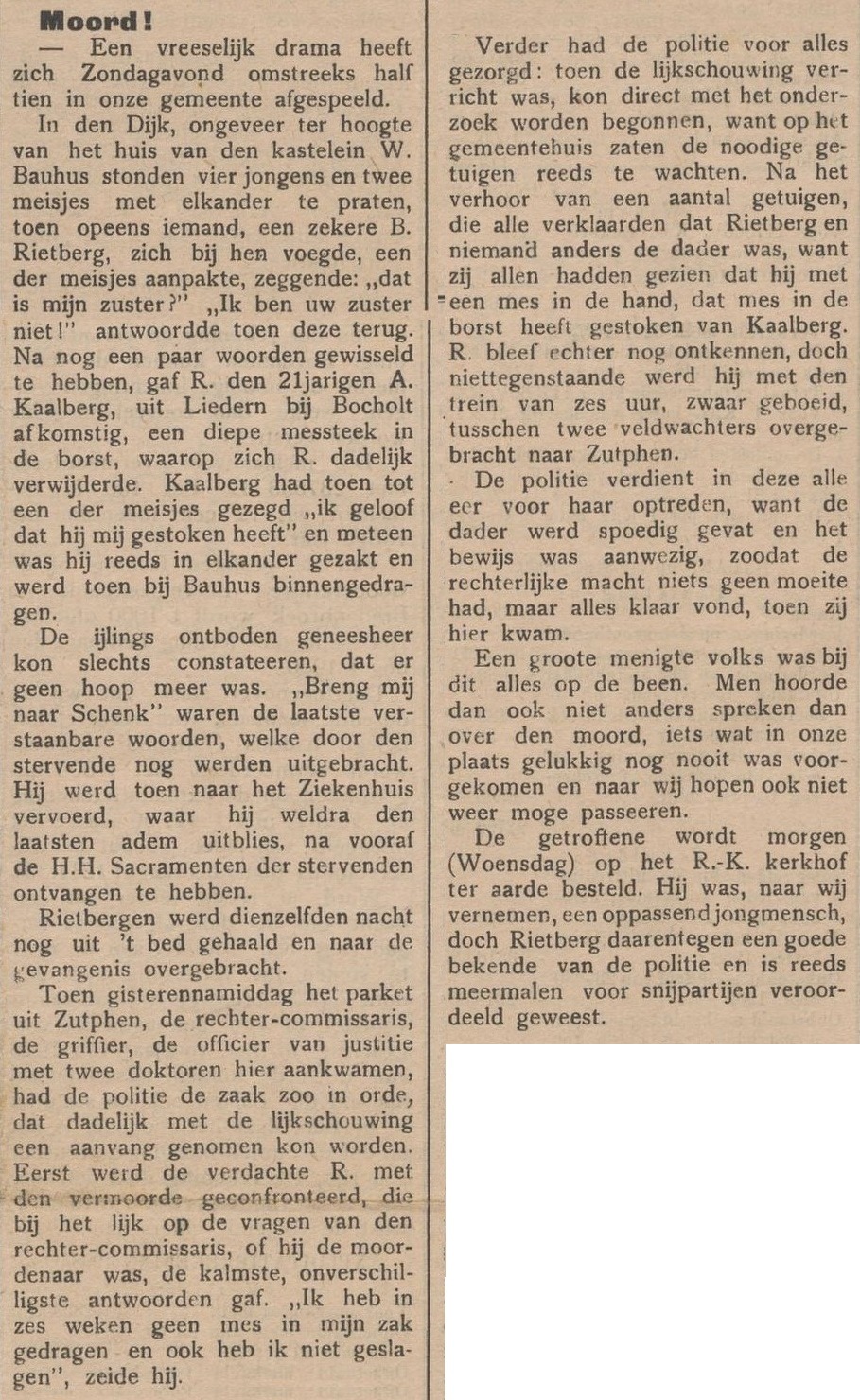
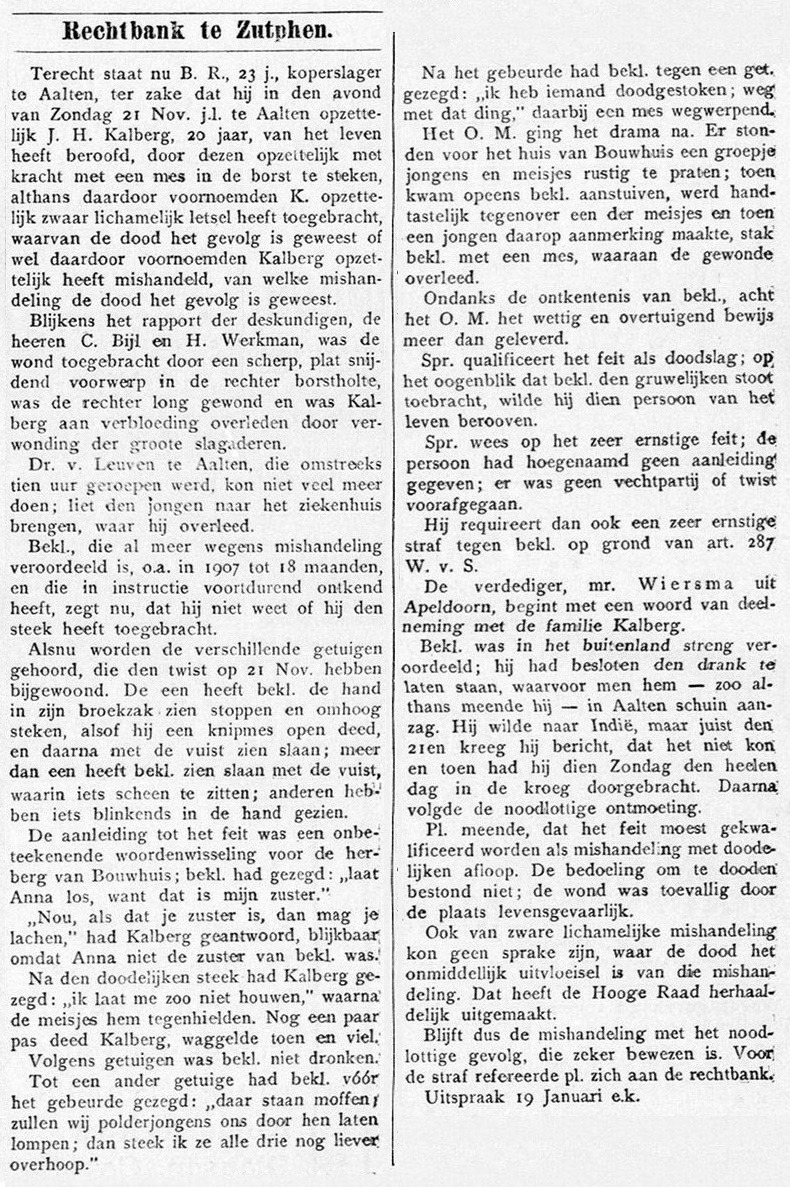
On Sunday evening, 21 November 1909, at around half past nine, a young man was killed at the beginning of Dijkstraat. Four boys and two girls were standing there talking to one another when 23-year-old coppersmith Bernardus Rietberg from Dale joined the group. He began harassing one of the girls, and an altercation ensued. Rietberg then stabbed one of the boys, 20-year-old factory worker Johann Heinrich Kalberg from Liedern (near Bocholt), in the chest with a knife.
While the perpetrator walked home in cold blood, according to newspaper reports, the victim managed to stagger a short distance into Kerkstraat before collapsing. His companions, including his younger brother, carried him inside Bauhuis’s café (Dijkstraat 1). Doctor Van Leuven was summoned in great haste to assist him. However, Kahlberg had been struck in his right lung so severely that nothing more could be done. The badly wounded youth was transported to the hospital on a cart. There, half an hour later and after receiving the Holy Sacraments, he drew his last breath. He had bled to death.
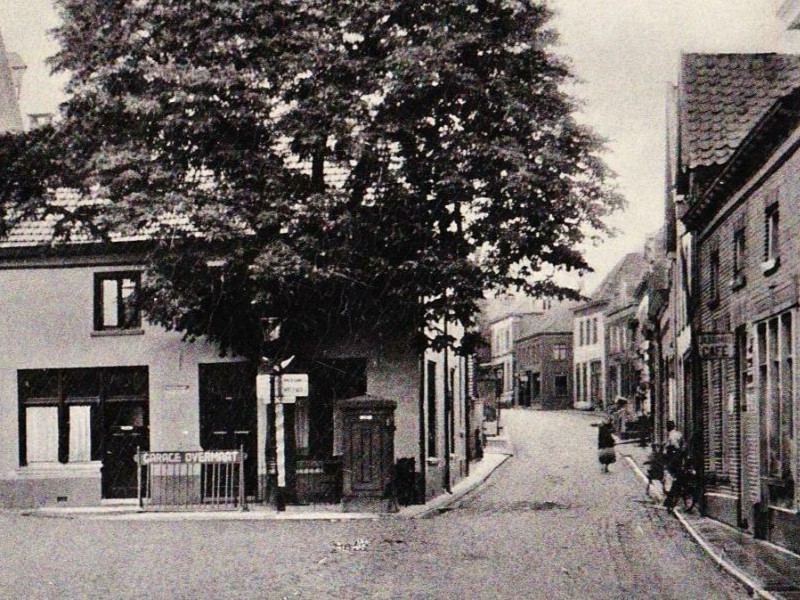
Café Bauhuis, Dijkstraat 5 (right)
Court case
Rietberg was roused from his bed by the police that very same night and taken to prison. The following day, judicial officials from Zutphen arrived in Aalten to investigate. At the end of the afternoon, they returned on the six o’clock train, this time accompanied by the handcuffed suspect. As the train departed, the assembled crowd voiced its fury with loud shouting.
The suspect initially denied that he was the perpetrator and also stated that he did not know the victim. The latter claim was highly doubted. A few days later, De Twentsche Courant reported that Rietberg allegedly had his eye on a sister of Kalberg, but that the latter had opposed it. This was considered a potential motive. However, whether this was a fact or merely a rumour remains unclear. The report of the trial in De Graafschapbode of 15 January 1910 makes no mention of it whatsoever.
Newspapers at the time were able to report that Rietberg had already run afoul of the law in Germany. He had also been previously convicted of assault. It is therefore hardly surprising that he was known in Aalten as an ‘extremely unfavourable’ character. He had reportedly been thrown out of Bauhuis’s café at nine o’clock on the evening of the crime. According to witnesses, however, he did not appear to be under the influence of alcohol.
On 19 January 1910, Rietberg was sentenced to six years’ imprisonment for taking the life of Johann Heinrich Kalberg.
National news
The murder in Aalten was national news at the time. The snippets below provide a fairly comprehensive picture of what was published.
Mr P., in Aalten, possessed a magnificent specimen of a parrot that had mastered the art of speech. A few days ago, the animal flew away and kept itself near a farmhouse. The bird’s talking led the farmer to believe that a “miracle bird” was threatening his farm, and so, by means of his rifle, he put an end to the bird’s “tasty, eh?” once and for all!
De Graafschapbode, 31 August 1907
A few weeks ago, we also reported on a parrot that had escaped from Mr P. in Aalten and was later shot dead by a farmer who mistook it for a miracle bird. The news made the rounds in several newspapers, and as a result, Mr P. received a letter this week from a lady in The Hague who possessed a “lorry” (parrot) that she was eager to part with. She addressed the letter as follows: — “To Mr P….. in Aalten, where 3 weeks ago the parrot was shot dead.” — The post office, clever as it is, delivered the letter to the correct address, and the lady in question was informed of its safe arrival.
Bernardus Hendrikus Bloemers was born on March 12, 1845, in Bredevoort, house number 7a, in the vicinity of the Misterstraat and Bekendijk. He was a son of Johannes Arnoldus Hendrikus Bloemers and Theodora Sessink. The family lived briefly on the Ambthuiswal, but departed for Terborg in December 1847.
Bernard’s life was no bed of roses. In 1896, he was arrested for vagrancy and, as punishment, admitted to the State Workhouse Veenhuizen I in Drenthe.
A wandering existence
The population register shows that Bernard certainly did not lead a settled life. From the age of sixteen, he stayed in numerous places, interspersed in his younger years with temporary returns to the parental home in Terborg:
1861–1862: ‘Esheren in Prussia’ (Esserden near Rees?)
1862–1864: Vethuizen, municipality of Bergh, as a farmhand on a farm
1867: Tegelen, Limburg
1867–1868: Beek near Sterkrade in Prussia (now Duisburg-Beeck)
1869: to Sterkrade again
1870: working as an iron molder near Ulft, after which he left for Isselburg
1872: Liège, Belgium.
Around 1873, Bernard married Johanna Francina Kok, born on January 21, 1848, in Oer near Ulft, presumably in Dinslaken. In 1877, he was recorded as “Bernardus Hendrikus Blummer” in the population register of Oosterhout near Tilburg, where he lived with his family, with the profession of sand molder. A few years later, they lived in Nijmegen, on the Steenstraat.
As far as is known, the couple had four sons:
Johannes Hermanus (Dinslaken, 1874 – 1876)
Johannes Arnoldus (Dinslaken, 1875)
Johannes Hermanus (Oosterhout, 1877 – Rotterdam, 1962)
Bernardus (Nijmegen, 1880 – Rotterdam, 1949).
In December 1883, the family left for Breda, and only a month later for ‘s-Hertogenbosch. In the population register, there is a difficult-to-read note behind Bernard’s name, possibly: “tried on October 9, 1884, in Utrecht”. Later, the family appeared in Rotterdam, where they seemed to settle permanently. Johanna passed away there in 1909.
It is striking that Bernard reappeared in Nijmegen in 1895 — without his family, coming from Zwolle. Why he left his family remains a matter of speculation. Poverty likely played a significant role. The frequent moves possibly point to an uncertain existence, in which one constantly sought better prospects — or fled from debts and problems.
In any case, Bernard’s life was no bed of roses, and the fact that he had fallen on hard times was confirmed shortly thereafter.
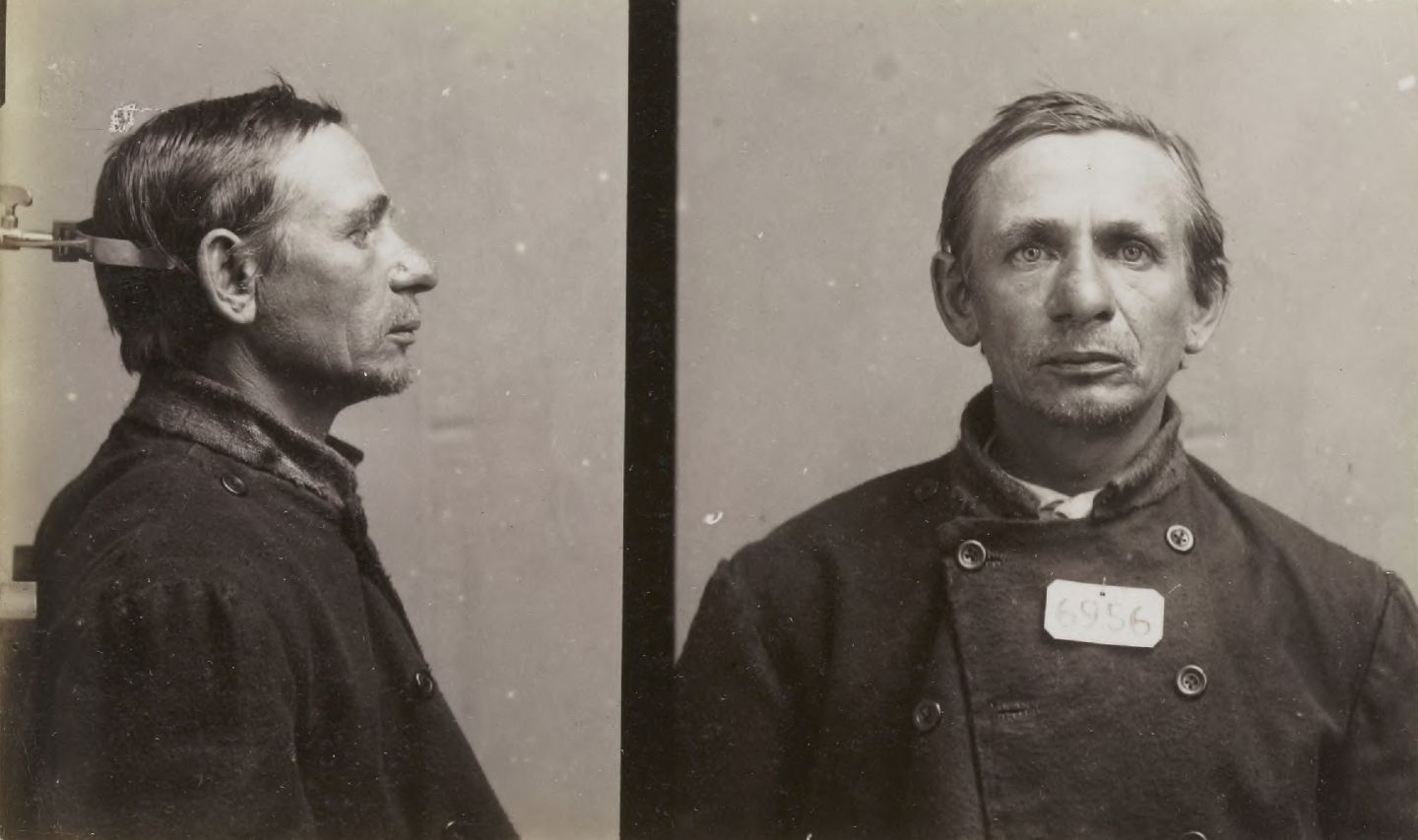
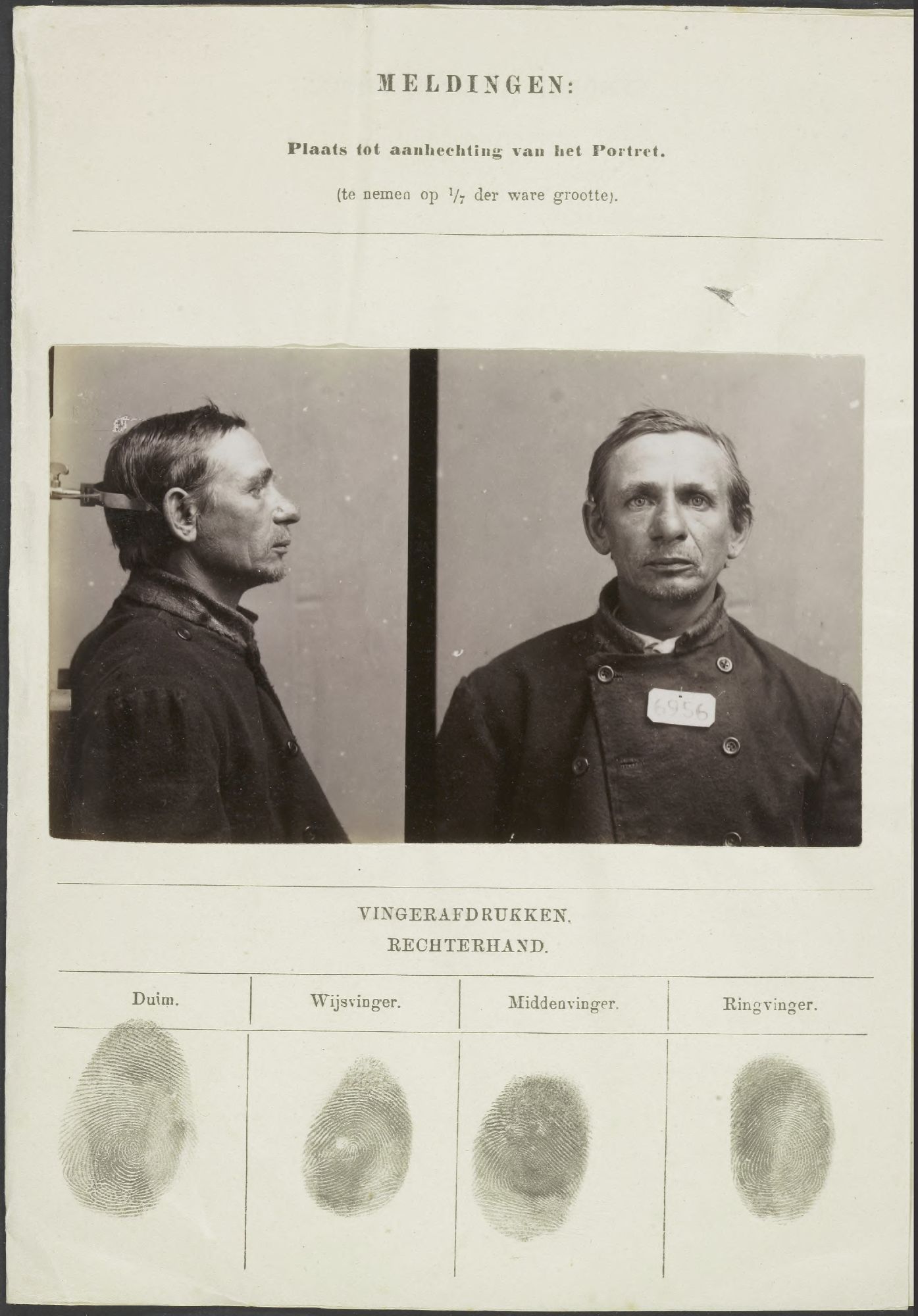
Description card of Bernardus Hendrikus Bloemers, Veenhuizen I, June 22, 1896
Admission to Veenhuizen
On June 22, 1896, Bernard was admitted to the Veenhuizen I State Workhouse for vagrancy. Upon entry, a description card was drawn up, featuring photographs, fingerprints, and a precise description of his appearance.
It is also mentioned that at that time he had no fixed place of residence (Nijmegen was noted as his last place of residence). His profession was ‘iron molder’, he had no identity papers, and was unmarried (!). He had been convicted of vagrancy in ‘s-Hertogenbosch. He had already been convicted twice before for the same offense.
The description card contains a detailed account of his physical characteristics, including his height (1 meter 51.9). His nose was broad, protruding, ‘with much blood showing through from below’ and with a scar on the right nostril.
What happened to Bernard after that remains unknown. We do not know if he ever left Veenhuizen, nor where or when he died.
Stay in the State Workhouse in Veenhuizen
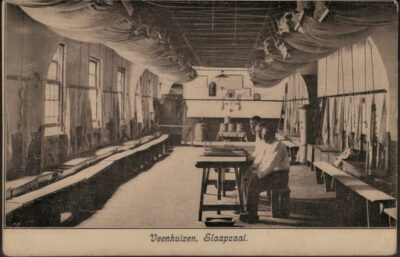
Dormitory Veenhuizen (photo: Prison Museum)
State Workhouse Veenhuizen 1 (the First Asylum) was a closed penal institution for men who had been convicted of begging or vagrancy. In this large-scale complex, discipline and labor were central.
The purpose of the institution was not only retribution, but also to effectively “combat vagrancy and begging” by purging society of individuals considered a nuisance and instilling discipline in them through forced labor.
Daily life was strict and sober under a military regime. Violations of the internal rules were punished with a stay in the punishment cell or a reduction in rations. The residents, referred to as wards, wore mandatory asylum clothing, slept in large communal wards, and were put to work six days a week. The labor consisted of heavy land reclamation on the heath or indoor work in workshops, such as weaving mats and repairing mailbags.
On 27 February 1880, a man who had served his prison sentence in Bocholt was escorted by a gendarme to the Dutch border near Aalten. Thanks to the excellent cooperation between the Dutch and Prussian border police, he was duly received at the border crossing by rijksveldwachter (national constable) Schaars Prins from Aalten, to be handed over to the Dutch justice system, which also had a bone to pick with him.
The former prison on Prinsenstraat in Aalten
The transport to Aalten took place by carriage. Upon arrival there, the man was taken to the house of detention. Everything proceeded quietly and orderly, until an individual who – as it later turned out – had followed the carriage at a trot, entered the prison.
When asked what he was doing there, a life-and-death struggle suddenly ensued between the prisoner and his friend on one side, and Schaars Prins, municipal constable Heersink, and the coincidentally present municipal messenger Gerhard Rots on the other.
After a few truncheons had been shattered across the bodies of the attacking rogues, Rots dealt out several blows with a type of frying pan, which was bent completely out of shape as a result. In this fight, the constables sustained only a few scratches and bruises, but the stout-hearted Rots was actually bitten on his nose, his hand, and in a certain hind part of his body.
Schaars Prins, who a few years earlier had been decorated by the German Emperor following an encounter with criminals in Aalten – who, having escaped from the prison in Bocholt, were nabbed by that moustachioed officer – held his ground firmly once again, yet would have been cut down with his own sabre had it not been for Rots.
In the end, all turned out well – the audacious rescue attempt failed, and the friends were put under lock and key. They were transported to Zutphen to have their case heard there and, undoubtedly, to receive their just deserts.
On the night of October 28, 1799, the lifeless body of 47-year-old Gesina te Winkel was found on the heath, near the border between the Aalten rural district of Haart and the German town of Barlo. She lay only a few minutes from her home and had multiple stab wounds. What had happened to her?
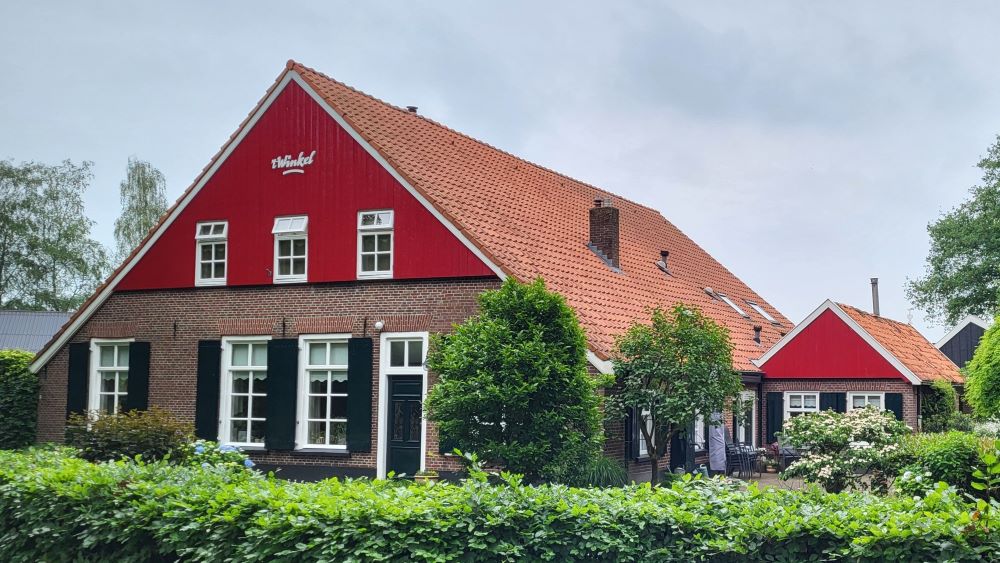
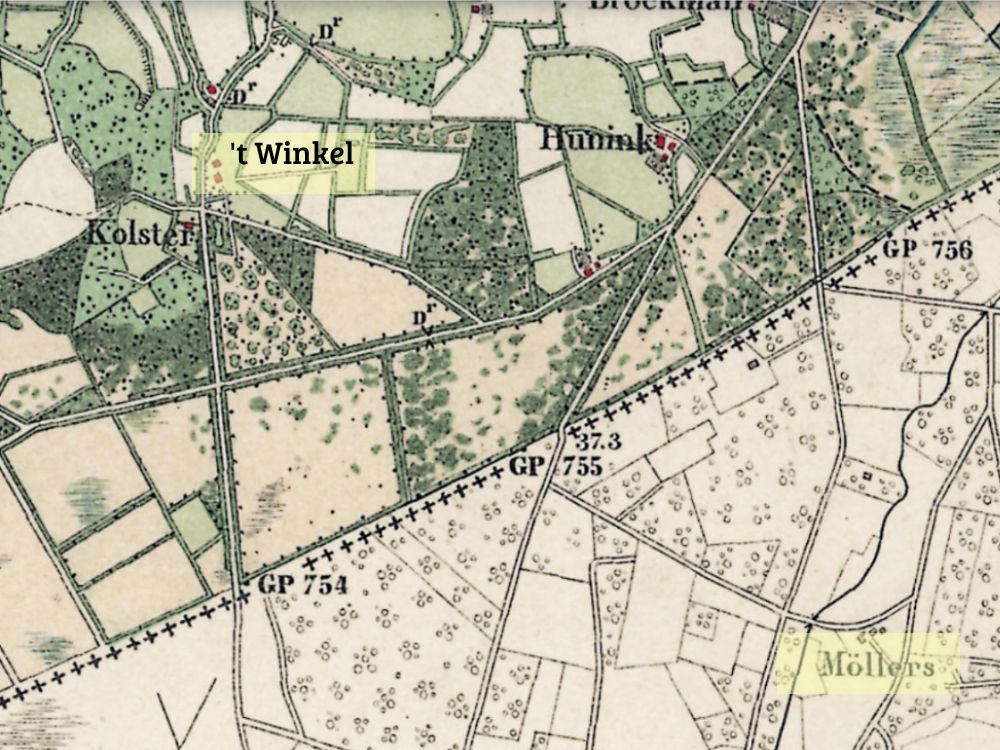
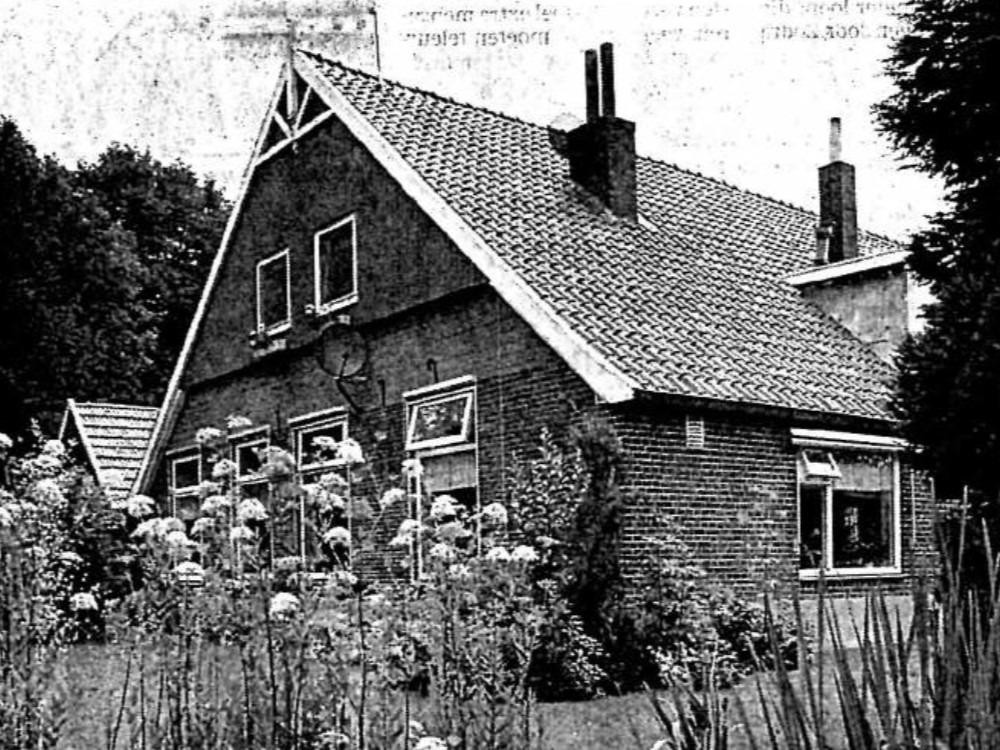
Gesina te Winkel was baptized in Aalten on April 30, 1752, as the daughter of Barent te Winkel and Enneken Dierkink.1 On April 20, 1777, she married Adolphus (Alof) Lensing2, who was later also called te Winkel. The couple lived at Gesina’s parental home, the ‘t Winkel farm in the Haart, only 800 meters away from the border with the then Bishopric of Münster, which is now part of the German state of North Rhine-Westphalia.
‘t Winkel farm in the Haart, photo: H. Schutte, 2024
The disappearance
On Sunday, October 27, 1799, around four o’clock in the afternoon, Gesina left home alone with a sandwich in her hand. She was on her way to the Möllers family to pick up some items of clothing. The Möllers lived just across the border in the Münsterland, about a fifteen-minute walk from ‘t Winkel.
When it began to get dark and Gesina had not yet returned, her husband Alof and their children began to worry. Where was she? Alof decided to go to the Möllers family’s house. He found three women there by the fire, who told him they had not seen Gesina that day.
Returning home, Alof wondered if his wife had encountered someone on the way or perhaps visited a neighbor. Upon arriving home, it turned out she was still not back. He then went out to search again, this time on the heath. When he could not find her there, he went to the Möllers’ house once more. The residents were already in bed, and when Alof knocked and asked about his wife again, the man and woman called out to him from bed that they had heard nothing of Gesina and that she had not been there that day.
Alof involved his nearest neighbor Hendrik te Kolste and the servant of his brother at Drenthel Schoppe, Harmen Swietink, in the search. Together they went out onto the heath once more to look for Gesina.
The discovery
By then it was pitch dark on the heath and they could see very little. Around midnight, one of them suddenly discovered something white. It turned out to be Gesina’s cap, with her lifeless body beside it. She was lying on her side; her feet were still warm, but the rest of her body was cold. She was found only five to ten minutes from her home. Alof had a cart brought and took her body home on it. He thought she had probably become unwell on the way and died as a result.
The judicial investigation
The following morning, Monday, October 28, Garrit Rensink, residing at the Beestmans Huisje farm in the Haart, reported to the court of the Seigniory of Bredevoort that the wife of his neighbor Alof te Winkel had been found dead on the heath the previous night.
Thereupon the court, accompanied by surgeon Steven Schaars, proceeded to ‘t Winkel. Upon examination of the body, it was determined that the woman had multiple stab wounds – three on her left side and two on her right side, presumably inflicted with a bayonet or a triangular object.
Apparently, they were not yet entirely convinced of the cause of death, because two days later the court went to ‘t Winkel again with Schaars for further investigation. During this, the deceased, who had already been placed in a coffin, was removed from the coffin and examined, whereby Schaars determined that the lower ribs on the right side were broken and that the wounds inflicted upon her had caused her death.
During interrogation, Alof, Hendrik, and Harmen stated that they initially thought they had found Gesina’s body on Dutch territory, but also that they had not been able to determine this properly due to the darkness. Upon further recollection, however, they were almost certain it must have been on Münster territory.
Hendrik and Harmen further stated that, as far as they knew, Alof te Winkel and his wife had a good relationship and that there was no question of disagreement or quarreling. They also stated that Gesina never quarreled with anyone, and that she “despite her years, looked very well.”
Arnoldus Obrink, a cooper in the Hoekstraat in Aalten, stated that he had seen Gesina around four o’clock that Sunday afternoon. He was walking on the road from Hunink to Aalten and Gesina was taking the road to the Münsterland, about 300 paces from her house. He had even spoken briefly with her while she was eating a sandwich. Furthermore, he had seen no one else in the vicinity.
An unconfirmed rumor
A rumor soon spread that Gesina had indeed been at the Möllers’ house that Sunday. According to the stories, a 13-year-old son of the family had been playing carelessly with a loaded gun, after which it accidentally went off and hit Gesina. It was even claimed that traces of the shot could still be seen in the chimney or near the hearth. However, there was no evidence for this rumor.
File to Bocholt
Because there was a strong suspicion that Gesina’s violent death had occurred on Münster territory, the drost of Bredevoort, Willem Paschen, sent a copy of the file to the court of Bocholt so that they could investigate this case further.4 Unfortunately, it is not known to us how this case ended. The tragic murder of Gesina te Winkel remains a mystery.
Funeral
In the Burial Register of the Dutch Reformed Congregation in Aalten, it is noted under October 1799: “deceased the 28th – Alof te Winkel his wife – buried the 31st”5
On the early morning of January 12, 1770, the neighbors of the Vosheurne farm in Lintelo were startled by a disturbing report. “The aunt is dead, she is very bloody, she may well have smashed her head,” resident Harmen Brunsink shouted. Extensive forensic investigation by the Court of Bredevoort revealed a story of a family conflict that degenerated into murder and would end with a gruesome execution.
Tensions in the House
Hendersken Tannemaat, born in 1705, had lived on the Vosheurne her entire life. Her niece, Gijsberta Deemshof, born in 1739 in Doesburg as the daughter of Hendersken’s sister Johanna, was raised by her ‘moeje’ (aunt) Hendersken from the age of three. In 1761, Gijsberta married Harmen Brunsink, born in 1729 at the Bekink farm in IJzerlo. After their marriage, Harmen moved in with Gijsberta and her unmarried aunt at the Vosheurne.
Initially, Hendersken lived with the young couple in exchange for board. In June 1768, however, she transferred all her possessions to Harmen and Gijsberta in exchange for room and board and all necessary care for the rest of her life. This was a common arrangement at the time between elderly people and their children—in this case, her niece and husband. Harmen and Gijsberta solemnly promised to fulfill this obligation.
However, the relationship between Harmen and the aunt deteriorated over the years, and tensions arose in the house. The aunt reportedly told Harmen several times that she wanted to undo the agreement “because you treat me so poorly!”
A Mysterious Death
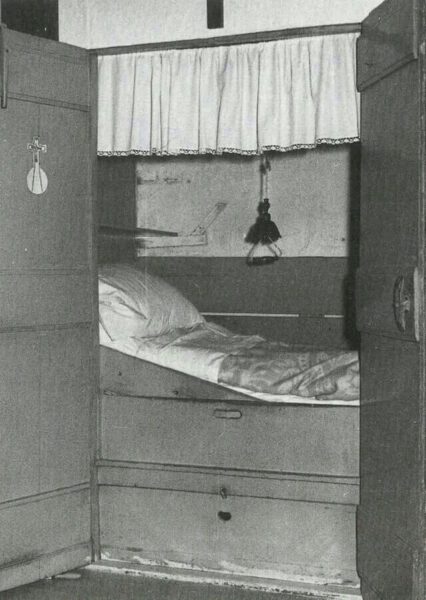
A box bed (photo for illustration)
On that fateful morning of January 12, 1770, Harmen frantically gathered the neighbors because the aunt was dead. It was customary in this region for neighbors to be called upon in the event of a death to arrange practical matters, such as the funeral and the ‘verhennekleden’—undressing the deceased and shrouding them in grave clothes. When the neighbor women entered the bedroom, they found Hendersken dead in her box bed, her hands folded over her chest. Her nose and arms were blue, and when her cap fell off, they discovered flour in her hair and blood seeping down her neck.
Gijsberta stated that she had used the flour to staunch the bleeding. Harmen added that the bruises were likely because the aunt suffered from scurvy, and that Hendersken had probably hit her head on the sharp edges of the bed plank. But the story did not add up. The neighbors did not trust it and brought the matter to the attention of the Court of Bredevoort.
The Investigation
Two days after Hendersken’s death, court officials arrived at the Vosheurne with two surgeons. Upon arrival, it appeared the body had already been coffined. In the presence of Harmen and Gijsberta, the surgeons examined the body. They discovered several severe injuries and bruises to the head. The injuries made it clear that an accident was out of the question. Suspicion immediately fell on Harmen and Gijsberta, who lived with Hendersken at the Vosheurne and could not provide a convincing account of what had happened.
Both suspects denied any involvement and claimed they had found Hendersken dead on the floor in front of her box bed that morning. They claimed to have placed her on the bed, sprinkled flour on her head to stop the bleeding, and put on her cap. However, their statements contradicted each other. Harmen had told the neighbors that he had found Hendersken dead in bed, not on the floor.
Voluntarily and without resistance, they went to Aalten, where they were taken into custody for further questioning. When the numerous head wounds were discussed, Harmen stated that these might have been the result of an epileptic seizure. Hendersken supposedly hit her head against the bed plank, the flax comb chair, the small chests, a trunk, or the beer stand. He also suggested that someone from outside the house could have broken in, as the house was in poor condition.
Further Investigation
On January 16, the Court, assisted by a doctor, a surgeon, and a prosecutor, returned to the Vosheurne with the suspects. Hendersken’s bedroom was meticulously examined.
The box bed showed a large bloodstain on the bed plank at the head end, as if the blood had splashed against the plank. But it had no sharp edges, as Harmen had claimed. Due to long-term use, the plank was actually rounded, and no sharp edges were found inside the box bed either. Other furniture in the room—small chests, a trunk, and a flax comb chair—showed no traces of blood. Nothing was found under the box bed either.
The doctor and the surgeon then examined the body even more closely. They stated primarily that there was a slight bruise on the nose, as well as severe bruising on both elbows, arms, and hands, beneath which coagulated, extravasated blood was found. These bruises could only have been caused by an external factor.
Not only on the right side of the head, at the level of the temple, were the external coverings and fleshy parts bruised, wounded, and destroyed down to the bone, but similar bruises and wounds were visible on the left side, albeit to a lesser extent. Two openings or wounds were discovered on the left side of the skull and one on the right, each about the size of a shilling. Upon loosening the external parts, it appeared that the skull had a fracture on the right side and that on the left side, the end of the skull bone was severely bent downwards and partially broken.
After sawing through and removing the skullcap, several ruptures were found. Due to these fractures and bone pressed outwards, the brain, particularly on the left side, was severely damaged. On both sides of the head, especially the left, extravasated blood was present on and under the dura mater and also within the brain itself. Furthermore, all blood vessels were completely filled with blood. This combination of injuries had inevitably caused her death.
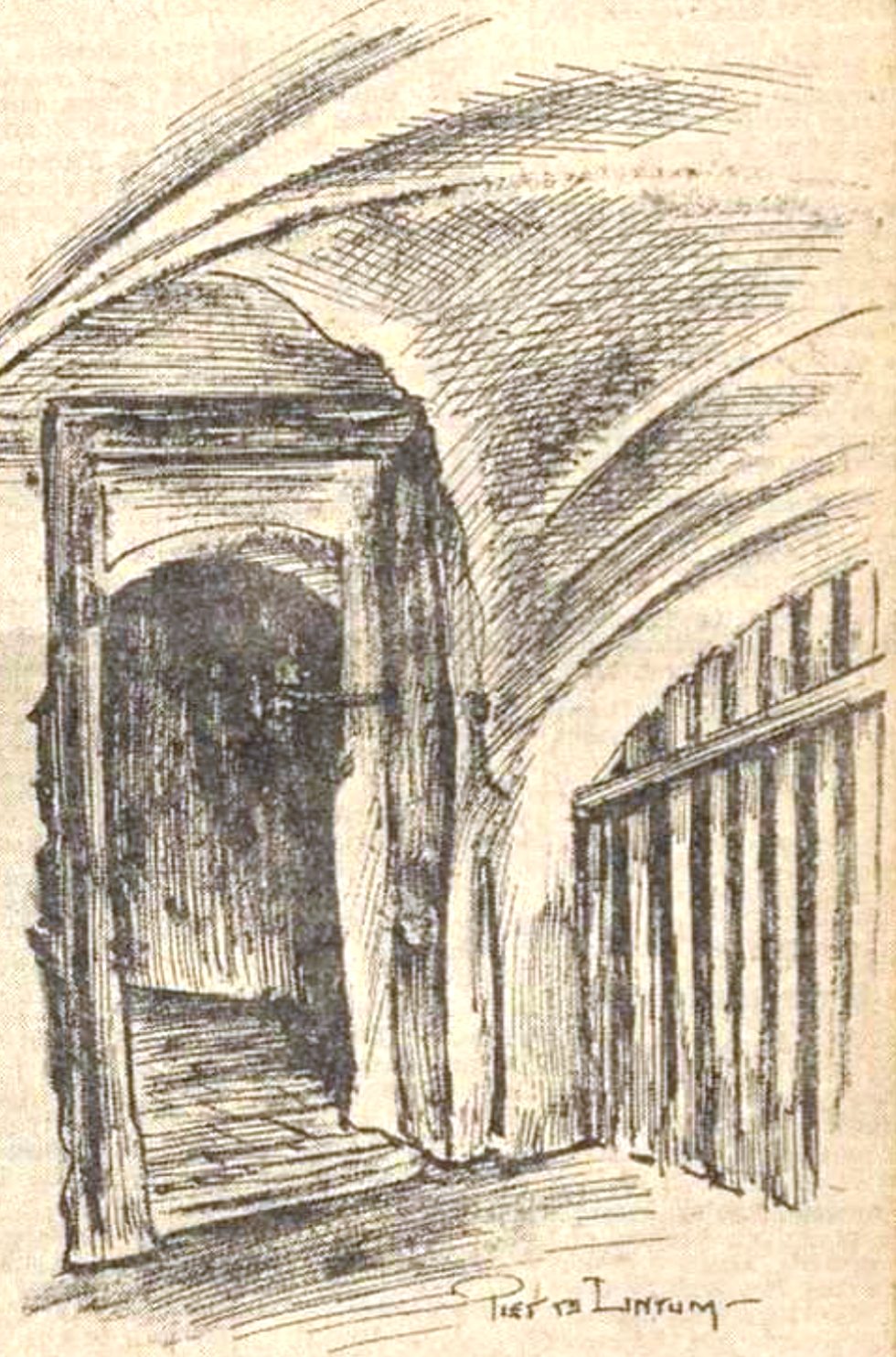
Although the suspects continued to maintain their innocence, the suspicions raised against them were only strengthened by these findings. From the situation on-site and the condition of the corpse, there was no longer any doubt that a murder had been committed. Such a thing could not happen unnoticed in a small cottage like that of the suspects, while they claimed to know nothing. The suspects were then transferred to the prison in the Ambtshuis in Bredevoort.
During the subsequent interrogations, Harmen and Gijsberta initially stuck to their story: Hendersken had died in an accident. But the evidence against them mounted. On January 19, a week after the murder, Harmen broke under the pressure and confessed what had really happened: He stated that he acted alone, without the help of his wife. He had previously said to his wife in bed: “There lies such a small pebble, I shall strike her five or six times on the head with it, then she will be gone, then the quarreling will be out of the house, then we can live in peace and unity.”
Around four hours before sunrise, he had risen, lit the lamp, went to Hendersken’s room, and hung the lamp on a nail above the box bed. Upon entering the room, the aunt woke up from the light. Thereupon, Harmen jumped into bed with her, sat astride her, held her head with his left hand, and struck her five or six times on the head with the pebble with his right hand, until she lay dead under his hands.
Gijsberta reportedly tried to stop him, but without success. When the aunt was dead and bleeding heavily, he ordered his wife to sprinkle flour on her head and wash off the blood. Afterwards, he called the neighbors. The stone with which he had struck her, he threw into the ditch behind the oven, near the spot where they fetched water.
Statement of Gijsberta
Gijsberta made her confession on January 20 and 22. She stated regarding her unhappy marriage: “Oh, how unfortunate I am! I married my husband against the wishes of my entire family, and from the beginning of our marriage, he has lived poorly with me.”
In the early morning of January 12, her husband, before he even rose, had said to her: “I will no longer have the quarreling in the house, I want to take decisive action, I shall get a pebble, and give the Aunt but one blow to the head with it, then she will be gone, and then the quarreling will be out of the house.” She was very upset by this, but he tried to reassure her, kissed her, and said: “Do not be dismayed, let me take decisive action, she is an old person, then we can have a peaceful life.”
He even came to her bed with gin and said: “You must drink plenty of gin, and you must be half-drunk, otherwise you would be too dismayed; we must now bite through a sour apple; but you must never betray me, even if I should happen to die, and you get another husband, then you must never say to him that I murdered your own blood.”
She then said to him: “Could you bring yourself to kill my own flesh and blood; if it comes down to it, then I must say it,” to which he had replied: “I will nevertheless take decisive action, I want the quarreling out of the house.”
When her husband was already in the aunt’s room and began striking her, he called Gijsberta to come there. She then went to the room, grabbed his linen smock to pull him away from the aunt, and said: “Fie, fie, what are you doing!” She added that her husband had forced her to be present, saying: “otherwise you might go and report me later.”
Gijsberta also stated that she had long been afraid to lie in bed with him, fearing he would attack her with a knife. That night, too, a knife lay in his trousers in front of the bed. She therefore also said to him: ”I am afraid that you will do me harm.” To which he assured her: “Oh no, I will never do you harm.”
She also confessed that her husband could not bear it if she was kind to the aunt, and that she had had constant sorrow with her husband since the aunt lived with them.
Gijsberta stated from the outset that she did not help carry out this gruesome deed. She also did not know what her husband used to beat the aunt to death, only that in the morning, while fetching water in the ditch in front of the house by the willows, she saw a gray pebble lying in the water that had not been there before.
Both suspects finally confessed that the aunt had never suffered from epilepsy. The neighbors and friends had also never heard of it, except only after her death.
The Verdict
The Court of the Lordship of Bredevoort ruled that everything indicated that Harmen Brunsink, on the night of January 11 to 12, 1770, had murdered Hendersken Tannemaat, a defenseless person estimated to be nearly seventy years old, lying on her bed in his house, in a gruesome manner, deliberately and with premeditation. Gijsberta was charged with failing to dissuade her husband, where possible, from this abhorrent intention.
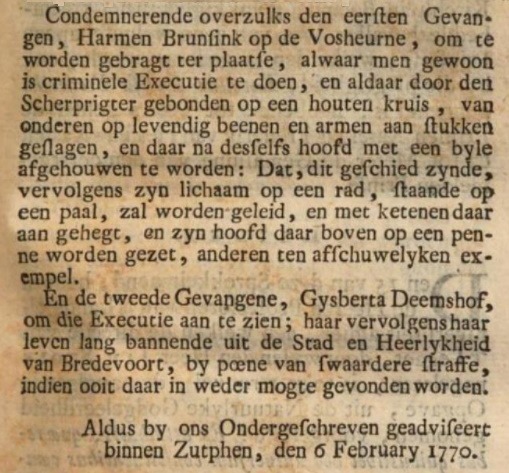
Harmen was sentenced to death: “to be brought to the place where criminal executions are customarily performed, and there to be bound by the executioner on a wooden cross, to have his legs and arms broken to pieces from the bottom up while alive, and thereafter to have his head severed with an axe. That, this having been done, his body shall subsequently be laid upon a wheel, standing on a post, and fastened thereto with chains, and his head set upon a spike above it, as a hideous example to others.” This punishment is called breaking on the wheel.
On February 10, the residents of Dinxperlo were summoned to the Hollenberg to erect the post and the wheel for the execution and to make the noose. Most refused or did not show up and were fined 30 thalers per person. 18 persons consented and erected the post and the wheel.
The sentence was carried out on the Hollenberg on February 12, 1770.
Gijsberta escaped the death penalty but was required to witness her husband’s execution. Subsequently, she was banished for life from the city and Lordship of Bredevoort. She remarried in 1776 in Silvolde to Jacob Kok and reportedly died in 1813.
Sources
Nieuwe Nederlandsche jaerboeken, of Vervolg der merkwaerdigste geschiedenissen, die voorgevallen zyn in de Vereenigde Provincien […]. Fifth volume. MDCCLXX, published by the heirs of F. Houttuyn in Amsterdam, P. van der Eyk and D. Vygh in Leiden, 1770 (link)
Klaas Nijman was baptized on January 16, 1698, in Dinxperlo as the son of Fredrik Nijman and Berentjen Eppink. At the age of fifteen, he left his parental home and began a wandering existence as a ‘beggar and vagabond’. In 1722, he was sentenced in Rhenen to a stay in a house of correction for violence and theft. His release was followed by banishment from the province of Utrecht.
Nijman then returned to the Achterhoek, where he sowed fear among the population, particularly in the vicinity of Dinxperlo and Aalten. He begged and stole, threatened people, and did not hesitate to use brute force. In 1729, he set fire to several houses and was arrested.
On October 3, 1729, following a trial in Bredevoort at ‘t Zand, Klaas Nijman was sentenced to death. He was taken to the Hollenberg, where he was strangled and subsequently set on fire. This gruesome punishment served as a deterrent to others. Nijman was 32 years old at the time.
Sentence
The following 18th-century text describes his crimes and sentence:
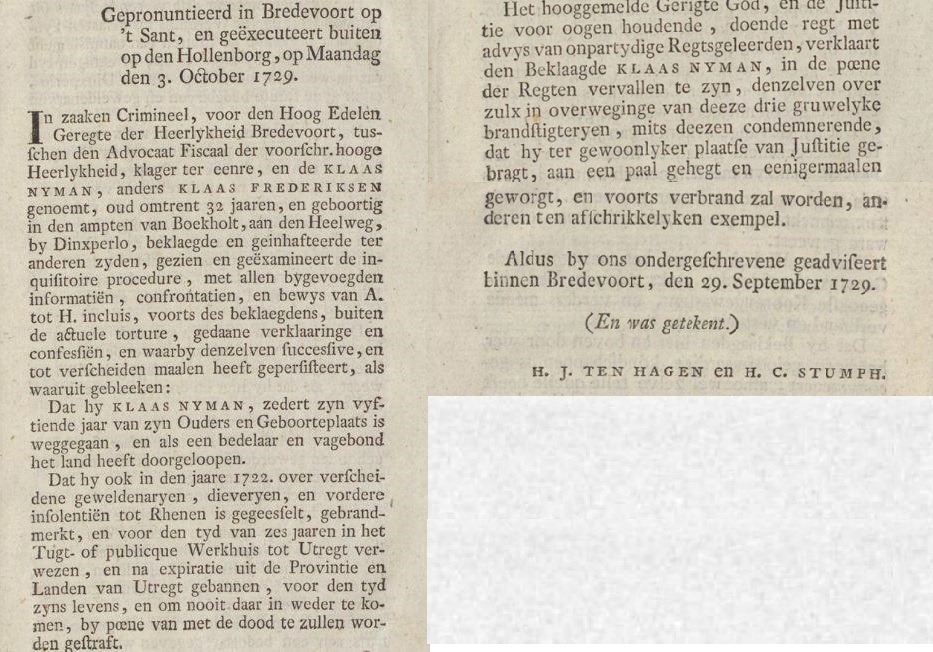
Pronounced in Bredevoort at ’t Sant, and executed outside on the Hollenberg, on Monday, October 3, 1729.
Verdict Klaas Nijman
In Criminal cases, before the Most Noble Court of the Lordship of Bredevoort, between the Advocate Fiscal of the aforementioned High Lordship, complainant of the one part, and KLAAS NYMAN, otherwise called KLAAS FREDERIKSEN, aged about 32 years, and born in the district of Bocholt, at the Heelweg, near Dinxperlo, defendant and prisoner of the other part, having seen and examined the inquisitorial procedure, with all attached information, confrontations, and evidence from A. to H. inclusive, furthermore the defendant’s declarations and confessions made outside of actual torture, and in which he has successively and at various times persisted, from which it has appeared:
That he, KLAAS NYMAN, since his fifteenth year has left his Parents and Birthplace, and has wandered the land as a beggar and vagabond. That he was also in the year 1722, for various acts of violence, thefts, and further insolences at Rhenen, flogged, branded, and committed for the term of six years to the House of Correction or public Workhouse at Utrecht, and after expiration banished from the Province and Lands of Utrecht for the term of his life, and never to return therein, upon pain of being punished with death.
That having been released from the aforementioned House of Correction or Workhouse about three-quarters of a year ago, yet the penalties of banishment remaining in force, he thereupon, or some time thereafter, returned to Dinxperlo, and continued in his bold beggaries and acts of violence. That he there, for a trifle on the public road near Dinxperlo, cut open the mouth of one DIRK WENSINK with a knife.
That he likewise, after his aforementioned release, again committed various thefts, such as of ironwork and an axe, and of linen, such as a pillowcase or sheet on the other side of Doesburg at the Steege; and also a shirt from the garden at HENDRIK te Loo or Kistershuis, between Dinxper and the Bredenbroek, and further as by the Reformations. That he, KLAAS NYMAN, has also for years past been notorious and held in suspicion by many inhabitants under Dinxperlo and Aalten, as being of no good and committing much evil.
That he also, following the . . . . of the sentence at Rhenen, was held suspect there of having committed very grave offenses. That the defendant, through his . . . . and malicious conduct and questionable language which he used here and there, has kept the good husbandman and the inhabitants in the countryside, and especially around Dinxperlo and Aalten and the surrounding area, in a state of constant anxiety and fear. That when he came to beg, he was not satisfied with what is ordinarily given to a beggar, although he was often given even more, and went away from the houses muttering to himself.
That this anxiety and fear among the inhabitants has doubled and reached its peak since fire broke out in the Parish of Aalten in this year 1729, and that further and even more burnings of houses close by followed. Such that several inhabitants ordered their people that, if KLAAS NYMAN came to their houses, they should just give him whatever he wanted, to gain his friendship and not to anger him, and that several people, out of fear of arsons, had to keep night watches at their houses during the night, whereby even some hamlets were placed in a state of near alarm.
That he, the defendant KLAAS NYMAN, is also the one who has come to such exceedingly wicked crimes that in the past Summer in the Parishes of Aalten and Dinxperlo, of this same year 1729, from June 13 to August 29, and thus within the span of a quarter-year, he has set fire to three houses, one after the other, and by no means the smallest, which houses were also totally burned down, and of which the corpora delictorum are known.
Namely, on June 13, the house at Lensink, under Aalten on the Esch at Yserlo, where he set a piece of white or spongy peat on fire by means of a tinderbox, flint, and tobacco pipe, and with that burning peat at the back on that side of the house where the wind was blowing against the house at the time, caused the fire. That eight days prior he had also set the same house Lensink on fire, and that it had already been burning, but that it was then still extinguished by the occupants.
Secondly, the house at Welink, also under Aalten on the Esch at Yserlo, on June 20, where he carried out the fire in the same manner as at Lensink with a piece of ignited spongy peat, and therewith set the house on fire from behind. That for both his arsons, at Lensink and Welink, he gives as his reason that he had done so to create anxiety and terror in the neighborhood, or among the people.
Thirdly, the house at Grevink, at ‘t Rexwinkel in the hamlet of Heurne, under Dinxperlo, on August 29, in the evening around 10 o’clock, when he caused the fire there with an ignited fuse made of linen rags, in the straw that lay at the back on the corner partition of the house. That in this aforementioned house Grevink, when it caught fire, a young woman in childbed, who had not yet been in childbed for two days, lay on the bed, and who by great fortune still having the strength to get off the bed, still escaped the fire. That he, KLAAS, gives as his reason for this arson at Grevink that he had done so because the same aforementioned woman in childbed, a long time ago when she was still unmarried, had given him a piece of pancake that had been too small for him.
That at Welink and at the last-mentioned Grevink, several pieces of live Cattle, harvested Grain crops, and further items were also burned and consumed. That he, the Defendant, is furthermore convicted by four sworn credible witnesses, although he himself has tried to deny it telle quelle, that on August 31 last he spoke those grim words at the house of ARENT OOSTENDORP, in the hamlet of Heurne, under Dinxperlo, that this or that corner would shortly be a poor corner.
That he furthermore has threatened to set fire to the house of the drummer boy within Dinxperlo, and has stood by and persisted in this, that if he had not been captured, he would indeed have done it, and similar terrible threats and dangerous utterances of the Defendant, as the information and confessions herein further set forth.
The highly-mentioned Court, keeping God and Justice before its eyes, doing right with the advice of impartial Legal Experts, declares the Defendant KLAAS NYMAN to have incurred the penalty of the Law, condemning him for the same in consideration of these three gruesome arsons, that he be brought to the usual place of Justice, fastened to a stake and somewhat strangled, and furthermore shall be burned, as a terrifying example to others.
Thus advised by us undersigned within Bredevoort, September 29, 1729.
(And was signed.)
H.J. TEN HAGEN and H.C. STUMPH
Source
Legal Treatises on Corporal Crimes by a prominent Legal Expert (Jan Jacob van Hasselt), published in Amsterdam by Hendrik Gartman, 1781 (link)
Beheer toestemming
Deze website gebruikt cookies voor een optimale ervaring en analyse van bezoekgegevens. Ga je hiermee akkoord? Zonder toestemming werken sommige onderdelen van de site mogelijk minder goed.
Functioneel
Always active
De technische opslag of toegang is strikt noodzakelijk voor het legitieme doel het gebruik mogelijk te maken van een specifieke dienst waarom de abonnee of gebruiker uitdrukkelijk heeft gevraagd, of met als enig doel de uitvoering van de transmissie van een communicatie over een elektronisch communicatienetwerk.
Voorkeuren
De technische opslag of toegang is noodzakelijk voor het legitieme doel voorkeuren op te slaan die niet door de abonnee of gebruiker zijn aangevraagd.
Statistieken
De technische opslag of toegang die uitsluitend voor statistische doeleinden wordt gebruikt.De technische opslag of toegang die uitsluitend wordt gebruikt voor anonieme statistische doeleinden. Zonder dagvaarding, vrijwillige naleving door je Internet Service Provider, of aanvullende gegevens van een derde partij, kan informatie die alleen voor dit doel wordt opgeslagen of opgehaald gewoonlijk niet worden gebruikt om je te identificeren.
Marketing
De technische opslag of toegang is nodig om gebruikersprofielen op te stellen voor het verzenden van reclame, of om de gebruiker op een site of over verschillende sites te volgen voor soortgelijke marketingdoeleinden.