
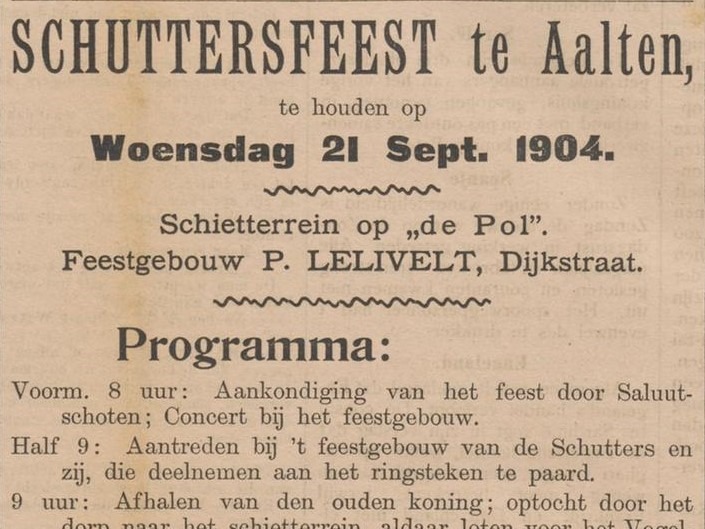
Aaltensche Courant, 24 September 1904
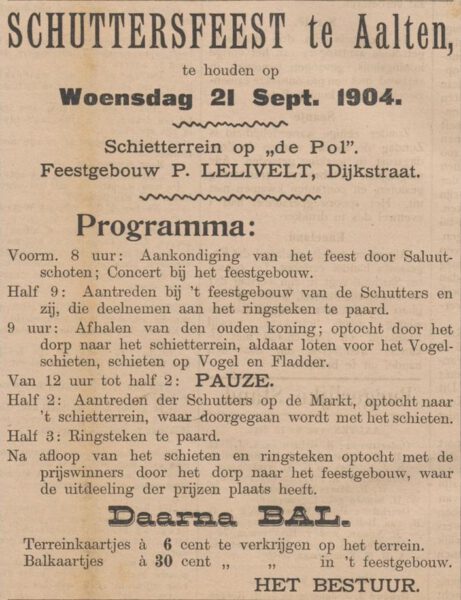
Although it was rather late in the season, a Marksmen’s Festival was to be held again that year, for the first time since 1900. In 1901, 1902 and 1903 the cycling club ‘Houd Moed’, either on its own or together with ‘Floralia’, had organised a celebration. But as the cycling club had, we were told, been disbanded, no festivities could be expected from that quarter.
It was therefore a good idea on the part of several workmen to try to organise a Marksmen’s Festival. Thanks to the generous support of local residents, who made substantial contributions, and to the large number of shooting enthusiasts who entered, this proved possible. The number of marksmen was more than twice that at the previous festival.
The procession through the village on Wednesday morning attracted a great deal of attention and was well worth seeing. With a fine band leading the way, it proceeded in good order through the various streets, and flag salutes were performed outside the homes of the mayor, the parish priest and several private residents. At the festival ground the poles were already in place, with the wooden bird and the ‘fladder’ targets at the top, on which the marksmen could demonstrate their skill.
The bird had been made particularly sturdy, and it therefore took a remarkably long time before it became clear who would be honoured as king of the Marksmen’s Festival. Eventually the different parts of the bird were shot away. First prize for bringing down the body went to A. H. Huinink, who thereby became king. D. Dibbets won second prize for shooting off the right wing. Third prize for the left wing went by draw to J. H. Papenborg, while J. Walvoort received fourth prize for the head and G. J. Wensink fifth prize for the tail.
In the ‘fladder’ shooting, the most skilful marksmen were H. J. Degenaar, who won first prize; G. W. van Eerden, second; H. A. Hoopman, third; G. J. Brunink, fourth; and Chr. Bijen, fifth. In the ring-riding competition on horseback, the prizes were won by H. Bouhuis, first; W. H. Veldkamp, second; J. Heersink, third; J. B. Bouhuis, fourth; and A. J. Mateman, fifth.
At about six o’clock, when the competitions had ended, another procession made its way through the village to Mr P. Lelivelt’s festival hall near the railway station. There the chairman of the festival committee, Mr De Wit, presented the prizes to the winners with a few appropriate words, after which the gathering continued in cheerful spirits for a long time. As the festival had been a great success and everything had proceeded in the best possible order, the organisers could look back on their work with pride. Such work always involved much effort and sacrifice, but they had given many people an enjoyable day, which in itself was a fine reward.