
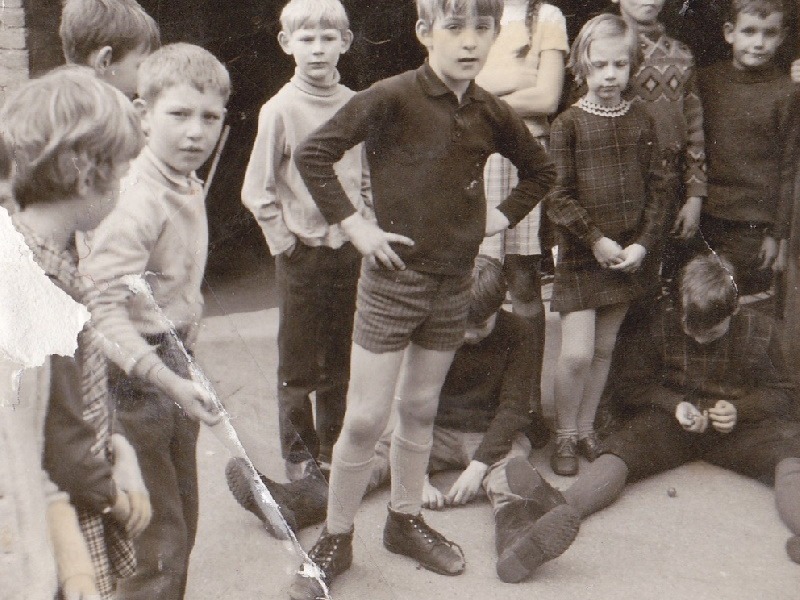
In 1937, G.H. Rots wrote a series of articles in the Aaltensche Courant describing everyday life in Aalten in earlier times. He also wrote about the games children used to play:
“Children’s games have changed a great deal too; several games that children used to play are no longer seen, including ‘bikkelen’ (knucklebones).
Marbles
“Boys also played marbles very differently in those days. It was a game of skill, and by no means every boy was good at it. The large round ‘marvel’ was held between the thumbnail and the index finger and flicked away, with the aim of striking a marble. You could play for one marble, two marbles or a small pile.
There had to be at least two players, although there were usually more. The marbles were placed about two metres apart, depending on the number of players. In turn, each player shot with his marvel, and whoever hit the most marbles won the most.
Once you had won a few marbles, you had to make sure you did not come too close to the starting line or to a neighbouring player. If another player managed to hit your marvel, you had to hand over the marbles you had won.
You could also ‘set’ yourself. If someone’s marvel lay ‘two handspans and a knuckle’ away from a pile or from marbles that had been staked, he could place his marvel beside the pile and then, on his next turn, try to ‘draw’ the whole lot. A skilful player could manoeuvre his marvel right up close to someone else’s and then only had to hit that marvel for all the staked marbles to end up in ‘zienen knikkerbuul’ — his marble bag. It is a great pity that this interesting game has fallen into neglect and has now become little more than aimlessly throwing marbles through holes in a board.”
Mottekoezen
“Another game that is no longer played was ‘mottekoezen’. It was usually played by four or five boys. In a patch of sandy ground, as many holes were dug as there were players. The holes were about 15 centimetres deep and wide. Each boy had a stick and kept it in his hole. The player who started had to try to knock a ball with his stick into one of the other players’ holes. That player defended his hole with his stick, but whenever he was not trying to block the ball he had to keep the stick in the hole.
If the player with the ball succeeded in getting it into someone else’s hole, the player who had been caught out then had to try to get the ball into one of the other holes. It was therefore a battle with sticks along the ground to strike the ball. Sometimes a swing missed and a stick struck another player’s legs. But boys did not go around with bare knees in those days: they all wore long trousers, so the risk of serious injury was small.”
Hoed je! de bal
“Another game was ‘Hoed je! de bal’. Boys all wore caps in those days, which is why the game can hardly be played now that almost everyone goes bare-headed. A number of boys placed their caps in a row against a wall. The boy whose cap was first in the row began. He stood about two metres from the caps and tried to throw a ball into one of them. He did not always succeed, but if he did, the owner of the cap had to grab the ball quickly and try to hit one of the other boys. By then they had scattered in every direction, although a quick thrower could sometimes still hit someone.
If a boy was hit, a small stone was put into his cap. If the thrower missed everyone, a stone went into his own cap instead. Taking turns in the order of the caps, each boy tried to throw the ball into one. Usually he aimed for someone else’s cap, but sometimes a boy deliberately threw into his own so that he could be first to seize the ball and quickly hit one of the others. Once someone had five stones in his cap he was out — ‘melk’, as the boys called it. The last player left was the winner. It was a very exciting and widely played game.
Mieroo
A chasing game often played by boys was ‘Mieroo’. One boy stood in the street, while a group of boys stood about 25 metres away. At the cry of ‘Mieroo’, they charged towards one another. Anyone touched by the boy standing alone had to join him. The group of catchers therefore grew until the last boy had been caught. Agility mattered above all: a quick, nimble player could repeatedly slip through the line without being touched.
Meneer ik ben de bukersteen
A game sometimes played by girls and boys together was ‘Meneer ik ben de bukersteen’. The way the game was played helps explain the idea behind the name. On a roughly marked-out piece of ground, one girl or boy took up position and treated the area as his or her own property. The other players stood around it and stepped onto the forbidden ground while calling out, ‘Meneer, ik ben op verboden terrein’ — ‘Sir, I’m on forbidden ground’ — to make clear that they had entered territory where they did not belong.
The sole ruler then had to try to catch the intruders. Anyone who was caught or touched had to help defend the territory. The boldest players ventured far into the forbidden area, while the more cunning ones took only a couple of steps over the boundary so that they could jump back immediately when danger threatened. Once the last player had been touched, the game was over and another game was thought up.
Meentje smieten
There were no unemployed boys in those days. Boys had to start work at an early age, either in a factory or on a farm. But on Sunday afternoons they would get together and go ‘de bussche in kateerkers jagen’ — into the woods to chase squirrels — and if they had a little pocket money, they sometimes played a game with pennies called ‘Meentje smieten’. A line was drawn on the ground and the boys stood two metres away and tossed a penny towards it. Whoever landed closest to the line, or on it, was allowed to pick up all the pennies that had been thrown. He shook them between his closed hands, tossed them up, and kept any coins that landed with the little lion facing upwards. It was therefore a kind of gambling game, and by no means every boy with a little pocket money took part in it.”