
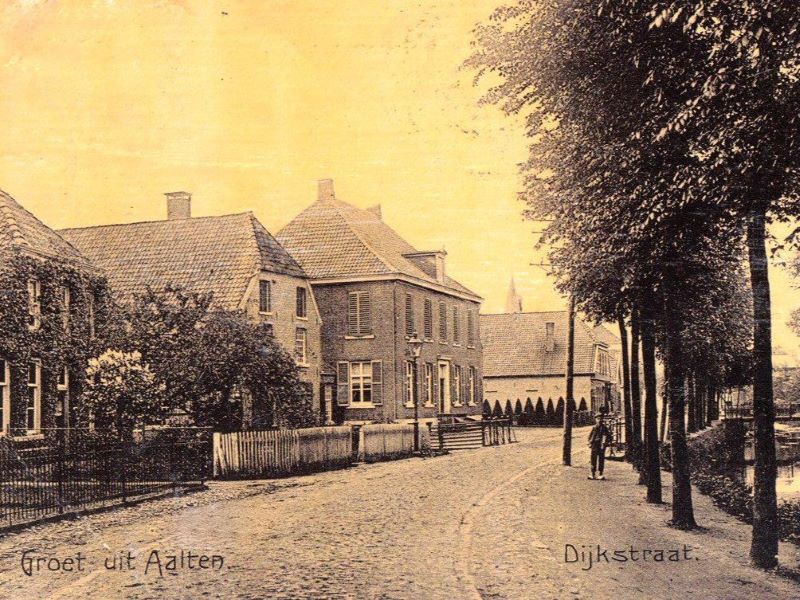
Dagblad Tubantia, 11 July 1953
About fifty years ago, on a dark summer evening, a ghost sat on the railing of the bridge over the Slingebeek in Dijkstraat, Aalten. The ghost was dressed in white, had black legs and from time to time cooed softly like a pigeon or snorted like a pig. It sat there almost motionless, terrifying anyone who had to make their way through the quiet and sparsely lit Dijkstraat late at night.
Young lads who only minutes earlier had been boasting to their girlfriends about their courage suddenly lost their nerve as they approached the bridge and saw the white figure sitting there, calm but ominous. Elderly men and women living nearby pushed the bolts more firmly across their doors; at least that way the ghost could not get inside.
‘Willum, bun ie ‘t!’
While frightened people gathered on either side of the Dijkbrug and nobody dared pass the ghost, Hendrik — a sturdy farmhand from IJzerlo — came striding into Dijkstraat from Kerkstraat. Everyone knew that Hendrik had the strength of two men and the courage of four, but this… ‘Good evening,’ said Hendrik, greeting the anxious people to his left and right. Then he walked boldly onto the bridge. The tension was enormous. People thought that even the tower clock of St Helena’s Church had stopped ticking…
‘Good evening,’ Hendrik said to the ghost. A splash followed, then a heart-rending cry, and moments later ‘the ghost’ crawled up the bank of the Slingebeek. A white sheet floated away with the current and a human figure emerged beside the bridge. A woman then rushed forward and screamed: ‘Willum, bun ie ‘t!’ — ‘William, is that you!’ She embraced ‘the ghost’ whom, less than ten minutes earlier, she had watched from a distance with chattering teeth…
Local History Museum
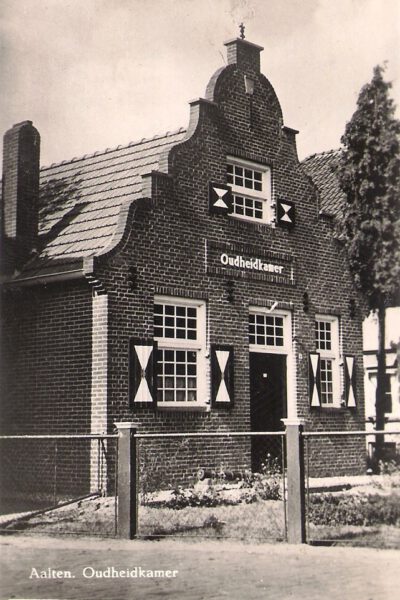
This story took place in Aalten fifty years ago. In those days ghosts were constantly being seen in Aalten and even more often in Bredevoort. People regarded them with great awe, and when they sat together talking in the evening by the light of a small oil lamp, conversation repeatedly turned to ghosts. Nowadays people laugh at such stories, but anyone who has visited the Local History Museum in Aalten and spoken to its guide, G.G.W. Essink, can gain some sense of the superstitions held by the people of Aalten and Bredevoort in former times.
People had to do their evening work by tiny oil lamps, if they lit one at all. If there was a fire burning in the open hearth, no lamp was often lit: that would only have cost unnecessary money, and the fire gave enough light. It also cast a ghostly glow. The atmosphere was therefore perfect for ghost stories, and such tales were never in short supply.
Mischievous boys took advantage of the population’s superstition by regularly appearing as ‘ghosts’. They were often frightened even of themselves. So afraid were many people in Aalten and Bredevoort that they did not want their children making figures with their hands in the evening and casting shadows on the wall by lamplight. Even these harmless ‘shadow rabbits’ caused unease. You never knew. Strange things were said to happen…
Street lighting was very limited, and everything therefore helped create a genuinely ghostly atmosphere. The Local History Museum still has an open hearth, with small lamps hanging in front of the chimney, and the guide is happy to tell visitors about the ghosts of former times.
A ‘Princely’ Fireback
Ghost stories are by no means the only things to be found in the Local History Museum. The small building in Dijkstraat, constructed in traditional style, contains a great many objects from earlier times. One example is a fireback bearing the inscription Georg Friderich, fürst zu Waldeck.
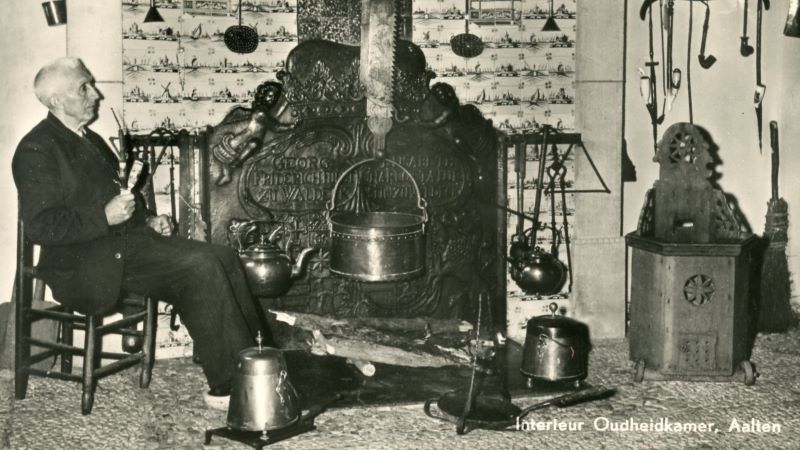
Centuries ago this prince lived in Culemborg. In the sixteenth century he had the first Lutheran church there built. The fireback made for him at the time, decorated with no fewer than nine coats of arms, eventually found its way to Aalten after many wanderings. Although very large sums have been offered for this work of art, the Local History Museum in Aalten does not wish to part with it.
A magnificent wooden spoon rack is particularly striking. It is rich in symbolism and depicts the Passion and death of Christ. An old-fashioned child’s chair is, of course, also part of this collection of historical objects, as is a waffle iron several centuries old. The thing weighs almost a kilogram, and there is little need to ask whether women who used to bake waffles had strong arms. They almost certainly did.
The clock frame from the Dutch Reformed church in Bredevoort has also found a home in the Local History Museum. After the flat pendulum had been invented in 1657, a clock equipped in this ‘modern’ fashion was installed in Bredevoort’s tower as early as 1666. After ticking away the minutes in the old town for about 280 years, it was replaced by a more modern mechanism. One drawback of the old clock was that it had to be wound every morning.
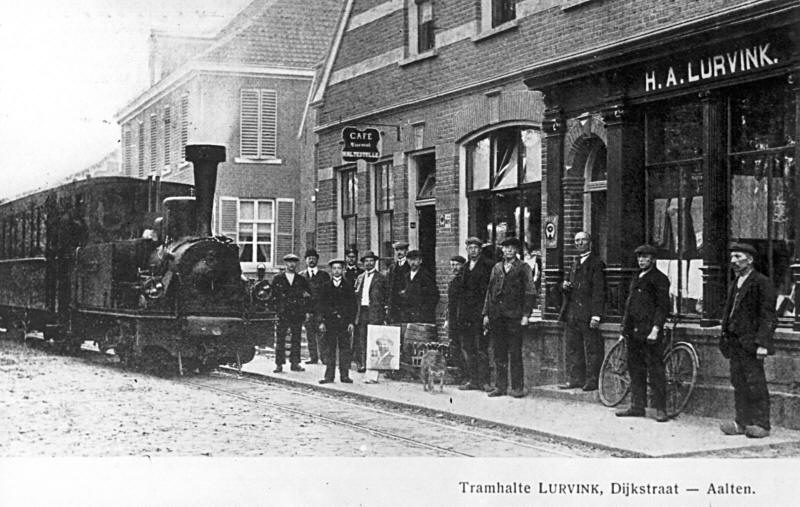
The Local History Museum in Aalten has recently also begun displaying photographs of old Aalten. Thanks to the efforts of Aalten’s Belang, these photographs have been acquired. Former residents of Aalten in particular take a great interest in them. One photograph, for example, shows the arrival of the first tram in Aalten. There was great excitement at the time. Last week the rails were torn up. Sic transit gloria…
The Dutch Railways station once stood in an open field. Local people complained that the station was terribly inconvenient, far outside the village. Now they grumble because the railway runs through the built-up area and they have to wait at closed level-crossing gates. There are also photographs of the former Market Square with its old pumps. It is still a great pity that the municipality removed those old pumps a few years ago.
Two old-fashioned bicycles — velocipedes, as they used to be called — stand in the Local History Museum. They are contraptions that might make one think our ancestors were amateur circus acrobats. They were not, of course, yet they rode these ‘bicycles’, with their huge front wheels and tiny rear wheels, through the streets of Aalten. During the last war — eight years ago — these bicycles were even used by German soldiers. If they failed to obtain an ordinary bicycle in Aalten, which often happened, they would in desperation take a velocipede from the Local History Museum and ride it to Bocholt.