
Graafschapbode, 7 December 1934
‘If you’re talking about sausage and sausage-making, I can point you to someone here in Aalten who’s been making sausage for more than sixty years — I think it may even be sixty-five. She can tell you what metworst is and how it’s made. If you want a nice little piece for your Graafschap-Bode, you ought to go and see her. You need to call on “Old Doortjen”; she lives here in Aalten in Lankhofstraat…’
This tip was given to us when we were in Aalten a few days ago and the conversation turned to slaughtering, home slaughtering, fine metworst and sausage-making. ‘You know what you should do, sir,’ our informant said when he realised we were interested in his suggestion. ‘Go from here as far as the level crossing over there, turn left just beyond the railway into Parallelweg, and then take the second-to-last house. The bricklayer Prins lives there. Just have a look round the back door. You’ll find “Old Doortjen” making sausage there. I happened to hear that today, and it ought to be right…’
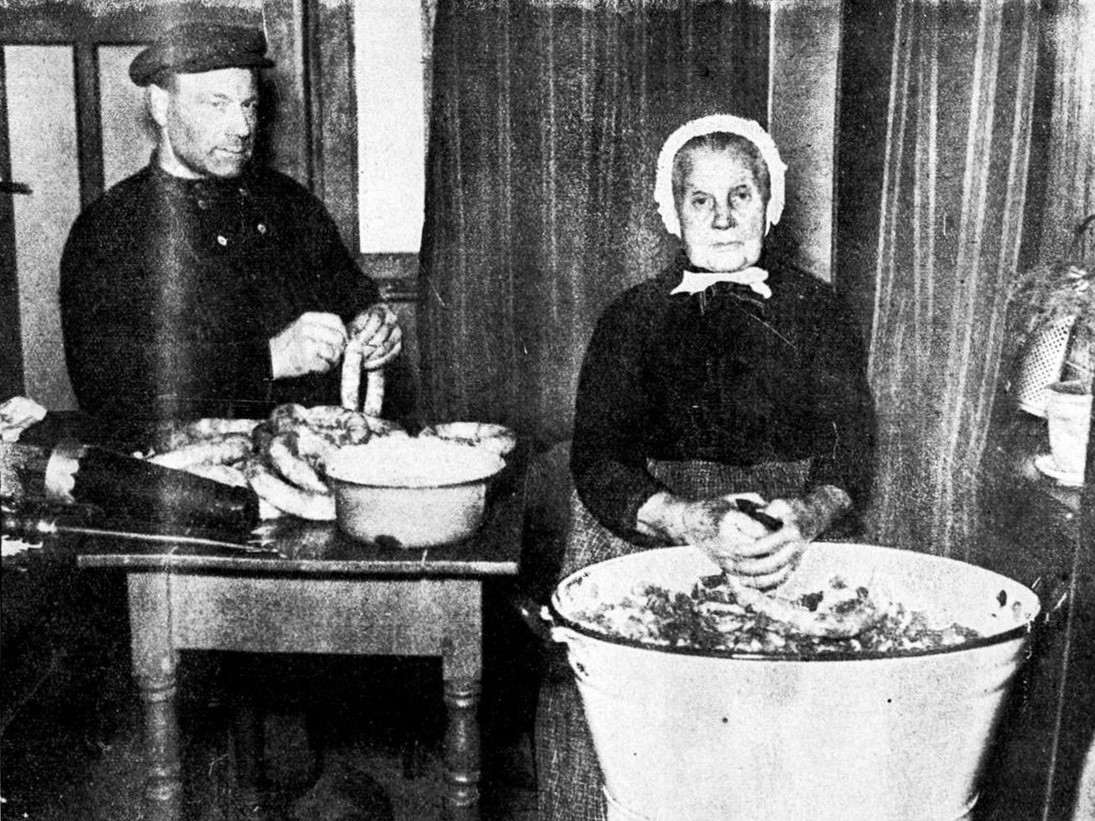
And indeed it was. When we entered the living kitchen through the back door at the address we had been given, we found the household busily occupied with the home slaughter. Parts of a freshly slaughtered pig lay on the kitchen table, where a woman was cutting the meat into pieces. By the window we found the person we had really come to see: ‘Old Doortjen’, seated on a chair. In front of her, on a low stool, stood a large enamel basin full of sausage meat. To her right was a small table holding a quantity of freshly made metworst and an enamel pan of water containing a number of sausage casings cut to size.
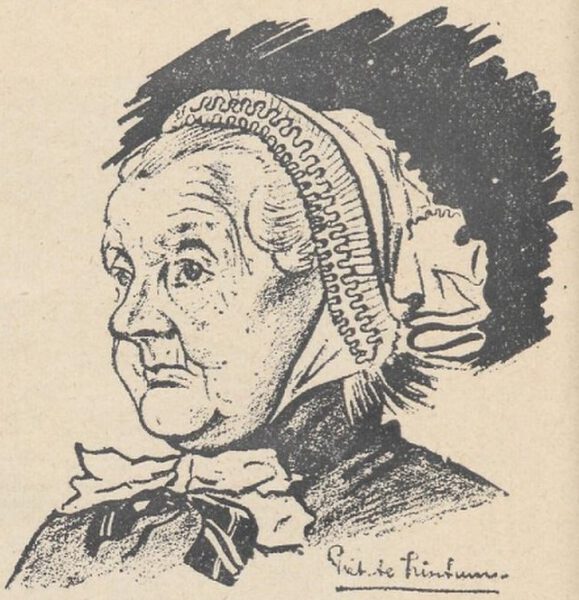
Once we had explained the purpose of our visit and the friendly residents had welcomed us with, ‘Sit yourselves down, gentlemen, and fetch a chair,’ we immediately turned to the central figure in this slaughter-time visit: the sausage-maker Doortje. She had been described to us as a very old woman, yet at first sight she looked a healthy woman in her sixties. Could this really be someone nearly eighty-three years old? We could hardly believe our eyes. Her face was bright, fresh and rosy, and still entirely free of wrinkles. Her eyes were lively, her hands constantly at work, and this sprightly, friendly little woman moved with remarkable ease. As we soon discovered, her mind was every bit as clear.
A Friendly Chat with ‘Old Doortjen’
‘You’ve certainly done this before, haven’t you, mother?’ we asked Doortje, referring to the ease and skill with which she worked. The answer came at once: ‘Oh, goodness yes, sir, since I was eighteen. My thumb shows it too…’ She held it up for us: from years of pressing into the sausage horn, it bent almost backwards at a right angle.
‘You’ve been doing this work for many years then. How old are you, actually?’ ‘I’ll be eighty-three on 8 March.’ When she read the surprise on our faces, she added sharply: ‘If you don’t believe me, just go to the town hall and they’ll tell you… I’ve been making sausage since I was eighteen, so that’s sixty-five years now.’
While the remarkably vigorous woman chatted away pleasantly and told us about her life, she kept filling the sausage horn again and again. With a wet, squelching sound, the raw meat slid through the funnel into the casing until another sausage was finished. A sausage pin lay ready; here and there she pricked the so-called air pockets, then deftly fastened the ends of the casing together. Slap — another O-shaped metworst landed beside the many others already finished.
Doortje told us a little about her childhood, which had been anything but easy. Her father was a home slaughterer, and as a child she had already had to help on farms, working hard for very little pay. Later, at the age of eighteen, she went to Germany to work as a maid in the household of the deputy mayor of Brünen, near Wesel. A great deal of slaughtering was done there in the autumn, and she had to help. That was where she really learned how metworst was made.
‘People don’t slaughter nearly as much nowadays, not by a long way. In the old days I sometimes started at six in the morning and didn’t get home until midnight…’
Still cheerfully talking, her experienced hands constantly reaching into the soft mass of meat before her, she told us about her youth and the rest of her life, in which she had endured a great deal. She had been married twice, and on both occasions death had taken her husband from her. [Her first marriage, in 1879, was to Gerrit Jan Prange, who died in 1916. In 1921 she married Lambertus Fles, who died less than nine months later. — ed.]
Life had certainly not spared her its hard blows. Yet she had worked her way bravely through its difficulties, helped no doubt by her cheerful nature and enviable optimism. And she had managed to preserve both that optimism and that good humour to the present day.
‘I was born in Aalten, and my real name is Dora Kalf.’ She had never had children. ‘They’d have cost me far too much,’ the old lady said mischievously. ‘You have to remember, in the old days I earned only fifteen cents for a day’s work. For that you spent the whole day making sausage. You got your meals, of course, and a little sausage to take home. Things are rather different nowadays, but even then we still had plenty of fun from time to time. When we were rendering fat, there could be a bit of merriment. Sometimes we sampled a good drink too. While you were making sausage, you’d have your little glass standing beside you. You don’t see that any more today. Yes, I’ve been through quite a lot — sweet and sour, good and bad…’ A mischievous smile crossed the bright face of this sharp-witted woman.
Then the photograph reproduced alongside was taken. ‘There!’ said our photographer. ‘That’s done.’ ‘Got the pretty face in as well?’ Doortje replied wittily. ‘I’m curious to see it…’
By then Mr Prins, the man of the house, and the home slaughterer, who had dropped in for a chat, had joined the conversation. Before long the talk turned to the ‘crisis’ and the ‘depression’. ‘Now you can face the winter,’ someone remarked to Mr Prins, referring to the supply of meat, bacon and sausage being prepared that day as winter provisions for his family.
We agreed, and he replied: ‘A bricklayer in winter is a pretty unfortunate creature, sir. But with this sort of thing you have to plan ahead and take precautions in good time, so you have something put by for a bad day. If you don’t grow your own potatoes and fatten a pig yourself in good time, you’re in real trouble in the winter months when you’ve got a wife and six children to feed — you can believe that!’
Doortje, with all her experience of life, also knew a thing or two about crises and hard times, for this was the second period of economic crisis she had lived through. ‘The crisis in the old days was much worse,’ she said. ‘People in general are much, much better off now than they were then, but they complain a lot more loudly…’
With her enviable optimism and seemingly boundless vitality, Doortje had come through life’s ups and downs remarkably well, and in our opinion would continue to do so for a long time yet. ‘She’s been doing our slaughtering for twelve years now, and you still can’t see that she’s changed a bit,’ Mr Prins said.
For a woman of her age she still worked exceptionally long days, yet fatigue seemed unknown to her. That became clear when we remarked that it might be very late that evening if the basin first had to be emptied. ‘That doesn’t matter,’ she said. ‘Nothing I can do about it — then it’ll just have to be late. Tomorrow I’ve still got two pigs, and more besides later this week. But I don’t get worked up about it. I’m not the nervous sort…’ These were the words of a woman nearly eighty-three years old, who could serve as an example to many people far younger than herself in this age of sighing and complaining.
Dora Kalf died in Aalten on 29 June 1937 and was buried in the Old Cemetery on Varsseveldsestraatweg.