
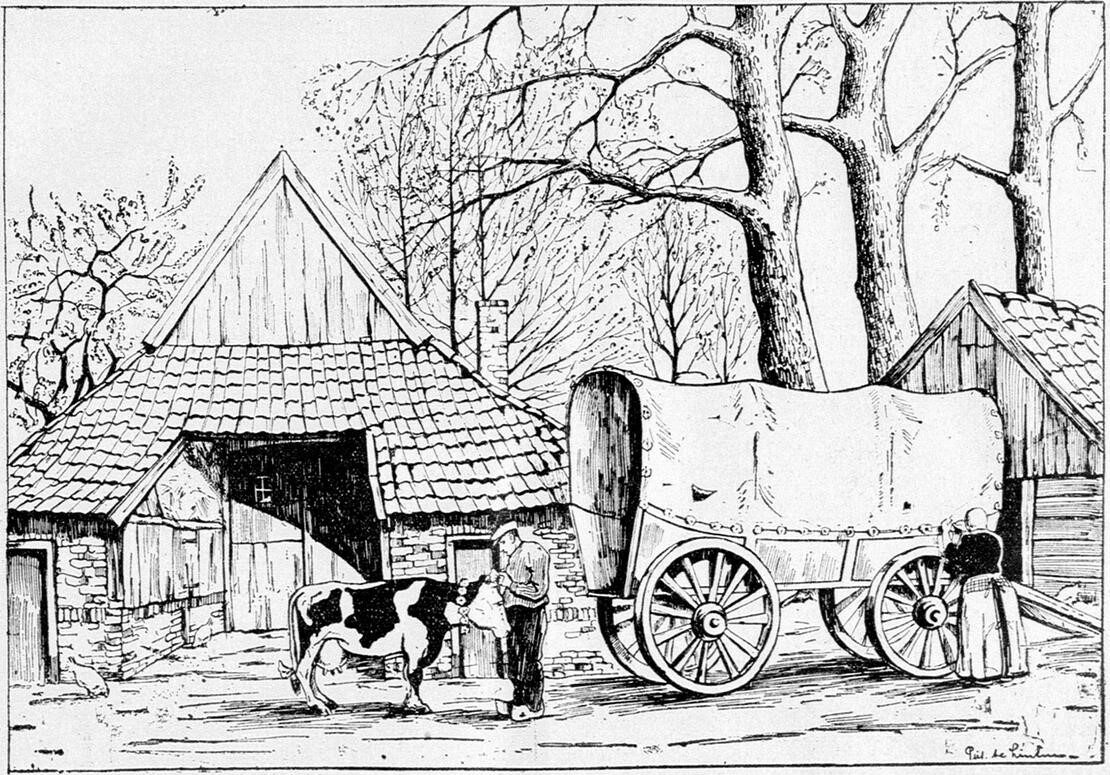
in the eastern Netherlands
They had been courting for a long time. ‘It had to happen.’ The day of the brullefte — the wedding — had been fixed. The brüdsneugers, the traditional wedding inviters, had been sent out. They set off on the day the intended marriage was formally registered. Earlier still, in the days my grandfather used to talk about, there had been no civil notice and no marriage before a registrar. The first step was simply to send out the wedding inviters. Then, when the great day came, a deed was drawn up before the Scholte, the local magistrate. Once it had been signed, either with a name or a cross, the agreement was complete. The man and his kin then went with the bride — who was called a bride for the first time that day — and her relatives to the man’s house, where they would henceforth live as husband and wife. Sometimes no contract was drawn up at all: the procession itself was the legal proof, and as soon as Sunday afternoon came, the church confirmed the union and entered it in its register.
By about the middle of the nineteenth century, things were already quite different: civil marriage had become fully established. The church continued in the old way and bestowed its blessing on the union after the civil act. In the eyes of the farmer, however, the appearance before the registrar was little more than the old contract in another form. The central act remained the fetching of the bride from her parents’ home.
On the eve of the wedding, the groom’s family arrived: men and women, father and mother, uncles and aunts, nephews and nieces. They came to speak officially about the ceremony of the following day, although in practice everything had already been arranged by the groomsmen. In a long and stately procession they made their way to the bride’s parents’ farmyard. There, everyone pretended to know nothing about the matter. Indoors, however, the table was already laid with coffee flavoured with cinnamon and slices of bread. They sat down as though this were an ordinary visit. The daughter who was the whole reason for the gathering was nowhere to be seen.
After a cup of coffee had been drunk, the eldest male member of the groom’s family stood up and asked whether ‘Gardine… was at home here’, because he wished to speak to her. The answer was, of course, yes, and the father sent a few of the younger relatives from both sides to look for her. They found her and brought her into the family circle.
Then came the solemn question: would she become Hendrik’s wife, and did she agree that he should come and fetch her the following morning? She answered, ‘Yes, if father and mother approve.’ They formally gave their consent, and with that the official part of the visit was over. The eldest man finished his coffee and made as if to leave. The bride’s father then invited him to stay a little longer, eat a little more and have another drink — and so they did.
The next morning there was great activity on both farms. At the groom’s parents’ home, the procession of wagons that would go to collect the bride and her family had to be assembled. At the bride’s home, everything had to be made ready to receive the guests, who would arrive early, because the bride’s entire family and the neighbours had been invited to wait there for the groom and his relatives.
By about ten o’clock the guests had arrived with their wagons, all in their finest harness. The bride, who on that day was addressed as ‘bride’ for the first time, was dressed but did not show herself. She wore a shift made from linen she had prepared herself and sewn with a single thread. After the wedding she would put that garment away again. It would be placed on her once more one day — but not during her lifetime.
The groom’s procession arrived. His wagon came first, decorated with greenery and ribbons. The groomsmen sat at the front, one of them driving the horses. At the back of the wagon sat two farmhands with guns, carrying a basket of loaves and bottles. Behind came the wagon with the parents and other relatives. When they reached the house, the groom climbed down, opened the door and was asked by the farmer, the bride’s father, what he wanted. ‘To fetch my bride,’ he replied. ‘I don’t know her,’ came the answer. ‘She is your Gardine.’ — ‘I don’t see her.’ — ‘Then have them look for her.’ And so they did. She was found.
Once outside, the groom took her around the waist and lifted her onto the wagon. Then he turned to her father and said, ‘You and your people come along too — everything is ready at my house.’ He climbed onto the wagon and took his place beside the bride. Her parents joined the groom’s parents on the following wagon, together with their youngest children, and everyone else took their places on the wagons of the groom’s and bride’s relatives. On almost every wagon sat a few young men with guns and young women with rattles.
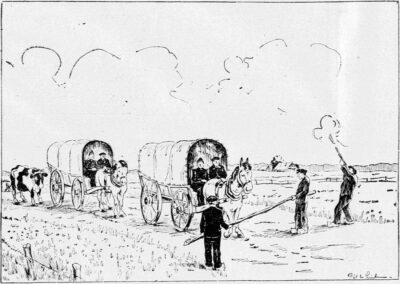
As the wagons moved off, guns were fired and rattles shaken. Such a din arose that the young farmers had their hands full keeping the horses under control. From the town hall the procession went to the house where the newlyweds would live. Along the way they repeatedly encountered obstacles that were removed in exchange for bread and drink. Here and there they were greeted by gunshots, which were answered from the wagons. In front of the young couple’s home, all the guns were fired. Their neighbours received them there, and for the rest of the day the neighbours and their farmhands and maids helped serve the guests and the newlyweds.
The groom once again lifted his bride down from the wagon. They then crossed the threshold without touching it: either a piece of wood had been laid across it or water had been poured over it. Once the bride had crossed, someone immediately wiped the dust from her shoes with their fine buckles, and she was expected to treat that person to a drink.
Then the wedding meal began. Bride and groom sat beneath the green crown on richly decorated chairs. There was plenty to eat and drink, after which everyone went for a walk around the farmyard and fields. Then came coffee with kandeel, a spiced egg drink, along with wine, brandy with sugar and Deventer cake. This continued until evening fell. The guests then left with an ‘ajuus, until tomorrow’, because the wedding inviters had already summoned them back for the following afternoon.
The next afternoon the older people returned with the small children, and everyone brought a gift for the young couple’s household. Later in the afternoon the young men and women arrived and the celebration moved to the dèle, the threshing floor of the farmhouse. There was a fiddler, one or two violins and a bass. Dancing continued until it grew dark, or, if there was a lamp, until the oil ran out.
On both evenings, but especially on the first, the newlyweds had to be prepared for all manner of practical jokes. Sometimes a young person who had hidden himself would suddenly appear at the most inconvenient moment, claiming that he had overslept and now wanted to go home. On another occasion everything might have been sewn together, leaving the bride to unpick sheets, blankets and pillows before going to bed. Or the shutter would refuse to close, or the bed would be filled with burrs.
After the two main days — sometimes extended by several more — came the celebration for the naobers, the neighbours. They were now the guests, while the younger relatives of bride and groom did the serving. This feast followed the same pattern: the older people during the day, the younger crowd in the afternoon, with plenty of food and drink throughout and dancing music in the evening.
And that is how a brullefte took place some fifty years ago, as I still knew it myself. Exactly when the bride lost her title I cannot say. I believe that once the wedding week had passed she was no longer called ‘the bride’, but I cannot be certain. Perhaps some readers know more and can add their own memories to what has been described here. Present-day customs will not help us, because the old and highly meaningful forms of former times have increasingly been abandoned.
J.H. GALLÉE.