
In 1937, G.H. Rots described in a series of articles how things were done in Aalten in former times. Regarding the ‘night watch’ and the constables (veldwachters) in Aalten, he wrote the following:
“When the population of Aalten had found rest in the arms of Morpheus, they were watched over at night. The night watchman made his rounds and, accompanied by his faithful dog and with a thick rattan cane in hand, patrolled Aalten’s streets. He also served as a ‘knocker-up’; that is, if certain people needed to be woken early, he was the man who ensured it happened.
For many years, the night watchman carried a rattle, and every time the tower clock was heard, the rattle was spun and the night watchman called out the hour that had struck. For example, at twelve o’clock, he would cry: ‘The clock has twelve, twelve has the clock!’. It was eventually realised that such customs were not conducive to the residents’ night’s rest, and the practice was subsequently abolished.
For monitoring purposes, check-clocks were mounted at several points in the village, designed so that the authorities could verify whether the night watchmen had performed their duty. In turbulent times, or whenever the authorities deemed it necessary, the night watchman was reinforced by a ‘watch’. Each rot (ward) had to provide one man to stand guard. The ‘watch’ was stationed in the building where Mr ter Maat’s barbershop is now located.
The permanent night watchman thus had the assistance of these men, and they accompanied him on patrol. When it was pitch black, it sometimes happened that such a greenhorn assistant-watchman lost his way and ended up in a refuse heap or a manure pit. It is well known that this circuit through the village—the rattling aside—was not entirely silent, and one could hear the night watchman approaching from afar. For thieves and other ruffians, this was the signal to take to their heels or go into hiding.”
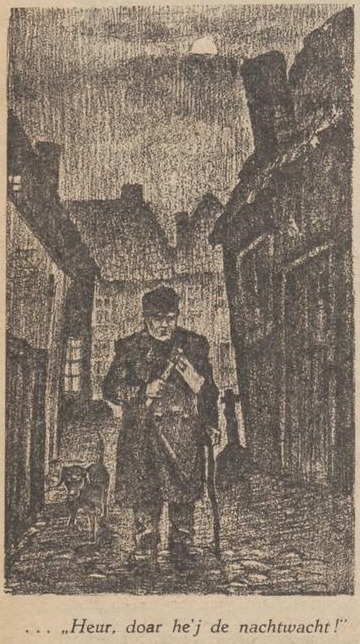
Since 1 January 1915, the night watchman in Aalten has been a thing of the past. One of the last night watchmen in Aalten was Jan te Slaa, better known as the town crier ‘Jan met de Panne’.
spine-chilling stories
“The old night watchmen could tell spine-chilling stories of what they had experienced at night. Hearing these tales made one’s skin crawl. For instance, it was said that ‘behind the hedges in the Heuksken’, a woman dressed in white wandered every night. And then there was that mysterious light in the charnel house at the churchyard. Sometimes, mysterious animals were encountered that made Aalten’s streets unsafe.
Then there were the ‘premonitions’ of fire. If a fire broke out in the village, one of the night watchmen had sometimes seen a ‘red glow’ above the site weeks in advance. This happened quite often, as Aalten had a certain ‘reputation’ when it came to fires. There were occasions when fires broke out three days in a row. The ‘red glow’ must have been seen quite frequently then.
The belief in witches and ghosts had not entirely vanished in the last century, so these ghost stories were often believed. According to folk belief, witches held meetings at night, and in the Aalter Esch, there was a spot used as a nocturnal witch’s dwelling. That piece of land, situated roughly halfway between the Linde and the Lichtenvoordscheweg, was called the ‘heksenbeddestëe’ (witches’ bedstead). It was a patch of no man’s land that no one claimed. The night watchmen were not afraid of any of this, and through their heroic stance against these mysterious things, they commanded great respect from the population. Undeniably, quite apart from the above, the night watchman performed good service, and many viewed the abolition of the night watch with regret.”
Constables
“And then there was the police surveillance. Jan Steven Schaars Prins was well known as a State Constable (Rijks-Veldwachter). Merely mentioning his name was enough to strike fear into people. The youth would retreat into their shells at the sound of his name, and naughty rascals could be sent to bed with it. But Schaars Prins was also someone held in awe by adults. His mere appearance helped to restore order, and when he took action, order was immediately reinstated.
A formidable man, then, who certainly faced his share of trouble. Often he set out alone to fine dangerous poachers, but he also showed his strength against more serious criminals. The arrest of two escaped German murderers in 1875 earned him an honourable distinction from the German government.
On one occasion, he is said to have been overpowered by superior force; poachers in the Aalter Goor tied him to a tree, and he was only freed a few hours later by a passer-by.
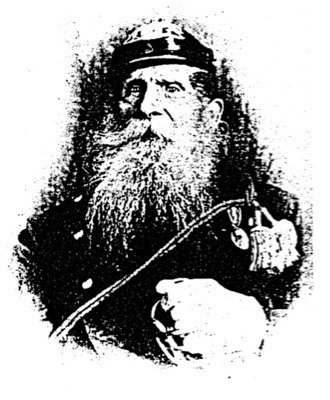
In the middle of the last century, Jan te Hoonte and Constable Beernink were known as the municipal police. They were appointed at a salary of 145 guilders a year. Not too many official reports (proces-verbalen) were drawn up, for if a case had to be heard at the court in Zutphen, they had to make the journey to Zutphen on foot as witnesses. Fining a poacher, however, was another matter, as it yielded an extra reward, which was quite welcome alongside the aforementioned salary.
The constable went to the town hall in the morning to ask if there was ‘anything special’ to report. Sometimes it was a message for a local resident, but usually, the Mayor had nothing on the agenda, and the constable would go to tend his farm; if something significant happened, one could find the constable out in the fields.”