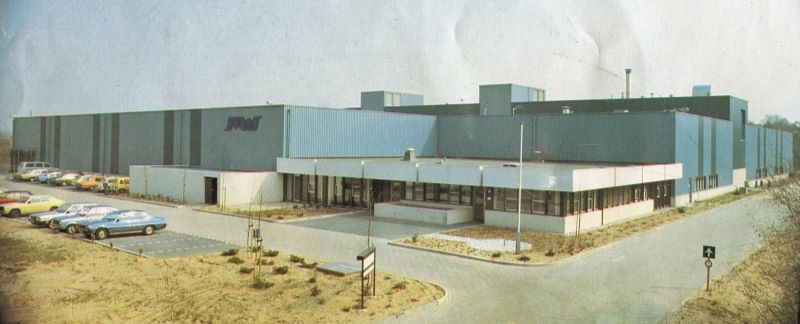
Eerste Broekdijk 85, Aalten (no longer extant)
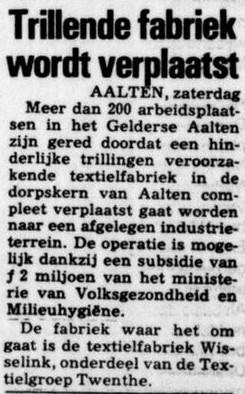
Textielweverij Wisselink Textiles, voorheen Gebr. Driessen, maakte sinds 1960 deel uit van de Textielgroep Twente. Zij maakten onder meer technisch textiel, tent- en vlaggedoek. Het bedrijf was sinds jaar en dag gevestigd aan de Dijkstraat, maar veroorzaakte daar in de dorpskern teveel geluids- en trillingsoverlast.
Daarom verhuisde de fabriek in 1981 naar een nieuw pand aan de Eerste Broekdijk, op bedrijventerrein ’t Broek. Zusterbedrijf Koala Tricotagefabriek verhuisde naar de Industriestraat. Door deze verhuizing bleven ruim 200 arbeidsplaatsen behouden.
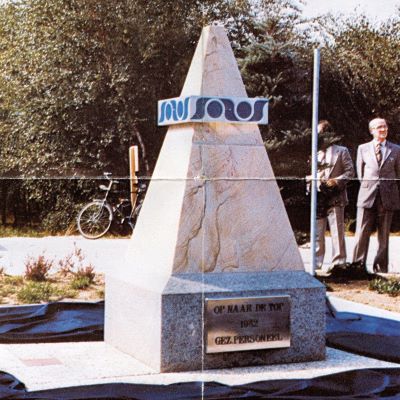
The official opening of the new building was performed by the then Queen’s Commissioner for Gelderland, Mr Geertsema. The collective staff presented the company with a pyramid-shaped sculpture with a flattened top, inscribed: ‘OP NAAR DE TOP’ (Onwards to the Top). However, Wisselink never quite reached that summit.
The Most Modern in Europe
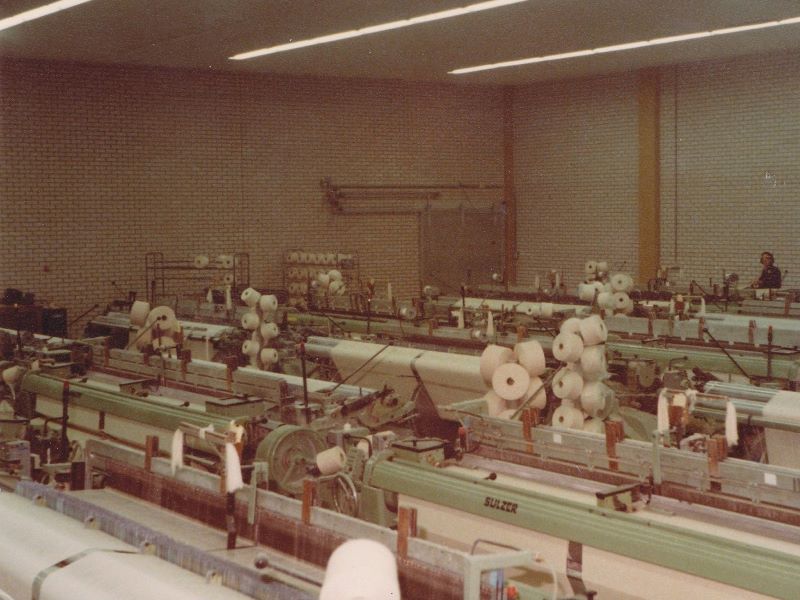
At the time, the new weaving mill was by far the most modern in Europe. It initially housed 76 state-of-the-art Sulzer projectile weaving machines and 20 older Picanol looms. The directors were, in succession, Messrs Schukkink, Van der Gronden (interim), Defourney, and Brouwer.
The company organised several staff parties a year. Highlights included sports days with sister companies from Enschede, Weerselo, Hengelo, and Bree (Belgium). The group’s centenary celebration at the Theaterhotel in Almelo was also a grand event. Wisselink had its own shooting club, ‘WIA’ (Wisselink Textiel Aalten), which was affiliated with the Aalten Shooting Association.
Despite the festivities, the textile industry demanded hard work: shift work, dust, and noise… above all, a lot of noise!
Takeover and Closure
Eventually, Wisselink faced financial difficulties. By 1997, the workforce had dwindled to 93 people—significantly fewer than in previous years. Following several painful reorganisations, the curtain finally fell in 2002. The company was taken over by the German firm Setex. A year later, the entire production was moved to the headquarters in Dingden, Germany. On 31 March 2003, the Aalten factory closed, and the building on Eerste Broekdijk was left vacant.
Enige jaren na de sluiting werd het pand aangekocht door de firma Kaemingk Season Decorations. Het voormalige productiebedrijf werd nu ingericht als magazijn. In 2015 werd het gebouw gesloopt en bouwde Kaemingk er een nieuw en groter magazijn voor in de plaats.
Invention
On 16 August 1980, the Dutch newspaper De Telegraaf reported on a new invention by the Wisselink textile factory:
‘Schulp’ without buttons designed for soldiers
In the future, soldiers can literally crawl into their shells (schulp). ‘Schulp’ is the name of the tent developed for the army by order of the Ministry of Defence. It is a two-person, single-roof tent for mobile use—quick to pitch and lightweight.
The latter is thanks to a new type of tent canvas, KSOOI/Wetfold, an invention by the Wisselink textile factory in Aalten. It is a lightweight cotton fabric provided with a so-called multi-porous coating (MPC).
Bivouacking becomes a lot easier because of it. The unique feature of this canvas is that it does not leak if touched during a rain shower or if it is folded and packed while soaking wet.
Thanks to an ingenious tensioning system, only two pegs are needed to set up the shelter. What more could a soldier want during field exercises in harsh weather conditions?
It is not just soldiers who can benefit from the tent designed by Mick Schmidt; a civilian version was also produced. It was awarded the 1986-’87 ANWB prize for the best tent design of the year.
Perhaps the greatest advantage of the tent is that it does not consist of two halves. There is not a single button on it. The only thing that might cause an argument is which of the two has to carry the thing on their knapsack.
Video
Features
| Cadastral no. | L-1207 |
| Function | Textile factory |
| Opening | 1981 |
| Sluiting | 2003 |