
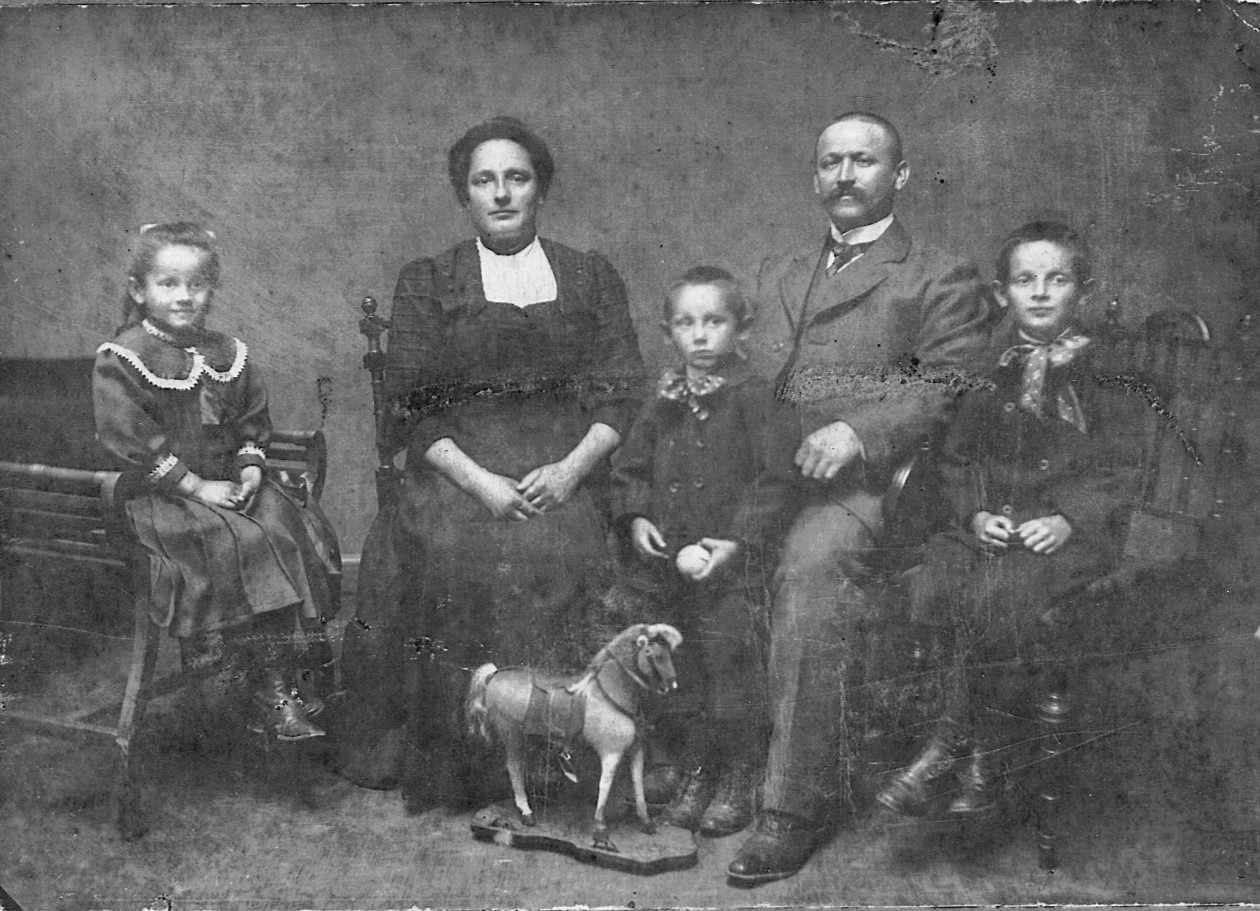
For more than a century, members of the Monasso family have been crafting terrazzo floors in the Achterhoek. The family ended up in Aalten in 1915, after fleeing from Bocholt, Germany, during World War I. Their origins lie in the Northern Italian region of Friuli.
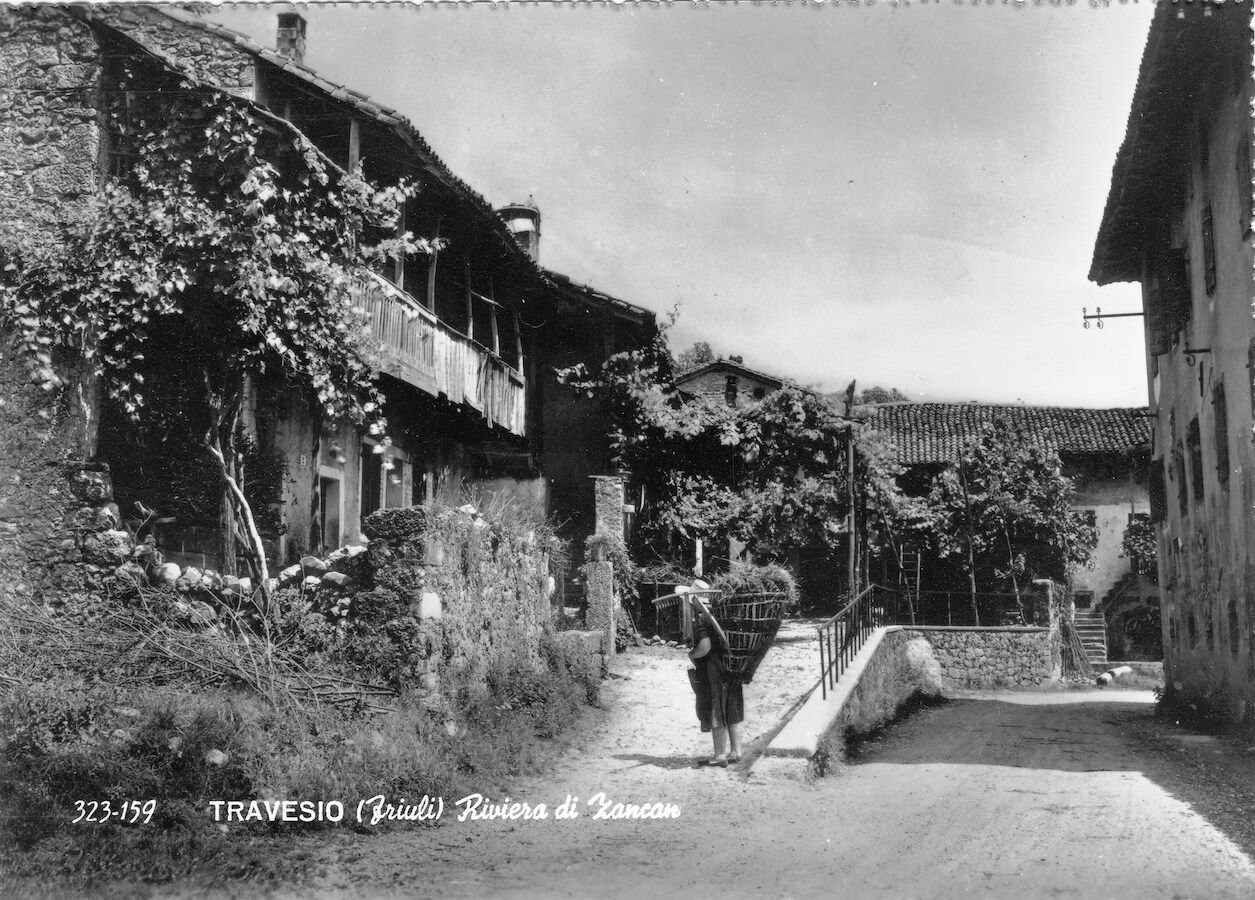
The family hails from the mountain village of Travesio, in the Friuli region. It was an impoverished area plagued by poor soil, earthquakes, floods, and high taxes. Many inhabitants left to find work elsewhere. Friulians were known as skilled craftsmen—foresters, carpenters, stonemasons, and terrazzo workers.
The First Generation
In 1868, Pietro Monasso married Maria Bortolucci in Travesio. They had three sons and four daughters. All three sons learned the terrazzo craft in Italian cities. One of them, Felice Monasso, was once repairing stairs at St Mark’s in Venice as a boy. He received a banknote worth about twenty guilders—a staggering amount for the time—from the newly arriving Pope Leo XIII. He did not spend it, but kept it as a relic.
The three brothers were Giovanni (1869–1939), Felice (1871–1962), and Antonio (1876–1967). They left Friuli at a young age: Giovanni and Antonio at age eleven, and Felice at fourteen.
Work in Germany
Giovanni travelled with fellow villagers to the Balkans to learn the carpentry trade. Felice worked first in Frankfurt, including at the large Odorico terrazzo company, which employed hundreds of Friulian workers. Giovanni and Antonio later joined him in Germany.
From Frankfurt, the brothers went to Münster, where their cousin Bortolucci ran a terrazzo business. They worked there as master journeymen, and there was plenty of work in Westphalia and the Netherlands. On the advice of their boss, they established themselves in 1896 in Bocholt, just across the border from Aalten. There, they started a terrazzo firm together.
The enterprise flourished. This was the era when wealthy textile barons in Bocholt were building grand houses. With their terrazzo work, the Monassos embellished many a villa on the prestigious Bahnhofstraße. The three families lived together with their staff in a large building on Münsterstraße in Bocholt.
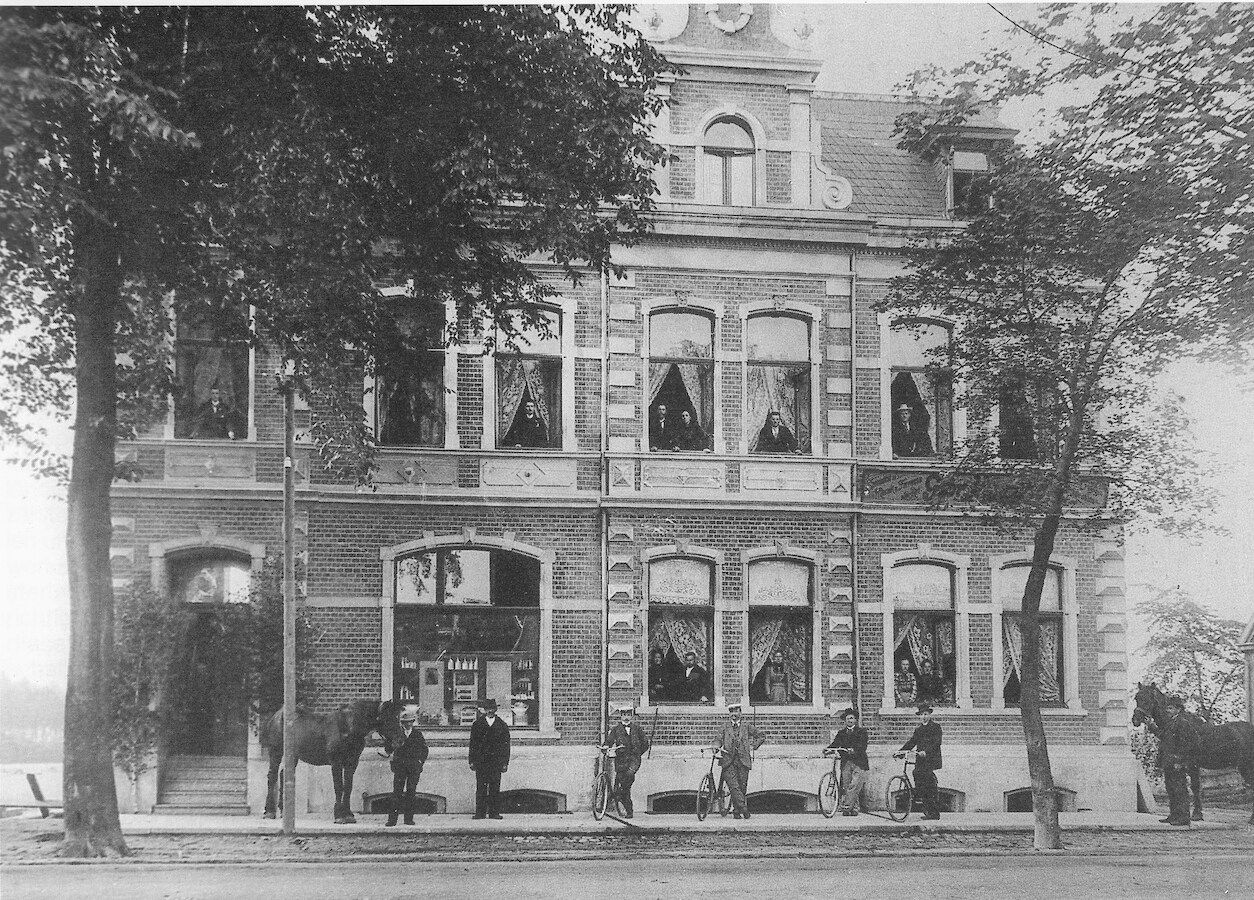
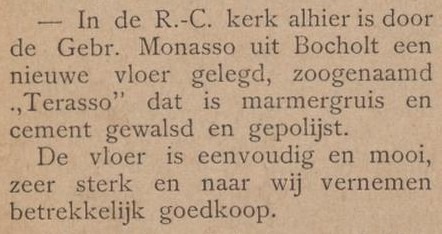
The firm ‘Gebrüder Monasso’ had plenty of work, including in the Achterhoek. As early as 1897, they laid a terrazzo floor in the Catholic St George’s Church in Bredevoort.
On 22 November 1899, Giovanni Monasso married Angela Chivilò (1879–1951) in Italy. Together they had four sons and two daughters.
Flight to Aalten (1915)
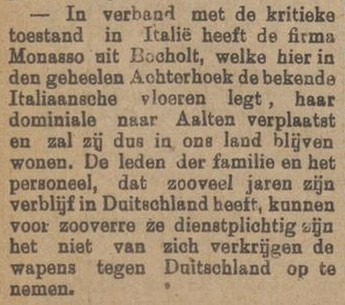
World War I began on July 28, 1914. Italy sided with the Allies, and the Germans saw this as a betrayal. An anti-Italian atmosphere emerged in Germany. Italian workers were insulted and sometimes even mistreated on construction sites. The three Monasso families decided to flee to Aalten, just across the border in the neutral Netherlands. In effect, they were asylum seekers.
It was a somber procession that departed Bocholt for Aalten before dawn on 19 May 1915. A horse and cart full of household goods was followed by twenty Italians. Three children remained behind in Bocholt: two because they were too ill to travel and one because he wanted to finish his year at the gymnasium.
In Aalten, they spent the first night at Vultink’s lodging house on Dijkstraat. The following day, Giovanni and Antonio moved into a house on Landstraat, and Felice into Bredevoortsestraatweg. Antonio and his wife found a home on Haartsestraat shortly thereafter. The then Mayor Monnik arranged for residency permits. The children who had stayed behind joined their families later.
A New Life in Aalten
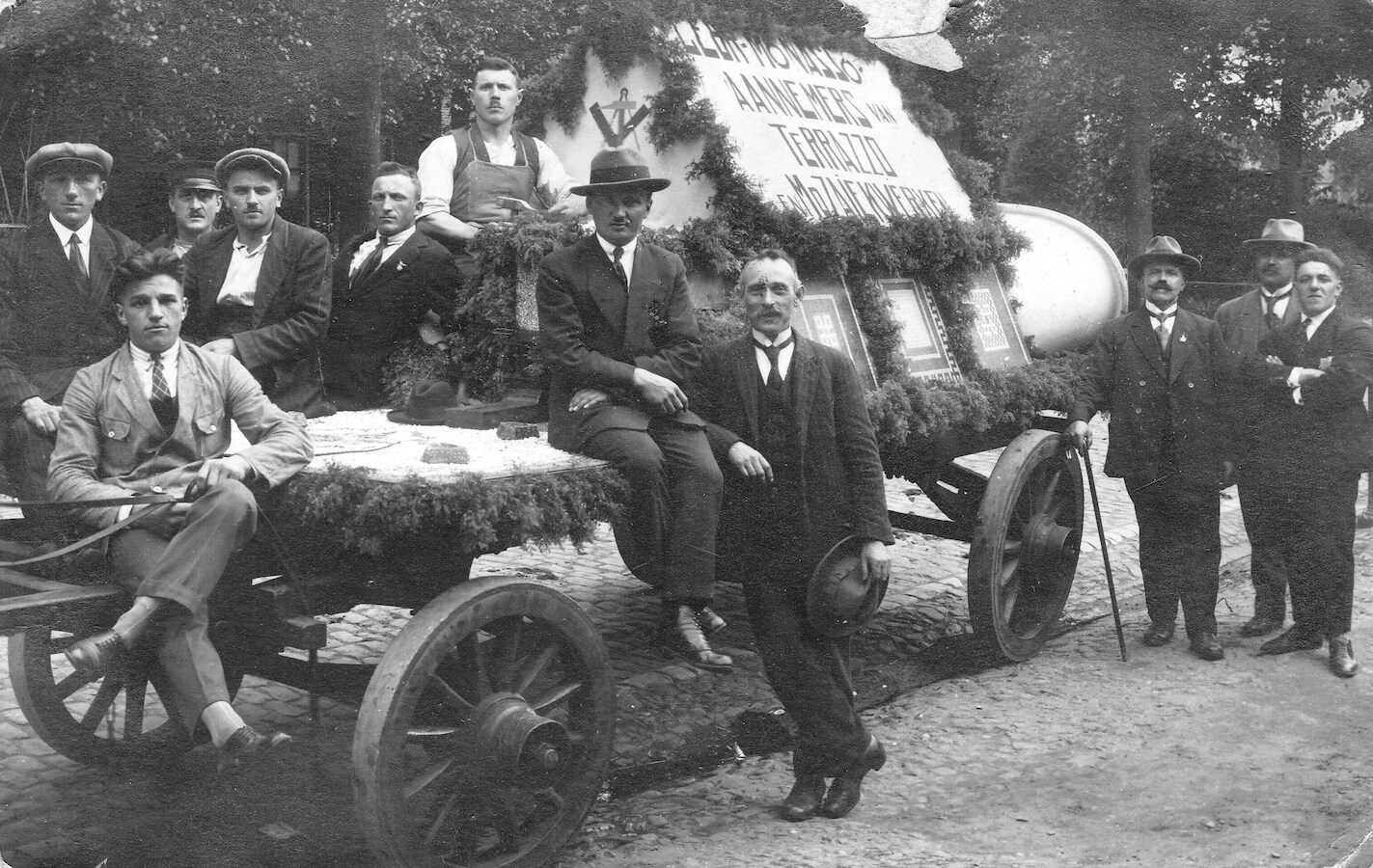
Giovanni demonstrated his entrepreneurial spirit by registering within a few days at Sociëteit Schiller, where local businessmen met. His brothers followed a week later. Within a short time, the Monassos were working again. They laid floors in homes, shops, schools, and churches in Aalten and the surrounding area, bringing in skilled terrazzo workers from Italy as staff.
They did not yet use machines or electric tools; everything was made by hand. Terrazzo floors were laid on-site, which was arduous work. Stairs, countertops, and other components were made in the workshop using moulds and were subsequently installed in kitchens or halls.
Around 1920, Giovanni established his business on Parallelweg in Aalten. In the mid-1950s, they moved to the adjacent Staringstraat, where a new showroom was opened in 1969.
Felice established a terrazzo business in Winterswijk in 1922; Antonio followed in 1932 with a branch in Doetinchem.
Later Generations
The second and third generations also remained active in the craft. In the decades following World War II, sons and grandsons took over the work. All four of Giovanni’s sons became terrazzo workers and married Dutch women.
Business thrived for decades. In the 1960s and 1970s, demand decreased due to the rise of synthetic floors and steel countertops. Nevertheless, the family business endured. The Monassos combined traditional techniques with modern methods, specialising not only in floors but also in worktops, thresholds, window sills, and restorations.
Current Company in Aalten
In 1982, Richard Monasso, Giovanni’s grandson, took over the company in Aalten. The business moved to Industriestraat. In the 21st century, terrazzo became popular once again. Richard Monasso now works on exclusive projects at home and abroad; his work can be found in a department store in London, a restaurant in Paris, and a villa in Greece.
Willem Monasso
In 1996, Willem Monasso, son of Giovanni Monasso and Angela Chivilò, spoke about his youth:
Wilhelm Franz Joseph (Willem) Monasso (1916–2001) was born in Aalten but returned to Italy with his mother as a child. They lived with an uncle who owned grape plantations. He attended primary school there. He did not learn Italian there, but so-called Furlan, a regional language that differs as much from Italian as Frisian does from Dutch.
At the age of ten, they returned to the Netherlands. Back in Aalten, Willem had to start again in the first grade. He left school after the fourth grade to enter the terrazzo trade.
On his mother’s side, the Monasso family owned a wine bottling plant and a silk plantation. They regularly had barrels of white wine from their region of origin in Italy shipped over. The first barrel always went to the parish priest of Aalten.
During World War II, Willem was the only Aalten resident allowed to have a radio because he held Italian nationality. Naturally, the occupiers did not allow him to listen to the English ‘Oranje’ station, but he did so in secret anyway, along with half the neighborhood.
Willem Monasso could tell captivating stories about his former work in the perfect Aalten dialect. Initially, countertops were made on-site in a formwork built by a carpenter. Later, this was done in the workshop, and they were transported to their destination by a small truck. The terrazzo technique requires great craftsmanship and is incredibly labour-intensive. Throughout the region, many beautiful Monasso floors can still be found in churches, hospitals, monasteries, schools, and scholten farms.
Sources
- Address directory Aalten (1934 & 1967)
- De Gelderlander, 27 November 2018
- Heritage Centre Achterhoek and Liemers
- MijnGelderland.nl – Een familie terrazzowerkers in Aalten
- Monasso.com – History
- OudWinterswijk.nl
- WieWasWie (WhoWasWho)
- “Wortels in de Achterhoek’, door Henk Harmsen, 28 September 1996 [p.13]