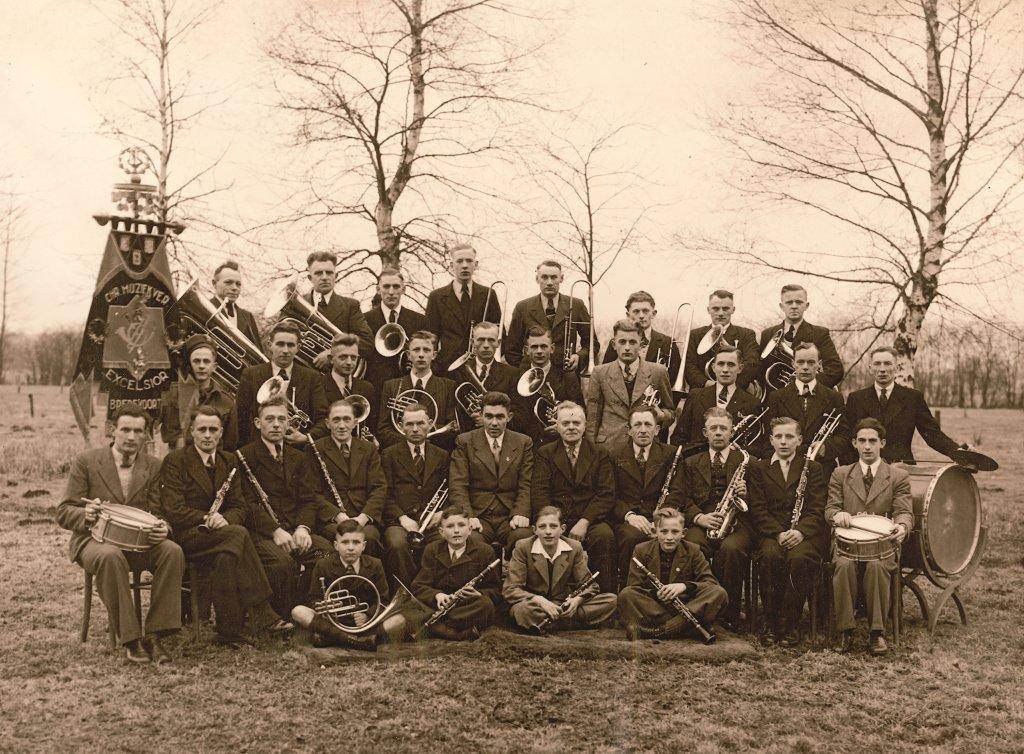
After the civic guards were officially disbanded in 1901, voluntary markmen’s guilds emerged in many places. These had a more folkloric character and organized events such as marksmen’s festivals, the fair, and the king shoot. Many markmen’s guilds also have a brass band and/or flag wavers.
In 1985, the Wilhelmina Markmen’s Guild in Bredevoort celebrated its 40th anniversary (after its re-establishment):
The Wilhelmina Markmen’s Guild occupies a special place in the Bredevoort community and is an integral part of special events in the old town. On October 12, the markmen’s guild celebrates its 40th anniversary. In reality, Bredevoort has had a markmen’s guild for much longer. This is evidenced, among other things, by four old banners that are still held in honor and date from the end of the last century.
“An outsider wouldn’t give a penny for them and would throw the whole lot with the rags. But for the members of the markmen’s guild, they are worth their weight in gold,” says the current chairman of the markmen’s guild, Hans Wensink from Boterstraat in Bredevoort. This 58-year-old resident of Bredevoort has been chairman for 30 years and also experienced the founding in 1945. “Perhaps we should speak of a re-establishment. It was after World War II, and during the war, the markmen’s guild was disbanded. However, on October 17, 1945, the markmen’s guild once again became a reality.”
Hans Wensink remembers well that Hendrik Frenken was the first commander. A man with a magnificent commanding voice. “When he gave the command: “battalion forward,” the R’s rolled out so beautifully,” Hans Wensink recalls. He also remembers that during marksmen’s festivals, Frenken did not allow himself to be addressed simply by his name. You had to call him captain, no matter how well you knew him. “That was the atmosphere at the markmen’s guild. After the Frenken period ended, J. van Merkenstein took over command, and now it is D. Dibbets who gives the orders.”
Core group
The markmen’s guild has always had a core group. After the war, there were only the old banners. These were later replaced because it was a pity to continue using them. Uniforms also arrived only later. In 1959, the traditional marksmen’s festival came to an end when it was decided to collaborate with the Folk Festival to create a joint celebration.
The markmen’s house has changed over time, but now they are back at their old base, Café Munsterbrug. The banners, however, are “maintained” by Mother Wensink. She meticulously ensures that everything is handled correctly. The 90-year-old is an enthusiastic supporter of the markmen’s guild. She can also tell stories about the markmen’s guild that was active in Bredevoort at the beginning of this century. Her husband, who passed away in 1938, was already an adjutant with the markmen’s guild in 1913 and rode on horseback with the group. In those days, ranks in the markmen’s guild were purchased. People came from far and wide to the markmen’s guild in Bredevoort. Mrs. Wensink also knows that the oldest banner dates from 1898 and was waved by Wubbels Sr., who also had three sons who were flag wavers.
“Ma” Wensink also ensures that the marksmen receive their coffee and bread on time during the bird shoot. In the past 40 years, it has happened seven times that the title of marksman king has gone to the Wensink family. “Then it is a real marksmen’s festival; I leave everything as it is and go to the markmen’s house,” says the elderly resident of Bredevoort.
Celebration
The markmen’s guild has 160 members, 40 of whom are “active.” The executive board consists of: Hans Wensink, chairman; Hans Piek, secretary; Engelbert Ebbers, treasurer. On Saturday, October 12, attention will be given to the 40th anniversary.
A reception will be held at the Munsterbrug markmen’s house from 3:00 PM to 5:00 PM, and in the evening, there will be a party for the members. “Whatever may change in the coming years, the markmen’s guild must be held in honor. This is something that was started by our ancestors. We must not tear that down. We must be careful with the traditions and customs,” says Hans Wensink.