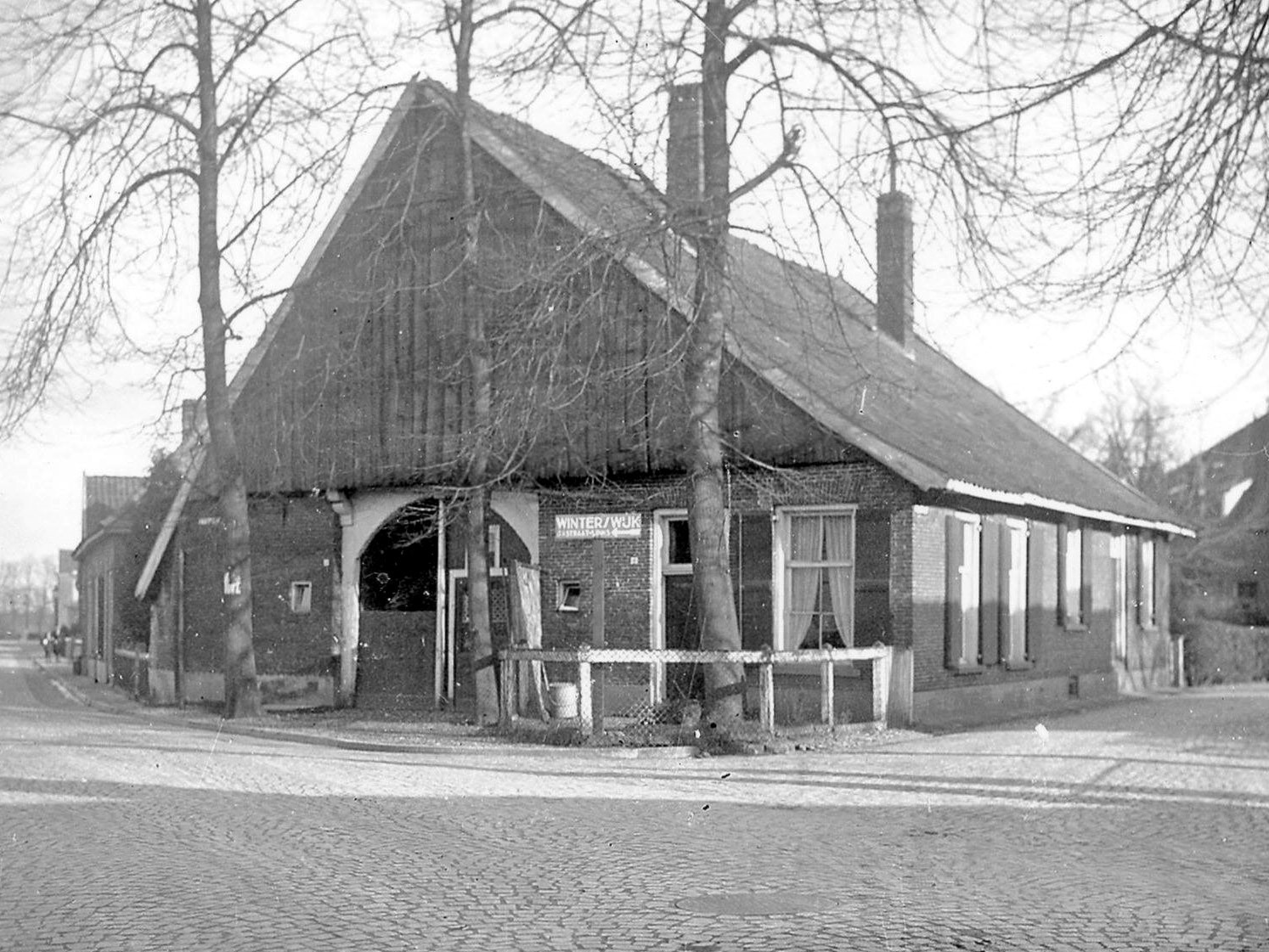
Around 1960, a little woman with the peculiar nickname ‘Knonnepoetse’ lived in Aalten. She resided in the Luutenshuus, a centuries-old farmhouse on the corner of Polstraat and Haartsestraat, which was demolished in 1962 to make way for the extension of Polstraat.
On their way to school, children would dare each other to knock on her windows. A furious old woman, who spoke half-German, would then come storming out. The children were absolutely terrified of her.
Guste Mina
In local parlance, she was also known as Guste Mina. She was said to be of Polish origin and had fled to Germany around the wartime period. She later married a man from Aalten named Koskamp.
This man Koskamp was “on the wrong side” during the war (fout). He used to walk around the village with a rifle slung around his neck. He referred to this rifle as ‘seine Kanone’ (his cannon). He cleaned his rifle frequently, often saying: “I just need to polish my Kanone.” After his death, the little woman inherited the nickname ‘Knonnepoetse’ (Cannon Polisher). The name had therefore originally been intended for her husband.
The couple initially lived on the corner of Stationsstraat and Admiraal de Ruyterstraat in Aalten, in Lurvink’s old house. This property was later demolished, and Nijman established his petrol station there—later Veneman petrol station, and currently the café-takeaway ‘De Admiraal’. The Koskamp couple subsequently moved to the Luutenshuus.
Who was she?
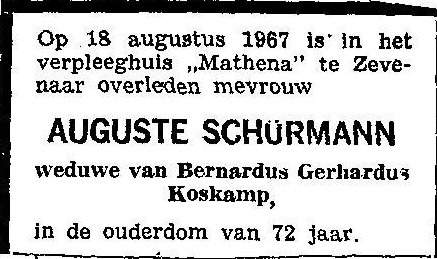
Her real name was Auguste Koskamp-Schürmann. She was born in Sterkrade (Germany) and married Bernardus Gerhardus Koskamp in Aalten in 1919. Around 1920, they lived in the village of Aalten at address A211a, which was later renumbered to B215a. This address presumably later became, or is currently, Hogestraat 60a.
In the 1967 Directory of the Municipality of Aalten, she is listed at the address Polstraat 17a. On 18 August of that same year, Auguste passed away in a nursing home in Zevenaar. She was buried alongside her husband at Berkenhove Cemetery.
‘Knonnepoetse’ did not have an easy life; she was quick to anger. The local youth knew this and took advantage of it. Bullying was something that very much occurred in those days as well.

Leave a Reply