Old Aalten

Tag: Textile Industry

  • The Driessen Textile Family

    The Driessen Textile Family

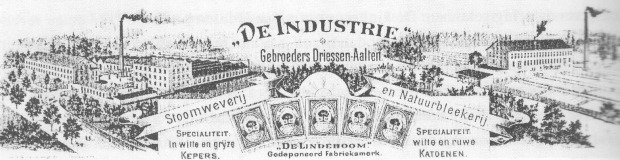
    Gebroeders Driessen, Aalten – Steam Weaving Mill and Natural Bleachery

    The Driessen family is a lineage of textile entrepreneurs, originally from Bocholt, just across the border in Germany. Members of the family were active as textile manufacturers in Bocholt, Aalten, and Leiden. It is a Catholic family, which was included in the Nederland’s Patriciaat (Blue Book) in 1961.

    The recorded lineage begins with Rutger Driessen, a weaver in Bocholt. In 1667, he paid taxes, but by 1672 he was considered too poor to be subject to taxation. Little is known about his son Johann Driessen (1663–after 1713) and grandson Gerard Driessen (1702–after 1738).

    The family’s social ascent began with Gerard’s son Bernard Driessen (1731–1772). He traded in textiles, which he purchased from home-weaving farmers around Bocholt and sold in Holland. The family likely owes its rise to the fact that, due to their poverty, they could not become members of the Boomsidenambt, the guild of cotton weavers. Guild members were prohibited from trading fabrics that had not been woven by fellow members. As the Driessens were not part of the guild, they were not bound by this rule and could trade freely in cotton produced by home-weavers.

    Thanks to this trade, Bernard became so prosperous that he was appointed schepen (alderman) of Bocholt, marking the family’s entry into the urban patriciate. However, he died at the age of 41 during a business trip to The Hague, before he could further strengthen his position.

    Expansion of the Textile Trade

    Two of Bernard’s sons continued the trade and expanded it significantly by employing hundreds of home-weavers: Peter Driessen (1756–1843) and Hermann Driessen (1765–1817). Initially, they worked together, but they later went their separate ways. Both brothers became very wealthy.

    Both married daughters of Johann Jacob Hölscher, a member of the cotton weavers’ guild and also an alderman of Bocholt. Peter married Elisabeth Hölscher, and Hermann married her sister Gertrud. These marriages demonstrated that the Driessen family had by then integrated into the local elite. Consequently, Peter Driessen served as the second mayor of Bocholt for fourteen years (1797–1811) and, in 1813, he was a member of the council of the Rees district during the Napoleonic era. In 1841, in his advanced years, he received a Prussian distinction: the Ritter des Roten Adlerordens (Knight of the Order of the Red Eagle), 4th class.

    From Trade to Manufacture

    Peter Driessen had approximately 500 home-weavers working for him around Bocholt. These weavers were formally independent but reliant on the ‘reder’ (merchant-manufacturer) who supplied the yarn and financed the loom. The rise of centralised workshops—precursors to factories—made it possible to exercise greater supervision over production. Looms could henceforth be used continuously. In this way, the merchant became a manufacturer or ‘fabriqueur’.

    Settling in Aalten

    To protect Dutch industry from British imports, King William I introduced an import duty of 25% to 45% on cotton fabrics in 1823. This made exports from Bocholt to the Netherlands virtually impossible. To circumvent this levy, two Driessen cousins settled in Aalten, just across the border: Heinrich Driessen (1794–1879, son of Mayor Peter) and Anton Driessen (1797–1879, son of Hermann). In Aalten, they established various textile enterprises, including a steam weaving mill and a bleachery.

    Over a period of more than 140 years (1826–1969), the Driessen manufacturers developed into the most significant employers in Aalten and the surrounding area. The factory buildings and private residences of the Driessens defined the village’s appearance. Until the second half of the 20th century, these manufacturers left a significant mark on the social and economic life of Aalten.

    Sources


    • ‘Geweven goed. De textielgeschiedenis van Aalten en Bredevoort’, H. de Beukelaer and J.G. ter Horst
    • Wikipedia
  • Wisselink Textiles

    Wisselink Textiles

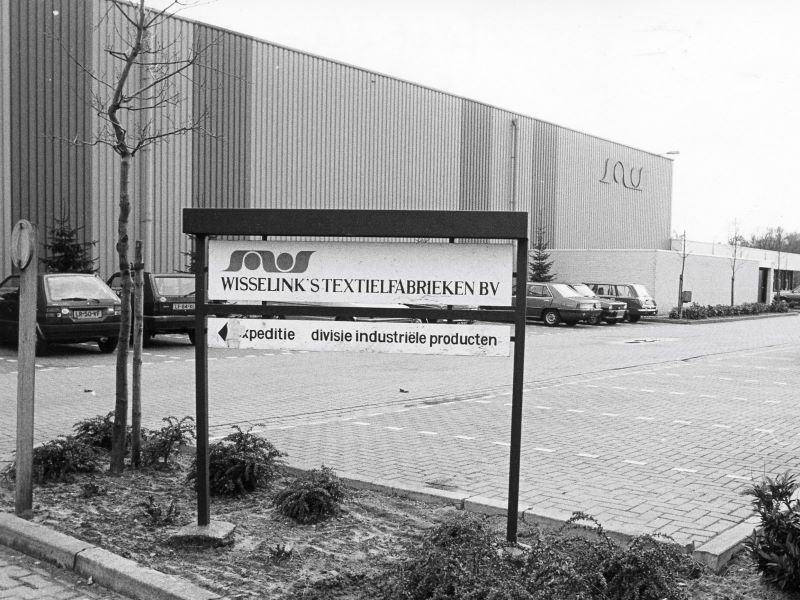
    Eerste Broekdijk 85, Aalten (no longer extant)

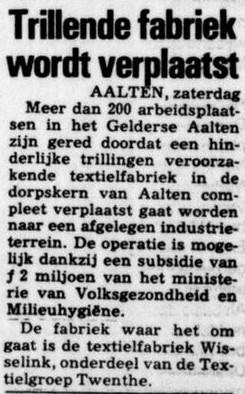
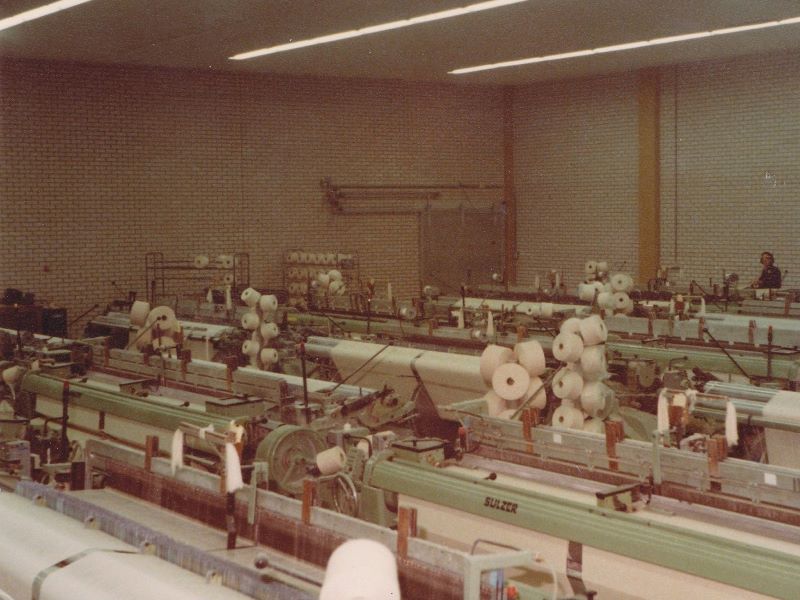
    The textile weaving mill Wisselink Textiles, formerly Gebr. Driessen, had been part of the Textielgroep Twente since 1960. They manufactured products such as technical textiles, tent canvases, and flag bunting. For years, the company was located on Dijkstraat, but its presence in the village centre caused excessive noise and vibration nuisance.

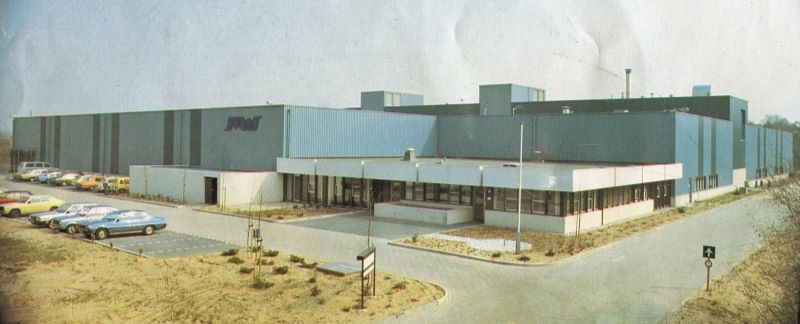
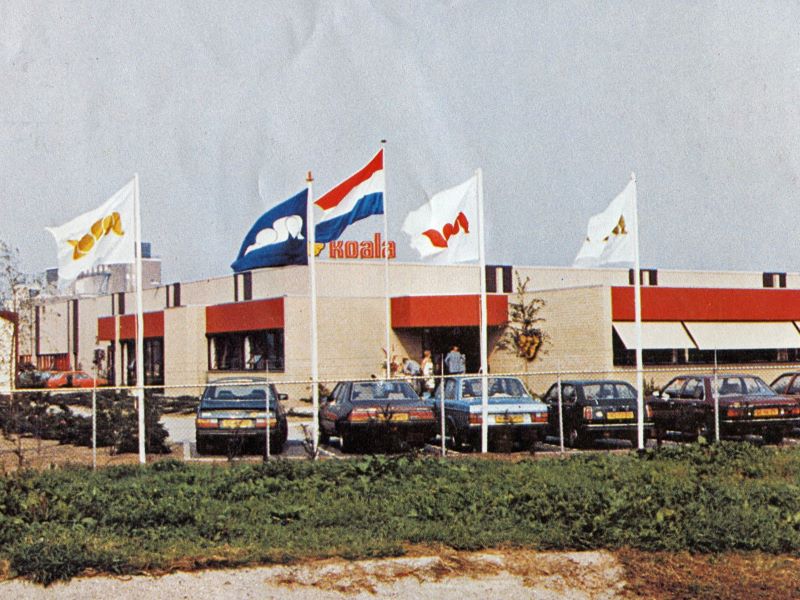
    Consequently, the factory relocated in 1981 to new premises on Eerste Broekdijk, within the ’t Broek industrial estate. Its sister company, Koala Tricotagefabriek, moved to Industriestraat. This relocation ensured the preservation of over 200 jobs.

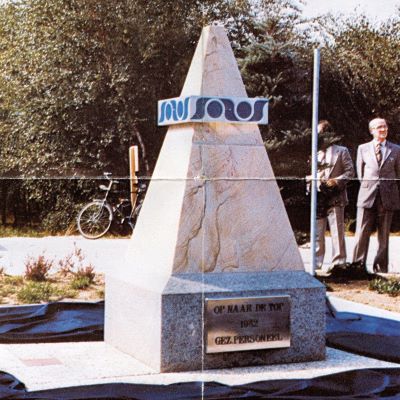
    The official opening of the new building was performed by the then Queen’s Commissioner for Gelderland, Mr Geertsema. The collective staff presented the company with a pyramid-shaped sculpture with a flattened top, inscribed: ‘OP NAAR DE TOP’ (Onwards to the Top). However, Wisselink never quite reached that summit.

    The Most Modern in Europe

    At the time, the new weaving mill was by far the most modern in Europe. It initially housed 76 state-of-the-art Sulzer projectile weaving machines and 20 older Picanol looms. The directors were, in succession, Messrs Schukkink, Van der Gronden (interim), Defourney, and Brouwer.

    The company organised several staff parties a year. Highlights included sports days with sister companies from Enschede, Weerselo, Hengelo, and Bree (Belgium). The group’s centenary celebration at the Theaterhotel in Almelo was also a grand event. Wisselink had its own shooting club, ‘WIA’ (Wisselink Textiel Aalten), which was affiliated with the Aalten Shooting Association.

    Despite the festivities, the textile industry demanded hard work: shift work, dust, and noise… above all, a lot of noise!

    Takeover and Closure

    Eventually, Wisselink faced financial difficulties. By 1997, the workforce had dwindled to 93 people—significantly fewer than in previous years. Following several painful reorganisations, the curtain finally fell in 2002. The company was taken over by the German firm Setex. A year later, the entire production was moved to the headquarters in Dingden, Germany. On 31 March 2003, the Aalten factory closed, and the building on Eerste Broekdijk was left vacant.

    Some years after the closure, the premises were purchased by Kaemingk Season Decorations. The former production facility was repurposed as a warehouse. In 2015, the building was demolished and replaced by a new, larger warehouse built by Kaemingk.

    Invention

    On 16 August 1980, the Dutch newspaper De Telegraaf reported on a new invention by the Wisselink textile factory:

    ‘Schulp’ without buttons designed for soldiers

    In the future, soldiers can literally crawl into their shells (schulp). ‘Schulp’ is the name of the tent developed for the army by order of the Ministry of Defence. It is a two-person, single-roof tent for mobile use—quick to pitch and lightweight.

    The latter is thanks to a new type of tent canvas, KSOOI/Wetfold, an invention by the Wisselink textile factory in Aalten. It is a lightweight cotton fabric provided with a so-called multi-porous coating (MPC).

    Bivouacking becomes a lot easier because of it. The unique feature of this canvas is that it does not leak if touched during a rain shower or if it is folded and packed while soaking wet.

    Thanks to an ingenious tensioning system, only two pegs are needed to set up the shelter. What more could a soldier want during field exercises in harsh weather conditions?

    It is not just soldiers who can benefit from the tent designed by Mick Schmidt; a civilian version was also produced. It was awarded the 1986-’87 ANWB prize for the best tent design of the year.

    Perhaps the greatest advantage of the tent is that it does not consist of two halves. There is not a single button on it. The only thing that might cause an argument is which of the two has to carry the thing on their knapsack.

    Video

    In 1990, FilmAalten made film recordings inside the Wisselink textile weaving mill:

    Features


    Cadastral no.L-1207
    FunctionTextile factory
    Opening1981
    Sluiting2003

    Sources


  • Koala Body Fashion

    Koala Body Fashion

    Industriestraat 15, Aalten (no longer extant)

    Koala Body Fashion (1982)

    Formerly Koala Tricotagefabriek, manufacturer of underwear.

    The Algemeen Dagblad wrote on 15 March 1989:

    FROM JANSEN & TILANUS TO KOALA BODY FASHION

    Koala Body Fashion is the new name of the manufacturer of the underwear and nightwear brand Jansen & Tilanus. This operating company of the Textielgroep Twente holds a 10 per cent share of the Dutch market. Koala — formerly Koala Tricotagefabriek — hopes that with this change of name, the company’s upward trend will continue.

    In 1987, profits rose by 10 per cent compared to the previous year. Although managing director H. ter Balkt does not expect this percentage to have been achieved in 1988, there is once again talk of substantial growth. He cites responding as quickly as possible to consumer desires as the most important prerequisite for this.

    Because nightwear and underwear have increasingly become an essential part of fashion in recent years, they are subject to new trends, rages, and developments. “An increasing portion of turnover is determined by products that did not exist six months earlier. In such a situation, you cannot work with long delivery times,” says Ter Balkt.

    In honour of its 70th anniversary, Koala Body Fashion is the first company in the Netherlands to deposit ƒ1,000 into a fund established by the Enschede University of Applied Sciences (Hogeschool Enschede). This fund is intended to enable the international exchange of lecturers and students in the field of textiles in the future. Koala is making an identical amount available for the best graduation project at the Higher Technical School for the Garment Industry (HTS voor de Konfektie Industrie) in Amsterdam.

    And Het Parool wrote on 1 September 1995:

    Textile company moves to Asia

    Textielgroep Twenthe is going to move its garment manufacturing activities to Southeast Asia. Other activities may also disappear from the Netherlands in the course of the year. Due to persistent losses, further reorganisations are not ruled out. In the first half of this year, the textile group suffered a loss of 4.5 million guilders.

    Seventy people work at Koala Body Fashion in Aalten. The garment workshop is the main cause of the persistent losses.

    According to a statement from the company, relocation is inevitable from the point of view of reducing cost prices and increasing flexibility. Efforts are being made to find a new location in Southeast Asia.

    A social plan has been drawn up for the forty staff members who will be made redundant. Approximately thirty people will remain in Aalten. They will focus on the manufacture of highly fashion-sensitive products for which a short delivery time is necessary.


    Video

    Features


    Cadastral no.K-1678
    FunctionTextile factory
    Foundation1982
    Closure1995

    Sources


  • Rise of the textile industry in Aalten

    Rise of the textile industry in Aalten

    The textile industry in Aalten was deeply rooted in the centuries-old tradition of domestic weaving and flax processing. In the 19th century, this craft grew into a flourishing industry, partly thanks to the establishment of German textile families such as the Driessens.

    For centuries, flax was cultivated in the Achterhoek and the adjacent Westphalia region, from which linen was woven on farms. This cottage industry led to a lively cross-border trade in woven fabrics.

    Numerous farm and street names in Aalten still recall this era, for example: de Weversborg, de Pellewever, de Bleeke, the Vlasspreideweg, and—due to the pure water—the Zilverbekendijk.

    The arrival of the Driessens

    Import duties on foreign fabrics were increased in 1823 to protect Dutch industry. German textile companies, including the firms Gebrüder Driessen and Peter Driessen & Sohn in Bocholt, moved to the Achterhoek. In 1826, they established themselves in Aalten.

    With their arrival in 1826, 56 looms and approximately twenty families from Prussia also came to Aalten. Most of them settled here permanently.

    Growth of employment

    The number of domestic weavers grew steadily. While the number was 292 in 1828, it had risen to 352 a year later, and in 1833 it was reported: ‘The fustian factories continued strongly, with the factories in Aalten typically employing approximately 630 weavers according to records. Both in this and in the surrounding municipalities of Winterswijk, Dinxperlo, Varsseveld, Lichtenvoorde, etc.’

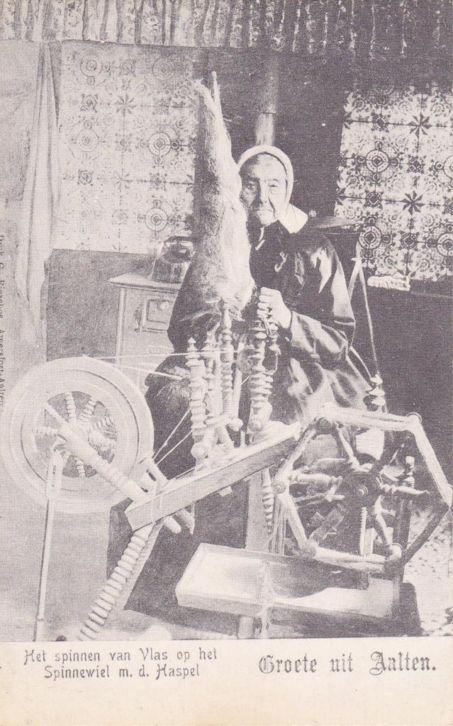
    Spinning flax
    Spinning flax on the spinning wheel

    The first factories

    In 1829, there were two cotton mills in Aalten ‘which provide work for about 40 people’, including that of the Driessen brothers. In 1830, there were three, with approximately sixty employees.

    On August 15, 1829, Jan Gerard Kraak ten Houten, ‘licensed shopkeeper and merchant in Aalten’, informed the Governor of Gelderland of his wish to establish ‘a fustian factory, spinning mill, dye works, and bleachery’ in his hometown, for which he requested permission. The municipal council had no objections to this establishment, ‘considering that the petitioner’s intention is only to have fustian manufactured by weavers at their homes, without erecting a spinning mill, bleachery, or dye works. This ensures sufficient work for the craftsman’, while no other interests are harmed. Ultimately, the King had to decide on the matter. Favorable advice was given by all advisors. It is not known how long this company existed or where it was located.

    Sources


    • Geweven goed, the textile history of Aalten and Bredevoort
      H. de Beukelaer, J.G. ter Horst – Fagus, 1992
  • Unrest in Aalten

    Unrest in Aalten

    Dagblad Tubantia, 6 January 1950

    German workers received a pound of coffee for Christmas; Dutch staff later received a rixdollar…

    While one of the German girls employed at a textile factory in Aalten was recently the cause of a sensational incident (she defaced the Dutch flag with a swastika), German textile workers in Aalten have once again been the catalyst for an event that has caused quite a stir in the quiet village, as two textile factories were involved.

    Sixteen German girls are employed at a textile factory in Dijkstraat. As Christmas approached, they began to ponder a surprise they could provide for their relatives across the border. It had to be coffee, was the general opinion!

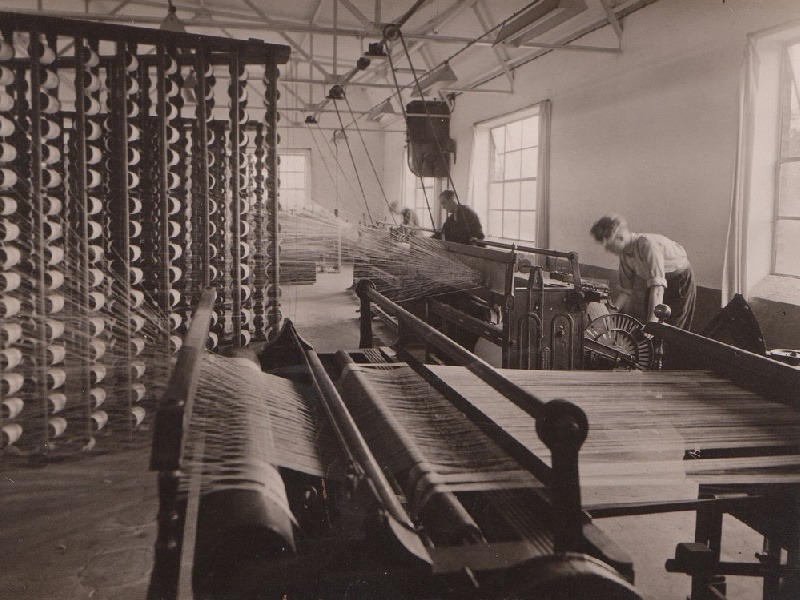
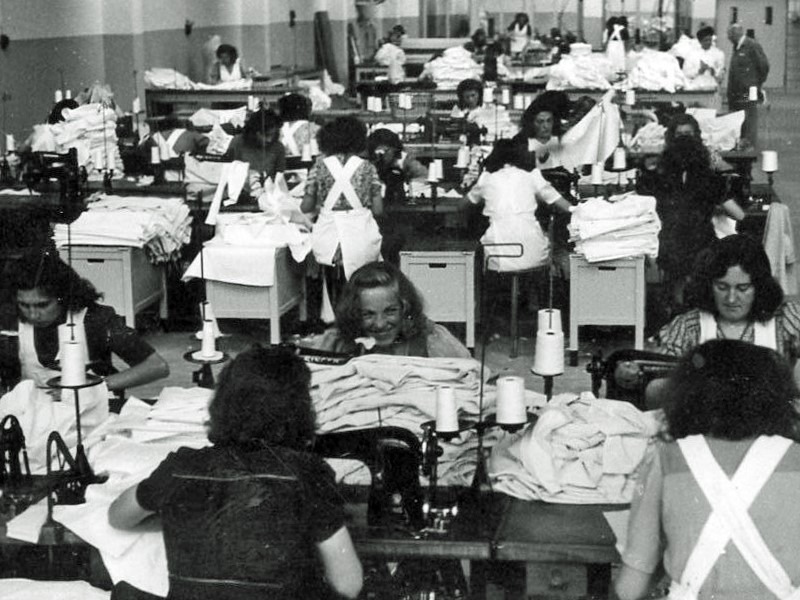
    Girls at work at the Driessen textile factory, Hofstraat. Photo for illustrative purposes.
    Girls at work at the Driessen textile factory, Hofstraat. Photo for illustrative purposes.

    The German girls enlisted the help of a staff member from Aalten, who knew just how to manage it. He, in turn, went to a businessman who proved able and willing to supply 16 pounds of coffee—one pound for each of the German girls. That evening, the girls cheerfully headed home by bus with their coffee. However, on that same bus were 19 female workers from a textile factory in Hofstraat.

    Understandably, they were none too pleased that their friends could take coffee home for “Weihnachten” while they could not. The matter was promptly raised the following day with the management in Hofstraat. They felt they could do little else but promise each of their German workers a pound of coffee as well. And the 19 pounds of coffee indeed materialised.

    But the difficulties did not end there! The Dutch staff had caught wind of the Christmas gift and now began to demand coffee too. After all, coffee is an item that has been very scarce in this country of late. The management of the Hofstraat factory restored industrial peace by giving every staff member a bonus of ƒ2.50. With that, the whole matter seemed to be settled.

    However, with so many people involved, it was almost inevitable that the police and the C.C.D. (Central Investigation Service) would hear of the case. The latter has since launched an investigation, which has already led to an official report (proces-verbaal) being filed against the management of the textile factory in Hofstraat. A second report followed for the granting of a bonus without the permission of the Board of Government Mediators. An official report has also been filed against the shopkeeper involved.

    We understand that the reason the German girls were able to export the coffee is that the Dutch customs, contrary to standing orders, allowed the coffee to pass; it was apparently assumed that it could be exported freely as long as its value was below ƒ15. The German customs had already promised the German girls that they would make an exception in view of the approaching Christmas holiday.

    Source


    • Dagblad Tubantia, 6 January 1950 (Delpher)
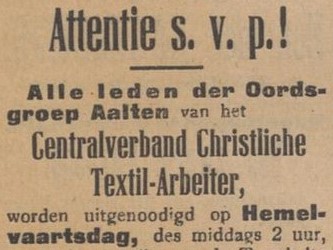
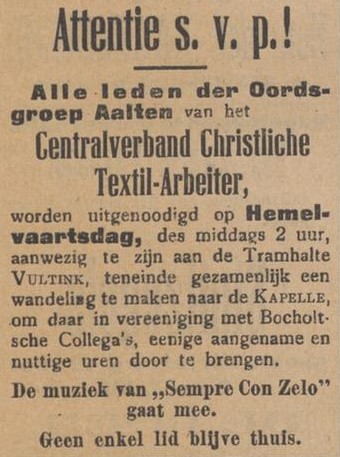
  • Zentralverband Chr. Textilarbeiter, branch  Aalten

    Zentralverband Chr. Textilarbeiter, branch Aalten

    At the beginning of the 20th century, hundreds of Aalten residents crossed the border to Bocholt daily to work in the textile factories there. In all weathers, they went on foot, by bicycle, or by horse and carriage. Some took as long as three hours to cover the (roughly) ten kilometers between home and work, both morning and evening! In 1910, a tram line to Bocholt was opened, allowing them to commute much faster and more comfortably from then on.

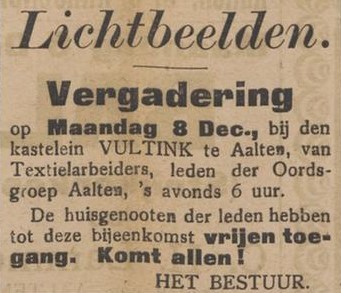
    Aalten even had its own branch of a German textile union, the Zentralverband Christliche Textilarbeiter, Aalten Local (Ortsgruppe). They met regularly in various cafés in Aalten. We found a number of reports on this subject on Delpher:

    Aaltensche Courant, 10 December 1913:

    On Monday evening, the Aalten Local of the Zentral-Verband Christl. Textilarbeiter Deutschland held a members’ meeting, to which family members of the organized workers were also admitted. Our friends from Bocholt had brought a magic lantern for this occasion, with which various scenes from the cottage industry, which was still very prevalent in Germany, were shown.

    Seeing these things, one can understand that a cry of horror arose, especially in Germany, when these most deplorable conditions came to light a few years ago through that large exhibition of cottage industry held in Berlin.

    From all this, it became clear that there is still a great deal of good work for legislators to do to improve the deeply sad lives of thousands who are forced by low wages to lead such a miserable existence.

    Mr. Mensink, from Enschede, then spoke pithily to those present, emphasizing that only a firm and solid organizational life can ultimately put an end to these abuses. One of the board members present expressed a heartfelt word of thanks to the propagandists, with which the meeting concurred.

    Aaltensche Courant, 12 September 1914:

    On Thursday morning, a well-attended meeting of the Aalten Local of the Zentralverband Christl. Textilarbeiter Deutschland was held in the café of the license holder te Linde. In his opening remarks, Mr. Ommering announced that, after much effort, the board had succeeded in establishing contact with their German colleagues and that the discussions held had led to the members of the Aalten Local also being able to count on support. This support will be paid out next Monday morning from 9:00 to 9:30 AM to members whose names begin with the letters A through M, and from 9:30 to 10:00 AM for the others; and that the support would certainly have been paid out earlier if the measures taken at the border by Dutch and German authorities had not intervened so disruptively.

    Subsequently, Mr. Mensink from Enschede explained the great benefit of being organized, which is brilliantly highlighted in these particularly difficult days for workers. The speaker explained in a very accessible discourse the difficulties workers face in these sad times, as well as those that the leaders of organizations have to struggle through, and concluded by urging that the members of the organization, also in their own interest, have a duty to support the organizational boards by remaining unconditionally loyal to the organization.

    Aaltensche Courant, 16 September 1914:

    On Monday morning, the war and emergency support was paid out to the members of the Aalten Local of the Zentralverband Christl. Textilarbeiter Deutschland. Although it had taken some time due to the closing of the borders, for many, under these circumstances, it was a significant amount that was paid out to them.

    If we are well-informed, the total payout that morning amounted to about 500 marks. We may safely assume that this payout brought a joyful mood to many a household.

    Let us hope, then, that the benefit of being organized is thoroughly recognized, that many who are still distant will join the organization later when the war has spent its fury, and that those few who had to be disappointed due to very poor contribution payments will mend their ways.

    Sources


    • Aaltensche Courant, 10 December 1913 (Delpher)
    • Aaltensche Courant, 12 September 1914 (Delpher)
    • Aaltensche Courant, 16 September 1914 (Delpher)