
The text below is a transcription of the “Regulations on the closing and opening of the gates of Bredevoort” from 1759.
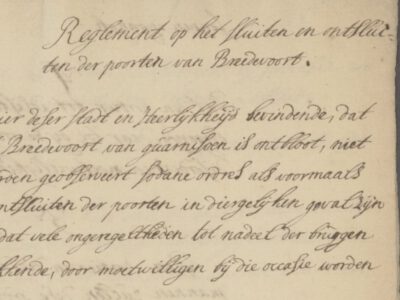
The Officer of this town and Lordship, finding that since this town of Bredevoort has been devoid of a garrison, such orders as were previously given for the closing and opening of the gates in similar cases are not being properly observed, and even that many irregularities detrimental to the bridges and gates are being committed by malicious persons on those occasions1.
Therefore, in order to provide for this as much as possible, the following regulations on the closing and opening of the gates are hereby decreed and established, as is done by these presents in the following manner:
- That in the evening at nine o’clock, after the ringing of the gate bell, the gatekeeper at the outermost bridge shall be required to call out three times whether anyone is still outside, and wait until those who have answered his call have been able to enter properly, and not close the gates before then; without anyone being admitted after that time, except for significant2 reasons. And after the closing has been completed, the keys shall immediately be brought by the gatekeeper to the house of the Mr. Land Writer pro tempore steward3.
- The gatekeeper shall put the gates on the bolt or latch one hour after sunset and, before opening, may and shall be entitled to demand half a stiver from every passenger, one stiver from a cart and horse, and two stivers from a wagon, including the driver. And at nine o’clock, after the ringing of the bell, they must be closed entirely, as mentioned in the previous article.
- That also in the morning the gates shall be opened half an hour before sunrise.
- That the gatekeeper shall have four men from the citizenry for assistance, to be summoned for that purpose by the rotmeesters (squad leaders) each time, to prevent all disorders and acts of malice.
- The gatekeeper and the men summoned for that purpose by the Rotmeesters shall strictly follow this order in the closing and opening of the gates and the raising of the bridges at the precise time in the morning and evening, on penalty4 of 6 stivers to be forfeited by each person who is absent and not present at the appointed hours, each time for the benefit of those present.
- That besides the gatekeeper and assistants, no one, whoever they may be, shall dare5 to interfere with the closing and opening of the gates or the raising and lowering of the bridges, to lay hands upon them, or to commit even the slightest act of malice, on a fine of two gold guilders to be forfeited by each and every one of the offenders6, with parents being responsible for and paying the fines for their children.
- And so that all the aforementioned shall be observed all the more exactly, the gatekeeper and assistants are recommended and at the same time ordered to pay close attention to all the aforementioned, and to report those offenders immediately, for which they shall benefit from one-third of the fine mentioned in the previous article.
- That this order shall be observed provisionally for as long as this town shall be devoid of a garrison.
And an extract of this shall be given to the gatekeeper for his information7.
And so that no one may plead the slightest ignorance of this, it shall be published and posted where it is customary to do so.
Thus provisionally decreed within Bredevoort on June 11, 1759.
By order of the Officer.
Footnotes
Sources
- Archive ‘Bailiff and Heirs of Bredevoort, 1608-1794’ (Erfgoedcentrum Achterhoek en Liemers), transcription: Remco Neerhof