
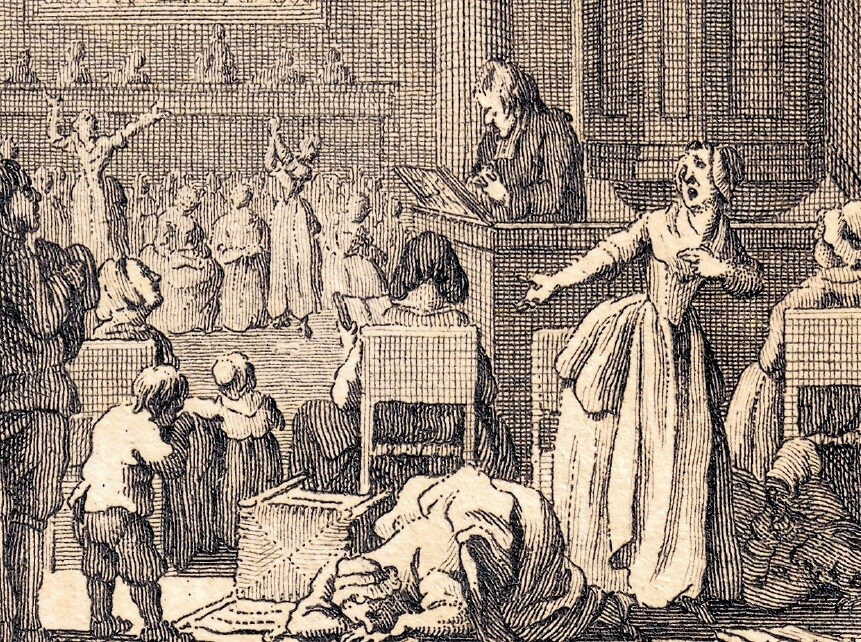
At the beginning of 1750, the quiet village of Aalten was shaken by a series of remarkable religious phenomena. During church services, people burst into tears, sighed loudly, or collapsed as if they had lost consciousness. Some even spoke of encounters with angels or attacks by the devil. These events garnered national attention and would go down in history as the Aalten Commotions.
What happened in Aalten was not an isolated incident. A year earlier, a religious revival had begun in Nijkerk, which quickly gained national fame. The stories of these Nijkerk Commotions spread rapidly and also provided the breeding ground for a separate, intense movement in Aalten.
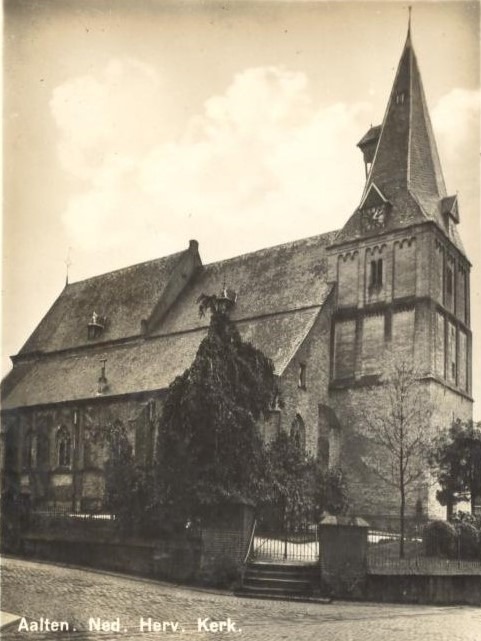
According to Reverend Philippus de Roy, who served the Reformed Congregation of Aalten at the time, there was a reluctance to repent and a ‘civil religion’ prior to these events, where people faithfully fulfilled their ecclesiastical duties, but faith was not “a matter of the heart.”
At the beginning of 1750, this suddenly changed. In a short period, hundreds of people in the congregation were deeply moved by a realization of their sins. This occurred in such an impressive manner that it spread “from house to house.” De Roy wrote about this:
“Now since the beginning of this year, God has revealed Himself in an outstanding (…) manner through His Spirit in our midst: and discovered hundreds of souls to themselves, by granting them a vivid understanding of the state of misery by nature.”
Intense emotions and physical phenomena
The revival was accompanied by extreme emotions and physical reactions. People became so fearful of God’s punishment that they felt they would “burst from anxiety” or as if their throats were being constricted. Sometimes they tore open their clothes to get air, but this did not help. Reports were made of “indescribable” sighing and groaning, and people trembled and shook throughout their entire bodies.
Some people were so overwhelmed that they fell to the ground and prayed loudly for forgiveness. A woman who fell to her knees during a meeting confessed her sins and pleaded on God’s promises. Later she explained that it was “impossible to restrain oneself because of the heavy burden of sin. Even if the whole world had been there, I would not have been able to keep quiet.” It was not uncommon for people to have to be transported home on carts after a meeting, as if they were wounded.
A village in turmoil
The influx of people was enormous. Church services and catechism classes, which were often held in homes, attracted so many people that the church was too small to accommodate all the visitors. The catechism classes, where the Sunday sermon was discussed, were the places where the commotion was most intense. During an outdoor gathering in May 1750, an “enormous emotion arose simply from the singing of a psalm”.
According to some reports, the number of those “moved” in Aalten was 1,700, even larger than in the more famous Nijkerk, where there were said to be 1,000. Such figures are difficult to verify, but they indicate the perceived scale of the movement.
Responses and the pamphlet war
The remarkable phenomena did not go undiscussed. A lively debate emerged in pamphlets and writings. Critics pointed to possible exaggeration and disorder in the worship services. De Roy responded to this criticism with a letter, addressed to an unknown lady, which was published in print. This booklet, Brief geschreven aan de WelEdele Juffer N.N. (Zutphen 1750), became a sensation: 5,000 copies were sold in three weeks, and a second edition followed as early as July 1750.
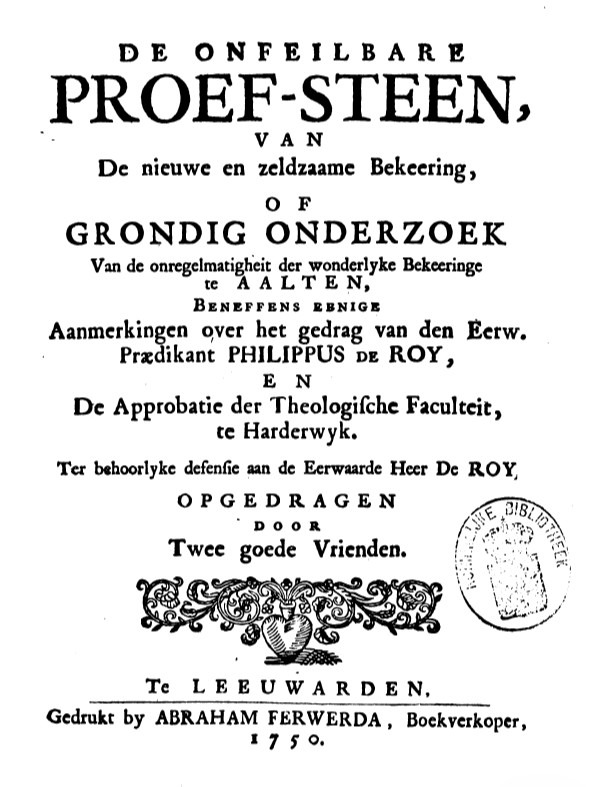
The success of this booklet provoked a critical response. In an anonymous pamphlet, De onfeilbare Proef-steen van De nieuwe en zeldzaame Bekeering (Leeuwarden 1750), the movement was fiercely attacked. Opponents accused the commotions of “fanaticism” and “religious enthusiasm.” De Roy did not leave this unanswered and wrote his own defense: De Feilbaarheid van den zo genaamde ONFEILBAREN PROEFSTEEN aangewezen (Zutphen 1750).
End of the commotions
The most intense phenomena in Aalten lasted only a few months. By around the summer of 1750, the intensity decreased. The meetings continued, but the massive emotional outbursts and dramatic scenes became increasingly rare. This pattern was similar to the commotions elsewhere in the Netherlands, such as in Nijkerk. Criticism from ministers, ecclesiastical boards, and anonymous pamphlets played a role in this and contributed to the movement slowly fading out.
Sources
- M.J. Oosting, De Aaltense beroeringen in 1750, Aalten 1987
- Philippus de Roy, Brief geschreven aan de WelEdele Juffer N.N., Zutphen 1750
- De onfeilbare Proef-steen van De nieuwe en zeldzaame Bekeering, Leeuwarden 1750
- Philippus de Roy, De Feilbaarheid van den zo genaamde ONFEILBAREN PROEFSTEEN aangewezen, Zutphen 1750
- Overview of pamphlets and context via DBNL
- Joke Spaans, Onderdrukking van de opwekking? (Utrecht University, 2003) PDF