
The verponding was a tax on real estate introduced in Gelderland in 1651 to replace the older schildschatting. This tax was levied on lands, farms, houses, and mills that generated income, with the aim of strengthening provincial finances. Wastelands, such as uncultivated common lands (markegronden), were exempt from this levy. The verponding remained in effect as a tax system in Gelderland until 1805.
Administration and Registration
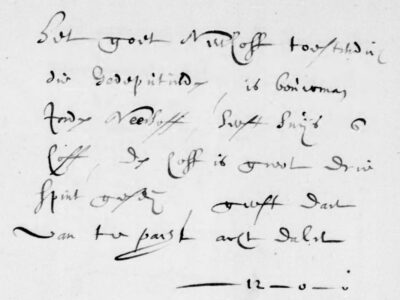
The term ‘verponding’ or ‘pondschatting’ likely refers to a tax assessment originally expressed in the unit of account ‘pond’ (pound). Data regarding the verponding was recorded in so-called verpondingskohieren (tax registers). These registers were compiled by local officials, such as bailiffs, sub-bailiffs, and rotmeesters, who were responsible for recording all real estate and its estimated value. The registers provide valuable historical information regarding the number of houses per location and their owners: nobility, church, or citizens. Additionally, they contain data on the size of holdings, lease structures, and ownership relationships.
Calculation
In the Quarter of Zutphen, to which Aalten and Bredevoort belonged, the amount of the verponding was determined based on the lease or rental value and the burdens resting on a property. For lands and farmsteads, the tax amounted to a sixth penny (or 1/6) of the taxable lease value; for houses and mills, this was a ninth penny (1/9) of the taxable rental value. If a property was not leased or rented but used by the owner themselves, the value was determined based on comparable properties that were leased or rented. Everyone was obliged to provide correct information and to show any lease contracts; negligence could result in a fine.
Collection and Payment
The collection of the verponding followed a strict timetable: the assessment, also known as a ‘maning’ (reminder), took place in November, and payment had to be made before the end of February. The tax could be calculated in various ways, and several deductions were possible, for example, for maintenance. Taxpayers received ‘maancedulen’ (assessment notices), which stated the amount due. The collected monies were handed over by the collectors to the receiver of the Quarter. In addition, both the ‘ambt’ (district) and the city and the Quarter could levy extra surcharges on top of the basic amount.
Verponding Register of 1647
The Verpondingskohier of 1647 is a frequently used source for historical research. At the time the verpondingskohieren were compiled, Gerhard Kreynck (1612-1692) was mayor of Zutphen. Kreynck had a great interest in historical documentation and made copies of important archives, including the verpondingskohier, city accounts, and feudal registers.
The Verpondingskohier of 1647 was transcribed by Kreynck in an abbreviated form around 1650, which later became known as Kreynck’s Transcript. The historical significance of the register lies in the fact that it is one of the first systematically compiled tax registers of Gelderland. The register provides insight into the economic situation of the region in the mid-17th century. The original register has been preserved and can be found in the National Archives in Arnhem.
Sources and Literature
- Erfgoedcentrum Zutphen
- Genealogiedomein: afbeeldingen en transcripties van de verpondingskohiers voor Aalten en Bredevoort.
- R. Wartena e.a., Boerderijnamen in de Achterhoek. Uit het verpondingskohier van ca. 1650, afschrift Kreynck, publicatie Oost Gelders Tijdschrift voor Boerderijonderzoek (link).
- H.K. Roessingh, Hoe zijn de Gelderse verpondingskohieren uit het midden van de 17de eeuw ingericht? Bronnen voor het lokaal-historisch onderzoek, Bijdragen en Mededelingen van Gelre LXIII (Arnhem 1968/1969), pag. 61-71.
- H.K. Roessingh, Garfpacht, zaadpacht en geldpacht in Gelderland in de 17e en 18e eeuw, Bijdragen en Mededelingen van Gelre LXIII (Arnhem 1968/1969), pag. 72-98.