
Deprecated: wpml_sticky_post_sync(): Implicitly marking parameter $sitepress as nullable is deprecated, the explicit nullable type must be used instead in /mnt/web417/b2/26/59666926/htdocs/Oud_Aalten/wp-content/plugins/sitepress-multilingual-cms/inc/functions.php on line 821
Deprecated: WPML\Container\make(): Implicitly marking parameter $args as nullable is deprecated, the explicit nullable type must be used instead in /mnt/web417/b2/26/59666926/htdocs/Oud_Aalten/wp-content/plugins/sitepress-multilingual-cms/classes/container/functions.php on line 26
Deprecated: WPML\Collect\Support\Arr::first(): Implicitly marking parameter $callback as nullable is deprecated, the explicit nullable type must be used instead in /mnt/web417/b2/26/59666926/htdocs/Oud_Aalten/wp-content/plugins/sitepress-multilingual-cms/vendor/wpml/collect/src/Illuminate/Support/Arr.php on line 134
Deprecated: WPML\Collect\Support\Arr::last(): Implicitly marking parameter $callback as nullable is deprecated, the explicit nullable type must be used instead in /mnt/web417/b2/26/59666926/htdocs/Oud_Aalten/wp-content/plugins/sitepress-multilingual-cms/vendor/wpml/collect/src/Illuminate/Support/Arr.php on line 163
Deprecated: WPML\Auryn\Injector::__construct(): Implicitly marking parameter $reflector as nullable is deprecated, the explicit nullable type must be used instead in /mnt/web417/b2/26/59666926/htdocs/Oud_Aalten/wp-content/plugins/sitepress-multilingual-cms/vendor/otgs/auryn/lib/Injector.php on line 51
Deprecated: WPML\Auryn\Injector::provisionFuncArgs(): Implicitly marking parameter $reflParams as nullable is deprecated, the explicit nullable type must be used instead in /mnt/web417/b2/26/59666926/htdocs/Oud_Aalten/wp-content/plugins/sitepress-multilingual-cms/vendor/otgs/auryn/lib/Injector.php on line 447
Deprecated: WPML\Auryn\CachingReflector::__construct(): Implicitly marking parameter $reflector as nullable is deprecated, the explicit nullable type must be used instead in /mnt/web417/b2/26/59666926/htdocs/Oud_Aalten/wp-content/plugins/sitepress-multilingual-cms/vendor/otgs/auryn/lib/CachingReflector.php on line 16
Deprecated: WPML\Auryn\CachingReflector::__construct(): Implicitly marking parameter $cache as nullable is deprecated, the explicit nullable type must be used instead in /mnt/web417/b2/26/59666926/htdocs/Oud_Aalten/wp-content/plugins/sitepress-multilingual-cms/vendor/otgs/auryn/lib/CachingReflector.php on line 16
Deprecated: WPML_Resolve_Object_Url_Helper::__construct(): Implicitly marking parameter $sitepress as nullable is deprecated, the explicit nullable type must be used instead in /mnt/web417/b2/26/59666926/htdocs/Oud_Aalten/wp-content/plugins/sitepress-multilingual-cms/classes/url-handling/resolver/class-wpml-resolve-object-url-helper.php on line 37
Deprecated: WPML_Resolve_Object_Url_Helper::__construct(): Implicitly marking parameter $wp_query as nullable is deprecated, the explicit nullable type must be used instead in /mnt/web417/b2/26/59666926/htdocs/Oud_Aalten/wp-content/plugins/sitepress-multilingual-cms/classes/url-handling/resolver/class-wpml-resolve-object-url-helper.php on line 37
Deprecated: WPML_Resolve_Object_Url_Helper::__construct(): Implicitly marking parameter $wpml_term_translations as nullable is deprecated, the explicit nullable type must be used instead in /mnt/web417/b2/26/59666926/htdocs/Oud_Aalten/wp-content/plugins/sitepress-multilingual-cms/classes/url-handling/resolver/class-wpml-resolve-object-url-helper.php on line 37
Deprecated: WPML_Resolve_Object_Url_Helper::__construct(): Implicitly marking parameter $wpml_post_translations as nullable is deprecated, the explicit nullable type must be used instead in /mnt/web417/b2/26/59666926/htdocs/Oud_Aalten/wp-content/plugins/sitepress-multilingual-cms/classes/url-handling/resolver/class-wpml-resolve-object-url-helper.php on line 37
Deprecated: WPML_URL_Converter_Url_Helper::__construct(): Implicitly marking parameter $wpdb as nullable is deprecated, the explicit nullable type must be used instead in /mnt/web417/b2/26/59666926/htdocs/Oud_Aalten/wp-content/plugins/sitepress-multilingual-cms/classes/url-handling/converter/helper/class-wpml-url-converter-url-helper.php on line 24
Deprecated: WPML_URL_Converter_Url_Helper::__construct(): Implicitly marking parameter $wpml_include_url_filter as nullable is deprecated, the explicit nullable type must be used instead in /mnt/web417/b2/26/59666926/htdocs/Oud_Aalten/wp-content/plugins/sitepress-multilingual-cms/classes/url-handling/converter/helper/class-wpml-url-converter-url-helper.php on line 24
Deprecated: WPML\Collect\Support\Collection::filter(): Implicitly marking parameter $callback as nullable is deprecated, the explicit nullable type must be used instead in /mnt/web417/b2/26/59666926/htdocs/Oud_Aalten/wp-content/plugins/sitepress-multilingual-cms/vendor/wpml/collect/src/Illuminate/Support/Collection.php on line 279
Deprecated: WPML\Collect\Support\Collection::first(): Implicitly marking parameter $callback as nullable is deprecated, the explicit nullable type must be used instead in /mnt/web417/b2/26/59666926/htdocs/Oud_Aalten/wp-content/plugins/sitepress-multilingual-cms/vendor/wpml/collect/src/Illuminate/Support/Collection.php on line 384
Deprecated: WPML\Collect\Support\Collection::last(): Implicitly marking parameter $callback as nullable is deprecated, the explicit nullable type must be used instead in /mnt/web417/b2/26/59666926/htdocs/Oud_Aalten/wp-content/plugins/sitepress-multilingual-cms/vendor/wpml/collect/src/Illuminate/Support/Collection.php on line 576
Deprecated: WPML\Collect\Support\Collection::sort(): Implicitly marking parameter $callback as nullable is deprecated, the explicit nullable type must be used instead in /mnt/web417/b2/26/59666926/htdocs/Oud_Aalten/wp-content/plugins/sitepress-multilingual-cms/vendor/wpml/collect/src/Illuminate/Support/Collection.php on line 995
Deprecated: WPML_Config_Update_Integrator::__construct(): Implicitly marking parameter $worker as nullable is deprecated, the explicit nullable type must be used instead in /mnt/web417/b2/26/59666926/htdocs/Oud_Aalten/wp-content/plugins/sitepress-multilingual-cms/classes/class-wpml-config-update-integrator.php on line 13
Deprecated: AbsoluteLinks::_process_generic_text(): Implicitly marking parameter $collector as nullable is deprecated, the explicit nullable type must be used instead in /mnt/web417/b2/26/59666926/htdocs/Oud_Aalten/wp-content/plugins/sitepress-multilingual-cms/inc/absolute-links/absolute-links.class.php on line 98
Deprecated: AbsoluteLinks::convert_text(): Implicitly marking parameter $collector as nullable is deprecated, the explicit nullable type must be used instead in /mnt/web417/b2/26/59666926/htdocs/Oud_Aalten/wp-content/plugins/sitepress-multilingual-cms/inc/absolute-links/absolute-links.class.php on line 776
Deprecated: WPML_Absolute_To_Permalinks::__construct(): Implicitly marking parameter $auto_adjust_ids as nullable is deprecated, the explicit nullable type must be used instead in /mnt/web417/b2/26/59666926/htdocs/Oud_Aalten/wp-content/plugins/sitepress-multilingual-cms/classes/url-handling/class-wpml-absolute-to-permalinks.php on line 16
Deprecated: WPML\Utils\AutoAdjustIds::__construct(): Implicitly marking parameter $wp as nullable is deprecated, the explicit nullable type must be used instead in /mnt/web417/b2/26/59666926/htdocs/Oud_Aalten/wp-content/plugins/sitepress-multilingual-cms/classes/utilities/AutoAdjustIds.php on line 22
Deprecated: WPML_Translation_Element_Factory::__construct(): Implicitly marking parameter $wpml_cache as nullable is deprecated, the explicit nullable type must be used instead in /mnt/web417/b2/26/59666926/htdocs/Oud_Aalten/wp-content/plugins/sitepress-multilingual-cms/classes/translations/class-wpml-translation-element-factory.php on line 18
Deprecated: TranslationManagement::__construct(): Implicitly marking parameter $wpml_cookie as nullable is deprecated, the explicit nullable type must be used instead in /mnt/web417/b2/26/59666926/htdocs/Oud_Aalten/wp-content/plugins/sitepress-multilingual-cms/inc/translation-management/translation-management.class.php on line 89
Deprecated: WPML_Post_Status_Display_Factory::__construct(): Implicitly marking parameter $sitepress as nullable is deprecated, the explicit nullable type must be used instead in /mnt/web417/b2/26/59666926/htdocs/Oud_Aalten/wp-content/plugins/sitepress-multilingual-cms/menu/class-wpml-post-status-display-factory.php on line 8
Deprecated: WPML_Canonicals::__construct(): Implicitly marking parameter $wpml_translations as nullable is deprecated, the explicit nullable type must be used instead in /mnt/web417/b2/26/59666926/htdocs/Oud_Aalten/wp-content/plugins/sitepress-multilingual-cms/classes/canonicals/class-wpml-canonicals.php on line 23
Deprecated: WPML_Compatibility_Gutenberg::__construct(): Implicitly marking parameter $php_functions as nullable is deprecated, the explicit nullable type must be used instead in /mnt/web417/b2/26/59666926/htdocs/Oud_Aalten/wp-content/plugins/sitepress-multilingual-cms/compatibility/gutenberg/wpml-compatibility-gutenberg.php on line 14
Deprecated: WPML_User_Language::__construct(): Implicitly marking parameter $wpdb as nullable is deprecated, the explicit nullable type must be used instead in /mnt/web417/b2/26/59666926/htdocs/Oud_Aalten/wp-content/plugins/sitepress-multilingual-cms/classes/user-language/class-wpml-user-language.php on line 37
Deprecated: Mobile_Detect_CV::__construct(): Implicitly marking parameter $headers as nullable is deprecated, the explicit nullable type must be used instead in /mnt/web417/b2/26/59666926/htdocs/Oud_Aalten/wp-content/plugins/pt-content-views-pro/includes/lib/Mobile_Detect.php on line 639
Deprecated: OTGS_UI_Loader::__construct(): Implicitly marking parameter $locator as nullable is deprecated, the explicit nullable type must be used instead in /mnt/web417/b2/26/59666926/htdocs/Oud_Aalten/wp-content/plugins/sitepress-multilingual-cms/vendor/otgs/ui/src/php/OTGS_UI_Loader.php on line 22
Deprecated: OTGS_UI_Loader::__construct(): Implicitly marking parameter $assets as nullable is deprecated, the explicit nullable type must be used instead in /mnt/web417/b2/26/59666926/htdocs/Oud_Aalten/wp-content/plugins/sitepress-multilingual-cms/vendor/otgs/ui/src/php/OTGS_UI_Loader.php on line 22
Deprecated: WPML_ST_Upgrade::__construct(): Implicitly marking parameter $command_factory as nullable is deprecated, the explicit nullable type must be used instead in /mnt/web417/b2/26/59666926/htdocs/Oud_Aalten/wp-content/plugins/wpml-string-translation/classes/upgrade/class-wpml-st-upgrade.php on line 42
Deprecated: WPML_ST_Translations_File_Dictionary_Storage::findAllUniqueComponentIds(): Implicitly marking parameter $componentType as nullable is deprecated, the explicit nullable type must be used instead in /mnt/web417/b2/26/59666926/htdocs/Oud_Aalten/wp-content/plugins/wpml-string-translation/classes/translations-file-scan/dictionary/class-st-translations-file-dictionary-storage.php on line 15
Deprecated: WPML_ST_Translations_File_Dictionary_Storage_Table::findAllUniqueComponentIds(): Implicitly marking parameter $componentType as nullable is deprecated, the explicit nullable type must be used instead in /mnt/web417/b2/26/59666926/htdocs/Oud_Aalten/wp-content/plugins/wpml-string-translation/classes/translations-file-scan/dictionary/class-st-translations-file-dicionary-storage-table.php on line 164
Deprecated: WPML\ST\TranslationFile\UpdateHooks::__construct(): Implicitly marking parameter $resetDomainsCache as nullable is deprecated, the explicit nullable type must be used instead in /mnt/web417/b2/26/59666926/htdocs/Oud_Aalten/wp-content/plugins/wpml-string-translation/classes/translation-files/UpdateHooks.php on line 26
Deprecated: WPML\ST\MO\Hooks\CustomTextDomains::__construct(): Implicitly marking parameter $syncMissingFile as nullable is deprecated, the explicit nullable type must be used instead in /mnt/web417/b2/26/59666926/htdocs/Oud_Aalten/wp-content/plugins/wpml-string-translation/classes/MO/Hooks/CustomTextDomains.php on line 42
Deprecated: WPML_String_Translation::getTranslatedMissingTranslationsMessage(): Implicitly marking parameter $lastItem as nullable is deprecated, the explicit nullable type must be used instead in /mnt/web417/b2/26/59666926/htdocs/Oud_Aalten/wp-content/plugins/wpml-string-translation/inc/wpml-string-translation.class.php on line 614
Deprecated: WPML\StringTranslation\Infrastructure\StringHtml\Validator\IsExcludedHtmlStringValidator::validate(): Implicitly marking parameter $text as nullable is deprecated, the explicit nullable type must be used instead in /mnt/web417/b2/26/59666926/htdocs/Oud_Aalten/wp-content/plugins/wpml-string-translation/StringTranslation/Infrastructure/StringHtml/Validator/IsExcludedHtmlStringValidator.php on line 9
Deprecated: WPML\StringTranslation\Application\StringGettext\Repository\QueueRepositoryInterface::addCurrentUrlString(): Implicitly marking parameter $context as nullable is deprecated, the explicit nullable type must be used instead in /mnt/web417/b2/26/59666926/htdocs/Oud_Aalten/wp-content/plugins/wpml-string-translation/StringTranslation/Application/StringGettext/Repository/QueueRepositoryInterface.php on line 8
Deprecated: WPML\StringTranslation\Application\StringGettext\Repository\QueueRepositoryInterface::isStringAlreadyRegistered(): Implicitly marking parameter $context as nullable is deprecated, the explicit nullable type must be used instead in /mnt/web417/b2/26/59666926/htdocs/Oud_Aalten/wp-content/plugins/wpml-string-translation/StringTranslation/Application/StringGettext/Repository/QueueRepositoryInterface.php on line 14
Deprecated: WPML\StringTranslation\Application\StringGettext\Repository\QueueRepositoryInterface::isStringAlreadyRegistered(): Implicitly marking parameter $name as nullable is deprecated, the explicit nullable type must be used instead in /mnt/web417/b2/26/59666926/htdocs/Oud_Aalten/wp-content/plugins/wpml-string-translation/StringTranslation/Application/StringGettext/Repository/QueueRepositoryInterface.php on line 14
Deprecated: WPML\StringTranslation\Application\StringGettext\Repository\QueueRepositoryInterface::isStringAlreadyTrackedOnUrl(): Implicitly marking parameter $context as nullable is deprecated, the explicit nullable type must be used instead in /mnt/web417/b2/26/59666926/htdocs/Oud_Aalten/wp-content/plugins/wpml-string-translation/StringTranslation/Application/StringGettext/Repository/QueueRepositoryInterface.php on line 15
Deprecated: WPML\StringTranslation\Application\StringGettext\Repository\QueueRepositoryInterface::queueStringAsPending(): Implicitly marking parameter $context as nullable is deprecated, the explicit nullable type must be used instead in /mnt/web417/b2/26/59666926/htdocs/Oud_Aalten/wp-content/plugins/wpml-string-translation/StringTranslation/Application/StringGettext/Repository/QueueRepositoryInterface.php on line 16
Deprecated: WPML\StringTranslation\Application\StringGettext\Repository\QueueRepositoryInterface::queueStringAsPending(): Implicitly marking parameter $name as nullable is deprecated, the explicit nullable type must be used instead in /mnt/web417/b2/26/59666926/htdocs/Oud_Aalten/wp-content/plugins/wpml-string-translation/StringTranslation/Application/StringGettext/Repository/QueueRepositoryInterface.php on line 16
Deprecated: WPML\StringTranslation\Application\StringGettext\Repository\QueueRepositoryInterface::trackString(): Implicitly marking parameter $context as nullable is deprecated, the explicit nullable type must be used instead in /mnt/web417/b2/26/59666926/htdocs/Oud_Aalten/wp-content/plugins/wpml-string-translation/StringTranslation/Application/StringGettext/Repository/QueueRepositoryInterface.php on line 18
Deprecated: WPML\StringTranslation\Infrastructure\StringGettext\Repository\QueueRepository::addCurrentUrlString(): Implicitly marking parameter $context as nullable is deprecated, the explicit nullable type must be used instead in /mnt/web417/b2/26/59666926/htdocs/Oud_Aalten/wp-content/plugins/wpml-string-translation/StringTranslation/Infrastructure/StringGettext/Repository/QueueRepository.php on line 141
Deprecated: WPML\StringTranslation\Infrastructure\StringGettext\Repository\QueueRepository::isStringAlreadyRegistered(): Implicitly marking parameter $context as nullable is deprecated, the explicit nullable type must be used instead in /mnt/web417/b2/26/59666926/htdocs/Oud_Aalten/wp-content/plugins/wpml-string-translation/StringTranslation/Infrastructure/StringGettext/Repository/QueueRepository.php on line 209
Deprecated: WPML\StringTranslation\Infrastructure\StringGettext\Repository\QueueRepository::isStringAlreadyRegistered(): Implicitly marking parameter $name as nullable is deprecated, the explicit nullable type must be used instead in /mnt/web417/b2/26/59666926/htdocs/Oud_Aalten/wp-content/plugins/wpml-string-translation/StringTranslation/Infrastructure/StringGettext/Repository/QueueRepository.php on line 209
Deprecated: WPML\StringTranslation\Infrastructure\StringGettext\Repository\QueueRepository::canTrackString(): Implicitly marking parameter $context as nullable is deprecated, the explicit nullable type must be used instead in /mnt/web417/b2/26/59666926/htdocs/Oud_Aalten/wp-content/plugins/wpml-string-translation/StringTranslation/Infrastructure/StringGettext/Repository/QueueRepository.php on line 225
Deprecated: WPML\StringTranslation\Infrastructure\StringGettext\Repository\QueueRepository::isStringAlreadyTrackedOnUrl(): Implicitly marking parameter $context as nullable is deprecated, the explicit nullable type must be used instead in /mnt/web417/b2/26/59666926/htdocs/Oud_Aalten/wp-content/plugins/wpml-string-translation/StringTranslation/Infrastructure/StringGettext/Repository/QueueRepository.php on line 249
Deprecated: WPML\StringTranslation\Infrastructure\StringGettext\Repository\QueueRepository::queueStringAsPending(): Implicitly marking parameter $context as nullable is deprecated, the explicit nullable type must be used instead in /mnt/web417/b2/26/59666926/htdocs/Oud_Aalten/wp-content/plugins/wpml-string-translation/StringTranslation/Infrastructure/StringGettext/Repository/QueueRepository.php on line 280
Deprecated: WPML\StringTranslation\Infrastructure\StringGettext\Repository\QueueRepository::queueStringAsPending(): Implicitly marking parameter $name as nullable is deprecated, the explicit nullable type must be used instead in /mnt/web417/b2/26/59666926/htdocs/Oud_Aalten/wp-content/plugins/wpml-string-translation/StringTranslation/Infrastructure/StringGettext/Repository/QueueRepository.php on line 280
Deprecated: WPML\StringTranslation\Infrastructure\StringGettext\Repository\QueueRepository::trackString(): Implicitly marking parameter $context as nullable is deprecated, the explicit nullable type must be used instead in /mnt/web417/b2/26/59666926/htdocs/Oud_Aalten/wp-content/plugins/wpml-string-translation/StringTranslation/Infrastructure/StringGettext/Repository/QueueRepository.php on line 307
Deprecated: WPML\StringTranslation\Application\StringCore\Repository\ComponentRepositoryInterface::getComponentIdAndType(): Implicitly marking parameter $context as nullable is deprecated, the explicit nullable type must be used instead in /mnt/web417/b2/26/59666926/htdocs/Oud_Aalten/wp-content/plugins/wpml-string-translation/StringTranslation/Application/StringCore/Repository/ComponentRepositoryInterface.php on line 10
Deprecated: WPML\StringTranslation\Infrastructure\StringCore\Repository\ComponentRepository::getComponentIdAndType(): Implicitly marking parameter $context as nullable is deprecated, the explicit nullable type must be used instead in /mnt/web417/b2/26/59666926/htdocs/Oud_Aalten/wp-content/plugins/wpml-string-translation/StringTranslation/Infrastructure/StringCore/Repository/ComponentRepository.php on line 31
Deprecated: WPML\StringTranslation\Infrastructure\StringCore\Repository\ComponentRepository::getCmpIdAndTypeData(): Implicitly marking parameter $context as nullable is deprecated, the explicit nullable type must be used instead in /mnt/web417/b2/26/59666926/htdocs/Oud_Aalten/wp-content/plugins/wpml-string-translation/StringTranslation/Infrastructure/StringCore/Repository/ComponentRepository.php on line 69
Deprecated: WPML\StringTranslation\Infrastructure\StringCore\Repository\ComponentRepository::getCmpIdAndType(): Implicitly marking parameter $context as nullable is deprecated, the explicit nullable type must be used instead in /mnt/web417/b2/26/59666926/htdocs/Oud_Aalten/wp-content/plugins/wpml-string-translation/StringTranslation/Infrastructure/StringCore/Repository/ComponentRepository.php on line 80
Deprecated: WPML\StringTranslation\Infrastructure\StringCore\Repository\ComponentRepository::isPlugin(): Implicitly marking parameter $filepath as nullable is deprecated, the explicit nullable type must be used instead in /mnt/web417/b2/26/59666926/htdocs/Oud_Aalten/wp-content/plugins/wpml-string-translation/StringTranslation/Infrastructure/StringCore/Repository/ComponentRepository.php on line 186
Deprecated: WPML\StringTranslation\Infrastructure\StringCore\Repository\ComponentRepository::isPlugin(): Implicitly marking parameter $fn as nullable is deprecated, the explicit nullable type must be used instead in /mnt/web417/b2/26/59666926/htdocs/Oud_Aalten/wp-content/plugins/wpml-string-translation/StringTranslation/Infrastructure/StringCore/Repository/ComponentRepository.php on line 186
Deprecated: WPML\StringTranslation\Infrastructure\StringCore\Repository\ComponentRepository::isTheme(): Implicitly marking parameter $filepath as nullable is deprecated, the explicit nullable type must be used instead in /mnt/web417/b2/26/59666926/htdocs/Oud_Aalten/wp-content/plugins/wpml-string-translation/StringTranslation/Infrastructure/StringCore/Repository/ComponentRepository.php on line 200
Deprecated: WPML\StringTranslation\Infrastructure\StringCore\Repository\ComponentRepository::isTheme(): Implicitly marking parameter $fn as nullable is deprecated, the explicit nullable type must be used instead in /mnt/web417/b2/26/59666926/htdocs/Oud_Aalten/wp-content/plugins/wpml-string-translation/StringTranslation/Infrastructure/StringCore/Repository/ComponentRepository.php on line 200
Deprecated: WPML\StringTranslation\Infrastructure\StringCore\Repository\ComponentRepository::isLoadingAndTranslatingPluginMetadataNotFromPluginItself(): Implicitly marking parameter $function as nullable is deprecated, the explicit nullable type must be used instead in /mnt/web417/b2/26/59666926/htdocs/Oud_Aalten/wp-content/plugins/wpml-string-translation/StringTranslation/Infrastructure/StringCore/Repository/ComponentRepository.php on line 217
Deprecated: WPML\StringTranslation\Infrastructure\StringCore\Repository\ComponentRepository::getPluginId(): Implicitly marking parameter $fn as nullable is deprecated, the explicit nullable type must be used instead in /mnt/web417/b2/26/59666926/htdocs/Oud_Aalten/wp-content/plugins/wpml-string-translation/StringTranslation/Infrastructure/StringCore/Repository/ComponentRepository.php on line 221
Deprecated: WPML\StringTranslation\Application\StringCore\Domain\Factory\StringItemFactory::create(): Implicitly marking parameter $context as nullable is deprecated, the explicit nullable type must be used instead in /mnt/web417/b2/26/59666926/htdocs/Oud_Aalten/wp-content/plugins/wpml-string-translation/StringTranslation/Application/StringCore/Domain/Factory/StringItemFactory.php on line 19
Deprecated: WPML\StringTranslation\Infrastructure\TranslateEverything\UntranslatedStrings::__construct(): Implicitly marking parameter $wpdb as nullable is deprecated, the explicit nullable type must be used instead in /mnt/web417/b2/26/59666926/htdocs/Oud_Aalten/wp-content/plugins/wpml-string-translation/StringTranslation/Infrastructure/TranslateEverything/UntranslatedStrings.php on line 37
Deprecated: WPML\StringTranslation\Application\StringGettext\Service\GettextStringsService::maybeTrackString(): Implicitly marking parameter $context as nullable is deprecated, the explicit nullable type must be used instead in /mnt/web417/b2/26/59666926/htdocs/Oud_Aalten/wp-content/plugins/wpml-string-translation/StringTranslation/Application/StringGettext/Service/GettextStringsService.php on line 159
Deprecated: WPML\StringTranslation\Application\StringCore\Repository\TranslationsRepositoryInterface::isTranslationAvailable(): Implicitly marking parameter $context as nullable is deprecated, the explicit nullable type must be used instead in /mnt/web417/b2/26/59666926/htdocs/Oud_Aalten/wp-content/plugins/wpml-string-translation/StringTranslation/Application/StringCore/Repository/TranslationsRepositoryInterface.php on line 9
Deprecated: WPML\StringTranslation\Infrastructure\StringCore\Repository\TranslationsRepository::isTranslationAvailable(): Implicitly marking parameter $context as nullable is deprecated, the explicit nullable type must be used instead in /mnt/web417/b2/26/59666926/htdocs/Oud_Aalten/wp-content/plugins/wpml-string-translation/StringTranslation/Infrastructure/StringCore/Repository/TranslationsRepository.php on line 19
Deprecated: WPML\StringTranslation\Infrastructure\StringCore\Repository\TranslationsRepository::getTranslatedStringText(): Implicitly marking parameter $context as nullable is deprecated, the explicit nullable type must be used instead in /mnt/web417/b2/26/59666926/htdocs/Oud_Aalten/wp-content/plugins/wpml-string-translation/StringTranslation/Infrastructure/StringCore/Repository/TranslationsRepository.php on line 46
Deprecated: {closure:WPML\StringTranslation\Infrastructure\StringGettext\Command\ProcessPendingStringsCommand::run():66}(): Implicitly marking parameter $name as nullable is deprecated, the explicit nullable type must be used instead in /mnt/web417/b2/26/59666926/htdocs/Oud_Aalten/wp-content/plugins/wpml-string-translation/StringTranslation/Infrastructure/StringGettext/Command/ProcessPendingStringsCommand.php on line 66
Deprecated: {closure:WPML\StringTranslation\Infrastructure\StringGettext\Command\ProcessPendingStringsCommand::run():66}(): Implicitly marking parameter $context as nullable is deprecated, the explicit nullable type must be used instead in /mnt/web417/b2/26/59666926/htdocs/Oud_Aalten/wp-content/plugins/wpml-string-translation/StringTranslation/Infrastructure/StringGettext/Command/ProcessPendingStringsCommand.php on line 66
Deprecated: WPML_Package_Translation::loaded(): Implicitly marking parameter $sitepress as nullable is deprecated, the explicit nullable type must be used instead in /mnt/web417/b2/26/59666926/htdocs/Oud_Aalten/wp-content/plugins/wpml-string-translation/inc/package-translation/inc/wpml-package-translation.class.php on line 13
Deprecated: WPML_ST_Package_Factory::__construct(): Implicitly marking parameter $cache_factory as nullable is deprecated, the explicit nullable type must be used instead in /mnt/web417/b2/26/59666926/htdocs/Oud_Aalten/wp-content/plugins/wpml-string-translation/inc/package-translation/inc/wpml-package-factory.class.php on line 8
Deprecated: WPML_File::__construct(): Implicitly marking parameter $wp_api as nullable is deprecated, the explicit nullable type must be used instead in /mnt/web417/b2/26/59666926/htdocs/Oud_Aalten/wp-content/plugins/sitepress-multilingual-cms/classes/class-wpml-file.php on line 32
Deprecated: WPML_File::__construct(): Implicitly marking parameter $filesystem as nullable is deprecated, the explicit nullable type must be used instead in /mnt/web417/b2/26/59666926/htdocs/Oud_Aalten/wp-content/plugins/sitepress-multilingual-cms/classes/class-wpml-file.php on line 32
Deprecated: WPML\LIB\WP\User::hasCap(): Implicitly marking parameter $user as nullable is deprecated, the explicit nullable type must be used instead in /mnt/web417/b2/26/59666926/htdocs/Oud_Aalten/wp-content/plugins/sitepress-multilingual-cms/vendor/wpml/wp/classes/User.php on line 222
Deprecated: WPML\LIB\WP\User::canManageTranslations(): Implicitly marking parameter $user as nullable is deprecated, the explicit nullable type must be used instead in /mnt/web417/b2/26/59666926/htdocs/Oud_Aalten/wp-content/plugins/sitepress-multilingual-cms/vendor/wpml/wp/classes/User.php on line 233
Deprecated: WPML\LIB\WP\User::canManageOptions(): Implicitly marking parameter $user as nullable is deprecated, the explicit nullable type must be used instead in /mnt/web417/b2/26/59666926/htdocs/Oud_Aalten/wp-content/plugins/sitepress-multilingual-cms/vendor/wpml/wp/classes/User.php on line 243
Deprecated: WPML\LIB\WP\User::isAdministrator(): Implicitly marking parameter $user as nullable is deprecated, the explicit nullable type must be used instead in /mnt/web417/b2/26/59666926/htdocs/Oud_Aalten/wp-content/plugins/sitepress-multilingual-cms/vendor/wpml/wp/classes/User.php on line 252
Deprecated: WPML\LIB\WP\User::isEditor(): Implicitly marking parameter $user as nullable is deprecated, the explicit nullable type must be used instead in /mnt/web417/b2/26/59666926/htdocs/Oud_Aalten/wp-content/plugins/sitepress-multilingual-cms/vendor/wpml/wp/classes/User.php on line 261
Deprecated: WPML\LIB\WP\User::isTranslator(): Implicitly marking parameter $user as nullable is deprecated, the explicit nullable type must be used instead in /mnt/web417/b2/26/59666926/htdocs/Oud_Aalten/wp-content/plugins/sitepress-multilingual-cms/vendor/wpml/wp/classes/User.php on line 275
Deprecated: WPML_Language_Switcher::__construct(): Implicitly marking parameter $dependencies as nullable is deprecated, the explicit nullable type must be used instead in /mnt/web417/b2/26/59666926/htdocs/Oud_Aalten/wp-content/plugins/sitepress-multilingual-cms/classes/language-switcher/class-wpml-language-switcher.php on line 19
Deprecated: WPML_LS_Templates::__construct(): Implicitly marking parameter $wpml_file as nullable is deprecated, the explicit nullable type must be used instead in /mnt/web417/b2/26/59666926/htdocs/Oud_Aalten/wp-content/plugins/sitepress-multilingual-cms/classes/language-switcher/class-wpml-ls-templates.php on line 25
Deprecated: WPML_LS_Public_API::__construct(): Implicitly marking parameter $slot_factory as nullable is deprecated, the explicit nullable type must be used instead in /mnt/web417/b2/26/59666926/htdocs/Oud_Aalten/wp-content/plugins/sitepress-multilingual-cms/classes/language-switcher/public-api/class-wpml-ls-public-api.php on line 27
Deprecated: WPML_TM_ATE_Authentication::__construct(): Implicitly marking parameter $site_id_manager as nullable is deprecated, the explicit nullable type must be used instead in /mnt/web417/b2/26/59666926/htdocs/Oud_Aalten/wp-content/plugins/sitepress-multilingual-cms/classes/ATE/API/class-wpml-tm-ate-authentication.php on line 21
Deprecated: WPML_TM_ATE_Authentication::get_signature(): Implicitly marking parameter $params as nullable is deprecated, the explicit nullable type must be used instead in /mnt/web417/b2/26/59666926/htdocs/Oud_Aalten/wp-content/plugins/sitepress-multilingual-cms/classes/ATE/API/class-wpml-tm-ate-authentication.php on line 45
Deprecated: WPML_TM_ATE_Authentication::add_required_arguments_to_url(): Implicitly marking parameter $params as nullable is deprecated, the explicit nullable type must be used instead in /mnt/web417/b2/26/59666926/htdocs/Oud_Aalten/wp-content/plugins/sitepress-multilingual-cms/classes/ATE/API/class-wpml-tm-ate-authentication.php on line 106
Deprecated: WPML_TM_AMS_API::request(): Implicitly marking parameter $params as nullable is deprecated, the explicit nullable type must be used instead in /mnt/web417/b2/26/59666926/htdocs/Oud_Aalten/wp-content/plugins/sitepress-multilingual-cms/classes/ATE/API/class-wpml-tm-ams-api.php on line 855
Deprecated: WPML_TM_AMS_API::signed_request(): Implicitly marking parameter $params as nullable is deprecated, the explicit nullable type must be used instead in /mnt/web417/b2/26/59666926/htdocs/Oud_Aalten/wp-content/plugins/sitepress-multilingual-cms/classes/ATE/API/class-wpml-tm-ams-api.php on line 923
Deprecated: WPML_TM_AMS_API::getSignedResult(): Implicitly marking parameter $params as nullable is deprecated, the explicit nullable type must be used instead in /mnt/web417/b2/26/59666926/htdocs/Oud_Aalten/wp-content/plugins/sitepress-multilingual-cms/classes/ATE/API/class-wpml-tm-ams-api.php on line 1011
Deprecated: WPML_TM_ATE_AMS_Endpoints::get_endpoint_url(): Implicitly marking parameter $query_string as nullable is deprecated, the explicit nullable type must be used instead in /mnt/web417/b2/26/59666926/htdocs/Oud_Aalten/wp-content/plugins/sitepress-multilingual-cms/classes/ATE/class-wpml-tm-ate-ams-endpoints.php on line 104
Deprecated: WPML_TM_ATE_AMS_Endpoints::get_ate_jobs(): Implicitly marking parameter $statuses as nullable is deprecated, the explicit nullable type must be used instead in /mnt/web417/b2/26/59666926/htdocs/Oud_Aalten/wp-content/plugins/sitepress-multilingual-cms/classes/ATE/class-wpml-tm-ate-ams-endpoints.php on line 326
Deprecated: WPML\TM\ATE\TranslateEverything\AbstractUntranslatedElements::__construct(): Implicitly marking parameter $oldJobsEditor as nullable is deprecated, the explicit nullable type must be used instead in /mnt/web417/b2/26/59666926/htdocs/Oud_Aalten/wp-content/plugins/sitepress-multilingual-cms/classes/ATE/TranslateEverything/AbstractUntranslatedElements.php on line 24
Deprecated: WPML\TM\ATE\TranslateEverything\UntranslatedPackages::__construct(): Implicitly marking parameter $oldJobsEditor as nullable is deprecated, the explicit nullable type must be used instead in /mnt/web417/b2/26/59666926/htdocs/Oud_Aalten/wp-content/plugins/sitepress-multilingual-cms/classes/ATE/TranslateEverything/UntranslatedPackages.php on line 24
Deprecated: WPML\TM\ATE\TranslateEverything\UntranslatedPackages::__construct(): Implicitly marking parameter $translatablePackages as nullable is deprecated, the explicit nullable type must be used instead in /mnt/web417/b2/26/59666926/htdocs/Oud_Aalten/wp-content/plugins/sitepress-multilingual-cms/classes/ATE/TranslateEverything/UntranslatedPackages.php on line 24
Deprecated: WPML_Upgrade_Command_Factory::create_command_definition(): Implicitly marking parameter $factory_method as nullable is deprecated, the explicit nullable type must be used instead in /mnt/web417/b2/26/59666926/htdocs/Oud_Aalten/wp-content/plugins/sitepress-multilingual-cms/classes/upgrade/class-wpml-upgrade-command-factory.php on line 13
Deprecated: WPML_WPSEO_XML_Sitemaps_Filter::__construct(): Implicitly marking parameter $back_trace as nullable is deprecated, the explicit nullable type must be used instead in /mnt/web417/b2/26/59666926/htdocs/Oud_Aalten/wp-content/plugins/wp-seo-multilingual/classes/YoastSEO/class-wpml-wpseo-xml-sitemaps-filter.php on line 34
Deprecated: WPML_WPSEO_Categories::__construct(): Implicitly marking parameter $slugTranslationSettingsFactory as nullable is deprecated, the explicit nullable type must be used instead in /mnt/web417/b2/26/59666926/htdocs/Oud_Aalten/wp-content/plugins/wp-seo-multilingual/classes/YoastSEO/class-wpml-wpseo-categories.php on line 17
Deprecated: WPML\ST\Batch\Translation\Module::batchStringsStorage(): Implicitly marking parameter $saveBatch as nullable is deprecated, the explicit nullable type must be used instead in /mnt/web417/b2/26/59666926/htdocs/Oud_Aalten/wp-content/plugins/wpml-string-translation/classes/batch-translation/Module.php on line 87
Deprecated: WPML\ST\Batch\Translation\Records::get(): Implicitly marking parameter $wpdb as nullable is deprecated, the explicit nullable type must be used instead in /mnt/web417/b2/26/59666926/htdocs/Oud_Aalten/wp-content/plugins/wpml-string-translation/classes/batch-translation/Records.php on line 39
Deprecated: WPML\PHP\Auryn\Injector::__construct(): Implicitly marking parameter $reflector as nullable is deprecated, the explicit nullable type must be used instead in /mnt/web417/b2/26/59666926/htdocs/Oud_Aalten/wp-content/plugins/sitepress-multilingual-cms/vendor/wpml/wpml/lib/Php/Auryn/Injector.php on line 51
Deprecated: WPML\PHP\Auryn\Injector::provisionFuncArgs(): Implicitly marking parameter $reflParams as nullable is deprecated, the explicit nullable type must be used instead in /mnt/web417/b2/26/59666926/htdocs/Oud_Aalten/wp-content/plugins/sitepress-multilingual-cms/vendor/wpml/wpml/lib/Php/Auryn/Injector.php on line 447
Deprecated: WPML\PHP\Auryn\CachingReflector::__construct(): Implicitly marking parameter $reflector as nullable is deprecated, the explicit nullable type must be used instead in /mnt/web417/b2/26/59666926/htdocs/Oud_Aalten/wp-content/plugins/sitepress-multilingual-cms/vendor/wpml/wpml/lib/Php/Auryn/CachingReflector.php on line 16
Deprecated: WPML\PHP\Auryn\CachingReflector::__construct(): Implicitly marking parameter $cache as nullable is deprecated, the explicit nullable type must be used instead in /mnt/web417/b2/26/59666926/htdocs/Oud_Aalten/wp-content/plugins/sitepress-multilingual-cms/vendor/wpml/wpml/lib/Php/Auryn/CachingReflector.php on line 16
Deprecated: WPML\UserInterface\Web\Infrastructure\CompositionRoot\Config\Parser::parseAdminPages(): Implicitly marking parameter $config as nullable is deprecated, the explicit nullable type must be used instead in /mnt/web417/b2/26/59666926/htdocs/Oud_Aalten/wp-content/plugins/sitepress-multilingual-cms/vendor/wpml/wpml/src/UserInterface/Web/Infrastructure/CompositionRoot/Config/Parser.php on line 92
Deprecated: WPML\UserInterface\Web\Infrastructure\CompositionRoot\Config\Parser::parseAdminNotices(): Implicitly marking parameter $config as nullable is deprecated, the explicit nullable type must be used instead in /mnt/web417/b2/26/59666926/htdocs/Oud_Aalten/wp-content/plugins/sitepress-multilingual-cms/vendor/wpml/wpml/src/UserInterface/Web/Infrastructure/CompositionRoot/Config/Parser.php on line 197
Deprecated: WPML\UserInterface\Web\Infrastructure\CompositionRoot\Config\Parser::parseAllAjaxEndpoints(): Implicitly marking parameter $config as nullable is deprecated, the explicit nullable type must be used instead in /mnt/web417/b2/26/59666926/htdocs/Oud_Aalten/wp-content/plugins/sitepress-multilingual-cms/vendor/wpml/wpml/src/UserInterface/Web/Infrastructure/CompositionRoot/Config/Parser.php on line 508
Deprecated: WPML\UserInterface\Web\Infrastructure\CompositionRoot\Config\Parser::parseAllRESTEndpoints(): Implicitly marking parameter $config as nullable is deprecated, the explicit nullable type must be used instead in /mnt/web417/b2/26/59666926/htdocs/Oud_Aalten/wp-content/plugins/sitepress-multilingual-cms/vendor/wpml/wpml/src/UserInterface/Web/Infrastructure/CompositionRoot/Config/Parser.php on line 513
Deprecated: WPML\UserInterface\Web\Infrastructure\CompositionRoot\Config\Parser::parseGeneralEndpoints(): Implicitly marking parameter $config as nullable is deprecated, the explicit nullable type must be used instead in /mnt/web417/b2/26/59666926/htdocs/Oud_Aalten/wp-content/plugins/sitepress-multilingual-cms/vendor/wpml/wpml/src/UserInterface/Web/Infrastructure/CompositionRoot/Config/Parser.php on line 521
Deprecated: WPML\UserInterface\Web\Infrastructure\CompositionRoot\Config\Parser::parseEndpoints(): Implicitly marking parameter $config as nullable is deprecated, the explicit nullable type must be used instead in /mnt/web417/b2/26/59666926/htdocs/Oud_Aalten/wp-content/plugins/sitepress-multilingual-cms/vendor/wpml/wpml/src/UserInterface/Web/Infrastructure/CompositionRoot/Config/Parser.php on line 571
Deprecated: WPML_PB_API_Hooks_Strategy::register_strings_in_content(): Implicitly marking parameter $stringCleanUp as nullable is deprecated, the explicit nullable type must be used instead in /mnt/web417/b2/26/59666926/htdocs/Oud_Aalten/wp-content/plugins/sitepress-multilingual-cms/addons/wpml-page-builders/classes/Shared/st/strategy/api-hooks/class-wpml-pb-api-hooks-strategy.php on line 28
Deprecated: IWPML_PB_Strategy::register_strings_in_content(): Implicitly marking parameter $stringCleanUp as nullable is deprecated, the explicit nullable type must be used instead in /mnt/web417/b2/26/59666926/htdocs/Oud_Aalten/wp-content/plugins/sitepress-multilingual-cms/addons/wpml-page-builders/classes/Shared/st/strategy/interface-iwpml-pb-strategy.php on line 17
Deprecated: WPML\BlockEditor\Blocks\LanguageSwitcher\Repository::__construct(): Implicitly marking parameter $dependencies as nullable is deprecated, the explicit nullable type must be used instead in /mnt/web417/b2/26/59666926/htdocs/Oud_Aalten/wp-content/plugins/sitepress-multilingual-cms/classes/block-editor/Blocks/LanguageSwitcher/Repository.php on line 13
Deprecated: WPML_Integrations_Requirements::__construct(): Implicitly marking parameter $third_party_dependencies as nullable is deprecated, the explicit nullable type must be used instead in /mnt/web417/b2/26/59666926/htdocs/Oud_Aalten/wp-content/plugins/sitepress-multilingual-cms/classes/requirements/class-wpml-integrations-requirements.php on line 41
Deprecated: WPML_Integrations_Requirements::__construct(): Implicitly marking parameter $requirements_notification as nullable is deprecated, the explicit nullable type must be used instead in /mnt/web417/b2/26/59666926/htdocs/Oud_Aalten/wp-content/plugins/sitepress-multilingual-cms/classes/requirements/class-wpml-integrations-requirements.php on line 41
Deprecated: WPML_Upgrade_Command_Definition::__construct(): Implicitly marking parameter $factory_method as nullable is deprecated, the explicit nullable type must be used instead in /mnt/web417/b2/26/59666926/htdocs/Oud_Aalten/wp-content/plugins/sitepress-multilingual-cms/classes/upgrade/class-wpml-upgrade-command-definition.php on line 25
Deprecated: WPML_Upgrade::__construct(): Implicitly marking parameter $command_status as nullable is deprecated, the explicit nullable type must be used instead in /mnt/web417/b2/26/59666926/htdocs/Oud_Aalten/wp-content/plugins/sitepress-multilingual-cms/classes/upgrade/class-wpml-upgrade.php on line 34
Deprecated: WPML_Term_Element::__construct(): Implicitly marking parameter $wpml_cache as nullable is deprecated, the explicit nullable type must be used instead in /mnt/web417/b2/26/59666926/htdocs/Oud_Aalten/wp-content/plugins/sitepress-multilingual-cms/classes/translations/class-wpml-term-element.php on line 18
Deprecated: WPML_Translation_Element::__construct(): Implicitly marking parameter $wpml_cache as nullable is deprecated, the explicit nullable type must be used instead in /mnt/web417/b2/26/59666926/htdocs/Oud_Aalten/wp-content/plugins/sitepress-multilingual-cms/classes/translations/class-wpml-translation-element.php on line 27
Deprecated: WPML\BlockEditor\Blocks\LanguageSwitcher\Model\LanguageItemTemplate::__construct(): Implicitly marking parameter $labelTemplate as nullable is deprecated, the explicit nullable type must be used instead in /mnt/web417/b2/26/59666926/htdocs/Oud_Aalten/wp-content/plugins/sitepress-multilingual-cms/classes/block-editor/Blocks/LanguageSwitcher/Model/LanguageItemTemplate.php on line 22
Deprecated: WPML_Translations::__construct(): Implicitly marking parameter $wpml_cache as nullable is deprecated, the explicit nullable type must be used instead in /mnt/web417/b2/26/59666926/htdocs/Oud_Aalten/wp-content/plugins/sitepress-multilingual-cms/classes/translations/class-wpml-translations.php on line 26
Deprecated: WPML_Menu_Element::__construct(): Implicitly marking parameter $wpml_cache as nullable is deprecated, the explicit nullable type must be used instead in /mnt/web417/b2/26/59666926/htdocs/Oud_Aalten/wp-content/plugins/sitepress-multilingual-cms/classes/translations/class-wpml-menu-element.php on line 15
The Liberal Gift was a one-time tax introduced in the Republic of the Seven United Netherlands in September 1747 to cover the escalating defense costs caused by the war with France.
Background
During the War of the Austrian Succession (1740–1748), the Republic was involved in a conflict against France and Spain as an ally of Great Britain and Austria. The military threat increased significantly in 1747 when French troops occupied large parts of the Southern Netherlands and even parts of the Republic, including Zeeland and Maastricht.
The Republic was poorly prepared for a large-scale war and was in a deep financial crisis. To finance the military expenditures, a one-time tax was established: the Liberal Gift, also known as the fiftieth penny.
What was the Liberal Gift?
The tax was called a ‘liberal’ or ‘voluntary’ gift, but in practice, it was not entirely optional. Every household—both poor and wealthy—was expected to contribute. The wealthy had to pay two percent of their assets (hence the name fiftieth penny). Those who possessed less than 500 guilders could determine for themselves how much they ‘furnished’ (gave). Residents had to declare under oath how much they owned. The contribution to the Liberal Gift could then be paid in four installments.
Registration of the Liberal Gift in Aalten and Bredevoort
The collection of the Liberal Gift took place in 1748 and was meticulously recorded in special registers (tax rolls). In the parish of Aalten, the registration was organized by village and rural districts, and further subdivided by ‘rot’ (district). The tax roll for the town of Bredevoort is likewise subdivided by district.
In the tax rolls, information was recorded per house, such as:
Names of the residents
(Sometimes) the farm name
Number of resident children (above and below 16 years of age)
Assets (more or less than 500 guilders)
Whether they paid anything and in which installments this was fulfilled
Scans of the tax rolls for the collection of the Liberal Gift in the lordship of Bredevoort can be consulted here.
Historical value
Thanks to this detailed registration, the Liberal Gift offers a unique insight into the composition of households and the prosperity of former Aalten residents in 1748. It not only shows where people lived—down to the district or farm level—but also provides an impression of the economic conditions within the community.
The former Lordship of Bredevoort was originally part of the County of Lohn, which likely originated in the 11th century. In 1152, this county included the parishes of Lohn, Winterswijk, Aalten, Varsseveld, Zelhem, and Hengelo (G). In their pursuit of independence, the Counts of Lohn came into conflict with the Bishop of Münster, whose suzerainty they eventually had to recognize in 1152. In 1246, half of the Bredevoort Castle was owned by Count Herman of Lohn, who in that year granted his share as a fief to Count Otto of Guelders.
Upon the death of the last Count of Lohn in 1316, his territory disintegrated. The parishes of Varsseveld and Silvolde went to the Lord of Wisch; the parishes of Zelhem and Hengelo had already been sold to Guelders. In 1316, the Bishop of Münster purchased half of Bredevoort Castle, along with its share of Lohnish rights, from Otto van Ahaus, one of the heirs. The other half of the castle had already been in episcopal possession since 1284.
County of Guelders
This purchase led to a dispute between Münster and Guelders, resulting in a war in 1324. Count Reinald of Guelders invaded the Bishopric of Münster and was defeated at Coesfeld, though he had already conquered Bredevoort. At the peace treaty concluded in Wesel in 1326, Reinald retained Bredevoort and received the jurisdictions of the surrounding parishes of Aalten, Dinxperlo, and Winterswijk as a pledge. The Bishop of Münster was entitled to redeem this pledge at any time for 3,500 gold marks, which, however, never occurred. From 1326 onwards, the area became an independent territory administered by a ducal official.
Gemen and Steinfurt Pledge (1388-1526)
In 1388, William of Jülich, as Duke of Guelders, pledged his castle, town, and the District of Bredevoort with its three parishes to Lord Henry III of Gemen in exchange for a substantial loan. Successive generations of this family remained pledge-holders of the lordship until 1492, when the pledge passed to his heirs and subsequently to the Counts of Bentheim-Steinfurt. It was not until 1526 that Duke Charles of Guelders redeemed the pledge and took the lordship back under his own administration. In 1534, he entrusted Bredevoort to his commander Marten van Rossum, who received the lordship as a pledge in 1545 from Emperor Charles V, the legal successor to the Dukes of Guelders.
Anholt Pledge (1562-1612)
When Van Rossum died in 1555, the pledge passed via Johan van Isendoorn to Hendrik van Isendoorn à Blois, who received the pledge sum back in 1562. King Philip II of Spain, acting as Duke of Guelders, then pledged the lordship for 50,000 Flemish shields to his vassal Dietrich van Bronckhorst-Batenburg. He was the Lord of neighboring Anholt in Westphalia, who already possessed many properties and rights within the Lordship of Bredevoort.
After the Reformation, the Lords of Anholt remained Roman Catholic and aligned with the Spanish side. Consequently, Bredevoort was besieged and conquered by Prince Maurice of Nassau in 1597. Lady Gertrud von Milendonck, the widow of Jacob van Bronckhorst-Batenburg, had the lordship returned to her by the Republic in 1602. However, the pledge was redeemed by the States of Gelderland in 1612 and subsequently taken over by Prince Maurice.
Many archival documents concerning the period 1526-1612 are located in the Bredevoort Collection within the Fürstlich Salm-Salmsches Archiv at the Wasserburg Anholt near Isselburg (D). Older documents from before 1562 were likely transferred to their house archive at the time by order of the Anholt pledge-holders as evidence of their rights. After the termination of the
Pledge City of the House of Orange
In 1697, Bredevoort was granted as a free lordship to King-Stadtholder William III, whose heirs possessed it until 1795.
In the house archive of the former inn De Leste Stuver in Bredevoort, held in Aalten, there is an almanac used by the Stadtholder or the Land Scribe as a pocket diary during the period 1737/38.
In 1646, the castle at Bredevoort was destroyed due to a lightning strike on the gunpowder tower. It took over 50 years before new housing was realized. In 1699, a new chancery, the Ambthuis, was built on Landstraat in Bredevoort.
District of Bredevoort (1795-1811)
After the Batavian Revolution in 1795, the possessions of the House of Orange were declared forfeit; the Lordship of Bredevoort was placed under civil administration. In 1798, the lordships were officially abolished. The former municipalities of Aalten, Bredevoort, Dinxperlo, and Winterswijk were established in 1795 and abolished in 1798. Following the abolition of the lordships in 1798, the former municipality of Lichtenvoorde was added to the District of Bredevoort and separated from it again in 1802.
In 1994, Dr. G.J.H. Krosenbrink of Winterswijk donated a report concerning the administrative organization of the old District, prepared for the new District administration in the period 1798-1802, originating from the then-district board member H. Willink Azn. of Winterswijk.
The District of Bredevoort remained in existence as an administrative unit until the French occupation. In the years 1811 and 1812, it was divided into the Mairies of Aalten, Bredevoort, Dinxperlo, and Winterswijk.
The archive of the District was kept at the chancery, the Ambthuis in Bredevoort. In 1795, it was seized and inventoried by order of the Provisional Government, after which it was placed under the management of the secretary of the Municipality of Aalten. After the French occupation, during the restoration of Dutch administration, documents were removed from the archive and transferred to the new municipalities of Aalten, Dinxperlo, and Winterswijk. The former steward J.B. Roelvink of the Nassau Domains also retained the chancery archive, which was unfortunately destroyed by a legal successor in 1985.
Administration
Bredevoort was originally a small ‘borgman’ town based on the Westphalian model. The noble defenders of the castle lived in fortified houses on the outer bailey, which consequently took on the character of a fortress. In the neighboring Bishopric of Münster, such ‘borgmannen’ exercised authority and jurisdiction over their staff and the serf inhabitants of the castle complexes they managed in Horstmar and Nienborg.
Upon the transfer of Bredevoort in 1326, the Bishop of Münster released his Bredevoort ‘borgmannen’ from their oath so they could enter Guelders’ service. In 1503, the Bredevoort ‘borgmannen’ obtained similar privileges from the then-pledge-holder, Everwijn van Steinfurt. However, no city rights for Bredevoort have survived. The military and administrative role of the ‘borgmannen’ ended after the defense was entrusted to a garrison during the 16th century.
The daily administration of the Lordship of Bredevoort rested with the Drost (Bailiff). Following the Münster occupation during the war years 1672-1674, a separate urban administration of a stadtholder and regents of the city of Bredevoort existed briefly within the walls. The Drost often also served as the Richter (Judge). Jurisdiction was provided by the Richter with two ‘keurnoten’ (assessors). The court was held once every two weeks in Aalten, Bredevoort, and Winterswijk. Court days for Dinxperlo were held in Aalten.
Jurisdiction in the city of Bredevoort was exercised by the Richter of the lordship with two ‘keurnoten’, as in the other parishes. Other officials at the court were the Land Scribe (secretary) and the Advocate-Fiscal (public prosecutor). The Land Scribe also served as the secretary to the Drost. Since the latter usually did not reside in the lordship, the Land Scribe often also acted as his deputy as acting-Drost or Stadtholder. Bredevoort had a fortress commander, the “Commandeur der Forteresse”. This position was often combined with that of acting-Drost in a single person. Furthermore, there was a whole series of lower officials, including a gauger, a tool sharpener, a surveyor, and armenjagers (rural constables).
Due to the fact that members of the noble Van Pallandt family and the related families of Van Lintelo and Van Coeverden held the position of Drost of Bredevoort for a long time, a large number of documents concerning Bredevoort matters from the period 1638-1796 are also found in the archive of House Keppel, likewise held at the Gelders Archief in Arnhem.
The last Drost of the District of Bredevoort, since the Batavian Revolution in 1795, was the Winterswijk citizen W. Paschen Gzn. of Winterswijk. His accounts for the period August 1808 – March 1811 were audited and deposited in Winterswijk on September 4, 1812, by the joint mayors of Aalten, Bredevoort, Dinxperlo, and Winterswijk. As early as 1811, Paschen, as temporary mayor of Winterswijk, requested the former Land Scribe to transfer documents concerning Winterswijk matters. According to a letter in the archive of the Municipality of Winterswijk, a chest of archival records was transported by wheelbarrow from Aalten to Winterswijk in 1813. The selection process at the time was somewhat arbitrary, so other Bredevoort documents also ended up in Winterswijk. Steward J.B. Roelvink also transferred Bredevoort documents to the Mayor of Winterswijk in 1815. Incidentally, Lichtenvoorde was only part of the District during the years 1798-1802.
Since 1612, officials were appointed by the Nassau Domain Council. For appointment data, see the so-called ‘Ambtboek’, held in the archive of the aforementioned Domain Council at the National Archives in The Hague. Information on appointments in the District of Bredevoort can also be found in the archive of the Drost and Geërfden, inv. nos. 22-33, and in the archival collection Local Government Winterswijk, inv. no. 14. Through the Drosten, many personnel records also ended up in the Keppel house archive, held at the Gelders Archief in Arnhem.
Besides the city of Bredevoort, the lordship consisted of three judicial districts, which coincided with the three parishes of Aalten, Dinxperlo, and Winterswijk. In each parish, a ‘voogd’ (warden) and one or two ‘ondervoogden’ (sub-wardens) were appointed, acting as intermediaries between the inhabitants of the parishes and the administration in Bredevoort. Each parish consisted of a village and a number of rural districts, called guilds, which were divided into wards. These were headed by ward and guild masters, who were responsible for the further dissemination of messages and the execution of orders. Additionally, each rural district had a messenger, an office tied to a specific farm.
Financial matters were handled per parish by the local ‘geërfden’ (landed stakeholders). These representatives of the population were delegated per village and rural district and were accountable to the Drost. The town of Bredevoort had its own Steward, who acted on behalf of the local ‘geërfden’. Each parish had its own collector of the ‘verponding’ (land tax). In Bredevoort, the ward masters sometimes acted collectively as collectors of the ‘verponding’. The churchwardens in each parish, responsible for managing the capital and property of the local church, were elected from the ‘geërfden’ and had to provide accounts to the Drost and their fellow ‘geërfden’. Alongside the ‘diaconie’ as a church institution, there was also a secular institution for poor relief, the ‘provisorie’. Like the churchwardens, ‘provisoren’ were elected from the ‘geërfden’ and were required to account for their management in the same manner.
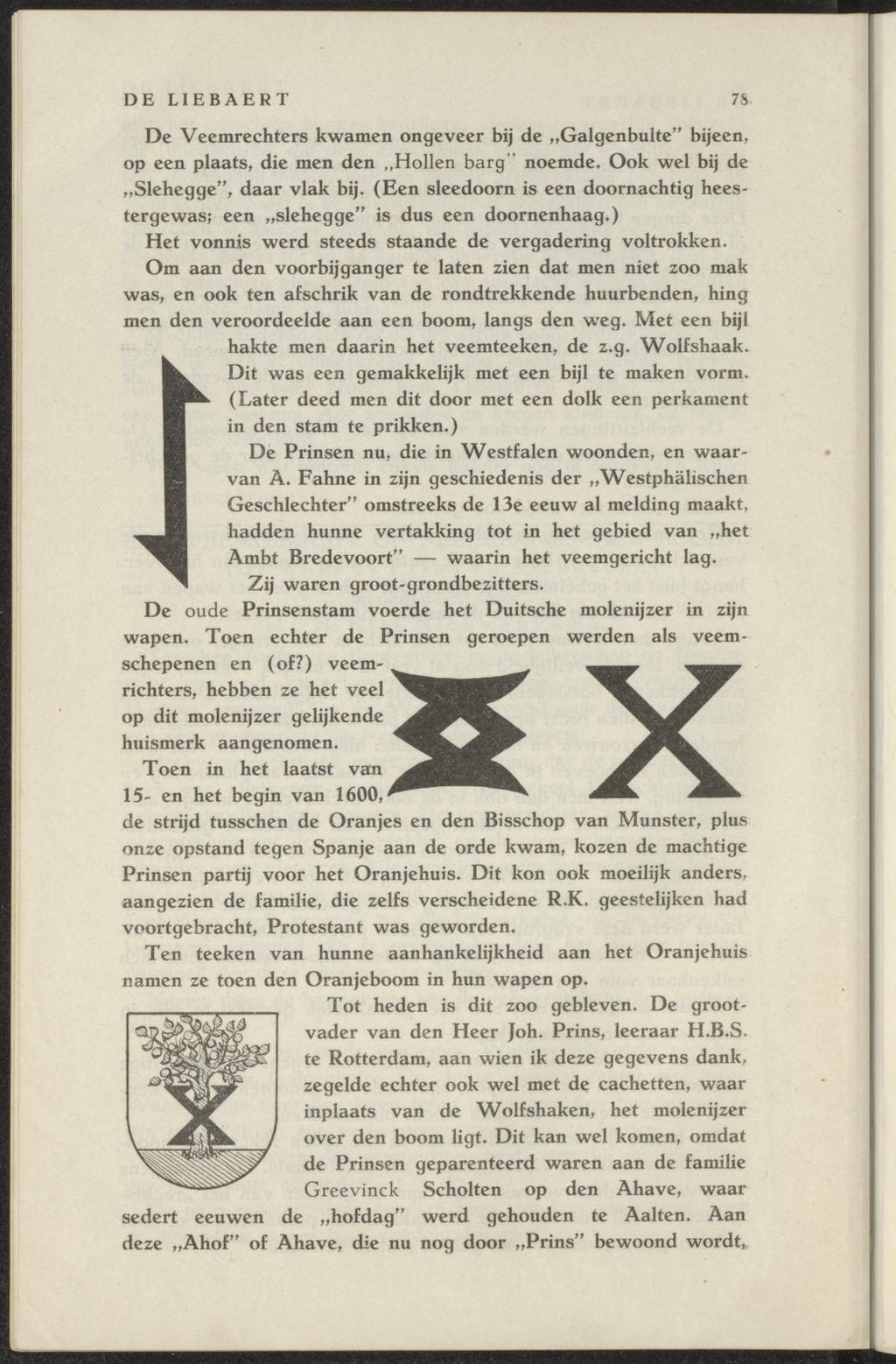
In the Middle Ages, a so-called veemgericht (vehmic court) was established in the vicinity of manor house ‘t Walfort near Aalten. Veem is Low Saxon for ‘punishment’. It was a special court whose hearings took place in the open air near a grove called “Sleehegge”. Here, justice was administered four times a year at sunrise.
The court was presided over by a free-count, a judge after the old Westphalian model. A free-count represented a so-called free seat. A free seat covered a certain area, usually similar to the gauges of Carolingian times. The free-count has its origins with the Saxons. After the subjugation of the Saxons by Charlemagne, the old vehmic courts continued to exist for a long time.
This free-count and a number of free vehmic jurors or assessors ruled on the charges, after summoning the suspect. The vehmic court would have intervened if there were concerns that a privileged person could not be brought before a regular court, thus filling a gap in the legal system.
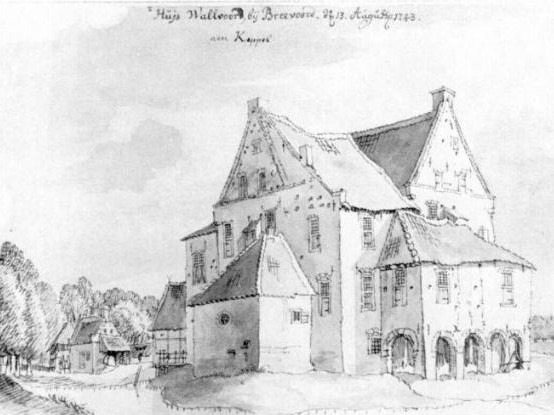
Havezathe ‘t Walfort, Jan de Beijer, 1743
The Dücker will get you
The most famous and notorious free-count at ‘t Walfort was Berend de Dücker, also mayor of Bocholt. He was appointed to ‘t Walfort in 1430 and was particularly feared, because his convictions often ended in death. The condemned man was hung by three anonymous vehmic jurors on a noose of willow branches. De Dücker presided over the vehmic court for 61 years. A well-known threat from parents to their children, if they did not want to obey, was still until the 20th century: “The Dücker will get you”.
Because the vehmic courts undermined the government’s monopoly to impose punishments, the Duke of Guelders forbade his subjects to comply with a summons to the vehmic court. At the end of the sixteenth century, the vehmic court on ‘t Walfort disappeared. It is the only place in the Netherlands where it has been proven that there was a vehmic court.
In 1936, the Rotterdamsch Nieuwsblad wrote about the vehmic court at ‘t Walfort:
The vehmic court on the Walfort.
Arising from the pressure of the times and as a reaction to the tyrannical domination of the Pledgers, it [the cattle court, ed.] met at night. The citizens, who formed the court, sometimes did not know each other. They appeared masked. To prevent the prisoners from revealing what had happened, and where the hearings, or rather the meetings, were held, the sentence that was passed was always the death penalty. The easiest punishment to carry out was that of the noose.
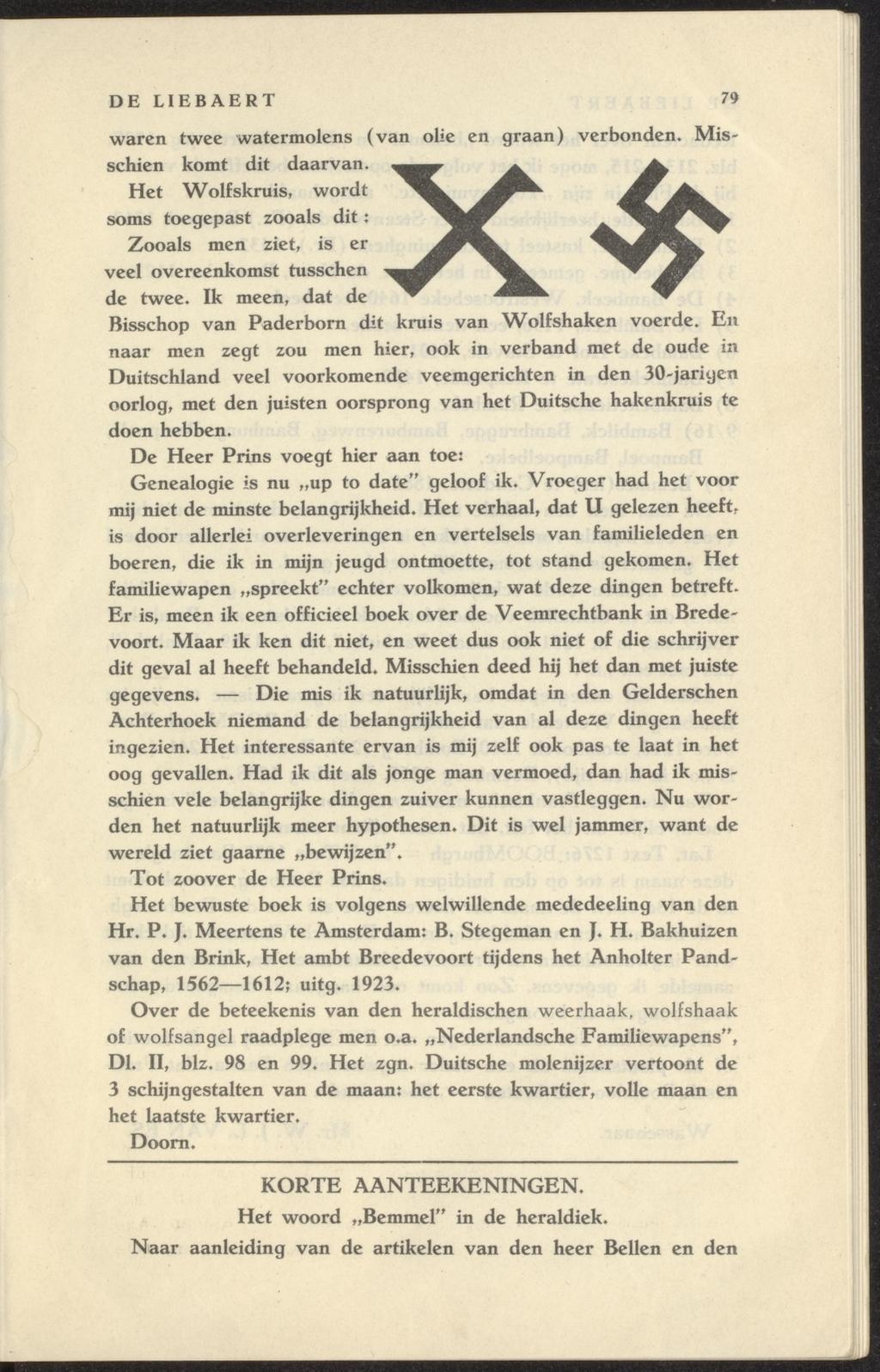
In order to show the passing that they were dealing with a vehmic sentence, the sign of the vehmic court was cut in the tree on which the hanged man had been sentenced with an axe, a so-called ‘Wolfshaak’ [or Wolfs’ Hook, ed.]. All this seems to us, at the present time, very cruel. But it must not be forgotten that the bitterness in connection with the need of the times has led to these measures.
For chiefly the majesties turned against the dismissed soldiers of the many armies of the many little armies of the many little potentates who were constantly fighting each other.
These warriors, who spared neither friend nor foe, scoured the countryside in larger or smaller troops. They stole cattle, chickens and food. Also money, which was scarce among the peasant population of those ancient times, as well as household goods and jewelry. And church treasures were to their liking.
These people behaved shamefully towards women and children. And woe betide the farmer who lived on a lonely farm dared to resist their crimes. His family was abused in front of his eyes, while he watched, bound. His farm was set on fire, and he himself was the last to be beaten to death.
The vehmic court, which was composed of residents of Bredevoort and Aalten, was later officially established on the Walfort, where the van Lintelo family, the judge, free-count or president of the court were elected. In 1573 we find Arend van Lintelo as such.
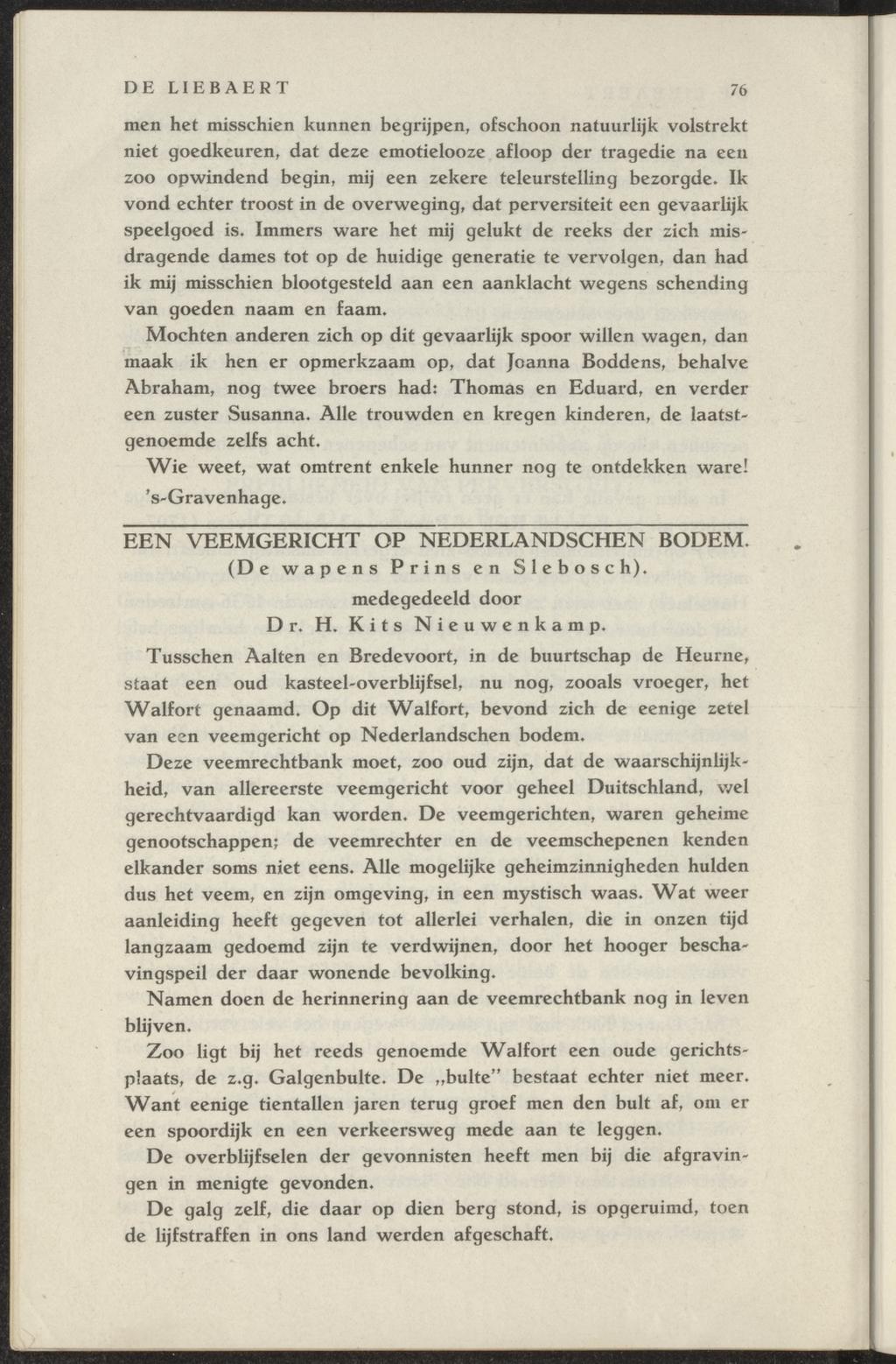
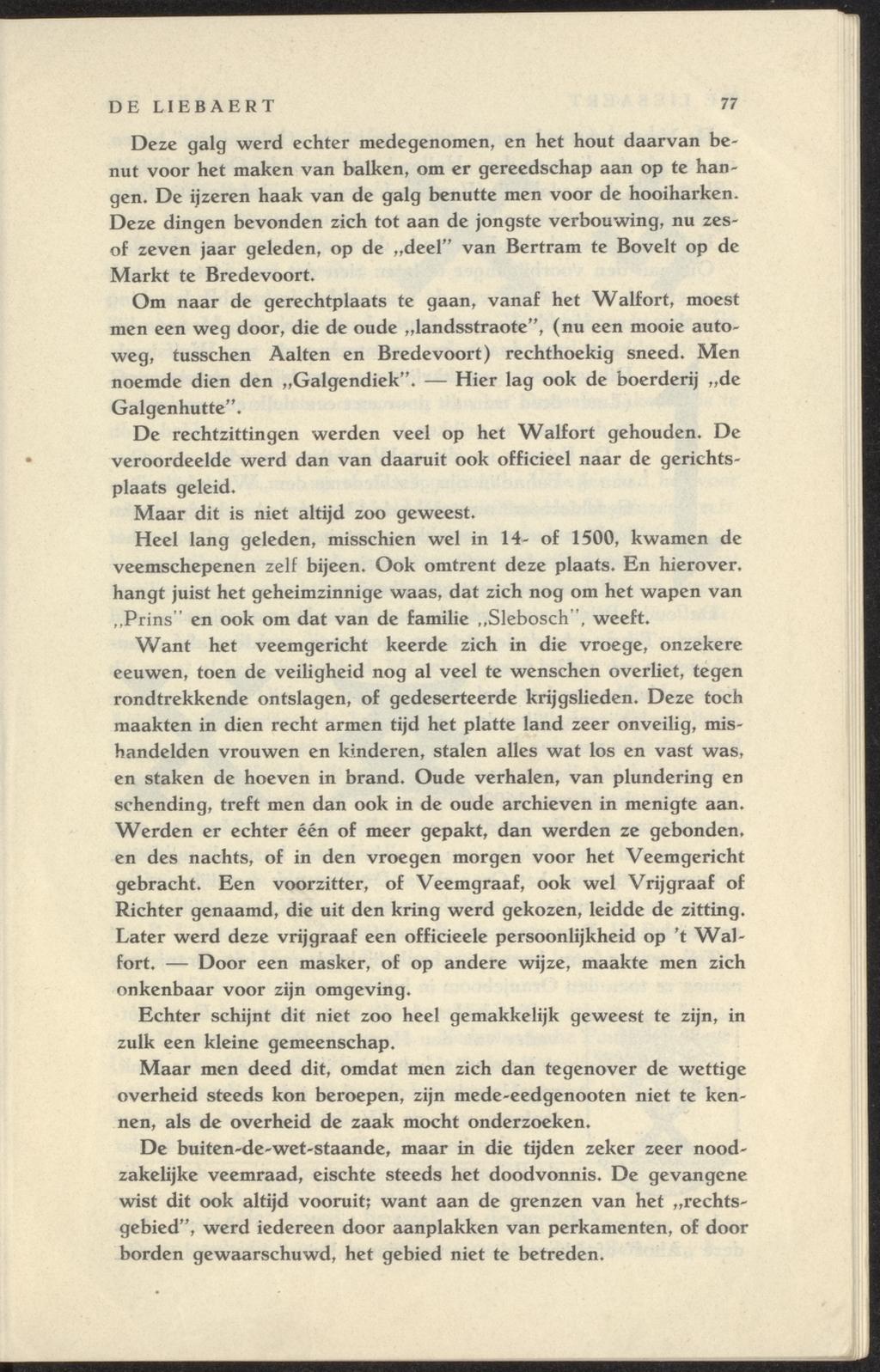
Also read “A vehmic court on Dutch soil”, by Dr. H. Kits Nieuwenkamp (1938):
Christiaan Caspar Stumph was baptized in Aalten on February 14, 1745, as the son of Abraham Stumph and Elisabeth Ovink. On November 12, 1780, he married Jeanne Lesturgeon. They had at least one child, Abraham Antoni. This son drowned in the Slingebeek at the age of 34. Popular belief held that his death was related to a broken heart.
In 1795, Stumph was accused of the attack on Ten Holte and imprisoned. He was released a month later as his guilt could not be proven.
Stumph was a close friend of the Freule van Dorth, who was executed in Winterswijk in 1799. Seven hours before her death, she wrote him a letter: “My Dear Friend, I thank you very much for all the kindness shown to me in this life. I write [this] at 4 o’clock, thus 7 hours before [life] shall be taken from me by a bullet. The journey from Groenlo etc. is the cause of my death. I find in the same a reconciled God; comfort my Unfortunate Brother who is distressed for me until Death. Be so kind as to say an Eternal Farewell to all my acquaintances. J.M.C.J. van Dorth.”
Marriage Record Amsterdam, 12 November 1780
The first mayor of Aalten
Following the annexation of our country by France on July 10, 1810, the entire administrative power was restructured and centralized according to the French model. A departmental organization was established, headed by a prefect for the departments, a sub-prefect for the districts, and a maire (mayor) for the municipalities.
On March 12, 1811, Christiaan Caspar Stumph was appointed maire of the Canton of Aalten. He is therefore considered the first mayor of the municipality of Aalten. He held this position until January 1, 1818, when a new administrative regulation was established.
Stumph lived at the Smees. He was a person of independent means and an organist in Aalten, a man of integrity with many noble objectives. On May 14, 1819, at the age of 74, he married 30-year-old Caatjen Weversborg in Aalten. As far as is known, their marriage remained childless.
Christiaan Casper Stumph was a man who frequently endeavored to put an end to existing abuses. One of his greatest grievances was the practice of burial inside the church or in the churchyard within the village. Indeed, this often led to unimaginable situations. On several occasions, subsidences occurred in the church floor, and the owners of these graves failed to carry out the necessary repairs. For weeks, the pews near the hole in question would be uninhabitable. Consequently, a regulation was established stating that churchwardens, in cases of negligence, were permitted to contract out the necessary repairs, whereby the plot in question would revert to the church.
Burial mound at ‘het Smees’
The condition of the cemetery around the church was also frequently poor. Because burials had not been conducted at a “sufficient” depth for a long time, bones regularly came to the surface. A bone collector gathered these remains from time to time for two bushels of rye per year and threw them into the “Beenhalle,” a small building in the churchyard on the Market side. If the stock became too large, it was cleared out, and the walls were cleaned and repaired where necessary.
With the improvement of social conditions and higher hygiene standards, changes slowly but surely occurred in this area, including the obligation to make graves sufficiently deep. A law to prohibit burial within towns and villages, following foreign examples, could not yet find favor in our country. People could not bring themselves to take the major step of breaking with all traditions and leaving the dead “just anywhere in the ground” far outside the village.
Stumph was a proponent of burial outside the village; he decided to have an “Outer Cemetery” created in one of the Smees meadows. In 1818, the foundation deed and will were drawn up. Christiaan Casper Stumph passed away on January 6, 1820. According to his last wish, he was buried at the old Smees. This site is still recognizable today as a burial mound, located on Nannielaantje.
During the French occupation of our country (1795-1813), a significant change occurred in the existing legal order. After the Netherlands was annexed to France by Napoleon Bonaparte in 1810, French legislation was also introduced here.
Justice of the Peace Court
By Imperial Decree of July 9, 1810, the Netherlands was divided into departments, districts, cantons, and municipalities. A justice of the peace court was established in every main town of a canton, including Aalten. The canton of Aalten consisted of the municipalities of Aalten and Dinxperlo.
The task of the justice of the peace was to resolve conflicts peacefully before they were brought before a ‘real’ judge, in order to save a great deal of expense. In addition, the justice of the peace had the authority to handle small, low-cost cases. Other powers of the justice of the peace lay primarily in personal and family law.
Cantonal Court
In 1838, the legal system was reorganized again, and the justice of the peace was replaced by the cantonal judge. The justice of the peace courts of Aalten and Winterswijk were then merged into the Aalten cantonal court. This court covered the fourth canton of the third district (Zutphen) of the Gelderland Court of Appeal and was classified as a fifth-class subdistrict court based on the Act of July 1, 1830.
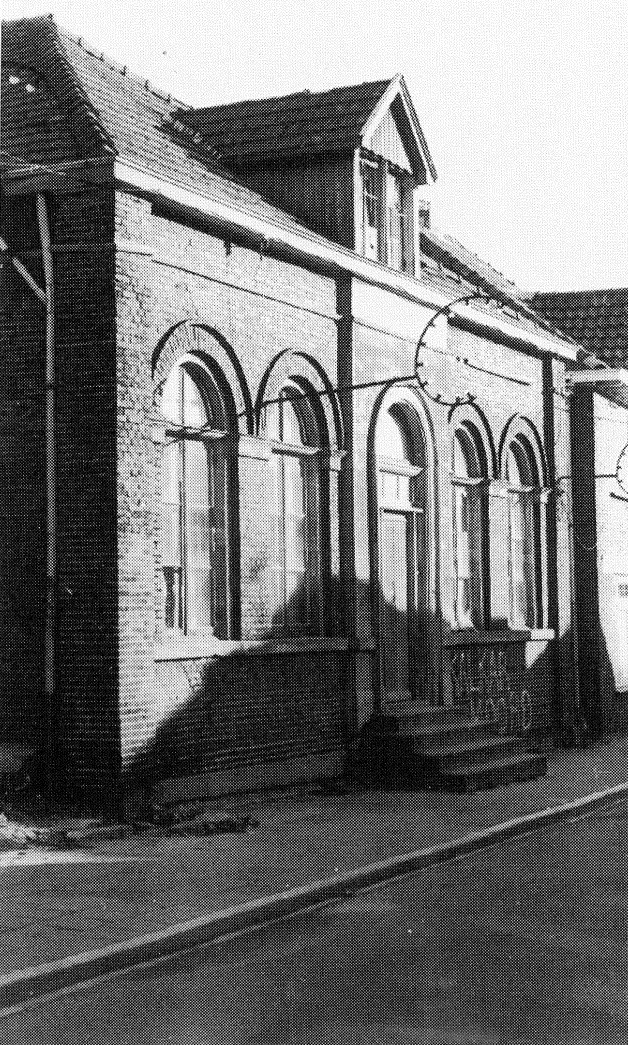
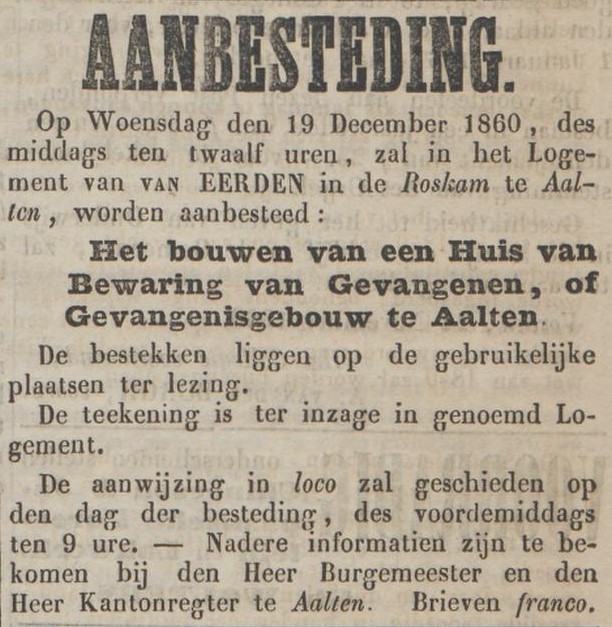
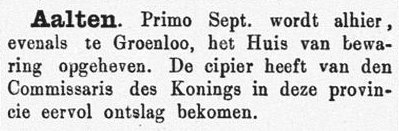
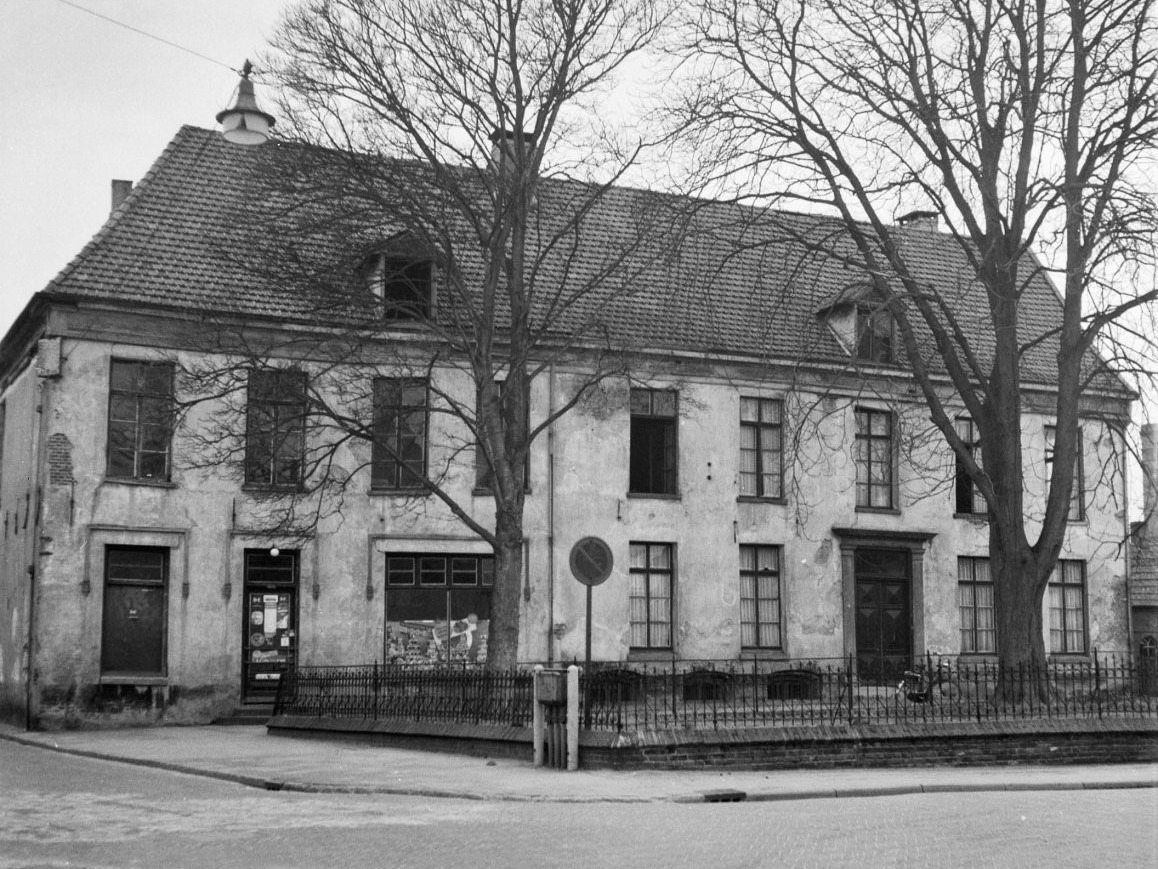
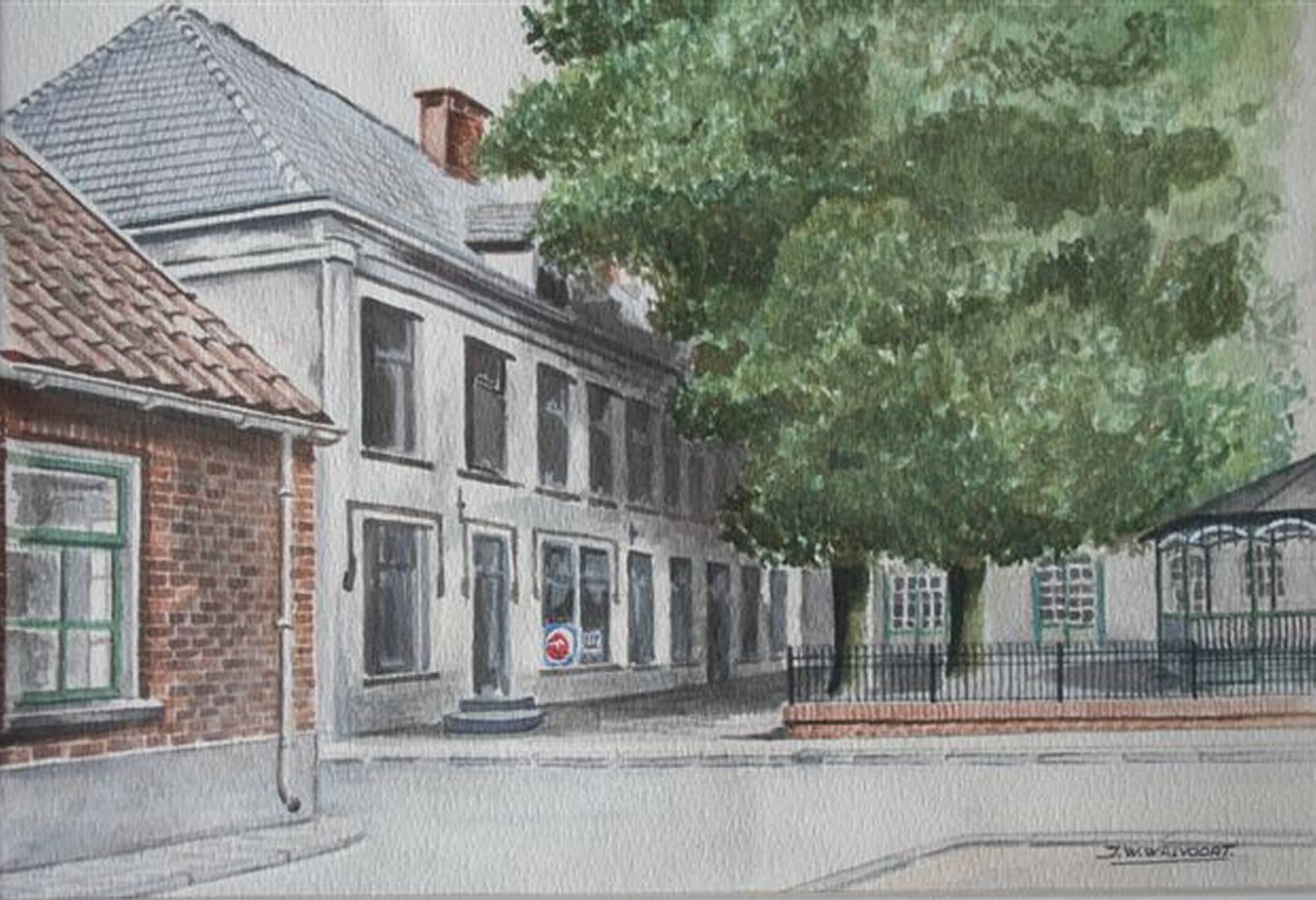
The Aalten cantonal court held its sessions in the town hall on the Markt. In 1861, a cantonal house of detention was built in Prinsenstraat, with six cells and a jailer’s residence.
The Aalten cantonal court was abolished in 1877. From that moment on, the municipalities of Aalten and Winterswijk belonged to the canton of Groenlo. The municipality of Dinxperlo was transferred to the canton of Terborg.
Archive
In 1968, the archive of the former Aalten cantonal court was transferred to the State Archives in Gelderland, along with the oldest part of the Groenlo archive. In 1961, the transfer of the Public Prosecution Service archive, which was still located in the Aalten town hall, took place.
Wax seal of the Aalten cantonal court (photo: Hans Schutte)Nederlandsche Staatscourant, November 6, 1828
Judges and clerks of the justice of the peace and cantonal court in Aalten 1811-1877 (still incomplete)
From 1852 to 1919, the Aalten electoral district was one of the sixteen Gelderland electoral districts for the Provincial Council. The district comprised the municipalities of Aalten, Winterswijk, and Dinxperlo and held three seats.
Following the constitutional revision of 1848, which for the first time enabled direct elections of the Provincial Council under census suffrage (voting rights for men who met a certain income requirement)1 – and the Provincial Act of 1850, Gelderland was divided into sixteen districts in 1852, including Aalten.2
With the introduction of universal male suffrage in 1917 and the Elections Act of 1919, the elections of April 10, 1919, were the first to use proportional representation within a single province-wide constituency, after which the Aalten electoral district ceased to exist.3
Origin and background
During the reign of King William I (1772–1843), provincial governments were appointed bodies in which nobility and local notables held seats without election. It was only with the constitutional revision of 1848 that members of the Provincial Council could be directly elected, albeit still on the basis of census suffrage. 1
Establishment of the Aalten electoral district
In 1850, the Provincial Act came into effect, which determined, among other things, how members of the Provincial Council were elected. Two years later, the Act regulating the division of provinces into electoral districts of November 5, 1852 (Bulletin of Acts and Decrees No. 197) established the final division: Gelderland was split into sixteen electoral districts, including Aalten. 2
Abolition and transition to proportional representation
The constitutional revision of 1917 introduced universal male suffrage and heralded the abolition of the district system. The Elections Act of 1919 put an end to small electoral districts and introduced a single province-wide constituency with proportional representation in all provinces. This system was first applied during the Gelderland elections of April 10, 1919, at which point the Aalten electoral district ceased to exist. 3
Delegates
Some well-known Council members representing the Aalten electoral district: 1
On the early morning of January 12, 1770, the neighbors of the Vosheurne farm in Lintelo were startled by a disturbing report. “The aunt is dead, she is very bloody, she may well have smashed her head,” resident Harmen Brunsink shouted. Extensive forensic investigation by the Court of Bredevoort revealed a story of a family conflict that degenerated into murder and would end with a gruesome execution.
Tensions in the House
Hendersken Tannemaat, born in 1705, had lived on the Vosheurne her entire life. Her niece, Gijsberta Deemshof, born in 1739 in Doesburg as the daughter of Hendersken’s sister Johanna, was raised by her ‘moeje’ (aunt) Hendersken from the age of three. In 1761, Gijsberta married Harmen Brunsink, born in 1729 at the Bekink farm in IJzerlo. After their marriage, Harmen moved in with Gijsberta and her unmarried aunt at the Vosheurne.
Initially, Hendersken lived with the young couple in exchange for board. In June 1768, however, she transferred all her possessions to Harmen and Gijsberta in exchange for room and board and all necessary care for the rest of her life. This was a common arrangement at the time between elderly people and their children—in this case, her niece and husband. Harmen and Gijsberta solemnly promised to fulfill this obligation.
However, the relationship between Harmen and the aunt deteriorated over the years, and tensions arose in the house. The aunt reportedly told Harmen several times that she wanted to undo the agreement “because you treat me so poorly!”
A Mysterious Death
A box bed (photo for illustration)
On that fateful morning of January 12, 1770, Harmen frantically gathered the neighbors because the aunt was dead. It was customary in this region for neighbors to be called upon in the event of a death to arrange practical matters, such as the funeral and the ‘verhennekleden’—undressing the deceased and shrouding them in grave clothes. When the neighbor women entered the bedroom, they found Hendersken dead in her box bed, her hands folded over her chest. Her nose and arms were blue, and when her cap fell off, they discovered flour in her hair and blood seeping down her neck.
Gijsberta stated that she had used the flour to staunch the bleeding. Harmen added that the bruises were likely because the aunt suffered from scurvy, and that Hendersken had probably hit her head on the sharp edges of the bed plank. But the story did not add up. The neighbors did not trust it and brought the matter to the attention of the Court of Bredevoort.
The Investigation
Two days after Hendersken’s death, court officials arrived at the Vosheurne with two surgeons. Upon arrival, it appeared the body had already been coffined. In the presence of Harmen and Gijsberta, the surgeons examined the body. They discovered several severe injuries and bruises to the head. The injuries made it clear that an accident was out of the question. Suspicion immediately fell on Harmen and Gijsberta, who lived with Hendersken at the Vosheurne and could not provide a convincing account of what had happened.
Both suspects denied any involvement and claimed they had found Hendersken dead on the floor in front of her box bed that morning. They claimed to have placed her on the bed, sprinkled flour on her head to stop the bleeding, and put on her cap. However, their statements contradicted each other. Harmen had told the neighbors that he had found Hendersken dead in bed, not on the floor.
Voluntarily and without resistance, they went to Aalten, where they were taken into custody for further questioning. When the numerous head wounds were discussed, Harmen stated that these might have been the result of an epileptic seizure. Hendersken supposedly hit her head against the bed plank, the flax comb chair, the small chests, a trunk, or the beer stand. He also suggested that someone from outside the house could have broken in, as the house was in poor condition.
Further Investigation
On January 16, the Court, assisted by a doctor, a surgeon, and a prosecutor, returned to the Vosheurne with the suspects. Hendersken’s bedroom was meticulously examined.
The box bed showed a large bloodstain on the bed plank at the head end, as if the blood had splashed against the plank. But it had no sharp edges, as Harmen had claimed. Due to long-term use, the plank was actually rounded, and no sharp edges were found inside the box bed either. Other furniture in the room—small chests, a trunk, and a flax comb chair—showed no traces of blood. Nothing was found under the box bed either.
The doctor and the surgeon then examined the body even more closely. They stated primarily that there was a slight bruise on the nose, as well as severe bruising on both elbows, arms, and hands, beneath which coagulated, extravasated blood was found. These bruises could only have been caused by an external factor.
Not only on the right side of the head, at the level of the temple, were the external coverings and fleshy parts bruised, wounded, and destroyed down to the bone, but similar bruises and wounds were visible on the left side, albeit to a lesser extent. Two openings or wounds were discovered on the left side of the skull and one on the right, each about the size of a shilling. Upon loosening the external parts, it appeared that the skull had a fracture on the right side and that on the left side, the end of the skull bone was severely bent downwards and partially broken.
After sawing through and removing the skullcap, several ruptures were found. Due to these fractures and bone pressed outwards, the brain, particularly on the left side, was severely damaged. On both sides of the head, especially the left, extravasated blood was present on and under the dura mater and also within the brain itself. Furthermore, all blood vessels were completely filled with blood. This combination of injuries had inevitably caused her death.
Although the suspects continued to maintain their innocence, the suspicions raised against them were only strengthened by these findings. From the situation on-site and the condition of the corpse, there was no longer any doubt that a murder had been committed. Such a thing could not happen unnoticed in a small cottage like that of the suspects, while they claimed to know nothing. The suspects were then transferred to the prison in the Ambtshuis in Bredevoort.
Harmen’s Confession
During the subsequent interrogations, Harmen and Gijsberta initially stuck to their story: Hendersken had died in an accident. But the evidence against them mounted. On January 19, a week after the murder, Harmen broke under the pressure and confessed what had really happened: He stated that he acted alone, without the help of his wife. He had previously said to his wife in bed: “There lies such a small pebble, I shall strike her five or six times on the head with it, then she will be gone, then the quarreling will be out of the house, then we can live in peace and unity.”
Around four hours before sunrise, he had risen, lit the lamp, went to Hendersken’s room, and hung the lamp on a nail above the box bed. Upon entering the room, the aunt woke up from the light. Thereupon, Harmen jumped into bed with her, sat astride her, held her head with his left hand, and struck her five or six times on the head with the pebble with his right hand, until she lay dead under his hands.
Gijsberta reportedly tried to stop him, but without success. When the aunt was dead and bleeding heavily, he ordered his wife to sprinkle flour on her head and wash off the blood. Afterwards, he called the neighbors. The stone with which he had struck her, he threw into the ditch behind the oven, near the spot where they fetched water.
Statement of Gijsberta
Gijsberta made her confession on January 20 and 22. She stated regarding her unhappy marriage: “Oh, how unfortunate I am! I married my husband against the wishes of my entire family, and from the beginning of our marriage, he has lived poorly with me.”
In the early morning of January 12, her husband, before he even rose, had said to her: “I will no longer have the quarreling in the house, I want to take decisive action, I shall get a pebble, and give the Aunt but one blow to the head with it, then she will be gone, and then the quarreling will be out of the house.” She was very upset by this, but he tried to reassure her, kissed her, and said: “Do not be dismayed, let me take decisive action, she is an old person, then we can have a peaceful life.”
He even came to her bed with gin and said: “You must drink plenty of gin, and you must be half-drunk, otherwise you would be too dismayed; we must now bite through a sour apple; but you must never betray me, even if I should happen to die, and you get another husband, then you must never say to him that I murdered your own blood.”
She then said to him: “Could you bring yourself to kill my own flesh and blood; if it comes down to it, then I must say it,” to which he had replied: “I will nevertheless take decisive action, I want the quarreling out of the house.”
When her husband was already in the aunt’s room and began striking her, he called Gijsberta to come there. She then went to the room, grabbed his linen smock to pull him away from the aunt, and said: “Fie, fie, what are you doing!” She added that her husband had forced her to be present, saying: “otherwise you might go and report me later.”
Gijsberta also stated that she had long been afraid to lie in bed with him, fearing he would attack her with a knife. That night, too, a knife lay in his trousers in front of the bed. She therefore also said to him: ”I am afraid that you will do me harm.” To which he assured her: “Oh no, I will never do you harm.”
She also confessed that her husband could not bear it if she was kind to the aunt, and that she had had constant sorrow with her husband since the aunt lived with them.
Gijsberta stated from the outset that she did not help carry out this gruesome deed. She also did not know what her husband used to beat the aunt to death, only that in the morning, while fetching water in the ditch in front of the house by the willows, she saw a gray pebble lying in the water that had not been there before.
Both suspects finally confessed that the aunt had never suffered from epilepsy. The neighbors and friends had also never heard of it, except only after her death.
The Verdict
The Court of the Lordship of Bredevoort ruled that everything indicated that Harmen Brunsink, on the night of January 11 to 12, 1770, had murdered Hendersken Tannemaat, a defenseless person estimated to be nearly seventy years old, lying on her bed in his house, in a gruesome manner, deliberately and with premeditation. Gijsberta was charged with failing to dissuade her husband, where possible, from this abhorrent intention.
Harmen was sentenced to death: “to be brought to the place where criminal executions are customarily performed, and there to be bound by the executioner on a wooden cross, to have his legs and arms broken to pieces from the bottom up while alive, and thereafter to have his head severed with an axe. That, this having been done, his body shall subsequently be laid upon a wheel, standing on a post, and fastened thereto with chains, and his head set upon a spike above it, as a hideous example to others.” This punishment is called breaking on the wheel.
On February 10, the residents of Dinxperlo were summoned to the Hollenberg to erect the post and the wheel for the execution and to make the noose. Most refused or did not show up and were fined 30 thalers per person. 18 persons consented and erected the post and the wheel.
The sentence was carried out on the Hollenberg on February 12, 1770.
Gijsberta escaped the death penalty but was required to witness her husband’s execution. Subsequently, she was banished for life from the city and Lordship of Bredevoort. She remarried in 1776 in Silvolde to Jacob Kok and reportedly died in 1813.
Sources
Nieuwe Nederlandsche jaerboeken, of Vervolg der merkwaerdigste geschiedenissen, die voorgevallen zyn in de Vereenigde Provincien […]. Fifth volume. MDCCLXX, published by the heirs of F. Houttuyn in Amsterdam, P. van der Eyk and D. Vygh in Leiden, 1770 (link)
Klaas Nijman was baptized on January 16, 1698, in Dinxperlo as the son of Fredrik Nijman and Berentjen Eppink. At the age of fifteen, he left his parental home and began a wandering existence as a ‘beggar and vagabond’. In 1722, he was sentenced in Rhenen to a stay in a house of correction for violence and theft. His release was followed by banishment from the province of Utrecht.
Nijman then returned to the Achterhoek, where he sowed fear among the population, particularly in the vicinity of Dinxperlo and Aalten. He begged and stole, threatened people, and did not hesitate to use brute force. In 1729, he set fire to several houses and was arrested.
On October 3, 1729, following a trial in Bredevoort at ‘t Zand, Klaas Nijman was sentenced to death. He was taken to the Hollenberg, where he was strangled and subsequently set on fire. This gruesome punishment served as a deterrent to others. Nijman was 32 years old at the time.
Sentence
The following 18th-century text describes his crimes and sentence:
Pronounced in Bredevoort at ’t Sant, and executed outside on the Hollenborg, on Monday, October 3, 1729.
Verdict Klaas Nijman
In Criminal cases, before the Most Noble Court of the Lordship of Bredevoort, between the Advocate Fiscal of the aforementioned High Lordship, complainant of the one part, and KLAAS NYMAN, otherwise called KLAAS FREDERIKSEN, aged about 32 years, and born in the district of Bocholt, at the Heelweg, near Dinxperlo, defendant and prisoner of the other part, having seen and examined the inquisitorial procedure, with all attached information, confrontations, and evidence from A. to H. inclusive, furthermore the defendant’s declarations and confessions made outside of actual torture, and in which he has successively and at various times persisted, from which it has appeared:
That he, KLAAS NYMAN, since his fifteenth year has left his Parents and Birthplace, and has wandered the land as a beggar and vagabond. That he was also in the year 1722, for various acts of violence, thefts, and further insolences at Rhenen, flogged, branded, and committed for the term of six years to the House of Correction or public Workhouse at Utrecht, and after expiration banished from the Province and Lands of Utrecht for the term of his life, and never to return therein, upon pain of being punished with death.
That having been released from the aforementioned House of Correction or Workhouse about three-quarters of a year ago, yet the penalties of banishment remaining in force, he thereupon, or some time thereafter, returned to Dinxperlo, and continued in his bold beggaries and acts of violence. That he there, for a trifle on the public road near Dinxperlo, cut open the mouth of one DIRK WENSINK with a knife.
That he likewise, after his aforementioned release, again committed various thefts, such as of ironwork and an axe, and of linen, such as a pillowcase or sheet on the other side of Doesburg at the Steege; and also a shirt from the garden at HENDRIK te Loo or Kistershuis, between Dinxper and the Bredenbroek, and further as by the Reformations. That he, KLAAS NYMAN, has also for years past been notorious and held in suspicion by many inhabitants under Dinxperlo and Aalten, as being of no good and committing much evil.
That he also, following the . . . . of the sentence at Rhenen, was held suspect there of having committed very grave offenses. That the defendant, through his . . . . and malicious conduct and questionable language which he used here and there, has kept the good husbandman and the inhabitants in the countryside, and especially around Dinxperlo and Aalten and the surrounding area, in a state of constant anxiety and fear. That when he came to beg, he was not satisfied with what is ordinarily given to a beggar, although he was often given even more, and went away from the houses muttering to himself.
That this anxiety and fear among the inhabitants has doubled and reached its peak since fire broke out in the Parish of Aalten in this year 1729, and that further and even more burnings of houses close by followed. Such that several inhabitants ordered their people that, if KLAAS NYMAN came to their houses, they should just give him whatever he wanted, to gain his friendship and not to anger him, and that several people, out of fear of arsons, had to keep night watches at their houses during the night, whereby even some hamlets were placed in a state of near alarm.
That he, the defendant KLAAS NYMAN, is also the one who has come to such exceedingly wicked crimes that in the past Summer in the Parishes of Aalten and Dinxperlo, of this same year 1729, from June 13 to August 29, and thus within the span of a quarter-year, he has set fire to three houses, one after the other, and by no means the smallest, which houses were also totally burned down, and of which the corpora delictorum are known.
Namely, on June 13, the house at Lensink, under Aalten on the Esch at Yserlo, where he set a piece of white or spongy peat on fire by means of a tinderbox, flint, and tobacco pipe, and with that burning peat at the back on that side of the house where the wind was blowing against the house at the time, caused the fire. That eight days prior he had also set the same house Lensink on fire, and that it had already been burning, but that it was then still extinguished by the occupants.
Secondly, the house at Welink, also under Aalten on the Esch at Yserlo, on June 20, where he carried out the fire in the same manner as at Lensink with a piece of ignited spongy peat, and therewith set the house on fire from behind. That for both his arsons, at Lensink and Welink, he gives as his reason that he had done so to create anxiety and terror in the neighborhood, or among the people.
Thirdly, the house at Grevink, at ‘t Rexwinkel in the hamlet of Heurne, under Dinxperlo, on August 29, in the evening around 10 o’clock, when he caused the fire there with an ignited fuse made of linen rags, in the straw that lay at the back on the corner partition of the house. That in this aforementioned house Grevink, when it caught fire, a young woman in childbed, who had not yet been in childbed for two days, lay on the bed, and who by great fortune still having the strength to get off the bed, still escaped the fire. That he, KLAAS, gives as his reason for this arson at Grevink that he had done so because the same aforementioned woman in childbed, a long time ago when she was still unmarried, had given him a piece of pancake that had been too small for him.
That at Welink and at the last-mentioned Grevink, several pieces of live Cattle, harvested Grain crops, and further items were also burned and consumed. That he, the Defendant, is furthermore convicted by four sworn credible witnesses, although he himself has tried to deny it telle quelle, that on August 31 last he spoke those grim words at the house of ARENT OOSTENDORP, in the hamlet of Heurne, under Dinxperlo, that this or that corner would shortly be a poor corner.
That he furthermore has threatened to set fire to the house of the drummer boy within Dinxperlo, and has stood by and persisted in this, that if he had not been captured, he would indeed have done it, and similar terrible threats and dangerous utterances of the Defendant, as the information and confessions herein further set forth.
The highly-mentioned Court, keeping God and Justice before its eyes, doing right with the advice of impartial Legal Experts, declares the Defendant KLAAS NYMAN to have incurred the penalty of the Law, condemning him for the same in consideration of these three gruesome arsons, that he be brought to the usual place of Justice, fastened to a stake and somewhat strangled, and furthermore shall be burned, as a terrifying example to others.
Thus advised by us undersigned within Bredevoort, September 29, 1729.
(And was signed.)
H.J. TEN HAGEN and H.C. STUMPH
Source
Legal Treatises on Corporal Crimes by a prominent Legal Expert (Jan Jacob van Hasselt), published in Amsterdam by Hendrik Gartman, 1781 (link)
The verponding was a tax on real estate introduced in Gelderland in 1651 to replace the older schildschatting. This tax was levied on lands, farms, houses, and mills that generated income, with the aim of strengthening provincial finances. Wastelands, such as uncultivated common lands (markegronden), were exempt from this levy. The verponding remained in effect as a tax system in Gelderland until 1805.
Administration and Registration
Fragment from the verponding register for the rural district of Dale near Aalten, c. 1650
The term ‘verponding’ or ‘pondschatting’ likely refers to a tax assessment originally expressed in the unit of account ‘pond’ (pound). Data regarding the verponding was recorded in so-called verpondingskohieren (tax registers). These registers were compiled by local officials, such as bailiffs, sub-bailiffs, and rotmeesters, who were responsible for recording all real estate and its estimated value. The registers provide valuable historical information regarding the number of houses per location and their owners: nobility, church, or citizens. Additionally, they contain data on the size of holdings, lease structures, and ownership relationships.
Calculation
In the Quarter of Zutphen, to which Aalten and Bredevoort belonged, the amount of the verponding was determined based on the lease or rental value and the burdens resting on a property. For lands and farmsteads, the tax amounted to a sixth penny (or 1/6) of the taxable lease value; for houses and mills, this was a ninth penny (1/9) of the taxable rental value. If a property was not leased or rented but used by the owner themselves, the value was determined based on comparable properties that were leased or rented. Everyone was obliged to provide correct information and to show any lease contracts; negligence could result in a fine.
Collection and Payment
The collection of the verponding followed a strict schedule: the assessment, also known as ‘maning’ (summons), took place in November, and payment was to be completed before the end of February. The tax could be calculated in various ways, and several deductions were possible, for example, for maintenance. Taxpayers received ‘maancedulen’ (payment notices) stating the amount due. The collected pennies were transferred by the collectors to the receiver of the Quarter. Furthermore, the district, the city, and the Quarter could levy additional surcharges (opcenten) on top of the base amount.
Verponding Register of 1647
The Verponding Register of 1647 is a frequently used source for historical research. At the time the verponding registers were compiled, Gerhard Kreynck (1612-1692) was the mayor of Zutphen. Kreynck had a great interest in historical documentation and made copies of important archives, including the verponding register, city accounts, and fief registers.
The Verponding Register of 1647 was transcribed in an abbreviated form by Kreynck around 1650, which later became known as the Kreynck Transcript. The historical significance of the register lies in the fact that it is one of the first systematically established tax registers in Gelderland. The register provides insight into the economic situation of the region in the mid-17th century. The original register has been preserved and can be found in the National Archives in Arnhem.
Genealogiedomein: images and transcriptions of the verponding registers for Aalten and Bredevoort.
R. Wartena et al., Farm Names in the Achterhoek. From the verponding register of c. 1650, Kreynck transcript, publication East Gelderland Journal for Farm Research (link).
H.K. Roessingh, How are the Gelderland verponding registers from the mid-17th century structured? Sources for local historical research, Contributions and Communications of Gelre LXIII (Arnhem 1968/1969), pp. 61-71.
H.K. Roessingh, Sheaf tithes, seed tithes, and money tithes in Gelderland in the 17th and 18th centuries, Contributions and Communications of Gelre LXIII (Arnhem 1968/1969), pp. 72-98.
Bredevoort Castle was a fortress in the heart of the eponymous town and former Lordship of Bredevoort in the County of Zutphen within the Duchy of Guelders. It was one of the most significant castles in Gelderland. During the 13th and 14th centuries, Bredevoort Castle played a major role in the struggle between Guelders and Münsterland.
The castle was first mentioned in 1188 on a list of properties belonging to the Diocese of Cologne as “Castrum Breidervort“. At that time, the castle was a site of contention. Consequently, it had multiple owners, leading to a centuries-long struggle for control. In 1238, the castle came into the hands of Ludolf van Steinfurt and Herman van Lohn as a shared inheritance. The castle was to be fortified, with both parties sharing the costs. In 1278, the fortress was destroyed by Count Everhard I von der Mark during an act of revenge. Following this, the castle remained a ruin for 23 years. A deed of sale from 1284 refers to the “area castri Bredevort”.
After years of conflict over Bredevoort between Münster and Guelders, the castle eventually returned to the hands of Count Herman van Lohn II in 1301. In that year, the bishops of Münster and Cologne pledged to assist Herman van Lohn with the restoration of the fortress. In the turbulent times that followed, the fortress frequently changed hands between Münster and Guelders through combat or sale. The bishops of Münster and Cologne were required to jointly fund the reconstruction of Bredevoort Castle.
After centuries of fighting over the castle, the Bishop of Münster abandoned the struggle and sought peace negotiations. Following years of negotiation, peace was finally signed on June 28, 1326, with the Treaty of Wesel. This significant treaty was also signed by the cities of Zutphen, Groenlo, Emmerich, and Arnhem. As a result, Reinoud II of Guelders acquired the pledge of the jurisdictions in Winterswijk, Aalten, and Dinxperlo, as well as the County of Bredevoort. This move definitively incorporated the area into Gelderland.
In 1882, J. Craandijk produced two drawings intended to represent Bredevoort Castle. Whether these are accurate, however, remains a matter of debate. Bredevoort Castle, ‘the Hall’
Floor plan
In 1562, the lord of the manor of Bredevoort, Diederik van Bronckhorst-Batenburg, Lord of Anholt, commissioned a floor plan of the castle at Bredevoort. This plan also described the functions and structural condition of the various components. Measurements were recorded in Rhineland feet. A Rhineland foot is over 31 cm long. The castle was a rectangle measuring 42 m long and 36 m wide. The walls were approximately 65 cm thick. An earthen rampart surrounded the castle, with roundels at the corners. The rampart was approximately 2 m wide.
Floor plan of Bredevoort Castle, 1562
Explanations of the descriptions on the floor plan (translated from old script):
This vault will collapse if it is not repaired soon.
Here is the staircase leading to the knights’ hall.
This wall is dilapidated. The vertical beams are rotted at the bottom. This is a large hall: 47 feet long and 23 feet wide, measured from the inside. Beneath it is a cellar. The floor consists of beams and planks and is finished with floor tiles. There is only one attic above the hall.
This is a staircase to enter the large hall.
This is the kitchen, 21 feet long and 23 feet wide. Beneath it is a cellar of the same size as the cellar under the large hall.
This shed was built by Drost Isendoorn. The walls are masonry set between beams.
This is the rampart that runs around the castle.
This is a very dilapidated shed, much like a pigsty.
The prison tower. It is 38 feet square (measured from the outside). The walls are 8½ feet thick. [This tower was likely used later as a powder tower, Ed.]
Here are two roundels.
The Drost’s chamber (Maarschalcksekamer) above the gate. [The name ‘Maarschalckse kamer’ dates from the period 1534-1555 when Marshal Maarten van Rossum was Drost of Bredevoort, Ed.]
This is the chapel.
From here, the hearth of the knights’ hall is stoked.
This is the knights’ hall. The room is 36 feet long and 19 feet wide. Below this are the rooms of the burgrave (castle warden) and the steward. The gate entrance is also located below here.
This wall is in good condition, as far as it can be seen above the rampart.
This wall is built between wooden beams and has a thickness of half a brick. [The bricks used were ‘kloostermoppen’ of approximately 14 cm in width, Ed.]
A dilapidated spiral staircase.
Another room. Below this is a laundry room. Because the rampart rests against the laundry room, the wall is rotted. The stones are loose.
This wall is largely built between wooden beams and is very dilapidated.
This contains the grain mill and the baking ovens. Above is the servant’s room, with two attics and a chimney.
This is where the Drost sleeps. The room is 28 feet long and 23 feet wide. Beneath it is a meat cellar.
This room is divided in two. The floor is made of wood. The meat cellar also lies beneath this area.
This upper room is called the salon (state room, armory). Below it is the armor room.
Here the rampart touches the wall, causing the wall to let in moisture and show defects. The wall is very thick, and if the water could be kept out, it would likely provide some improvement.
These two rooms, as well as the granary, are located above the bakehouse and brewhouse.
This drawing was made in Arnhem after everything was measured as accurately as possible. The drawing is fairly accurate. However, in reality, some parts are slightly larger than depicted here, such as the chapel, the spiral staircase in the courtyard, and the prison tower.
Not much is known about exactly how Bredevoort Castle looked. While drawings of the castle exist, they are partly based on assumptions and imagination.
The castle was built on a sandy ridge of approximately 42 x 26 meters, making it one of the larger castles in the Netherlands. Old maps show the main fortress to be a typical concentric castle, featuring double moats and a thick curtain wall. It included an outer bailey with heavy corner towers and a rectangular castle wall equipped with four corner towers, three of which were later lowered to become roundels.
The castle and the town were separated by a double moat. Access to the castle from the town was via a bridge. One had to pass through two gates, the second of which was equipped with a barbican, and finally a gatehouse in the curtain wall before reaching the inner courtyard. Within the fortress, various buildings stood around a spacious inner court. These depictions changed over time, and the appearance and stature of the castle would have been altered frequently throughout the centuries due to conflict, war, city fires, and other causes.
3D reconstruction of Bredevoort Castle, based on a drawing by Jacobus Craandijk from 1882.
Destroyed
The castle was heavily damaged by the Gunpowder Tower Disaster in 1646. Following this, the castle dominated the cityscape as a ruin for over 150 years until around the end of the 18th century. The last known mention of a visible ruin dates to 1791, recorded in the Bredevoort church council minutes when William V viewed the remains during his visit to Bredevoort. The main building (excluding the outer bailey, roundels, and curtain wall) had dimensions of approximately 42 x 36 meters. This made it one of the larger castles in the Netherlands.
Bredevoort Castle in 1597
Remains
Today, the remains of the castle—in the form of foundations, vaults, tunnels, and rubble—lie beneath and around the ‘t Zand square and the Hozenstraat in the heart of the town. In the spring of 2009, during archaeological research around the former school on ‘t Zand, part of the foundations was uncovered. Wall remains between 2.5 and 4 meters thick were found. On ‘t Zand square, foundations of the barbican were discovered. The contours of this gatehouse have been made visible in the paving with brass-colored bands.
Deze website gebruikt cookies voor een optimale ervaring en analyse van bezoekgegevens. Ga je hiermee akkoord? Zonder toestemming werken sommige onderdelen van de site mogelijk minder goed.
Functioneel
Always active
De technische opslag of toegang is strikt noodzakelijk voor het legitieme doel het gebruik mogelijk te maken van een specifieke dienst waarom de abonnee of gebruiker uitdrukkelijk heeft gevraagd, of met als enig doel de uitvoering van de transmissie van een communicatie over een elektronisch communicatienetwerk.
Voorkeuren
De technische opslag of toegang is noodzakelijk voor het legitieme doel voorkeuren op te slaan die niet door de abonnee of gebruiker zijn aangevraagd.
Statistieken
De technische opslag of toegang die uitsluitend voor statistische doeleinden wordt gebruikt.De technische opslag of toegang die uitsluitend wordt gebruikt voor anonieme statistische doeleinden. Zonder dagvaarding, vrijwillige naleving door je Internet Service Provider, of aanvullende gegevens van een derde partij, kan informatie die alleen voor dit doel wordt opgeslagen of opgehaald gewoonlijk niet worden gebruikt om je te identificeren.
Marketing
De technische opslag of toegang is nodig om gebruikersprofielen op te stellen voor het verzenden van reclame, of om de gebruiker op een site of over verschillende sites te volgen voor soortgelijke marketingdoeleinden.
Deprecated: WPML\Core\Component\Translation\Domain\Links\HandleUpdateTranslation::adjustOnlyOnce(): Implicitly marking parameter $triggerItem as nullable is deprecated, the explicit nullable type must be used instead in /mnt/web417/b2/26/59666926/htdocs/Oud_Aalten/wp-content/plugins/sitepress-multilingual-cms/vendor/wpml/wpml/src/Core/Component/Translation/Domain/Links/HandleUpdateTranslation.php on line 77
Deprecated: WPML\Legacy\Component\Translation\Domain\Links\AdjustLinks::adjust(): Implicitly marking parameter $triggerItem as nullable is deprecated, the explicit nullable type must be used instead in /mnt/web417/b2/26/59666926/htdocs/Oud_Aalten/wp-content/plugins/sitepress-multilingual-cms/vendor/wpml/wpml/src/Legacy/Component/Translation/Domain/Links/AdjustLinks.php on line 22
Deprecated: WPML\Legacy\Component\Translation\Domain\Links\AdjustLinks::adjustLinksInStringTranslations(): Implicitly marking parameter $triggerItem as nullable is deprecated, the explicit nullable type must be used instead in /mnt/web417/b2/26/59666926/htdocs/Oud_Aalten/wp-content/plugins/sitepress-multilingual-cms/vendor/wpml/wpml/src/Legacy/Component/Translation/Domain/Links/AdjustLinks.php on line 76
Deprecated: WPML\Legacy\Component\Translation\Domain\Links\AdjustLinks::revertNameInTranslatedLinks(): Implicitly marking parameter $triggerItem as nullable is deprecated, the explicit nullable type must be used instead in /mnt/web417/b2/26/59666926/htdocs/Oud_Aalten/wp-content/plugins/sitepress-multilingual-cms/vendor/wpml/wpml/src/Legacy/Component/Translation/Domain/Links/AdjustLinks.php on line 127
Deprecated: WPML\Core\Component\Translation\Domain\Links\AdjustLinksInterface::adjust(): Implicitly marking parameter $triggerItem as nullable is deprecated, the explicit nullable type must be used instead in /mnt/web417/b2/26/59666926/htdocs/Oud_Aalten/wp-content/plugins/sitepress-multilingual-cms/vendor/wpml/wpml/src/Core/Component/Translation/Domain/Links/AdjustLinksInterface.php on line 12