
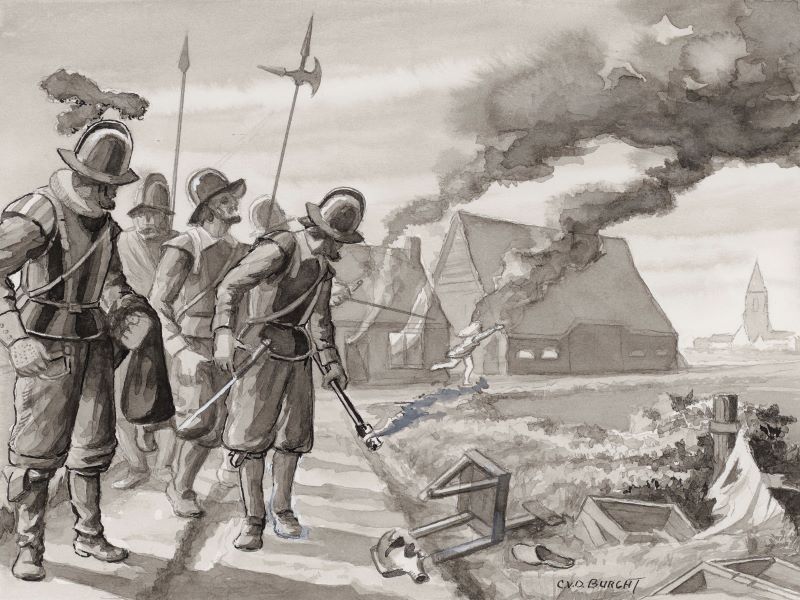
In earlier centuries, the population of Aalten regularly suffered from forced contributions. A forced contribution (brandschatting) is a (usually high) sum of money that a village or region had to pay to passing troops to prevent them from looting and burning the village or region.
The soldiers in question usually received irregular pay and were primarily paid from these forced contributions. If the amounts could not be raised, the troops felt entitled to looting and other misconduct. Since multiple armies often passed through a region during wartime, the imposition of this ‘war tax’ usually led to bitter poverty. Additionally, the population often suffered from roaming, dismissed mercenaries.
This practice plagued many areas not only in the Middle Ages, but also during various wars in the 16th, 17th, and 18th centuries. In the peripheral areas of the Republic of the Seven United Netherlands, for example, such as North Brabant, Limburg, and the eastern border regions, it led to a major economic and demographic decline during these centuries.
Historical Description
In 1938, G.H. Rots wrote a series of articles in the Aaltensche Courant about the history of the municipality of Aalten. He wrote the following about forced contributions in Aalten:
“In the years before 1597, the year of the conquest of Bredevoort by Prince Maurice, Bredevoort had regularly been in the possession of the Spaniards. However, one should not think that there was peace and quiet in the Ambt of Bredevoort at that time. Troops regularly passed through and stayed in Bredevoort and the associated districts. The village of Aalten suffered particularly from these passing troops. There was little dispute over property rights. The soldiers simply took whatever they liked, and the Ambt of Aalten was repeatedly levied for forced contributions, i.e., ordered to hand over a number of horses, cows, or money to the passing troops.
One could also strike a deal with the marauding bands and prevent the seizure of livestock and horses by paying a sum of money. As evidence of how Aalten suffered under these repeated raids and robberies, the following is mentioned in that regard.
On March 2, 1582, English horsemen arrived in Aalten and took 16 people prisoner. These prisoners were released after paying a ransom of 2,000 guilders.
An honorable citizen named Hondarp, however, was transported to Zutphen but was later released for a ransom of 200 dalers. The son of the aforementioned Hondarp was taken prisoner on October 17 while he was in Doetinchem. He had ridden to Doetinchem on horseback, and it seems his appearance suggested he did not lack means, as he was able to regain his freedom upon payment of 100 dalers and the surrender of his horse.
On December 1 of that year, soldiers from Lochem arrived and demanded 100 dalers to prevent looting. Things did not go well for Hondarp, as on January 15, 1583, he was taken prisoner along with his wife and son. They could only extract 60 dalers from him, for which they finally regained their freedom. In March of that year, another group of soldiers from Doetinchem arrived and stole a number of horses ‘at the Pas’. The owners were able to buy them back for 51 dalers, except for the best horse, which the soldiers took with them.
On May 29, the people from Doetinchem returned and stole a horse and a cow, but this time no ransom was paid, probably with the thought: if they get no money, they won’t return so quickly. But the next day it was the same story again; 3 horses were stolen. The ransom decreased, as they only had to pay 9 dalers, with which the soldiers were satisfied.
However, looting was in the blood of the garrison at Doetinchem, as they repeatedly came to Aalten. On June 18, they stole three horses; the ransom was 13½ dalers.
On the 10th, they were back again, and now they demanded 3 horses, 2 cows, 2 heifers, and 3 bulls. The heifers were slaughtered and valued at 10 dalers. The rest were bought back for 10 imperial guilders and the bulls for 10 dalers.
On June 14, one horse was stolen, which was bought back for 3 dalers and 18 stuivers. It would get even worse, for only two days later, soldiers from Bergh, Doetinchem, and Nijmegen arrived and stole 41 horses, 4 oxen, 33 cows, and 37 head of barren cattle. Only a portion of these could be bought back for 674 dalers.
And now more robberies followed. On July 19, 20 horses were taken by soldiers from Bronckhorst. On August 11, another 6 horses. On September 14, soldiers from Ulft stole 3 cows, for which a ransom of 15 dalers was paid by the owner.
On September 17, a company of soldiers led by a certain Stael arrived and seized 11 cows, 40 horses, 40 head of large cattle, and 12 oxen. They took the best livestock with them, and the rest was bought back for 419 dalers. Until now, it had always been livestock, but on December 15, soldiers from Lochem arrived and demanded 8 horses and 2 carts of buckwheat. On March 15 of the following year, a carter with a wagon of rye, drawn by 2 horses, drove through the IJzerlo field. Some horsemen from Bergh and Doetinchem seized everything, and the carter saw his property taken away.
Now they began taking heads of households prisoner again. They were released for a ransom or in exchange for other prisoners languishing in the dungeon at Bredevoort. Immediately after Whitsun, a large raid was undertaken, and many horses and cows were seized and partially bought back. Subsequently, on June 9, June 20, and June 24, there were repeated raids and thefts of horses and livestock.
And the measure was not yet full. The population of Aalten had a hard time, for on July 13 and 14, 1584, 15 people were taken prisoner in the municipality of Aalten and 600 head of cattle and horses were stolen. The prisoners were released for a ransom of 1,100 guilders. Who can fathom the sorrow of the population in those days?
Because of all these mentioned raids, people became fearful. They hardly dared to go outside with a horse, ox, or other animal; danger lurked from all sides. Soldiers were stationed in all the surrounding fortresses, and whenever they needed something, they went out looting. It was in the middle of harvest time, but the farmers left the grain in the fields; why should they harvest? Soon the enemy and also the State soldiers would come—for in this regard it was ‘six of one and half a dozen of the other’—and steal their possessions.
There were also farmers who fled and tried to find a living in regions further to the east. Those who remained here complained to the village authorities, but what could they do! In those years, a certain Jan Holstein was the advocate (voogd) of Aalten. He addressed petitions to the Lady of Anholt. It seems, however, that she was also powerless to end the situation. It was wartime, and the soldiers, mostly mercenaries and volunteers, demanded money, food, and drink on time. And when the army leadership could not provide that on time, the soldiers tried to obtain it themselves through looting and robbery. The population became the victim.”
Billeting
“Added to all that misery was the fact that garrisons were relieved of soldiers by billeting them with farmers and village residents. The people themselves had almost nothing to eat, and when soldiers were billeted, they would act out if they did not receive enough food. If people had provisions, they were largely hidden, otherwise everything would be seized. To make matters worse, an extra tax was imposed on the population. The Lady of Anholt needed money, and the Stewards traveled around to collect the funds; but everywhere there was poverty and want.
Then it would seem as if peace would return, and nothing would be heard for a year. But suddenly it would flare up again. As in the summer of 1586, the looting began once more. The Aalten farmers then pursued the looters as far as Enschede and Oldenzaal. They wanted their stolen cattle back. They had to return empty-handed, and the suffering was almost unbearable.
One of the worst afflictions was when the soldiers brought their wives and children with them. Then they also had to be given something to eat. In January 1587, such a troop was to be partially billeted in Aalten. Fear struck the hearts of the population. It was heard that they were mercenaries from Wallonia in Belgium, who were notorious for their ferocity and cruelty. Outposts had already been sent out because it was suspected that Geuzen soldiers were in the vicinity. On a Sunday morning, such an outpost troop of 20 men arrived in Aalten, led by the landdrost Thieseling. They moved on to Bocholt, where a Spanish cavalry unit had arrived under the command of Colonel Taxis.
Reconnaissance had determined that no State or Geuzen soldiers were to be seen, and so it was agreed to ride back to Groenlo and then carry out the billeting. But between Aalten and Bocholt, they were suddenly ambushed by the Geuzen soldiers, and a fierce battle broke out. The Geuzen were victorious, and the fear remained. The dreaded billeting did not happen.
Near Bredevoort, there seem to have been fertile meadows in addition to marshes. Specifically, there was a town meadow at the Swanebroek and several private grazing lands. But in 1587, everything had been grazed bare by the enemies’ horses, the meadows were completely ruined by riding, and afterwards a period of rain came and everything was flooded, so that no hay could be harvested that year. While they had been spared billeting in the spring, in December of that year a large number of horsemen suddenly arrived from Groenlo and stole horses, cows, and pigs. Sixty molders of rye and buckwheat were also to their liking, along with 43 wagonloads of unthreshed grain.
On March 26, 1588, it was a number of State soldiers who looted in Aalten. Thus, the population was bitten first by the cat and then by the tomcat. The advocate of Aalten, Jan Holstein, wrote a letter on June 9, 1588, to Godfried Gerardi, advisor to the Lady of Anholt, in which he recalls the situation in Aalten. The harvest cannot be safely brought in. Citizens of Aalten have been taken prisoner and are being held hostage elsewhere. There is no money to ransom these people.
On July 4, 1588, an army of 2,000 infantrymen (foot soldiers) and 300 horsemen approached Aalten. They entered the village, and the residents fled fearfully into their houses. What would happen to them now? The command was held by the Spanish governor and field commander Verdugo and Count Herman van den Berg. It appeared, however, that they were just passing through towards Bocholt-Recklinghausen, so Aalten was spared billeting or robberies this time.
The Lady of Anholt considered ways to end the robberies. She needed money to pay the soldiers’ wages and therefore decided to introduce an extra levy (extra tax). But of course, you can’t pluck feathers from a frog. Aalten had to provide an extra 70 dalers, and the advocate of Aalten wrote to the Lady that he did not know how he would collect this sum, which had been easy to pay in the past, at this time. The population is starving, horses and cows are almost non-existent, and what remains is being stolen.
Yes, my readers, who can fathom the depth of misery of the unfortunate population, for not only the mentioned afflictions hit the people. It is as if everything conspired to complete the system of destruction, for while the crops promised somewhat of a good harvest, a violent storm arose accompanied by heavy hail and destroyed all the crops standing in the fields. How deeply our ancestors had to drain the cup of misery is indescribable and cannot be understood by us, who do complain about bad times.
For even more atrocities were to occur. The hordes of soldiers who roamed about and often indulged in strong drink threatened women and daughters with dishonor if they were not given what they demanded. In 1597, Bredevoort was taken by Prince Maurice. The change in government had come, but it did not bring the protection of home and property. It remained restless in the Ambt of Bredevoort. The fortunes of war fluctuated, but soldiers were soldiers; one group might be slightly better than the other, but on average they could all be painted with the same brush.”
Twelve Years’ Truce
“Only in 1609, when the Twelve Years’ Truce was made, could the population catch its breath again. With the changing fortunes of war, religious disputes had also flared up. As long as the Spanish domination existed, the Reformers could not show themselves openly. No sooner had the tide of war turned than the change in the churches also took place. The victors took measures against the vanquished that, in hindsight, are indefensible.
After the Twelve Years’ Truce, the conflict began to flare up again. In Groenlo, there was still a garrison of Spanish soldiers. That was a breeding ground for bad elements. They roamed the rural districts and again stole everything they could. The new Lord of this municipality, Prince Maurice and later Frederick Henry, was constantly petitioned for protection. Finally, on July 17, 1627, Frederick Henry decided to rush to the aid of his subjects in the County. A significant military force of 55 squadrons of cavalry, 168 companies of foot soldiers, and 75 cannons entered the County, coming from the direction of Emmerich. The siege of Groenlo was laid, and a fierce battle erupted there between besiegers and besieged.
After the siege had lasted a month, Frederick Henry took the city and thereby established the rule in the County. For thirty days, Frederick Henry stayed in Groenlo and visited the surrounding places. Aalten also received an official visit from Frederick Henry. He encouraged the population. Since then, a member of the House of Orange has never made an official visit to Aalten. If a street or square in Aalten ever needs to be named again, it might well be named after this liberator of Aalten territory. For afterwards, peace returned, except for small robberies compared to the past, until the peace was signed in 1648, ending the Eighty Years’ War.”
Sources
- Wikipedia
- ‘From Aalten’s Past’, by G.H. Rots, Aaltensche Courant, February 18 & 25, 1938 (via Delpher, part XVII & part XVIII)