
The Capture of Bredevoort in 1572 was the conquest of the fortified town of Bredevoort by a Sea Beggar (Geuzen) army led by William van den Bergh during the Eighty Years’ War. The siege lasted from 9 June to 20 June and resulted in the successful seizure of the town by the besieging forces. This operation was part of William of Orange’s second invasion, aimed at opposing the ‘Spanish’ Army of Flanders.
During the Eighty Years’ War, Bredevoort was under Spanish authority. However, from the autumn of 1570, rumours circulated in the Achterhoek of an imminent attack by insurgents, known as the Geuzen. Until 1572, this remained merely a threat. Following the Capture of Brielle on 1 April 1572, Count William van den Bergh, the brother-in-law of William of Orange, assembled an army of approximately 5,000 men in Wesel. His objective was to undertake a campaign through the Achterhoek and along the IJssel. This campaign was marked by the plundering of churches and monasteries, among other targets.
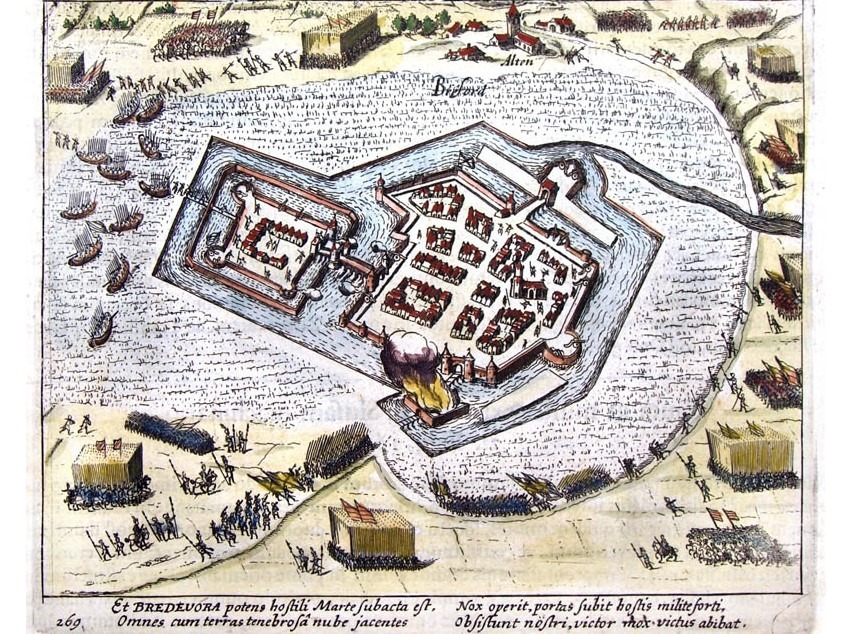
Siege
On 9 June, a trumpeter appeared before the city gate to demand the town’s surrender on behalf of William of Orange. The choice was simple: swear an oath of allegiance to the Prince, or face battle. The demand was accompanied by harsh warnings; should they choose to fight, the town would face an assault in which neither property nor life would be spared. The Drost (Bailiff), Jasper van Broeckhuijsen, replied that they first wished to await the opinion of the pandheer (mortgage holder), Dirk van Bronkhorst-Batenburg.
Meanwhile, William van den Bergh captured the city of Zutphen the following day and sent letters to the towns that had not yet been conquered, inviting them to Zutphen to swear the oath to the Prince. The Bailiff of Bredevoort advised the citizens to go, but this advice was not followed.
Van Broeckhuijsen eventually managed to convince the pandheer in Anholt that Bredevoort was incapable of defending itself against such superior numbers. Van Broeckhuijsen then travelled to Zutphen to negotiate. On 19 June, a treaty was concluded in which the house, town, and lordship were surrendered to the Prince, though the pandheer would retain his rights.
Capture
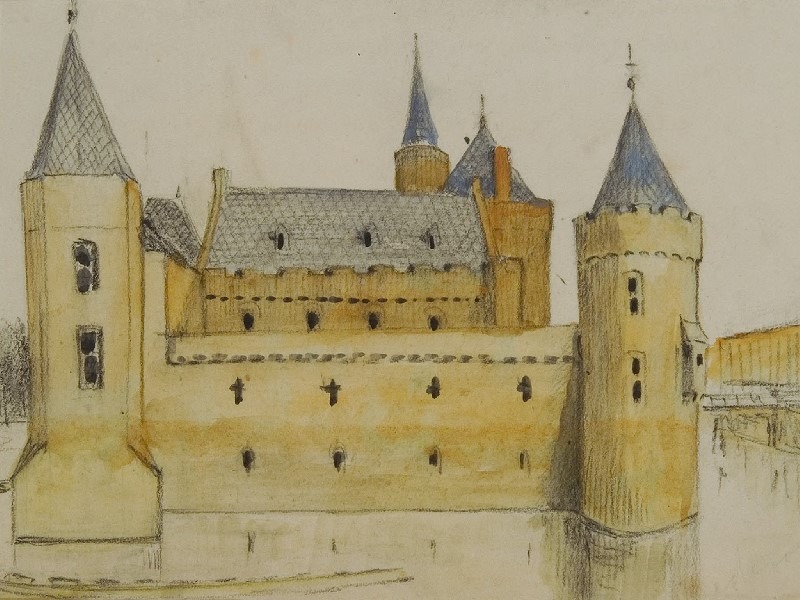
On 20 June, Bredevoort was captured and occupied by Gisbert van Heerde and his regiment of French troops. Jasper van Broeckhuijsen and all officials of the lordship were dismissed, and Jacob van der Capellen was subsequently installed as the new Bailiff. The remainder of the army advanced westward to capture Doetinchem. However, peace was short-lived.
In the meantime, Don Frederick was approaching with a large army for a punitive campaign, and by November, Bredevoort was once again a theatre of conflict. On 20 November, Jacob van Bronkhorst, son of the Lord of Anholt, retook the town for the pro-Spanish forces of the Duke of Alba and his son Don Frederick. A month later, the Geuzen plundered Bredevoort Castle, the Schaer Monastery, St George’s Church, and the St James’s Church in Winterswijk.
Following the Massacre of Zutphen, Van den Bergh fled to Germany, accompanied by the Geuzen who had been stationed in Bredevoort. They took five cannons and ammunition from the town. The pandheer Dirk van Bronkhorst-Batenburg now openly declared his Spanish sympathies. Bredevoort would remain under the Spanish flag until the siege of 1597 by Maurice of Nassau, the future Prince of Orange.
Source
- Wikipedia
- H.A. Hauer: in Breevoort can ick vergeten niet, blz. 25-28, Uitgever: De Graafschap, 1956
- Staring Instituut: Bredevoort een Heerlijkheid, ISBN 90-9002135-3 (eerste uitgave 1988)