
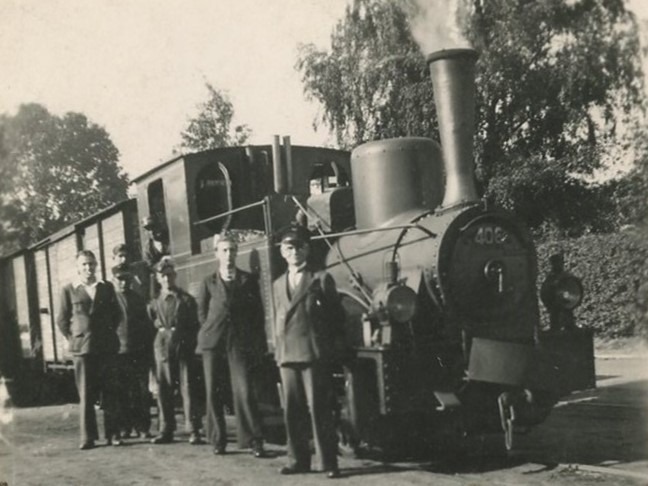
Aaltensche Courant, 29 September 1900
Vrijdagavond waren er in de Sociëteit een 40tal belangstellenden opgekomen om nog iets naders van de tram te vernemen, terwijl de meesten ook schenen gekomen te zijn om door het nemen van aandeelen aan de totstandkoming mede te werken.
In response to a question from one of those present as to whether the Prussian government would also provide a subsidy for the section on German territory, the answer was believed to be in the negative. The desirability of a connection to the station in Bocholt was also discussed, but it was thought that the residents of Bocholt would see to this themselves once the line was established. Another expressed doubt about this, as much expense is currently being spent on the Aa and it is not being counted upon, so that many costs would arise from it later.
These and several other points were discussed following the reading of the report, of which we provide some excerpts here:
On February 19 last, a route map with description was sent to His Excellency the Minister of Water Management, Trade and Industry, and in an accompanying address, support was requested for one-third of the construction costs, including rolling stock. The plans, budget, description, etc., of the Dutch-Prussian border–Bocholt steam tram section were prepared by Mr. Regierungsbaumeister G. Küchler, and these documents have been sent to the Mr. Regierungsrath-Präsident in Munster; we have already received word that these documents were submitted to the Mr. Landrath in Borken and to the Mayor of Bocholt for assessment, etc. The “landespolizeiliche Vorprüfung” (state police preliminary examination) of the plans by the relevant authorities took place on Monday, August 27 last.
The choice of the direction for the Lichtenvoorde–Dutch-Prussian border line gave rise to some difficulties. In the first place, we considered it important to include Bredevoort in the plan; to satisfy this, the purchase of a house in the centre of the village was necessary. Before marking out the line through Bredevoort, we secured possession of a portion of the house.
Secondly, whether to go around or through Aalten. After various leveling surveys were conducted near and in Aalten, we became convinced that, in view of the steep slopes which would later present many difficulties during the operation of the steam tramway, the route to the east of Aalten should be preferred over the one through the centre of the municipality. There was much opposition to that direction from the Municipal Executive of Aalten and private individuals. After discussions with a Committee from the Council, it was again investigated how the objections could be met.
Het gevolg daarvan was dat twee nieuwe richtingen aan het oordeel van den Raad werden onderworpen. Deze richtingen konden evenmin de goedkeuring van dien Raad verkrijgen; deze bleef bij zijn verlangen dat de stoomtramweg zoo mogelijk door de Kerkstraat moest worden aangelegd. Nadat wij de verlangde richting door de Kerkstraat opnieuw hebben laten opnemen en hoewel ons wederom gebleken is dat de gevolgen niet zullen uitblijven van duurder exploitatie bij deze richting, hebben wij gemeend, met het oog op het welslagen der onderneming, bij den wensch van het Gemeentebestuur van Aalten ons te moeten neerleggen.
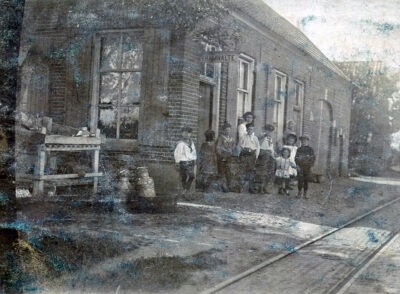
Door een en ander zal de richting Lichtenvoorde–Bocholt de navolgende zijn: De lijn vangt aan bij den tweesprong gevormd door den grindweg Lichtenvoorde–Groenlo en den grindweg Lichtenvoorde–Aalten, zoodat aansluiting wordt verkregen, zoowel in de richting van Lichtenvoorde station N.W.S. als in de richting Zeddam. Vanaf bovengenoemden tweesprong volgt de tramlijn den rechterberm van den grindweg naar Aalten tot aan de herberg „de Domme Aanleg”, van daar den rechterberm van den grindweg naar Bredevoort tot ongeveer 100 Meter voor de hoeve „het Nieuwe Bouwhuis”, waar zij den weg kruisende dezen verlaat en op eigen baan in nagenoeg oostelijke richting verder gaat. Vervolgens zuidelijk afbuigende wordt de Kloosterdijk gekruist en komt de tramweg weder op den linkerberm op ongeveer 300 Meter voor de kom van Bredevoort. De lijn loopt door Bredevoort en verlaat de plaats over den Zuidelijken berm van den grindweg naar Aalten. Daarna over de Markt door de Kerkstraat, om vervolgens de oostzijde van den Bocholterweg te volgen. Nabij de grens wordt de weg gekruist en wordt op Duitsch grondgebied de westzijde van den weg tot Bocholt gevolgd.
Zoowel op Nederlandsch als op Duitsch grondgebied wordt een douanestation gevestigd. Aan het westelijk einde van het dorp Lichtenvoorde zal een loods voor locomotieven en rijtuigen worden gebouwd, met werkplaats en woning (tevens kantoor), voorts station en goederenloods benevens woning voor den stationschef; nabij Zeddam is een hulploods voor locomotieven en rijtuigen ontworpen. Te Aalten en Bocholt worden eveneens loodsen voor locomotieven en rijtuigen gebouwd. Behalve op bovengenoemde plaatsen zijn wisselplaatsen ontworpen nabij Harreveld, in den Heelweg, Varsseveld, Westendorp, en Etten. Verder te Bredevoort en aan de Nederl. Pruiss. grenzen. In Lichtenvoorde, Varsseveld, Zeddam, Aalten en Bocholt zullen eenvoudige inrichtingen worden gemaakt ten behoeve der watervoorziening van de locomotieven en verder haltegebouwen enz. waar deze later zullen blijken noodig te zijn.
A telephone line will be installed along the designed tram lines (of which, however, the public may not make use for the time being).
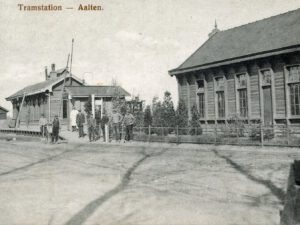
It is proposed to acquire: 8 locomotives, 10 passenger carriages, and 45 goods wagons. Negotiations have been opened with the Geldersche Stoomtram-Maatschappij in Doetinchem regarding the shared use of the section of that Company’s steam tramway and of the Gendringen tramway company near Terborg, while negotiations are also being conducted with the “Ouden IJssel” Water Board and with the managers of the Terborg–Etten road regarding the conditions for the steam tram crossing the Ouden IJssel bridge.
We have contacted the Hollandsche IJzeren Spoorweg-Maatschappij in Amsterdam regarding the crossing of the G.-O. local railway at Aalten and at Terborg and regarding the laying of rails on the station yard at Lichtenvoorde.
The construction costs for the Lichtenvoorde–Zeddam line are estimated at ƒ453,000, from which interest-free advances from the state and province amounting to ƒ196,300 are deducted, so that a share capital of ƒ260,000 in round figures must be found. Those for the Lichtenvoorde–Bocholt line are estimated at ƒ360,000. It is expected that the state and province will grant an interest-free advance totaling ƒ104,000, so that for this line too, a capital of ƒ260,000 in round figures must be found. During the first twenty years, an interest of 3¼% per annum is guaranteed on the corporate capital of ƒ520,000 through the already promised and the yet to be requested interest guarantee of ƒ16,900.
Since very early times, many commercial relations have existed between the municipalities of Lichtenvoorde, Aalten, and Bocholt, and that these have not yet disappeared but continue to exist is evident from the substantial receipts (± M. 80,000) of the German border office. At this moment, a large number of workers from Bredevoort and Aalten go to the factories in Bocholt, either on foot, by bicycle, or by wagon. These workers will undoubtedly make use of the tram if worker trains run, because they will then not need to set out before dawn and can be home again in good time in the evening. Daily transport of at least 200 workers to Bocholt can be confidently counted upon, in addition to a significant transport of foodstuffs to Prussia. The city of Bocholt is a very flourishing manufacturing town with an ever-growing population. Significant traffic between Aalten and Bocholt is to be expected.
The designed steam tram lines can, as far as location etc. is concerned, be considered approximately equal to the Gendringen Tramway. According to the report of the Director of the Geldersche Stoomtram-Maatschappij (operator of the Terborg–Gendringen steam tramway), the receipts of the said tramway for the 1899/00 financial year per day-kilometer were: passengers ƒ2.76, goods ƒ3.49, totaling ƒ6.25.
Although we can find no reason to expect lower revenue for the designed lines, we wish, for the sake of caution, to reduce the revenue per day-kilometer of Terborg–Gendringen of ƒ6.25 by 25%, thus taking ƒ4.69 as the standard for the new lines, making for 49.2 kilometers x ƒ4.69 x 365 days (rounded) ƒ84,300; the operating costs, generously estimated, will amount to ƒ50,200, and depreciation of 1% of construction ƒ8,100, totaling ƒ58,300, so that a credit balance of ƒ26,000 remains, i.e., 5% of the share capital.
From the foregoing it may therefore appear that, even if the outcome in the first years should not be as favourable as can be deduced from the fairly accurate calculations, the undertaking will prove to be a fairly solid investment for the shareholders, and for the region a pleasant and fast means of transport, which will certainly give a powerful boost to the development of local and tourist traffic and cause trade and industry to increase.
The name shall be: Geldersch-Westfaalsche Stoomtramweg-Maatschappij.
After some discussion among themselves, several lists placed on the various tables were taken up and filled in, but the request was made to see the list on which the members of the committee had signed, and a number of persons then placed their signatures on it with the number of shares to be taken. The list was read out upon request, and it then appeared that an amount of ƒ24,500 had been subscribed.
When the members of the committee, in response to the question from Mr. W.H. Lammers, declared that they did not intend to go around to the residents with the lists in order to place even more shares, the latter thought that not much would come of the matter. He and a few other gentlemen, however, declared themselves willing to take lists with them to attempt to further increase the number of shares placed, after which the meeting was closed.
N.B. The photos on this page have been added for illustration purposes and were not part of the original article.