Overview
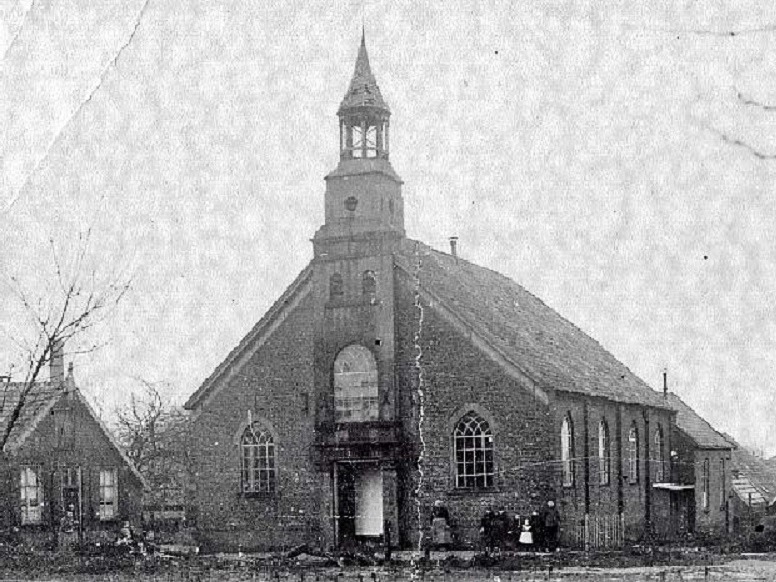
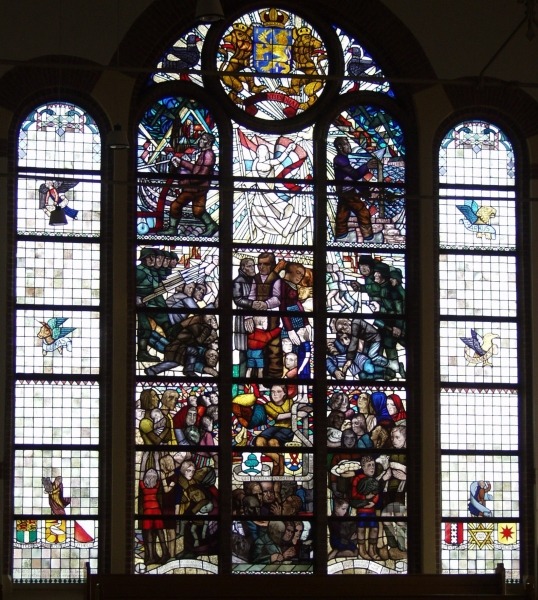
The Oosterkerk (East Church) is a former Reformed church in Aalten. It replaced the first ‘Seceded Church’ (Afgescheiden Kerk) from 1844 in 1913 and was expanded several times over the years. The building contains a unique memorial window from 1946, which was gifted in gratitude for the aid Aalten provided during World War II. Today, the building has been repurposed as a residential care facility.
In 1834, a group of believers broke away from the Dutch Reformed Church and established the Christian Reformed Church (Afgescheiden Kerk). A seceded congregation emerged in Aalten as well. Initially, the congregation gathered in private homes. In 1844, they built their own church, the Afgescheiden Kerk, on the site where the Oosterkerk stands today. The first minister was the Rev. Breukelaar.
Construction and architecture
After the first Oosterkerk became too small, the current church was erected in 1913, designed by architect Ane Nauta from Holwerd. The building contractor was D.J. te Mebel. The construction costs, including the demolition of the old church, amounted to approximately 30,000 guilders. The church was also referred to as ‘Church A‘, while the Westerkerk was known as ‘Church B’.
An expansion followed in 1931 because the number of seats still proved insufficient. In his design, Nauta drew inspiration from the Neo-Renaissance, with influences from Hendrik Petrus Berlage.
The church features a T-shaped floor plan. The front façade, which has a gabled wall, was given an entrance with its own small gable and a window framework above it. There are several round-arched windows and, in the centre, a triforium with stained glass. Towers stand on both sides of the front façade, the left one being the largest; both are topped with a needle spire. Leadlight windows have been used in all façades.
Memorial window
In 1946, the Oosterkerk was fitted with an eight-metre-high memorial window, gifted by a committee from the Reformed Church of Kralingen on behalf of the churches and the Jewish community of Rotterdam. The window was an expression of gratitude to the people of Aalten for sheltering and aiding people in hiding (onderduikers), Jewish citizens, those suffering from starvation, and the many children from Rotterdam who were taken in here during the war.
Repurposing
The final church service in the Oosterkerk took place on Sunday, 27 June 2021. The building was subsequently repurposed as the Oosterkerkhuis, housing twenty studio apartments for residents with dementia. The purchase agreement stipulates that the unique memorial window and the organ must be preserved.
Images