Chr. Reformed Minister
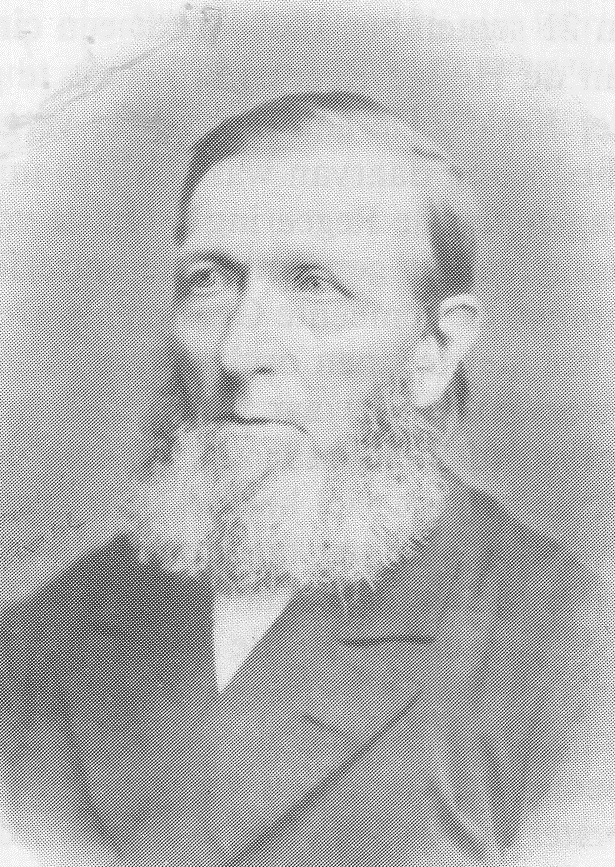
Derk Breukelaar was born on 28 December 1814 in Varsseveld, the son of ‘chair turner’ Wessel Breukelaar and Grada Johanna te Rietstap. In 1847, he married Janna Hendrika Pennings (born in Aalten, 12 November 1825) in Aalten. Nine children were born from this marriage.
Following the foundation of the Christian Secession Congregation (Christelijke Afgescheidene Gemeente) in Aalten in July 1843, the young faith community sought to call a minister. On the advice of Reverend Brummelkamp, the young Derk Breukelaar from Varsseveld was invited. He accepted and moved to Ommen to study under Rev. A.C. van Raalte (1811–1876)—one of the first Secessionist ministers in the country.
Minister in Aalten
After completing his studies, Breukelaar was ordained on 24 September 1846 as the minister of the congregation in Aalten. This would remain his only parish; he served there for 44 years until his retirement in 1888. When Rev. Wildenbeest of Varsseveld passed away suddenly in 1852, that congregation extended a call to him. Initially, he accepted, but—realising he was then the only Secessionist minister in the Achterhoek region—he eventually declined and remained committed to the church in Aalten, though he also worked extensively in the surrounding areas.
’t Grotenhuis
Breukelaar lived with his family in a small farmhouse called ’t Grotenhuis, located on present-day Hessenweg just outside the village. Here, he grew his own food to supplement his modest stipend of 225 guilders, which later rose to 600 guilders per year. Parishioners also contributed in kind by bringing food, such as meat and potatoes, to his home. Catechism classes were also held at ’t Grotenhuis, as there was no room for them in the church. During busy periods, such as the harvest, his wife took over the teaching of these classes.
Evangelism and Youth Work
Evangelism was very close to the minister’s heart. This was the reason Derk Breukelaar took the initiative to establish several Sunday schools, through which he reached not only the children but also their parents. For children in the outlying hamlets, Sunday school was held at someone’s farmhouse so that the children did not have to travel all the way to the village. Later, long after Breukelaar’s death, various Sunday school buildings would be erected in the rural districts surrounding Aalten.
In 1868, Breukelaar founded the Reformed Young Men’s Association „Uw Koninkrijk kome” (Thy Kingdom Come).
Difficult Years and Recognition
The late 1870s were not the easiest years for the minister. In 1876, his wife passed away, and a few years later, he became involved in the “School Struggle” (schoolstrijd) in Aalten as the chairman of the school board.
Nevertheless, Breukelaar received much appreciation. On his fortieth anniversary in office in 1886, his congregation presented him with a States Bible on a beautifully crafted wooden lectern. On the same joyous occasion, the classis (regional church council) presented him with an engraving depicting ‘Golgotha’. When he retired in 1888, his catechism pupils gave him a tea service and a cake set as a gift.
Death and Legacy
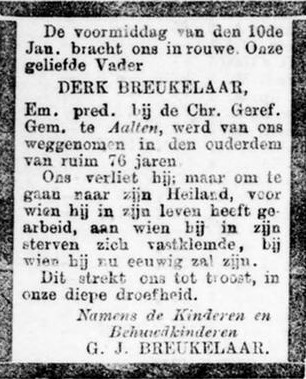
Reverend Breukelaar passed away on 10 January 1891 in Aalten at the age of 76. He was buried at the Old Cemetery on the Varsseveldsestraatweg. The church council honoured him with a funerary monument. The inscription on the gravestone, which is now barely legible, is noteworthy for its curious use of the church name ‘Christian Secession Congregation’ (instead of ‘Christian Reformed Congregation’).
Three of his sons followed in his footsteps and also became ministers: Gerrit Jan, Willem, and Johannes. The latter is regarded as the founder of Christian education in Aalten. In June 1918, Johannes himself opened the Breukelaar School on Piet Heinstraat, which was named after him.

Leave a Reply