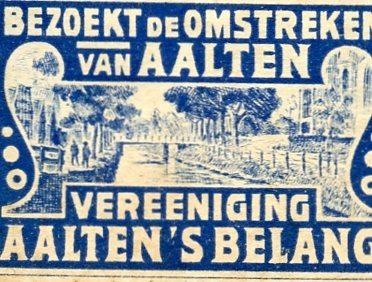
Interest Association
The association Aaltens Belang was founded on 14 December 1898 by a number of local dignitaries. The association’s objectives included campaigning for a better connection with Bocholt, the improvement of public transport, the installation of urinals on the Market Square and at the edges of the village, and improvements to both the postal service and housing.
The board consisted of thirteen members, matching the number of seats on the Aalten municipal council at the time. “Why,” it was argued, “should Aaltens Belang make do with fewer?”
The board took a broad view of its objectives. They also dedicated themselves to matters such as the operation of a commercial evening school and a tourist information office (VVV), the management of the local Loohuisbos nature reserve, and the organisation of trade fairs or the annual outing for the elderly.
Merged into the VVV
In its early years, the association was instrumental in establishing both the first refuse collection service and the Museum Frerikshuus. In later years, the association focused primarily on organising activities and providing information regarding tourism and recreation. When these tasks were professionalised and transferred to a new VVV (Tourist Office) organisation, the association merged into it in the mid-1980s.
Bench, Loohuisbos, and Nannielaantje
Bij haar 25-jarig bestaan in 1923 schonk de Vereniging Aaltens Belang de plaatselijke gemeenschap een stenen bank. Deze bank vinden we tegenwoordig nog steeds aan het wandelpad langs de Slinge, nabij de brug in de Polstraat, achter basisschool De Slinger.
In 1928 redde Aaltens Belang het Loohuisbos, 21 hectare groot, door het aan te kopen voordat het zou worden ontgonnen. Maar de vereniging kon het geld niet opbrengen en verkocht het bezit door aan de Vereniging tot Behoud van Natuurmonumenten. Daardoor bleef het bewaard als een stukje oud Achterhoek.
Toen de boerenplaats Het Smees in 1934 door de erven Slichter van Bath werd verkocht, ging Aaltens Belang in gesprek met de koper. Men vreesde namelijk dat “het bekende en zoo natuurschoonrijke” Nannielaantje zou verdwijnen. Dankzij de inzet van Aaltens Belang bleef het populaire laantje gelukkig behouden.