
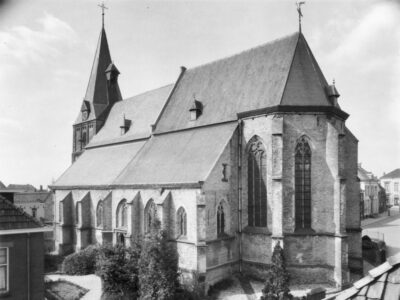
The nineteenth century was a turbulent period in Dutch church history. In 1834, the Secession (Afscheiding) from the Reformed Church took place in Ulrum. The seceders declared they were breaking with the Reformed Church, “until it returns to the true service of the Lord”. Besides the Ulrum congregation, many thousands of believers elsewhere in the country also left the ‘Dutch Reformed Church’. They no longer felt at home there, partly due to liberal preaching.
Instead of going to church, the seceders began holding house meetings. There they read the Bible together, or sermons by very orthodox ministers from centuries past, sang psalms together, and questioned each other about their spiritual lives.
Seceders in Aalten
In Aalten, too, there were several Seceders at that time, as the Dutch Reformed church council minutes of November 1835 reflect: “In the months of September and October, several persons saw fit to secede from the existing church denomination”. Their names are also known: Lammert Geurink, Antonia Knuvers, Janna G.E. Navis, Derk Jan Klumpenhouwer, H. Wevers, B. Goorhuis, and Hendrik Jan te Kotte. In November 1836, the number of ‘aggrieved’ members stood at ten.
In Aalten, during the first few years, the Seceders met for their religious services at the Bouhuis farm on Bolwerkweg, the Sondern farm on Sondernweg, and the Navis farm on Brakenweg. Rev. A. Brummelkamp (1811–1888) from Hattem, one of the first Seceded ministers in our country, often led these services, which usually took place during the week. These were long journeys for the minister, who nevertheless supported the Achterhoek Seceders with advice and action. Furthermore, he frequently had to pay a fine for breaking the law: without permission from the local authorities, it was forbidden to hold religious gatherings of more than twenty people.
Christian Seceded Congregation
The Christian Seceded Congregation in Aalten was presumably instituted in July 1843 with the confirmation of the office bearers. These were the elders G. Bouhuis and A.J. Pennings and the deacons F. Heijerman and J.H. Kappers.
The young Seceded Congregation wished to call a minister. On the advice of Rev. Brummelkamp, the young Derk Breukelaar (1814-1891) from Varsseveld was asked if he would become the minister of Aalten. He agreed, after which he left post-haste for Ommen to study with Rev. A.C. van Raalte (1811-1876) – also one of the first Seceded ministers in our country. Meanwhile, in September 1843, the church council members asked the classis if the minister of Varsseveld, Rev. J. Wildenbeest (1808-1852), and the minister of Winterswijk, Rev. J.W. te Bokkel (1815-1888), could come to preach in Aalten and Bredevoort as often as possible.
The Aalten church council also took steps to be recognised by the government as a Seceded Congregation. Rev. Brummelkamp drafted a petition for this purpose, which was sent to King William II on 10 October 1843 (he was the head of the Dutch Reformed Church).
In the letter, the King was informed that the Three Forms of Unity constituted the confessions of the Aalten congregation, and that the Utrecht Church Order of Rev. H.P. Scholte (1805–1868) served as its regulations. They further promised to make no claim to the funds and properties of the Reformed Church nor to funds from the State Treasury. They also reported that they would hold their church services in “a church building to be erected for that purpose on a piece of land on the Esch near the village of Aalten, specifically to the North East”. Thirty-five male members signed the petition.
On 12 January 1844, King William II recognised the congregation as an independent Christian Seceded Congregation.
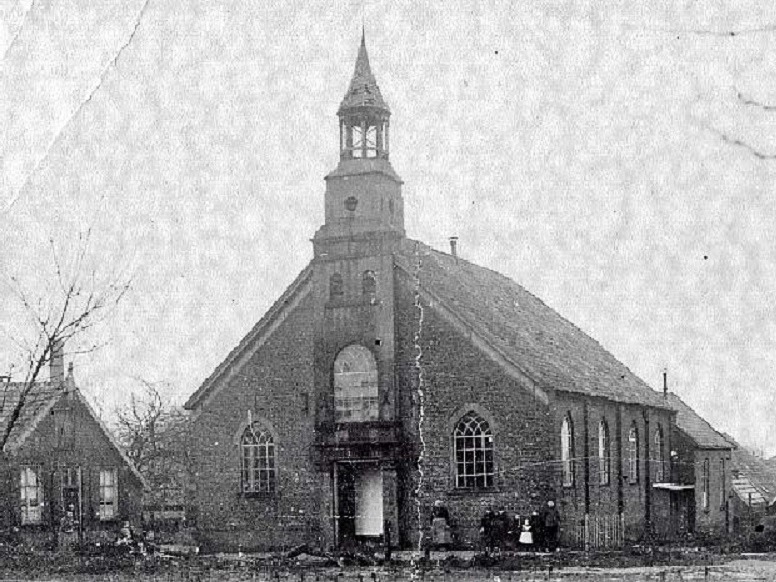
Holding church services in the various farms of congregation members was a solution in the early days, but it was naturally not an ideal situation. Therefore, in 1844, the church council, together with the male members, decided to build their own church. The location chosen was the present-day Oosterkerkstraat, on the site where the (now decommissioned) Oosterkerk stands today. “With great sacrifices, one giving money, another their labour, a third both”, the church was finally completed and could be put into use.
After Derk Breukelaar had finished his studies, he was inducted into the Seceded congregation of Aalten on 24 September 1846. It would remain his only congregation. He worked there for forty-four years until his retirement in 1888. When Rev. Wildenbeest of Varsseveld died suddenly in 1852, that congregation issued a call to him. Initially, he accepted it, but – realising that he was now the only Seceded minister in the Achterhoek – he ultimately declined and remained connected to the church in Aalten. However, he also worked extensively in the surrounding area.
Rev. Breukelaar lived in a small farm (called ‘t Grotenhuis) on the present-day Hessenweg, just outside the village. Catechism classes were also held at ‘t Grotenhuis, as there was no space for them in the church. His wife, Janna Hendrika Pennings, also sometimes took the catechism classes when the minister himself had hardly any time for them during the harvest season.
The Doleantie of 1886
After the Secession in 1834 and subsequent years, many orthodox Reformed members had remained in the Dutch Reformed Church with the intention of ‘bringing the Reformed church back to the Reformed path of the Fathers’ from within, as it was called. In Amsterdam, however, this ‘struggle for Church Restoration’ eventually resulted in a schism in 1886, which took place under the leadership of, among others, Dr Abraham Kuyper (1837–1920).
This conflict, known as the ‘Doleantie’ (from ‘dolere’ = to grieve), stemmed from the struggle that had been waged for years against the habit of the Reformed synod to grant as much freedom as possible to those who did not agree with the Church’s confession, in order to avoid any ecclesiastical conflict.
Rev. J.H.F. Gangel was a fervent supporter of this movement in Aalten. Mutual tensions rose so high that the municipal authorities were forced to call in military assistance to maintain public order. Rev. Gangel had been removed from office by the classical board of the Dutch Reformed Church, which he initially refused to accept. Notable in this context is that the minutes of the church council from 26 November and 23 December 1885 have been removed from the register of church council minutes. However, lists of those who wished to remain members of the Dutch Reformed Church are found in the archives. These lists date from 1887.
The end result was that the ‘dolerenden’, like the seceders, had to leave the Dutch Reformed Church. In doing so, they also had to relinquish church property. The lawsuit brought by the ‘dolerenden’ against the Reformed congregation of Aalten regarding church possessions ended in 1888 to their disadvantage.
By bailiff’s writ, Rev. Gangel and the former church council were forced in 1888 to hand over the financial administration of the rest home in Aalten to Rev. van Oostrum-Soede and the sitting church council. From the religious composition of the population of Aalten, one can deduce the scale the Doleantie had reached in 1885-1888: in 1901, the number of Dutch Reformed in Aalten was 3,560 souls, the number of Reformed (Gereformeerd) was 2,497, the number of Roman Catholics was 1,287, and the number of Christian Reformed was 118. This was out of a total population of 7,726 inhabitants.