
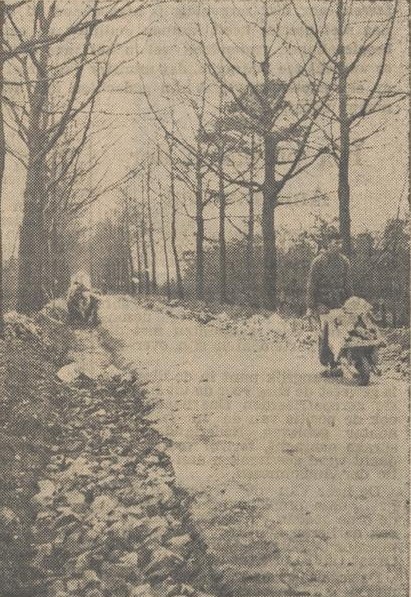
Dagblad Tubantia, 26 March 1953
It is certainly appropriate that the road from Aalten to Dinxperlo has been given the name Dinxperloseweg, but had that name not been chosen, it could with equal justification have been called ‘Kerkweg’ — Church Road — because within a few months this route will have every right to that name. Work is currently under way to widen the Aalten–Dinxperlo road.
At the end of the nineteenth century there was nothing more than a sandy track from Aalten to Dinxperlo. When streets and gravel roads were being laid in neighbouring places, Aalten municipal council also began to ask whether it was not time to build a proper hard-surfaced road from Dinxperlo to Aalten. Carrying out such a plan within the municipality of Aalten, however, would only make sense if Dinxperlo council also agreed to surface the section lying within its own municipality.
Around the middle of the nineteenth century, Aalten council asked its counterpart in Dinxperlo to proceed with surfacing the road, saying that Aalten would do the same. Nothing came of it. Dinxperlo council replied that it would indeed favour a surfaced road, but one running from the Varsseveldseweg in Aalten via Lintelo. That proposal also came to nothing, and it was not until the end of the nineteenth century that the decision was finally taken to surface the Aalten–Dinxperlo road in both municipalities.
Traffic on this road is fairly heavy, and the fact that Aalten council had not been mistaken in its judgement in the mid-nineteenth century is clear from the fact that the road to Dinxperlo now has to be widened. By contrast, the roads through Lintelo — the Sondernweg and Gendringseweg — are fairly narrow, but are still quite capable of handling the traffic that uses them.
Surfacing with church rubble
In recent years Aalten municipal council had repeatedly discussed the need to widen the Aalten–Dinxperlo road. Provincial funding, however, was still not forthcoming, even though from time to time it was thought that provincial approval for the work might soon be granted. A few years earlier, the Roman Catholic church in Aalten, which had been badly damaged during the war, had to be demolished, leaving a large quantity of rubble. Aalten municipality managed to secure this material, and the old bricks, lumps of cement and similar debris were taken to the Dinxperloseweg and deposited along the verges of the road that was to be widened.
Permission to begin widening the road nevertheless failed to arrive, something no one had taken into account when the rubble was dumped there. It lay quite close to the carriageway, with the result that many cars drove over stones lying in the road during the evening and at night — hardly good for the vehicles, nor for the tempers of their drivers. It was also very difficult for two cars to pass one another on a road effectively barricaded on both sides.
Many complaints were received, but these should now be a thing of the past, as work to widen the road began a few days ago. The old Roman Catholic church is thus literally being used for the road, so it takes little imagination to give it the nickname ‘Kerkweg’. In modern street naming, however, a Kerkstraat usually runs past or towards a church. It is only rarely that a church itself is turned into a road.