
De Graafschapper, 23 June 1948
The Sewage Treatment Plant in Aalten
Perhaps you have sometimes wondered what happens to wastewater after it disappears down the sink and into the sewer. We had wondered the same thing and, to satisfy our own curiosity and perhaps yours as well, we paid a visit to Aalten’s municipal sanitation department.
We had, however, reckoned without the rules. When we arrived, we discovered that we were not allowed inside without written permission. That, too, was eventually arranged after a couple of visits to the Municipal Works office, where we finally received an official-looking ‘Authorisation’, giving us permission to enter this heavily secured site.
The sewage flows first into a pair of large settling tanks, where the heaviest waste is allowed to sink. This material is then dried and can be used as compost or fertiliser.
The remaining water still contains suspended matter and passes into a large chamber with a capacity of 40 cubic metres. When the water reaches a certain level, a pump starts automatically and sends it to the preliminary treatment stage. Depending on the amount of incoming water, one, two or three pumps are switched on. Normally, the 40-cubic-metre chamber fills in about fifteen minutes. The inflow is generally at its highest until around three o’clock; after that, it decreases.
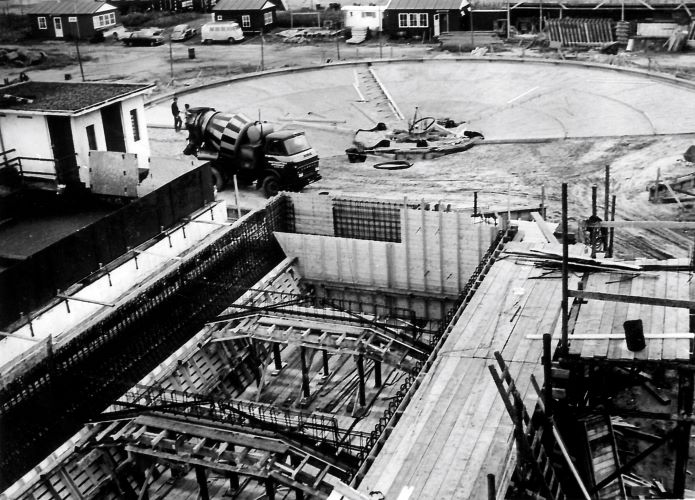
In the preliminary treatment unit — a series of tanks which, like all the other basins, are 8.60 metres deep — the solid matter is allowed to settle.
From there, the water passes to the main treatment unit, which consists of eight tanks. It flows from one group of tanks into the next. At the dividing point is a set of brushes that beats oxygen into the water. This is the essential principle of the purification process. If the water still contains more than 20% sludge at this stage, a drain valve is opened and the thickened sludge is returned to the system.
The water has then been cleaned of its impurities and is discharged into the stream.
The Final Product
The waste matter that has settled in the preliminary treatment unit is transferred about once a week to the digestion chamber. It remains there for around a month, during which it decomposes thoroughly. Any small amount of water still present is returned to the chamber. Once the sludge has fully digested, it is taken to the drying beds. These are large basins in which a layer that is not too thick is spread out. At the bottom is sand, beneath that a thick layer of rubble, and below this a system of pipes that carries any remaining drainage water back to the chamber.
After some time — depending on the thickness of the layer and the weather — the material is completely dry and the final product is obtained. This final product has considerable value as a fertiliser. For comparison with old farmyard manure, the following percentages are given:
| Compost | Old farmyard manure | |
|---|---|---|
| Organic matter | 10 | 15 |
| Water | 42 | 79 |
| Mineral matter | 48 | 6 |
| Nitrogen (N) | 0.85 | 0.6 |
| Phosphoric acid (P2O5) | 1.2 | 0.3 |
| Potash (K2O) | — | 0.55 |
This compost should not be confused with the municipal compost also known locally, which consists of partially processed household refuse.
This treatment plant had been in operation for about ten years by then and was one of the most modern of its kind. That becomes clear when browsing the visitors’ book, which contains the names of mayors, aldermen and other representatives of municipalities who came to Aalten to learn more about a modern sewage-treatment installation.