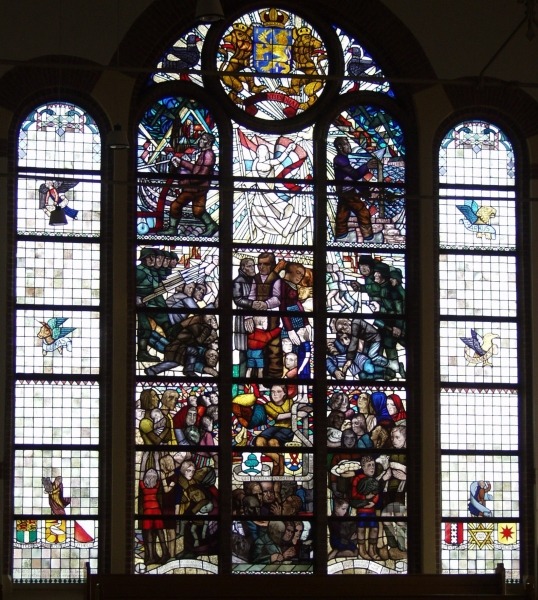
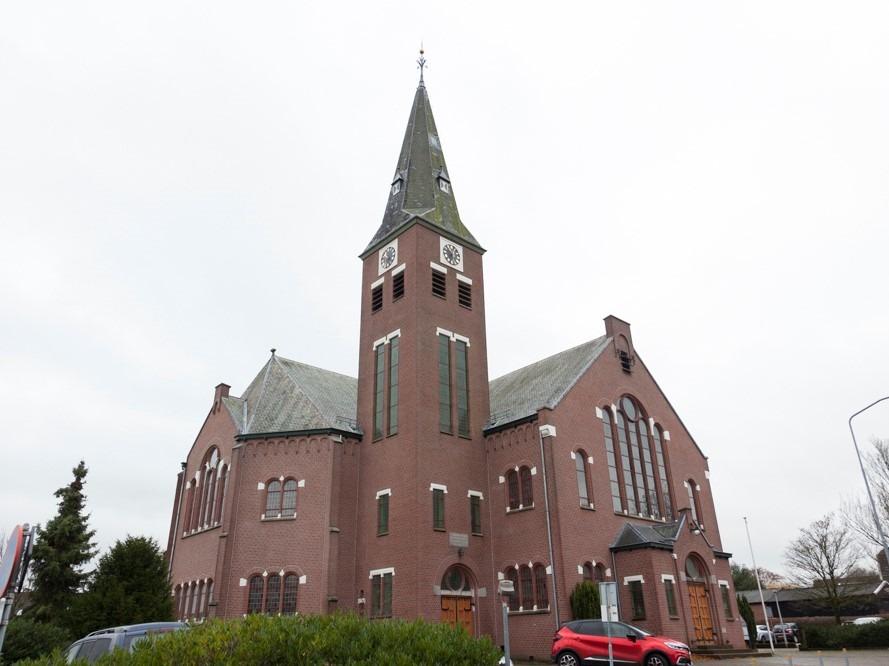
The Oosterkerk in Aalten houses a monumental stained-glass window dating from 1946. The window was gifted by a committee from the Reformed Church of Rotterdam-Kralingen, on behalf of the churches and the Jewish community, as a token of thanks for the assistance provided by the people of Aalten during World War II to those in hiding (onderduikers), Jewish fellow citizens, the starving, and hundreds of children from Rotterdam.
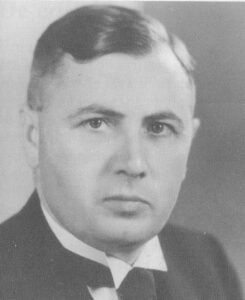
Rev. Thomas Delleman (1898–1977)
Thomas Delleman (1898–1977) served as a minister in Aalten from 1930 to 1938 before moving to Rotterdam-Kralingen. Following the Bombing of Rotterdam in May 1940, he took the initiative to arrange for children from his new parish to stay in Aalten for a holiday. During the war years, a total of approximately 800 children from Rotterdam were taken in by host families in Aalten.
Delleman contributed in other ways as well. He ensured that young men wishing to evade the Arbeitseinsatz (forced labour) could go into hiding in Aalten. Furthermore, in 1943, around 500 evacuees from Scheveningen were accommodated in Aalten. During the ‘Hunger Winter’, trains carrying food regularly departed from Aalten for the west of the country.
This dedication made a profound impression in Rotterdam and led to the formation of a committee after the liberation to thank the people of Aalten.
Origin of the Commemorative Window
Initially, the intention was to place the window in the Westerkerk, as more than forty young men had been arrested there during a roundup (razzia) in 1944. However, all the windows in the Oosterkerk had been shattered after a V1 rocket landed nearby in January 1945. Consequently, it was decided to install the window in the Oosterkerk instead.
The window was designed by the Rotterdam artist Marius Richters (1878–1955) and executed by glazier Henri van Lamoen (1900–1949). With a height of eight metres and a width of over three metres, it is one of the largest stained-glass windows in the Achterhoek. Richters utilised bold colours and clear, almost narrative scenes that express both the threat of war and the warmth of the relief efforts.
The window was installed in the front facade of the Oosterkerk and officially unveiled by Rev. Delleman on 13 July 1946. The ceremony was broadcast live on the radio by the NCRV.
Design
The window is over eight metres high and three metres wide, set within a trifora.
Commemorative Window in the Oosterkerk, Aalten
At the top: The coat of arms of the Netherlands with the motto “Je maintiendrai”. Below this is the Dutch Maiden, holding the flag in her right hand and a burning torch in her left. On either side stand a farmer and a bricklayer, referring to the post-war reconstruction.
Central: A farmer and his wife, symbolising the people of Aalten, surrounded by children and a person in hiding. From both sides, German soldiers with bayonets march into the scene.
Bottom left: Emaciated women and children pleading for help.
Bottom right: A group of people who have been helped, returning home supplied with foodstuffs.
Bottom centre: The coat of arms of Aalten featuring the linden tree and the coat of arms of the House of Orange, with a scroll reading: “Uit dankbaarheid voor hulp in oorlogstijd, soli Deo gloria” (In gratitude for help in wartime, to God alone the glory). Biblical texts are incorporated elsewhere in the window.
In 1947, two side windows were added to either side of the main window. These feature the symbols of the four Evangelists, images of Moses and Isaiah, and at the bottom, the coats of arms of Rotterdam, Scheveningen, Utrecht, Amsterdam, Kralingen, and a Star of David.
At the base of the side windows are lines of verse by Muus Jacobse (pseudonym of the poet Klaas Heeroma):
Maar als ik leven mag tot de bevrijding en juichen op het overwinningsfeest, God, doe mij dan dit weten, wat voorbijging aan nood en leed is niet vergeefs geweest.
(But if I may live until the liberation and rejoice at the victory feast, God, then let me know this: that the hardship and suffering which passed was not in vain.)
Current Status
The commemorative window can still be seen in the Oosterkerk. When the church was repurposed as a residential care location in 2021, it was formally agreed that the window would be preserved. This ensures the window remains not only an artwork of exceptional scale but also a lasting war monument and a tangible reminder of the aid and hospitality offered by Aalten during World War II.
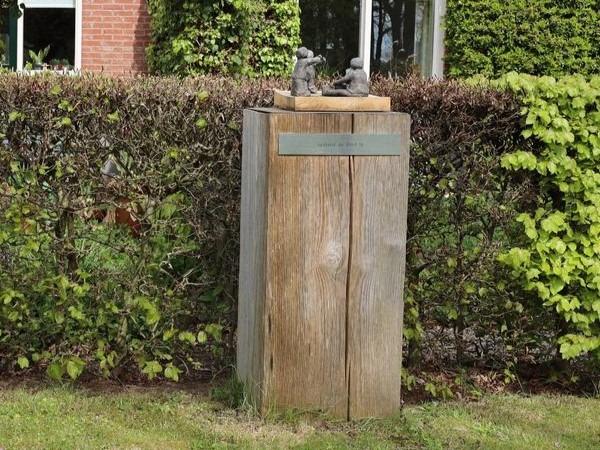
On the Piepersweg in the Aaltense Heurne there is a memorial in memory of a tragic accident that took place shortly after the liberation of Aalten. The monument was erected in memory of three young boys who died in the accident.
On the afternoon of 4 April 1945, just a few days after the liberation, the boys Wim Schenk (8 years old), his brother Henk Schenk (6 years old) and their friend Wim Wisselink (5 years old) were playing outside.
In a dry ditch along the Bocholtsestraatweg they found a projectile. Unaware of the danger, they threw it at each other. At one point, one of the boys threw the projectile against the wall of a nearby house, after which it exploded.
The consequences were horrible. Wim Schenk died on the spot. His brother Henk and Wim Wisselink were seriously injured and were taken to a military emergency hospital in Barlo, where they died shortly after each other.
Booklet and monument
In 2011 a booklet about this dramatic event was published entitled ‘Spelend de dood in’, written by Louis Veldhuis.
Seventy years after the accident, in 2015, relatives of the Schenk family unveiled a monument at the site of the tragedy. It consists of a pedestal with images of the three boys and was designed by artist Ans Braamskamp.
On March 30, 1945, the Aalten rural district of Barlo was liberated by the Allies. During the relief of Barlo and the surrounding area, an air-raid shelter at the Nijhof farm was hit by an Allied bomb aimed at the retreating Germans.
During the skirmishes between the warring parties, the seven children of the Weenink family, the Elfers couple who had fled from The Hague and the Nijhof couple and daughter Wanda hid in the shelter of the Nijhof farm, which was considered a reliable hiding place.
Headmaster Weenink, who had fourteen children, lived next door to the school that had been taken over by German soldiers. When the alarm went off, he sent his children to the shelters outside the center of Barlo, because he thought it was too dangerous there. Seven children fled to the shelter at the Nijhof farm on the Nijhofsweg. The other children went to the shelter of farm ‘t Markerink. The shelter at Nijhof was not under, but next to the house. The house remained unscathed.
The last bomb dropped from an Allied plane fell on the shelter. The people in it were buried under earth and tree trunks. The Nijhof family was just at the entrance of the cellar to see if the bombing had ended and was spared by this. But five of the seven children and the couple from The Hague died. The liberation of Barlo would become a day of mourning because of this tragedy.
The seven victims were Thomas Elfers (74 yrs.), Helen Elfers-Reisenleitner (74 yrs.), André Weenink (6 yrs.), Co Weenink (17 yrs.), Jan Weenink (3 yrs.), Mien Weenink (20 yrs.) and Rudolf Weenink (6 yrs.).
Listed
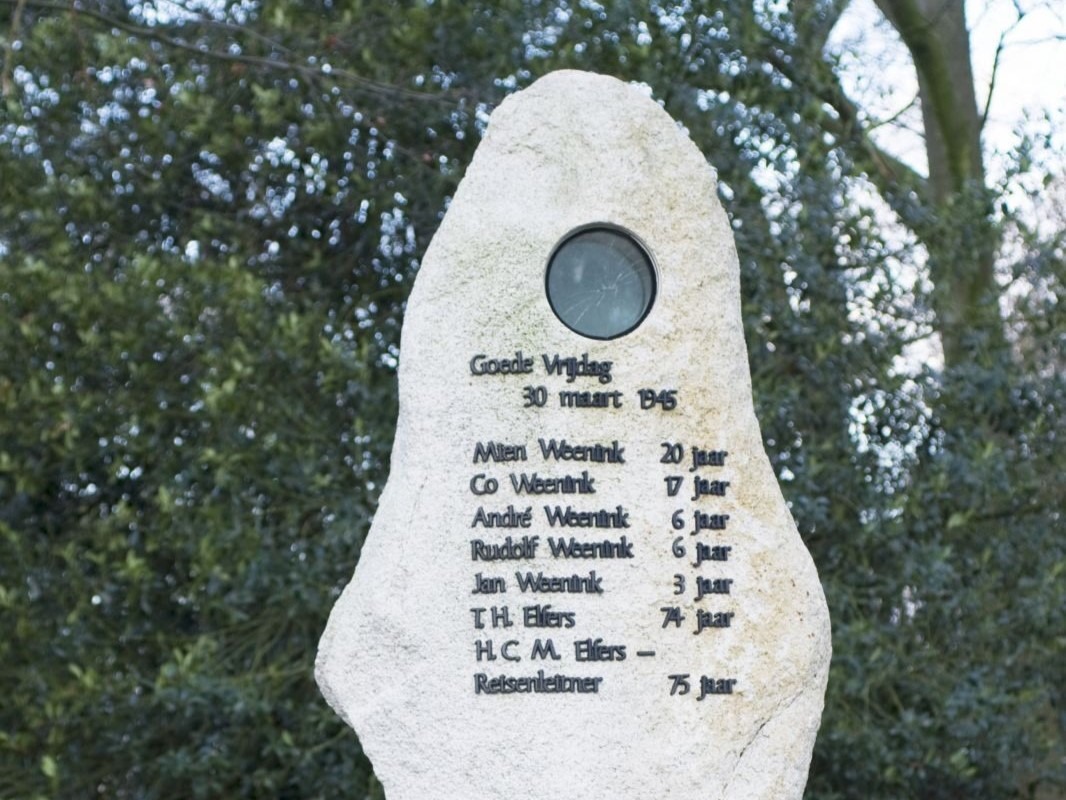
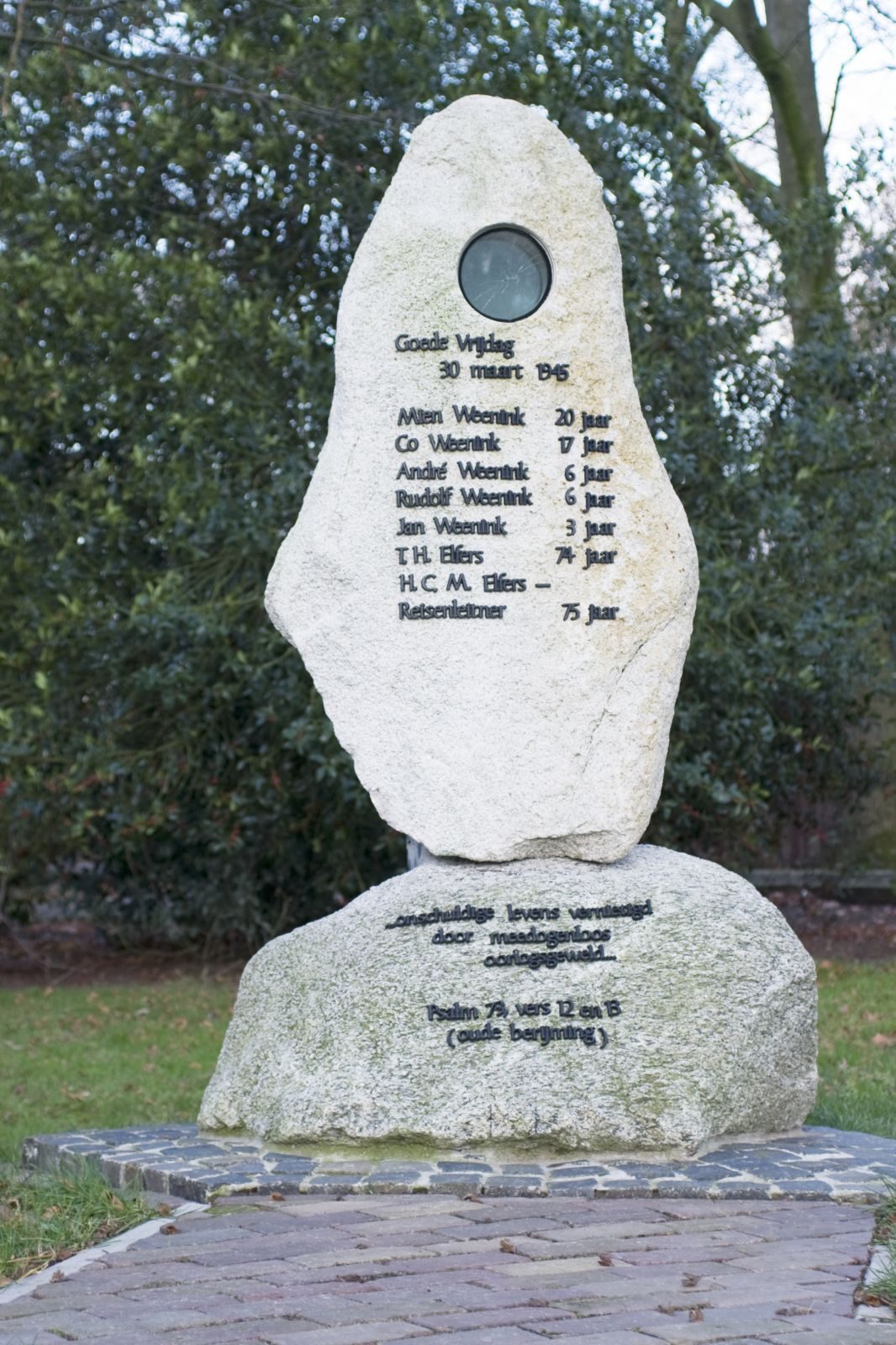
On the initiative of the Dwars door Barlo Foundation and the relatives of the victims, a monument has been erected in memory. The monument was placed at the Nijhof farm and was unveiled on March 30, 2009. The monument consists of two boulders, one standing upright on top of the other. In the top stone is a round hole with a piece of broken glass in it, as a symbol of the irreparable damage. Below are the names and ages of the victims. On the bottom stone, which serves as a pedestal, is a quote from the Bible. An information board has also been placed at the monument.
The text on the monument reads:
‘GOOD FRIDAY MARCH 30TH, 1945
MIEN WEENINK 20 YEARS CO WEENINK 17 YEARS ANDRÉ WEENINK 6 YEARS RUDOLF WEENINK 6 YEARS JAN WEENINK 3 YEARS OLD T.H. ELFERS 74 YEARS H.C.M. ELFERS-REISENLEITNER 75 YEARS’.
On the pedestal is the quote:
‘INNOCENT LIVES DESTROYED BY RELENTLESS WAR VIOLENCE
PSALM 73, VERSES 12 AND 14 (OLD RHYMING)’.
The text on the information board reads:
‘MONUMENT IN MEMORY
ON GOOD FRIDAY, MARCH 30, 1945, THE LAST BOMB FELL THIS PLACE WHERE AN AIR-RAID SHELTER ONCE STOOD. THIS WAS THE END OF THE SECOND WORLD WAR IN THE HAMLET OF BARLO. THE STRONG HIDING PLACE OF THE NIJHOF FAMILY TURNED OUT NOT TO BE ABLE TO WITHSTAND SUCH NOTHING RUTHLESS VIOLENCE OF WAR.
THE NIJHOF COUPLE AND THEIR DAUGHTER SURVIVED THE WOOF; THE ELFERS COUPLE AND FIVE WEENINK CHILDREN DIED.
THE FIELD BOULDERS SYMBOLIZE THE LEADEN AND MASSIVE SADNESS. THE HOLE WITH THE – BROKEN – GLASS IN ONE OF THE ERRATIC STONES SHOWS US A GLIMPSE OF A NEW FUTURE, ALTHOUGH IT WILL NEVER BE UNSCATHED.
WE HOPE THAT THIS PLACE OF REMEMBRANCE WILL MAKE YOU QUIET STAND BY THE GREAT GIFT OF FREEDOM THAT WE NOW WE CAN LIVE. LET US BE CAREFUL WITH THAT AND TO WORK TO HELP OTHERS IN THIS WAY AS WELL. TO GIVE THE WORLD THAT FREEDOM.
FOUNDATION DWARS DOOR BARLO.’
War Memorial Nijhofsweg, Barlo (photo: Francien Wiersma-Luimes)
On 8 February 1945, a mistake bombing took place in the Aalten rural district of Dale, in which eleven people were killed. In memory of these victims, a monument was unveiled in 1988 on the corner of Aladnaweg and Grevinkweg.
Less than three months before the end of the war, on February 8, 1945, American B-26 Marauder bombers took off from their base in Cambrai in northern France. Their primary target was the area around Kleve, and if that was not possible, they had an alternative target at Groenlo. At Kleve it was too cloudy and so they flew on, but also in the Achterhoek the visibility was poor. Just after 11:00 a.m., they dropped 528 fragmentation bombs.
Two hours later, the aircraft returned safely to Cambrai. Their mission report stated: “Impossible to determine further damage or to locate pattern accurately due to 80% cloud cover”.
Death and destruction
The deadly cargo ended up in the vicinity of the Elshoek and the Grevink in Dale, with terrible consequences. The hundreds of splinter bombs caused death and destruction. The shards flew horizontally across the ground and affected both people and animals. Everywhere lay dismembered horses, cows, sheep, chickens and geese. Some farms suffered direct hits.
All doctors, nurses and emergency services were sent to the crash site. In the mud and among the rubble, they provided first aid to the wounded. These were transported on stretchers and ladders to Huize Avondvrede on the Hogestraat. From there, the seriously injured were transferred to the emergency hospital in Harreveld.
The bombing eventually claimed eleven lives and left several people permanently disabled.
Thes laughter offerings
In the kitchen of the Neerhof family’s farm ‘t Olde Nooitgedacht , Joop de Roon from Rotterdam was found dead. At the Glieuwe farm, where the Hogenkamp family lived, daughter Anna and sons Herman and Jozef were killed. The Bekerhuis farm of the Te Grotenhuis family was completely destroyed. There were four victims here: the children Arie and Teun te Grotenhuis and the brothers Hendrik and Gerrit Stronks, who were in hiding there.
In addition, bombs also fell in the Haartsestraat. Clarel Smit, who had just left Van Lente’s house, was so injured in his feet and legs that he died four months later in the emergency hospital in Harreveld.
The monument
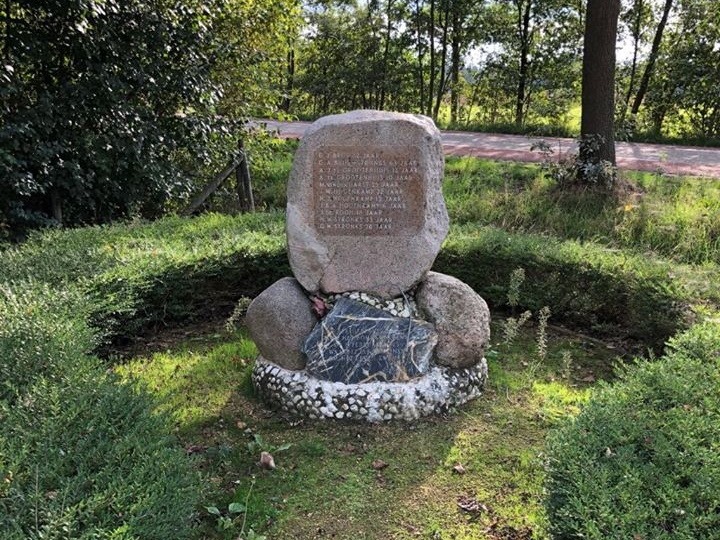
The monument in memory of the victims consists of four stones, from the remains of the house of the Te Grotenhuis family. Mr. Te Grotenhuis piled up these stones at the place in question after the bombing. For years, the stones functioned as an unofficial memorial. In 1988, at the insistence of the local population, they were recognized as an official monument.
The monument for the victims of the mistake bombing in Dale
The names of the victims are inscribed on the memorial stone:
G.J. BRUS 62 YEARS OLD
G.A. BRUS-STRONKS 63 YEARS OLD
A.J. TE GROOTENHUIS 12 YEARS OLD
A. TE GROOTENHUIS 10 YEARS
M. VAN DER HARST 25 YEARS OLD
J.M. HOGENKAMP 22 YEARS OLD
H.J. HOGENKAMP 15 YEARS OLD
J.B.A. HOGENKAMP 6 YEARS OLD
J. DE ROON 18 YEARS OLD
H.W. STRONKS 33 YEARS OLD
G.W. STRONKS 26 YEARS OLD
Sources
Aalten in wartime, J.G. ter Horst
If only I could see them again, the bombing of Dale 8 February 1945, H. de Beukelaer
On or under, Aalten, the land of the people in hiding and of illegality, G.W. Vaags
Interview with Karel Aversteeg (Louis Veldhuis and Gerrit Nijman)
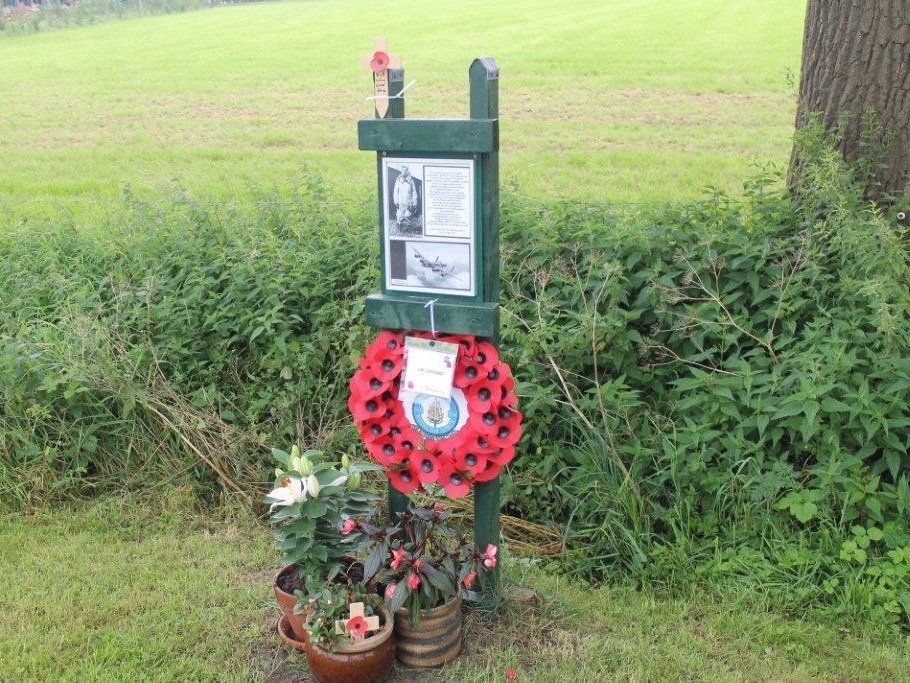
On the Gandvoortweg in the rural district of Barlo in Aalten, there is a modest memorial, erected in memory of the British Flying Officer Leslie Pulfrey of the Royal Air Force (RAF). The memorial marks the meadow where Pulfrey was found dead in the early morning of June 17, 1944, after a failed jump from his burning Lancaster bomber.
The mission
On the evening of 16 June 1944, the four-engined Avro Lancaster bomber ME840, with Pulfrey as a crew member, took off from North Killingholme airfield in Lincolnshire, England. The mission was an attack on factories in Sterkrade, Germany, where, among other things, synthetic oil was produced for the German war industry.
The plane, with seven crew members on board, completed its bombing raid and returned to England. On the way back, however, it was intercepted and attacked by the German night fighter pilot Joseph Nabrich. One of the fuel tanks in the wing caught fire almost immediately, leaving the aircraft irretrievably lost.
The fatal leap
On the pilot’s orders, the crew was ordered to abandon the aircraft. Leslie Pulfrey was the first to jump into the airspace above Barlo. But something went terribly wrong. Although the exact cause remains unclear, he was found dead in a meadow in the early morning of 17 June 1944 by farmer Johan van Eerden of the nearby farm Nieuw Kolstee (Smol).
It is possible that Leslie came into contact with the plane during his jump or that his parachute did not open properly. From a distance, the place where he had landed was clearly visible; His body was still connected to his parachute, which was bulged by the wind. There was a large tear in the parachute and his head had become entangled in the cords. Leslie also missed one of his aviator boots, which he apparently lost after his jump. His name was mentioned on his identification plate.
The crash
The burning Lancaster eventually crashed in a meadow behind the ‘Oude Lieftinck’ farm on the Heelweg (now Twenteroute 5). All but one of the crew were killed. Flight engineer Roy Kay was thrown out of the plane by an explosion just before the crash. Miraculously, he was the only survivor to reach the ground in one piece. He escaped arrest and finally managed to return to England on 22 September 1944, with the help of pilot helpers.
Leslie Pulfrey and his killed colleagues were transferred to Varsseveld, where they were buried.
Tribute
In June 2014, Leslie Pulfrey was honored with a ceremony, during which a so-called Fly-past took place. Four F-16s flew over the vicinity of the Gandvoortweg, and one of the aircraft took off straight up on the spot as a tribute. Thea Onnink has recorded her memories of this moment in this story, read by Herman Onnink.
A small group of glider pilots from this area, who until now practiced their sport at the airfield near Enschede, sought out a site in the Schaarsheide—a location that combines all the favorable factors for gliding.
The steep slope descending from Vragender and Barlo toward this site provides the necessary thermal air currents, while the site itself, spanning over 5 hectares, is beautifully level and has firm ground.
Should the site be approved by the competent authorities, the intention is to commence gliding activities at the beginning of August. An aircraft is already under construction and is nearing completion. If these plans are realized, Aalten will have the scoop on this most modern of sports.
Aaltensche Courant, 5 October 1934
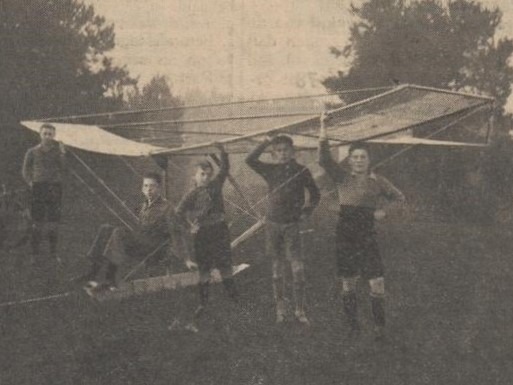
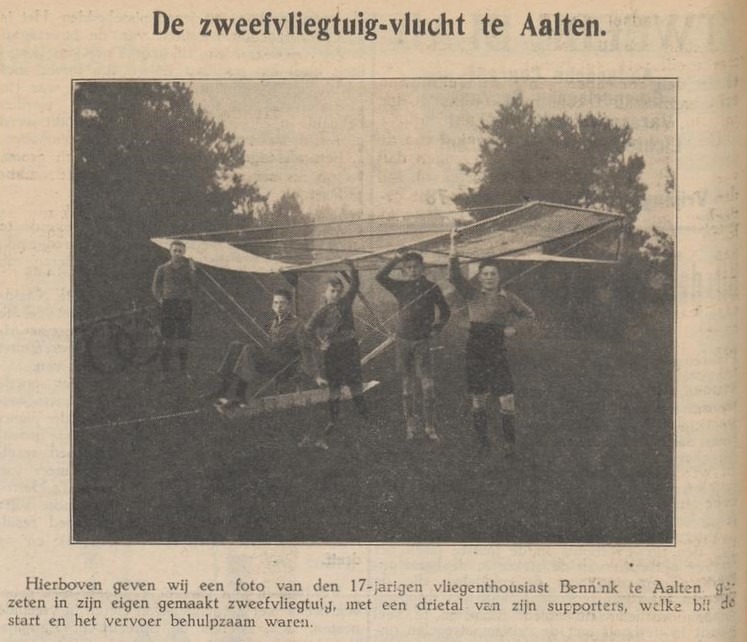
One of the enthusiastic glider pilots may well have been Jan Bennink from Aalten. He built his own glider in 1934 and successfully flew it. Read more »
In 1932, there was excitement among historians regarding a potential “find of prehistoric value” in the Ringkampsbulten near Aalten. The presence of 2,000-year-old vaulted dome-shaped graves was suspected within an artificial mound there. Excavations were to provide clarity, with unexpected results.
Mysteries
On 9 March 1932, the Graafschapbode reported:
Mr Beernink from Aalten, a member of “de Graafschap”, approached the secretary, Dr Westerbeek van Eerten from Hummelo, with the request to come and conduct an investigation in a heathland area on the German border to the south-east of Aalten. Situated there was a small artificial mound with ramparts where, according to the local residents, things were not quite right. They spoke of pixies, ghosts, ulkenpötte (hobgoblins), and further mysteries.
The Aaltensche Courant wrote on 11 March 1932:
Along the historical road leading from neighbouring Barlo in Germany to the old fortress town of Bredevoort lies, on the right-hand side as one travels in the direction of Germany, a small pine wood, ostensibly identical to several of these woodland plots still to be found on the Haart.
For the historian, particularly the researcher of prehistory, this wood signifies more than just a plot of woodland. For him, the lines and contours of the soil are a page of history – history from thousands of years ago. To the layman, it is a bumpy plot of pines, featuring first a rampart about 1 metre high, then a slight depression, followed once more by a rise in the centre of which is a bowl-shaped hollow.
Upon closer inspection, it appears that the outermost rampart follows a roughly egg-shaped course, with a length of about 100 metres and a width of approximately 50 metres. Within this enclosure sits the aforementioned elevation with its characteristic bowl-shaped hollow, which immediately leads the connoisseur to suspect a “tumulus” or barrow from prehistoric times. At the thickest end of this egg shape (the pointed end lies on the eastern side), we encounter the mound with its bowl-shaped hollow.
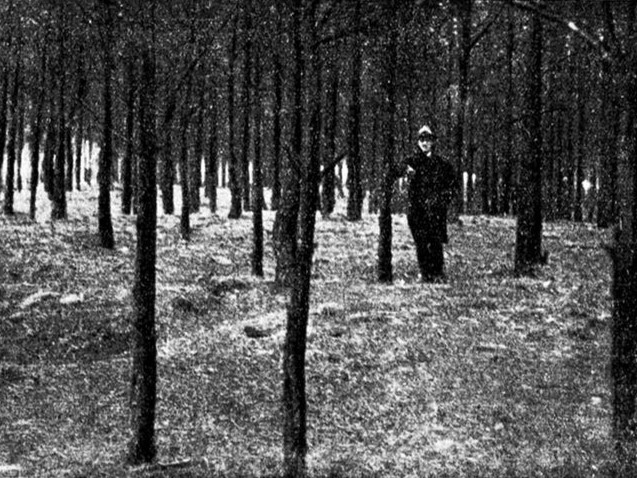
A photograph of the presumed “tumulus” in the Ringkampsbulten. Underneath the vaulted ground, 2,000-year-old graves were believed to be located.
Standing upon this mound and looking eastwards, it becomes apparent that this elevation in the terrain – which locally consists predominantly of light yellow fine sand – directly borders a plain which, as far as the eye can see, formerly consisted of marshy ground, but has been converted into agricultural land over the past forty years through effective drainage. Further north, the terrain remains fairly undulating and mainly sandy. A few lower-lying plots have already been brought into cultivation here as well.
The outermost ring or rampart (the site derives its name of “Ringkampsbulte” from this ring) has partially fallen into decay on the western side due to a cart track, whilst a woodland path also intersects the ring in two places. However, when standing on the mound, the characteristic shape of the ring is clearly delineated. The terrain is entirely overgrown with pines, the falling needles forming a soft carpet over the firm ground into which our feet sink. Rabbits, burrowing their holes into the mound, have brought the pure sand to the surface here and there.
Pixies
In popular folklore, it is said that “eerdmannekes” (pixies) have been seen playing on the rampart; furthermore, the mound was reputedly haunted, while older folk recall tales of urns that are supposedly present there. According to the scholars, one is dealing here with a barrow from the Neolithic period – that is to say, from the third or indeed the final period of the Stone Age. The outermost ring, however, is unique.
Mr A.J.G. Beernink of this town, who had been aware of these conditions for years and sensed the history of this piece of nature, informed the government commissioner for the detection of historically valuable monuments of this some years ago, because so much of value had already been lost on the Haart. This warning, however, yielded no result. To prevent unskilful digging and searching, Mr Beernink did not publicise the matter. Fortunately, the land, which is municipal property, remained intact.
In August 1930, the aforementioned gentleman informed Mr Hoefer in Hattem, chairman of the prehistoric society, of his suspicion that a grave or cremation site of the ancient Germanic peoples was to be found here. Initially, nothing was heard in response to this either, but after Mr Beernink had once again pressed the matter with the society, Mr Westerbeek van Eerten came here as the plenipotentiary of the “Foundation for the Protection of Prehistoric Monuments in Gelderland”. Then the ball was set rolling.
Scientific investigation
Shortly, a systematic scientific investigation will begin under the direction of Dr van Giffen. Dr van Giffen considers the find highly important, all the more so since traces of timber construction have been found and the dimensions are unique. The excavation, which must of course be carried out with the necessary caution and usually consists of hoeing away the soil layer by layer in thin slices, will commence before long. This will be done from the south-western side towards the centre, because experience has shown that over such a vast span of time, the topsoil shifts somewhat in a north-easterly direction due to weather influences. With this method, one therefore stands the best chance of finding the actual dome-shaped graves as quickly as possible.
What will be found? Perhaps interesting discoveries will be made even for a layman, in the form of urns and stone objects. The urns, if found, are extremely fragile upon discovery because, being mostly fashioned from clay, they were dried in the sun. Baked urns, which are consequently stronger, invariably dated from a later period. If dried urns are found and are handled and dried carefully, they can sometimes still be saved. For the expert, however, every non-natural modification in the strata provides an invaluable clue.
Thus, for example, dark round spots in the excavation point to a post that was driven in previously, whilst in this manner it has been possible to establish the site where a hut stood thousands of years ago. A ring-shaped site, for instance, enclosed by round dark spots in the lighter-coloured soil, indicates the posts that propped up the hut. Inside such a ring, one then sometimes finds remnants of ash and occasionally prehistoric objects as well.
All objects that are found will be handed over to the local Oudheidkamer (historical museum). When presently the hoe is thrust into the soil, when the scanning eye of the historian searchingly contemplates the exposed earth and finds what is presumed to be found, then this find will prove to be one such as has not been made in the Netherlands, indeed perhaps in Europe, to date. May it be so.
Unexpected result
On 25 July 1933, the Zutphensche Courant reported:
In its annual report for 1932, the board of the Foundation for the Protection of Prehistoric Cultural Monuments in Gelderland states, among other things, the following: At the general meeting of 26 February 1932, a commission was granted to Dr van Giffen to carry out an excavation on the Ringkampsbulte near Aalten, after which Dr van Giffen made a start on the investigation at the beginning of April. Just a few days later, the excavation was halted, as to the astonishment of Dr van Giffen and his staff, it had become apparent that one was dealing here with a natural ring dyke (ringwal), the highly peculiar shape of which had misled the experts.
Close to the ring dyke, however, lies a grave from the La Tène period, and Dr van Giffen suspects the presence of a necropolis there, for which further investigation would undoubtedly be rewarding. This investigation, however, was impossible for the moment due to the condition of the land, so that we hope to be able to return to this later.
Whether any matters of interest have been found in the Ringkampsbulten (since then) remains unknown to us for the time being. Do you have more information? We would love to hear from you!
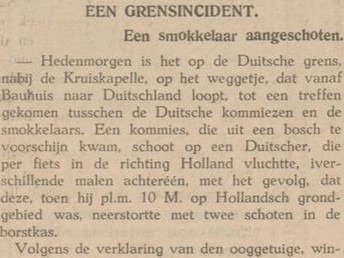
This morning, on the German border near the Kruiskapelle, on the small road leading from Bauhuis to Germany, an encounter took place between German customs officers and smugglers. A customs officer, emerging from a forest, fired several consecutive shots at a German who was fleeing by bicycle toward Holland, with the result that, when he was approximately 10 m onto Dutch territory, he collapsed with two gunshot wounds to the chest.
According to the statement of the eyewitness, shopkeeper Bauhuis, the customs officer must still have been shooting when the smuggler was already on Dutch territory. If this is the case, and the statement is very pertinent, it signifies an instance of border violation that will likely have further consequences.
The Eyewitness’s Story
When we asked Bauhuis about the circumstances of the case, he informed us of the following:
Around 7 o’clock this morning, three German smugglers headed toward the German border. Just as they were briefly on German territory, a young German customs officer emerged from a forest and attempted to detain the smugglers. Two of them fled toward Germany, one toward Holland. The latter was pursued by the customs officer.
During this pursuit, he fired about twenty shots, even when the fugitive had already arrived on Dutch territory. When he had crossed the border by approximately 10 meters, he collapsed, hit in two places on the right side of the chest by revolver bullets.
His statement was firm that shots had been fired at the smuggler who was already on Dutch territory. He was also of the opinion that the customs officer, a very young man who had presumably arrived only recently, did not know exactly where the border lay at that location.
When the man was shot, Bauhuis stated, I was under the impression that he was going to die soon, and since I would rather not have him in the house, I made him a bed of straw on German territory, where we laid him down. I should not have done that, because later the German police took custody of him and transported him to the hospital in Wesel.
This naturally complicates the investigation from the Dutch side, as it is no longer possible to determine exactly what the situation was when the man fell.
Meanwhile, a different explanation is being given from the German side. The matter is being investigated. The leadership of this is in the hands of the detachment commander of the Marechaussee here, Sergeant G. v. Buren. During the initial investigation, the acting Mayor, Alderman F.H. Somsen, was present at the scene.
During the First World War, Aalten offered shelter to many foreign refugees.
It was 28 July 1914 when the First World War broke out. Two days later, the Netherlands declared its neutrality. As a result, we were spared the great horrors of this war. However, the Netherlands soon faced an entirely different problem: refugees. Many escaped prisoners of war, deserters, and civilians arrived from the surrounding countries to find a safe haven here. This was also the case in Aalten.
Newspaper reports
“Italian refugees. In Aalten, the Rectory and the minister’s residence of the Christian Reformed congregation have been made available for several Italian families who have fled from Germany.” Het Vaderland, May 22, 1915
“We are informed from the Eastern border: That it is not yet so very easy for escaped prisoners of war to cross the border may be evident from the fact that the Feldwebel, serving at the rural district of Kotten on the border of the municipality of Winterswijk, reported that in the last few weeks no fewer than 70 refugees were detained in the border strip located along the municipalities of Winterswijk and Aalten. Nevertheless, during that time, approximately 20 prisoners of war—French, Russians, Belgians, and also an Englishman—arrived on Dutch territory in that area.” Arnhemsche Courant, March 25, 1916
“Aalten, 29 Dec. The number of refugees, prisoners of war, deserters and civilians who have arrived here across the border in recent days is very large. No less than 25 Russians arrived here who had worked in the coal mines in Germany. All were transported to Rotterdam. In addition, 17 Poles, two of whom had their wives and children with them. They had come from Courland and had worked in the mines for a wage of 9 to 10 marks a day; The poor diet had forced them to move to our country. They had had a very difficult journey. Furthermore, 4 deserters and 1 escaped French prisoner of war arrived. On Wednesday another French prisoner of war arrived here, who had escaped with two others from a prison camp in Germany. One of them was shot before he reached the border, and the other wounded and taken prisoner. Yesterday afternoon two more Russians and a German deserter arrived and this morning another German deserter reported to the border guard.” Zutphensche Courant, 30 December 1916
“Saturday evening and Sunday morning, 9 Russian Poles, a Belgian, and a Russian cavalry non-commissioned officer crossed the border at Aalten.” Het Nieuws van den Dag, January 16, 1917
“In Aalten, a German deserter with his wife, two children, and a servant crossed the border and departed for Amsterdam on Monday. The wife was born in Argentina.” Het Nieuws van den Dag, January 23, 1917
“In Aalten, three German deserters and three French servicemen who had escaped from the camp at Muhlheim crossed the border on Sunday. Among this group of six was the guard of the aforementioned camp, who had acted as a guide for the refugees.” Het Nieuws van den Dag, November 20, 1917
“In Aalten, two French prisoners of war crossed the border on Saturday. They had escaped from a camp at Friedrichsfeld.” Het Nieuws van den Dag, June 10, 1918
“Today, Friday, the following were expected here from Winterswijk: 316 French, 22 Belgian, and 2 Italian prisoners of war.” Aaltensche Courant, November 29, 1918
French refugees in the Festival Hall
Towards the end of WW I, a second wave of refugees started from northern France, mainly of French, but also Belgian citizens.
Friday, September 27, 1918 – In northern France, the German occupying forces had called on the population of some 250 towns and villages, which were located between the Hindenburg Line established by the Germans and the border with Belgium, to leave their homes. Heavy fighting was expected now that the Allies pushed the Germans back towards Belgium, so it would be better to evacuate the region. Those who responded to the call often traveled on foot through occupied Belgium, taking their meager possessions with them. The Netherlands had promised to provide temporary shelter to a large group.
Saturday, October 26, 1918 – Arnhem was a place of passage for French refugees. At 18:00, 350 refugees arrived here. They would be transferred to Borculo, Groenlo and Aalten the next day. On Sunday evening, another 800 to 900 refugees arrived, who would go to various places in Gelderland on Monday. Members of a certain group wore bands of the same color around their arm as a distinguishing sign.
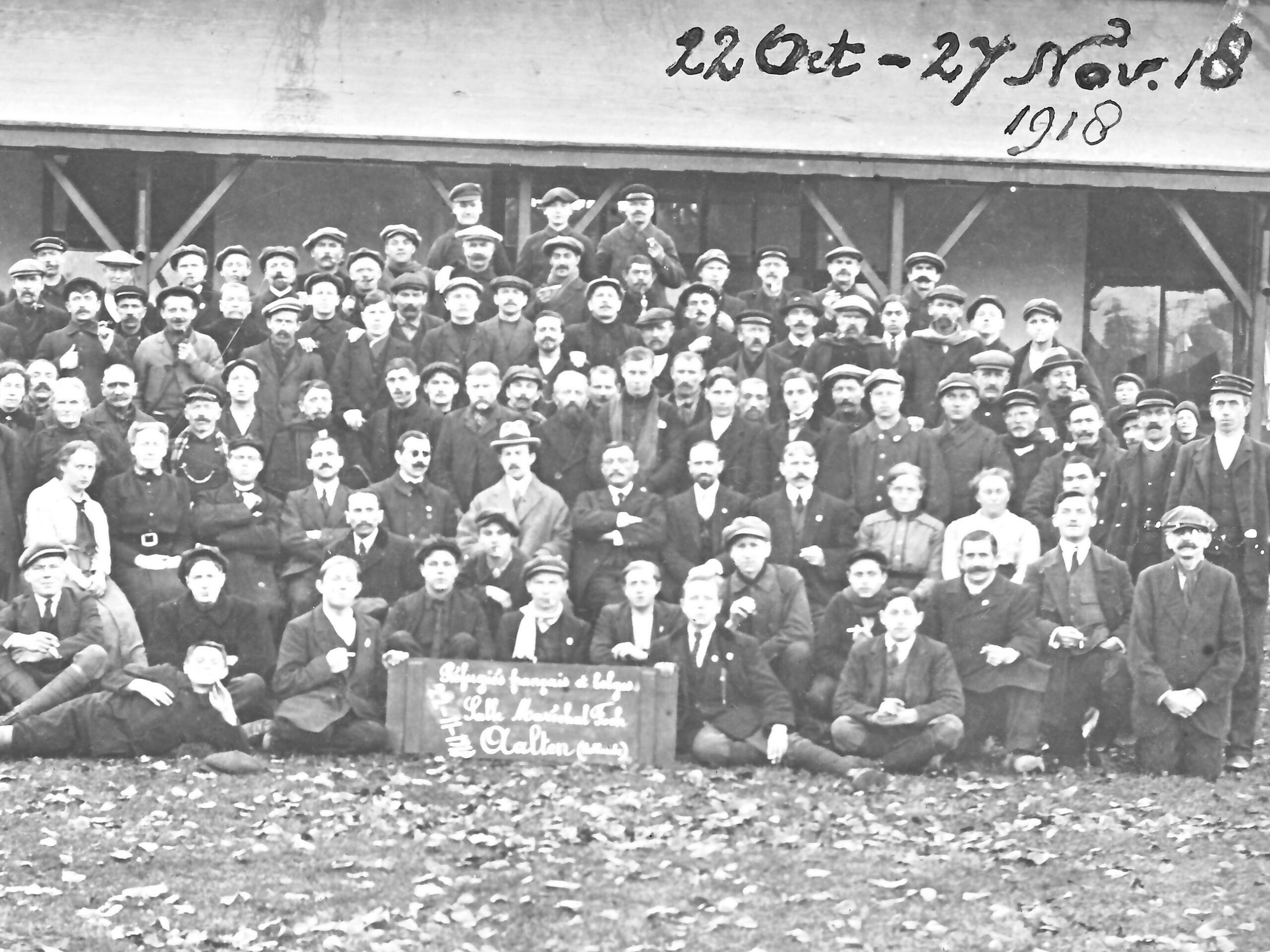
Sunday, October 27, 1918 – It was a turbulent Sunday for the normally quiet Aalten. On Saturday, the mayor had received word that a large number of refugees, both men and women, were to be accommodated in his municipality, as in other places in Gelderland. A meeting of the Committee for the Aid of Refugees, established in 1914, was hastily convened. It was decided that the men would be housed in the Elim building and the women and children in the Community Hall. Furthermore, the necessary measures were taken to provide the refugees with food and drink.
Sunday afternoon 13.00 hours a large crowd of people had gathered at the station . The members of the fire brigade were on the platform to provide the necessary assistance in transferring the guests. It was a long train that transported not only Aalten but also a hundred refugees for Winterswijk and Groenlo. The supervisor, a merchant from Antwerp, got out and invited the 108 men he accompanied to follow his example. Groups of four lined up, the luggage was loaded onto a truck, and so the procession, surrounded by a large crowd, made its way to the Festival Hall.
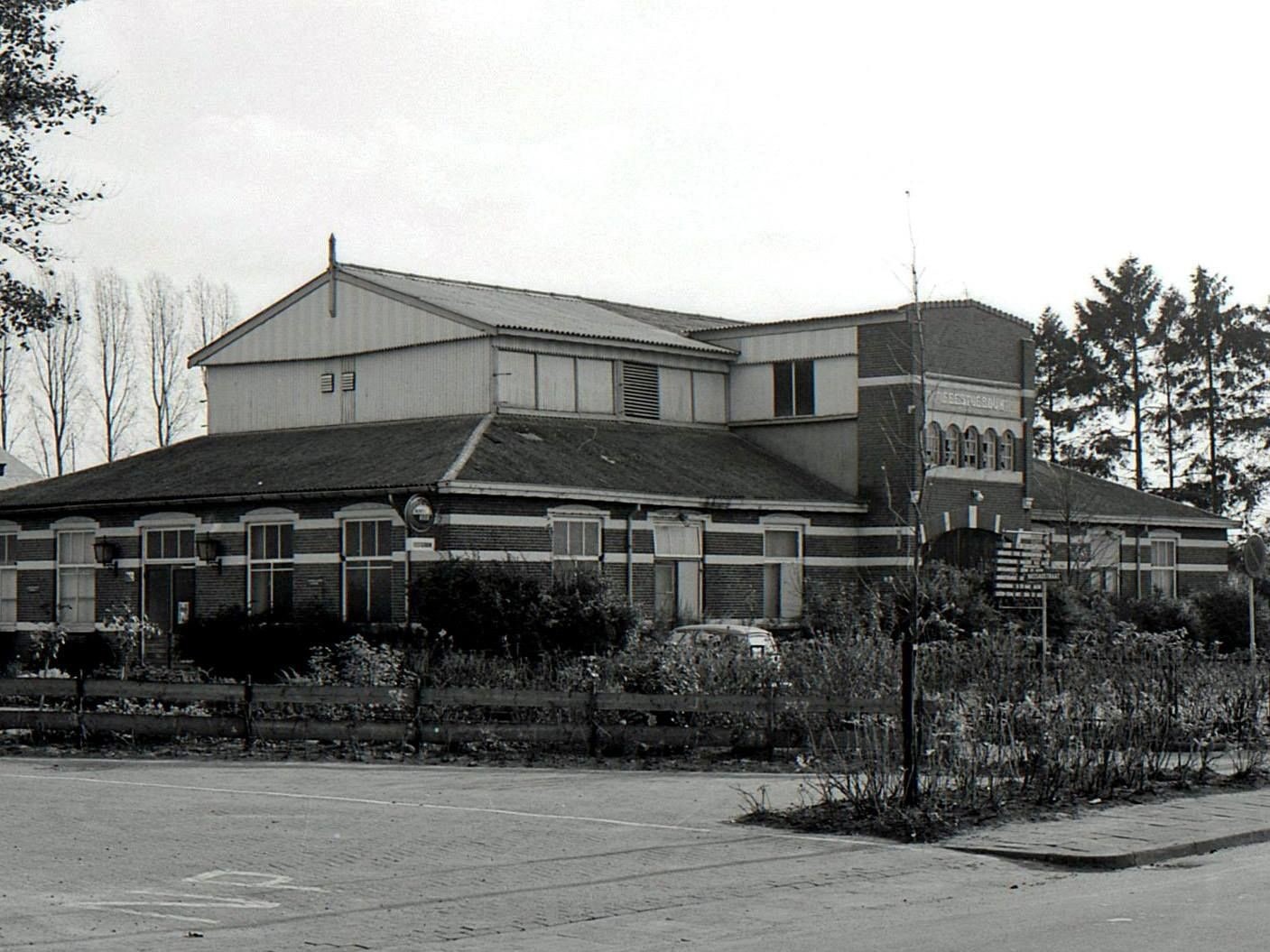
Feestgebouw, (Festival Hall), Aalten
Salle Maréchal Foch
The Community Hall was renamed ‘Salle Maréchal Foch‘ for the occasion, after France’s renowned commander-in-chief.
Everything here was neatly arranged as a sleeping place for the strangers. Long tables were placed, where meals could take place. On a table were jugs of the fire brigade, which could serve as a washing set. Some refugees were so tired that they immediately lay down on their army bed of straw. No wonder, because they had all walked from Lille or Tourcoing to Brussels the week before. In the Belgian capital they were actually destined for German service, but through a ruse – most of them had a false pass – they, with thousands of others, managed to cross the Dutch border.
After the guests had refreshed themselves with coffee and bread, their names were recorded with place of residence and profession. There were: a stationmaster and two teachers, the three of whom were appointed as the regulation committee, to whom the refugees could turn with requests and complaints.
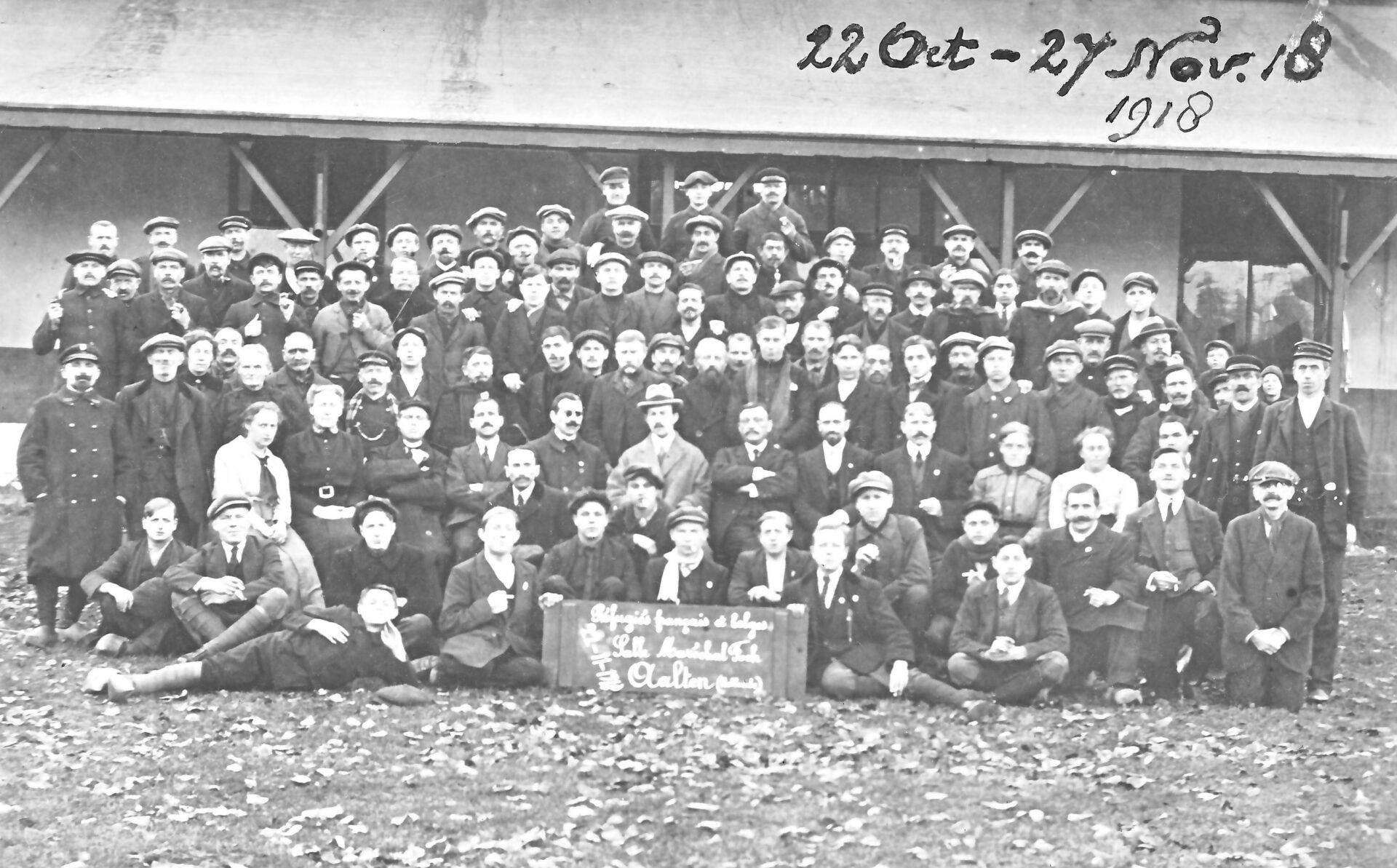
“Réfugiés Français et Belges, Salle Maréchal Foch, Aalten (Hollande), 22-11-1918”
Of course, many of them felt the need to let their relatives know that they were safe and sound in the hospitable Netherlands. That is why paper and ink were made available to them, while the gentlemen Johs. Driessen and Jongen made sure that they could exchange their foreign currency for Dutch money. Thanks to the action of the committee, under the excellent leadership of Ms. Hesselink could be served lunch at 18:00, which the French enjoyed.
Certain measures had been taken to maintain order. For example, everyone had to be inside at 21:00 in the evening and the cafes were not allowed to serve them liquor.
According to the supervisor, the refugees would not stay longer than 14 days under any circumstances. They would be brought back to their homeland as soon as possible via Zeeland through liberated Belgium. Negotiations about this were already underway. It would be four weeks.
Tuesday, October 29, 1918 – Two days after their arrival, three of the refugees housed in Aalten decided to flee. After breakfast, they had left the building with all their belongings, with directions from Aalten via Varsseveld and Terborg to Arnhem. However, they were caught by the police and brought back to the Community Hall.
Italians
In an interview with Mayor Monnik, he tells about Italian prisoners of war, who were killed in the factory of N.V. Textiel Mij. were accommodated: “We experienced something peculiar with those Italians. We had given them all some of our beautiful soap, of which we had a whole supply at the time, to be able to wash themselves fresh, but the next day all the soap was eaten by the Italians!”
End of the First World War
Monday, November 11, 1918 – In a forest near the French town of Compiègne, about eighty kilometers north of Paris, the armistice was concluded that ended the First World War. The more than 40,000 French refugees in the Netherlands were able to return home. This was quite a logistical organization, so it would take until January 1919 before the last French could leave. In addition, the Germans released their prisoners of war, and of course they also wanted to return to their homeland as soon as possible. A huge stream of refugees started, partly via the Netherlands.
Saturday, November 16, 1918 – In Aalten, everything was prepared to receive the stream of English refugees that was expected from Germany. In the schools and other buildings, everything was set up for this purpose so that 900 men could be housed. The rest would be forwarded to surrounding municipalities. To maintain order, a company of infantry of the 22nd regiment from Ede had arrived in Aalten. The soldiers were housed in the public school on the Herenstraat as well as in the Chr. School on the Bredevoortsestraatweg. The Nieuwe Aaltensche Courant added: “For our otherwise so quiet village a lot of hustle and bustle!“.
Tuesday, November 19, 1918 – Nieuwe Aaltensche Courant: “On the eastern border, the camp management, in anticipation of the throngs of prisoners of war, who are now being released in Germany and want to return to their homeland on their own, was no longer in control of the situation. To prevent fermentation, a deputation came to ‘s-Heerenberg to discuss transport. In order to guide the stream into a good bed, the Dutch army command has determined that Belgians and French may only pass through the narrowest strip of Limburg on our land, at the other points they will be irrevocably relegated. Only English people are admitted there. Concentration camps are being prepared in ‘s-Heerenberg, Aalten, Dinxperlo and Winterswijk.”
Refugees from German prison camps also crossed the border into Aalten. On Saturday, November 16, a group of 21 French refugees managed to reach Aalten. They had even already found their way to the Community Hall, where they joyfully greeted their compatriots. To their disappointment, however, they were informed that—due to the aforementioned decision—they would be sent back to Germany. Understandably, they were not keen on this, but it was mandatory. As a farewell, they asked to be allowed to sing the Marseillaise with their brothers from the Community Hall, which was granted by the commander.
In a supplement to the above-mentioned report, the same newspaper nevertheless reported that “The initially taken decision to send the French who arrived here back to Germany has been withdrawn, so that they can be forwarded from here to Rotterdam.”
Word of thanks on departure from Aalten
Friday, November 29, 1918 – Aaltensche Courant: “So we have lost our French guests once again! On Tuesday, the prisoners of war departed, and on Wednesday morning, the refugees left the Community Hall, where the following grateful speech was delivered by Mr. Lopes:
“Mr. Commander. We are about to leave our camp, which you yourself have baptized “Salle Maréchal Foch,” thus showing your sympathy for France and your admiration for him who led us to victory.
Before leaving, we will repeat to you that by your benevolence and by the devotion with which you have done your difficult work so well, you have won the esteem of all the refugees. And our stay here has not always been very pleasant, because it was not feasible for you to give us all the pleasures that we hope to find again in our family; but you have done the impossible to soften our fate.
We have come to Dutch soil, M. the Commander, especially to escape the forced labor against our fatherland, against our brothers, against our fathers, against our children. We have found a refuge in this quiet country, where we have been able to recover from the fatigues and inconveniences of our long journey. If the Netherlands had offered us nothing but this satisfaction, that we know we are safe from forced labour, we would already owe it a great debt of gratitude.
But we have other reasons to keep pleasant memories of the municipality of Aalten, because at first we could think of a fairly cool reception, in the sequel we saw that the great majority of the population was well-disposed towards us. Moreover, we have material proofs of this: corrections, successively made to our lodgings, blankets have been distributed, the hall has been heated, the evening meal has been improved, soap has been distributed, postcards have been provided free of charge, smoking in the dining room has been permitted, cigars have been distributed, everyone has received a guilder, books, illustrated sheets have been donated, various games, underwear and superwear and clogs have been given, repaired shoes, mended undergarments and outerwear, yes, you gave parties and lectures, offered little memories, etc.
Moreover, the members of the Bureau, during their visits to thank the generous donors and in their friendship with several respectable families, were very surprised to find, so close to the German border, many people who knew the French language, even subscribed to newspapers from our country.
So, M. the Commandant, we will keep our stay in Aalten in pleasant memories. We will never forget a benevolence and a devotion that nothing could slacken, whatever the objections that had to be overcome. This sincere and heartfelt gratitude, of which we assure you, is the expression of the feelings of all the réfugiés in the ‘Maréchal Foch’ hall; it is unanimously brought to you (you may be proud of it!). Although we would like to thank you personally, we must not forget Mr. Chief Deputy, the entire Fire Brigade and also the police. To us, they were more friends than guards.
And as for the kind ladies who have so often honored us with her presence, and even voluntarily made themselves our servant maids at all our meals, they have reminded us too much of our wives, our mothers, our sisters, our betrothed, for us to forget them. But it is impossible for us to mention the names of all those who have taken an interest in the improvement of our lot. We therefore ask you, M. de C., to be our interpreter for these people, to thank them on behalf of the Bureau, on behalf of all comrades, on behalf of our families, on behalf even of the three twin cities of Lille, Roubaix, Tourcoing, from which we almost all come and where French and Belgians have learned to live on good terms. working side by side, one of one’s minds, long before the common suffering.
And, now that we are going to leave for our hearths, allow us to cry out loudly: Long live M. the Commander! Long live Aalten! Long live the Netherlands! Long live Belgium! Long live France!”
It has become quite empty in our streets. We were already used to seeing groups of red-trousers, or yellow- and grey-trimmed warriors in front of the shop windows. To Rotterdam by rail, they go there today, Friday, on the boat that takes them to France. How happy they will be when they can see the coast of Picardy again! No doubt the ladies, who have helped all the time that the refugees stayed here, with the distribution and distribution of the food, will be remembered by them with gratitude for a long time to come, and our brave fire brigade no less.”
French frustrations
It will come as no surprise that the conditions in which the refugees were housed were not ideal. Nor that frustrations arose after a while among some of the refugees. What is remarkable is the following publication in the Nieuwe Aaltensche Courant of 3 January 1919, more than a month after the departure of the French refugees:
“Aalten enjoyed the honor, probably for the first time, to be mentioned in the French Chamber, in the discussion of the situation of the French refugees in the Netherlands. It was said by one of the deputies that forty thousand refugees in our country are literally starving. Isn’t it beautiful? See here a sketch of the situation:
“Our refugees are housed in stables and barns, without heating and without beds. They sleep on dirty straw. Under the arrangements made, the mayors must arrange for the supply at the expense of the Relief Commission. Unfortunately, the lack of organization is felt everywhere. Everywhere it is a “pan”! Items that are requested will not be delivered. For every step, for every complaint, six instances are needed, so that everything goes into disarray. Women and children are shivering from the cold here, without coal, without warm clothes. For days there is no meat, the weakest succumb to lack of care. The bread provided by the Dutch government is inedible.”
We do not know how care was arranged in other places. But we do know that this description does not fit the treatment as the refugees have received in Aalten. Now it is not impossible that here and there the organization was not immediately punctual – would the French, in the same circumstances, have fared better? – but ‘dying of hunger and cold’ will, we trust, turn out to be a horrible exaggeration.”
In addition, the French delegate reported:
“Several French refugees, who were housed in Aalten, have lost their patience and sent the following ultimatum to our representative by telegraph: “Two hundred refugees, powerful men from Lille, Roubaix and Tourcoing, demand immediate repatriation. They will leave on foot on Thursday, if no solution is found by then.”
To whom is the blame that the refugees lost their patience? In no case to the Dutch authorities. Those who had quietly left before their time have themselves stated in a letter to the chief of the fire brigade that their departure was not caused by undue treatment or care, but solely by the fact that they longed to return to their hometown.
We hope that our government will provide a resounding protest against the false rumors spread on this subject by enemies of our country. Let them inform the French authorities themselves, so that they are not exclusively dependent on the information of the French embassy in The Hague, which is so well informed of the actual situation, that the following message has been received here in the last few days: “The French refugees who are staying in Aalten may leave on January 15th.” While they have already arrived in their respective homes in northern France a few weeks ago!“
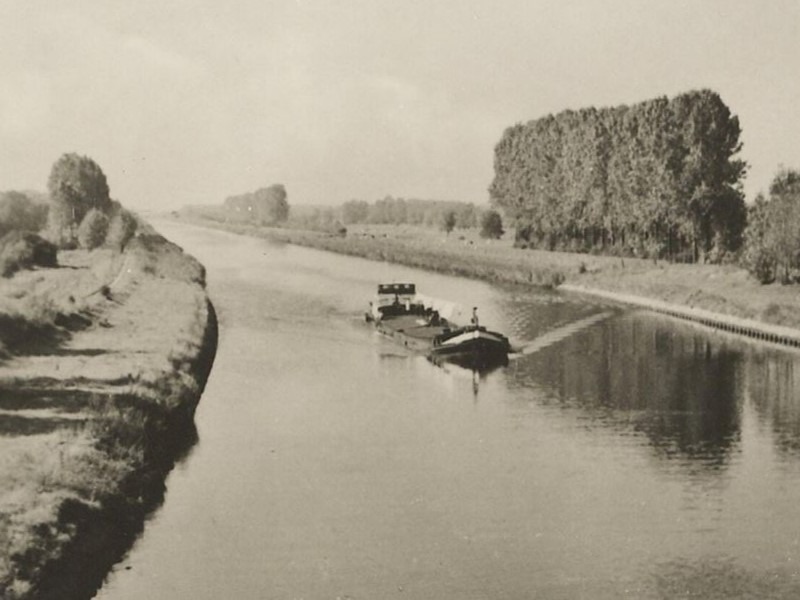
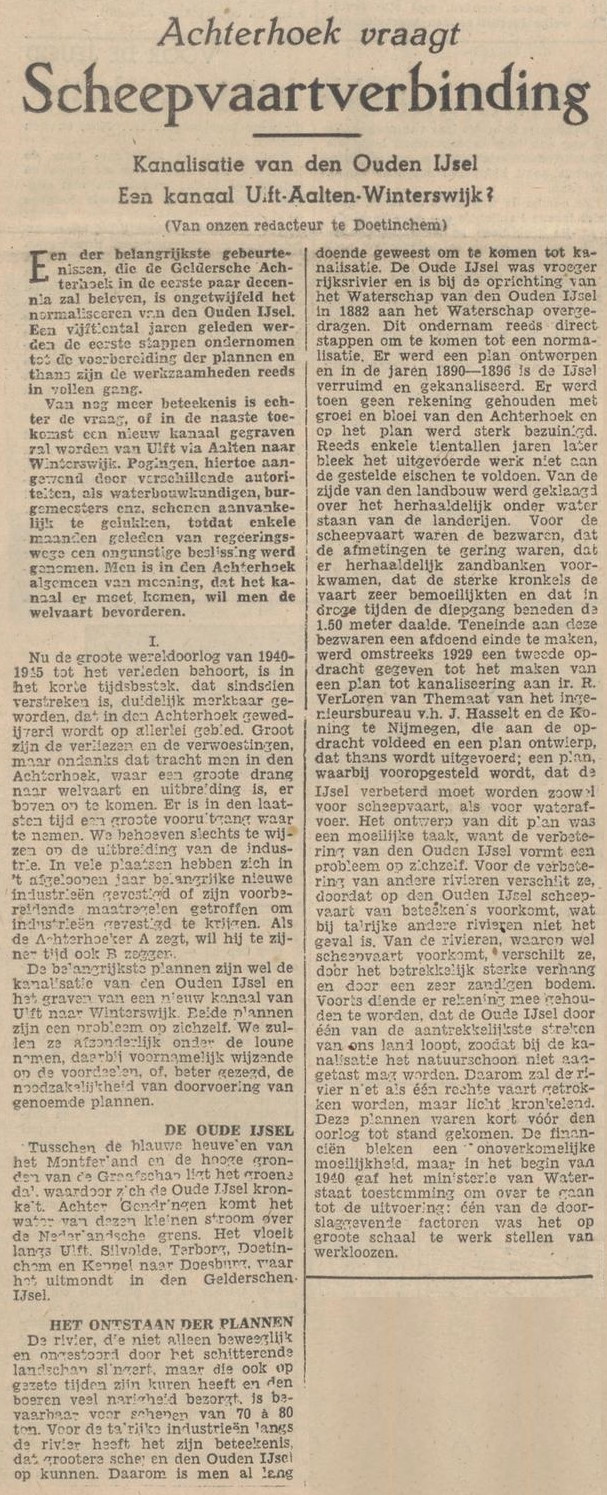
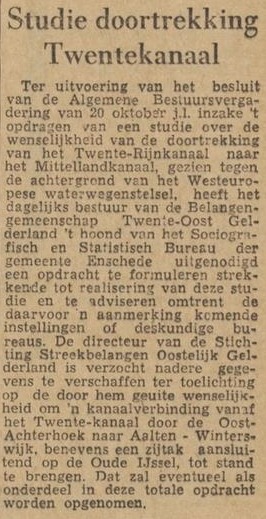
In the first decades of the twentieth century, numerous plans were drawn up in the Netherlands for the construction of canals to facilitate bulk transport. For instance, the initial plans for the Twente Canal (Twentekanaal) were presented in Twente in 1907.
In 1936, the 54-kilometre-long canal between Enschede and Zutphen was opened to shipping. Similar plans also emerged in the Achterhoek.
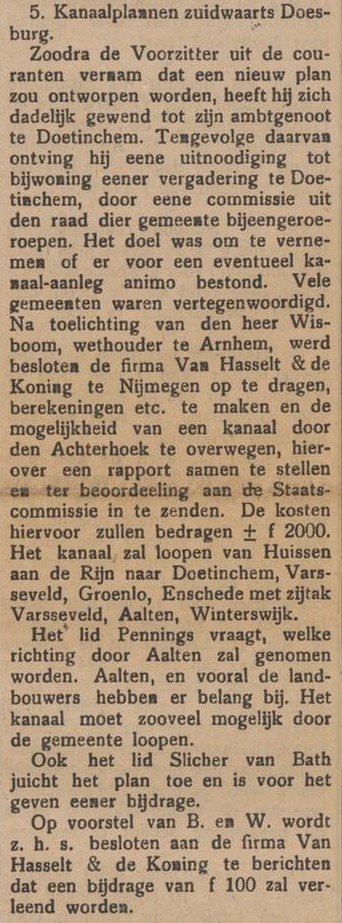
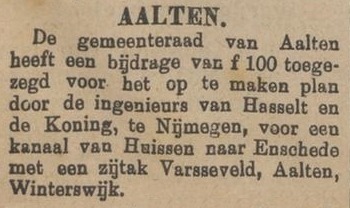
In 1914, Doetinchem municipal council decided to take action on this idea. In March 1915, a proposal was presented based on a Twente–Rhine Canal (Twente-Rijnkanaal). The planned canal was to begin six hundred metres north of the head of the IJssel and run via Duiven, Wehl, Doetinchem, and Varsseveld, passing Lichtenvoorde, Groenlo, Eibergen, and Haaksbergen on its way to Hengelo, including a branch canal via Aalten to Winterswijk.
Following decades of debate and planning, continuing at least into the 1960s, the projects ultimately foundered somewhere along the line.
Newspaper reports
Aaltensche Courant, 29 July 1914Nieuwe Winterswijksche Courant, 1 August 1914Aaltensche Courant, 3 August 1917
Nieuwe Aaltensche Courant, 15 January 1918Nieuwe Aaltensche Courant, 15 March 1918Aaltensche Courant, 30 April 1918
Nijmeegsch Dagblad, 4 February 1947Twentsch Dagblad Tubantia, 15 December 1961
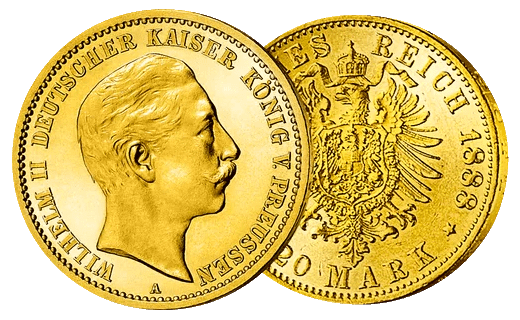
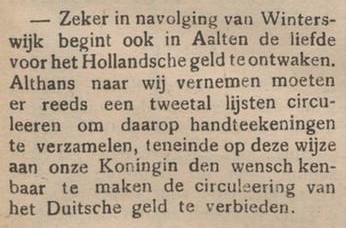
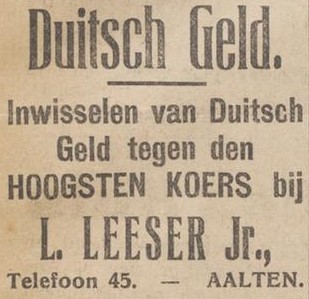
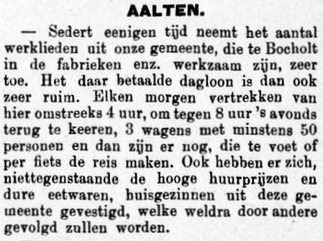
Until the beginning of the 20th century, German money was the daily means of payment in Aalten. This was due on the one hand to the lively trade with Germany and on the other because many residents of Aalten worked in the textile factories in Bocholt. They were paid in German money and put this into circulation in Aalten.
In 1937, G.H. Rots described in a series of articles how things were done in Aalten in former times. For instance, he wrote about the local payment transactions:
“…Speaking of agio, that was caused by the German money that was in circulation here and was the daily means of payment. It was such that Dutch currency was rarely seen. If one needed ‘Dutch money’, for example for taxes, one had to go to a few individuals who ran large businesses to exchange German money. Until the beginning of this century, the circulation of German money in our municipality was still common.
A very rare 20-mark gold coin from 1888, shown here for illustrative purposes.
When the government wanted to take measures to prohibit that circulation, many people resisted. The association ‘Aalten’s Belang’ became involved, and within that association, a fierce struggle arose over the abolition or retention of German money. In Hotel De Roskam, owned by Mr. Voorderman, well-attended meetings were held. Those who conducted a lot of trade with Germany or had German customers in their shops saw a significant disadvantage in the abolition of German money.
That trade with Germany was quite busy. There were almost no border restrictions, and on the Bocholt market days, numerous merchants went there to sell their wares. And those who worked in Germany also naturally received their wages in German money and put this back into circulation in our municipality. One should therefore not think too lightly of it. And at one of the meetings of Aalten’s Belang, it came to heated debates, and even the continued existence of the association was jeopardized as a result of this issue. Finally, the abolition was introduced in July 1914, and the population adapted to it.”
Aaltensche Courant, 29 October 1904Aaltensche Courant, 26 November 1910Aaltensche Courant, 2 May 1919
Source
‘From Aalten’s Past’, by G.H. Rots, Aaltensche Courant, 31 December 1937 (via Delpher)
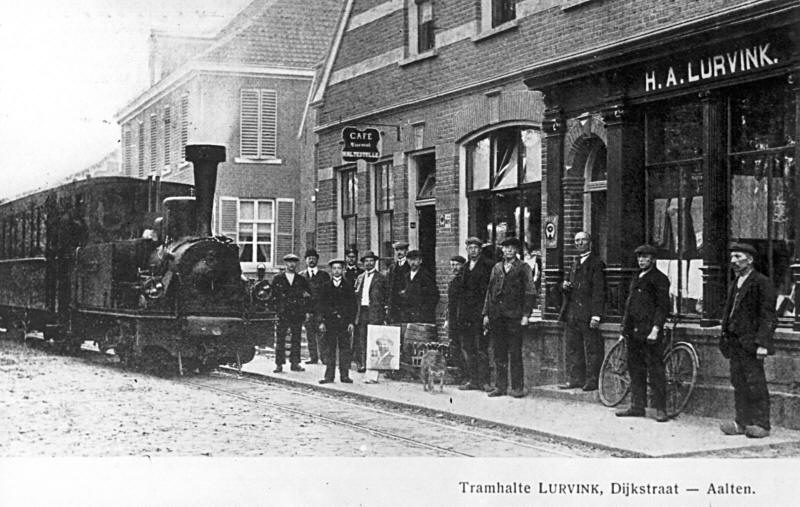
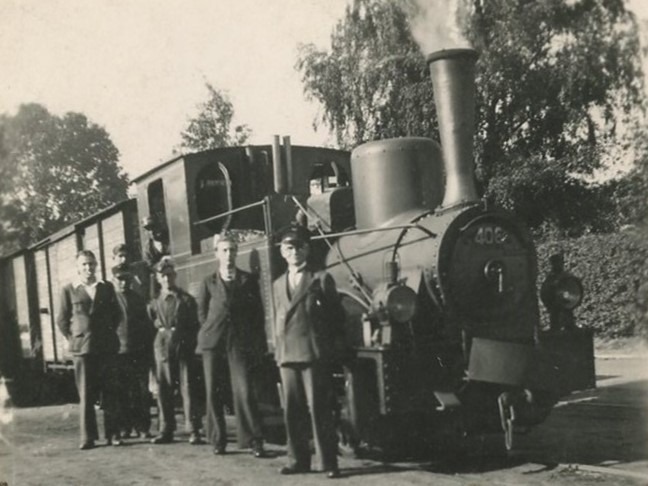
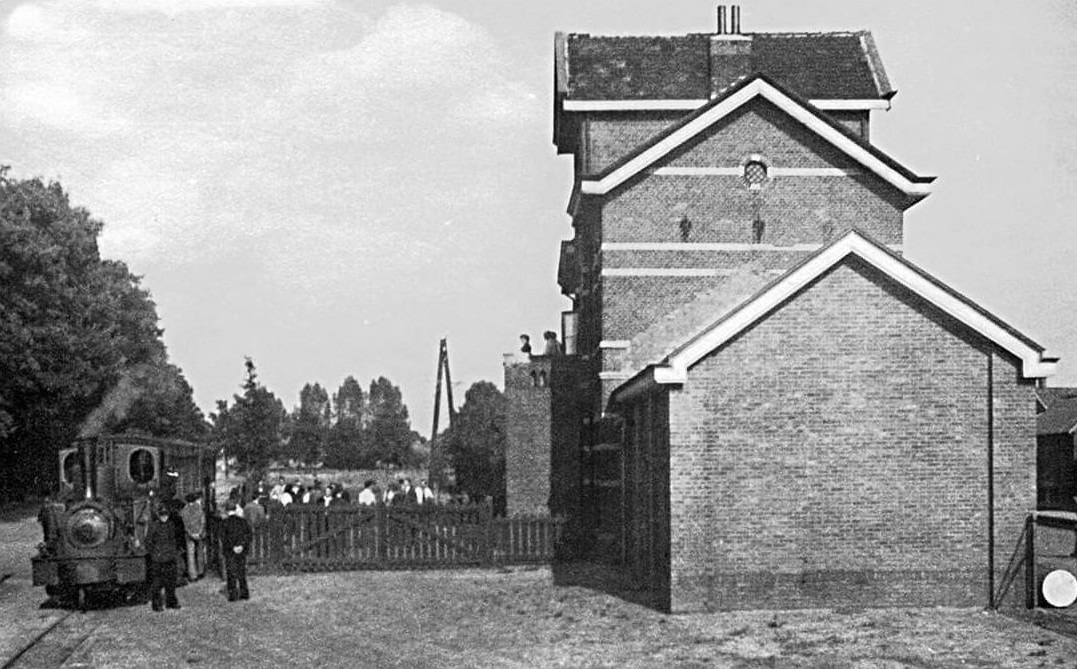
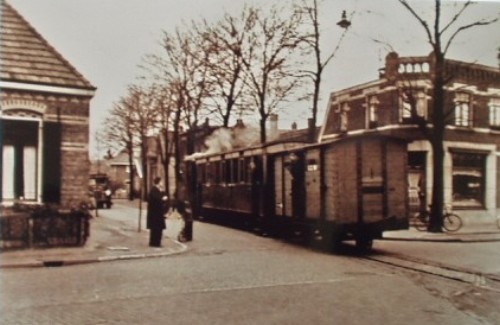
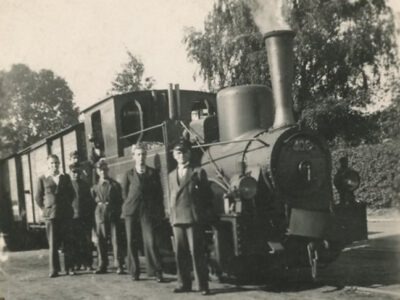
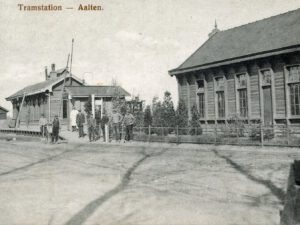
In 1910, a tram line was opened from Lichtenvoorde to Bocholt, via Bredevoort and Aalten. In 1953, the tram line was discontinued and the tracks were broken up.
Around the turn of the 20th century, hundreds of Aalten residents crossed the border every day to work in one of the textile factories in the neighbouring German city of Bocholt. In all weathers, they travelled on foot, by bicycle, or by horse and carriage. Some took up to three hours to cover the (roughly) ten kilometres between home and work, both in the morning and in the evening!
Plans
As early as 1880, there were plans to extend the Lichtenvoorde–Groenlo tram line to Aalten, Varsseveld, and Terborg. By 1893, there were plans for a horse-drawn tram line from Groenlo to Lichtenvoorde, Bredevoort, Aalten, and Dinxperlo/Bocholt. In 1899, the final plan was eventually drawn up for two steam tram lines: from the Lichtenvoorde-Groenlo station to Zeddam and to Bocholt. To this end, the Geldersch-Westfaalsche Stoomtram-Maatschappij (GWSM) was established in 1905, with its head office in Lichtenvoorde.
The Bocholter Volksblatt wrote on 1 October 1907:
Holländische Arbeiter in Bocholt
“Yesterday evening, a local citizen on his way back from Aalten to Bocholt, as he informs us as a loyal subscriber, took the pleasure of counting the workers returning by bicycle from Bocholt to the border. On his way from the Kreuzkapelle to the Holtwicker Bach, he counted no fewer than 276 cyclists; he also encountered a large wagon which was also transporting workers, estimated at perhaps 40–50. In this respect, therefore, the Bocholt–Aalten light railway certainly does not have such bad prospects for ridership, especially since there will undoubtedly be many more workers who wish to come here for work.”
A year later, on 4 November 1908, the same newspaper wrote:
Dampfeisenbahn Bocholt–Aalten
“After long negotiations, the Bocholt manufacturers and other interested parties have finally succeeded, through the subscription of large sums of money, in ensuring that the Bocholt–Aalten light railway is now being built. It has now been entered into the commercial register of the local district court under Geldersch-Westfälische Dampfeisenbahn-Gesellschaft AG in Lichtenvoorde in the Kingdom of the Netherlands, with a branch office in Bocholt. Hundreds of Dutch workers are employed in the local factories, who have had to cover the approximately 3-hour journey to Holland on foot or by bicycle, every morning and evening, in wind and weather. Construction of the railway will be commenced immediately.”
Festive Opening
In 1909, construction of the tram line began. However, the work suffered significant delays as a result of a major flood near Bredevoort that year. Finally, the tram line was festively opened on 29 April 1910.
It soon became apparent that only the Aalten–Bocholt section was a successful part of the GWSM. However, due to the outbreak of World War I, the border crossing was closed, making it impossible for transport to continue from Aalten to Bocholt. When this route was resumed in 1915, there were far fewer passengers than before, and it was therefore shut down completely in 1916.
From the 1920s onwards, passenger services between Aalten and Lichtenvoorde were largely operated by motor trams. This continued until 1933, when buses from the Veldhuis company began operating. After the 1930s, only freight transport proved successful (with the exception of the Aalten–Bocholt section).
In 1953, the tram line came to an end and the rails were broken up.
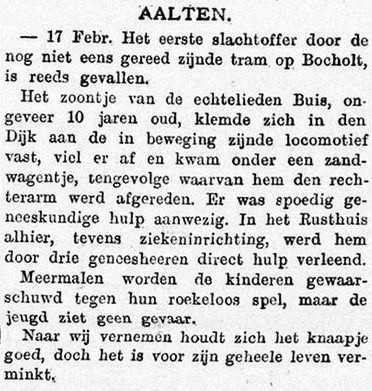
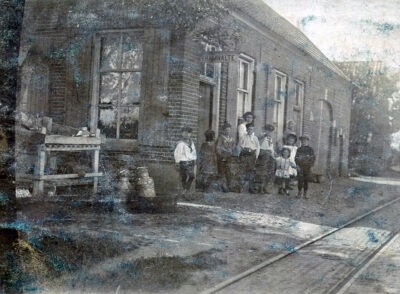
Steam tram Gelderland No. 406 in AaltenSteam tram at Aalten train station (photo courtesy of Hans Schutte)Patrimoniumstraat, AaltenGraafschapbode, 19 February 1910
Stops
Below is a list of stops between Lichtenvoorde and Bocholt that were located within the municipality of Aalten (click here for a list of all stops):
The German city of Bocholt lies approximately twelve kilometers south of Aalten. At the end of the 19th and the beginning of the 20th century, Bocholt grew into an important center of the textile industry. This flourishing industrial city attracted many workers from the border region. Hundreds of border workers from Aalten, Bredevoort, and surrounding rural districts found employment there, especially in the numerous textile factories and in construction.
In 1904, Prof. Dr. H. Blink wrote: “Every day, as many as 150 workers go from Aalten to Bocholt; rough, large wagons, covered with white hoods in the rain and drawn by two horses, bring the workers to Bocholt every morning and carry them back in the evening.”
Thanks to the Aalten population register, in which the employer was also regularly recorded around 1900, we know of many workers that they worked in Bocholt and for which company.1
De Graafschapbode, 4 December 1897
Who were the people working in Bocholt?
In the overview below, you will find the names of many border workers from the municipality of Aalten who were employed in Bocholt around 1900, including their profession and employer. Perhaps some of your ancestors are among them? Please note: this overview is not exhaustive.
Below is an overview of companies in Bocholt where workers from Aalten were employed around 1900. This list is also incomplete:
Franz Beckmann & Cie.
Cotton mill
Founded in 1895, this firm grew into one of the city’s largest spinning mills. The company was acquired by the firm Flender in 1967. The original factory building has been renovated and restored to its former glory.
Founded in 1873 on Kaiser-Wilhelm-Straße. In 1897, a dye works and a fabric finishing department were added on Frankenstraße. In 1921, the firm was removed from the commercial register.
The first large industrial enterprise in Bocholt, founded in 1857. After a fire in 1888, the factory was replaced by a larger new building. The company ceased operations in 1978. The 34-meter-high chimney was preserved and now stands in the middle of the Arkaden shopping center.
Around 1900, the firm Wwe. B. Messing was active in Bocholt as a producer of cotton waste. The factory was located in the current Weber Quartier, behind the Kinodrom on the river Aa.
Founded in 1864. No further information available.
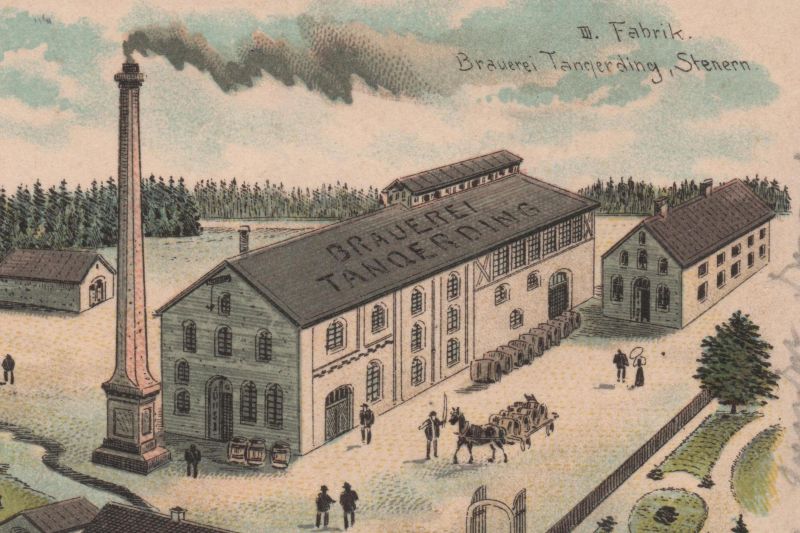
Brauerei Tangerding
Steam beer brewery
The Hirsch-Brauerei of Franz Tangerding in Bocholt-Stenern produced various types of beer, soft drinks, and fruit lemonades. The ruins of the original brewhouse from 1896 are still present on the former brewery site.
“At the entrance of the current Karolingerstraße stood the factory of Cosman Cohen, and further south were the factories of Gebr. Weyl and Braunschweig.”
In 1859, Josef Philipp Beckmann started a steam weaving mill on Kreuzstraße with his sons. In 1891, the company split into J. Beckmann Nachfolger and Heinrich Beckmann Söhne. Both companies later merged again into IBENA.
Founded in 1862 on Kaiser-Wilhelm-Straße. In 1897, the factory burned down. A new factory was built at Industriestraße 7. In 1929, the weaving mill was sold to the neighboring company H. Beckmann Söhne and is now owned by IBENA.
In 1898, the Aktiengesellschaft Baumwollspinnerei Rothe Erde had a factory built between Werther Straße and the Aa. The spinning mill with the adjacent weaving mill was one of the largest companies in the city.
From 1857, Ludwig Schwartz had several steam weaving and spinning mills built on his estate Haus Woord. After his death, the company was continued by his widow Theodora Schwartz and later by their sons. The firm ended its activities in 1971. The current Schwartzstraße in Bocholt serves as a reminder of this textile enterprise.
The firm Vagedes was located in the Biemenhorst district. In 1990, the company was on the verge of liquidation. Two former employees then founded Setex-Textil and continued Vagedes’ activities.
In 1889, Max Hugo von Velsen, former director of Ludwig Schwartz’s spinning mill, founded his own cotton spinning mill. The factory, located between the Westend and the river Aa, included a spinning mill, twisting mill, and finishing department. The company closed in 1934.
Below you will find a map showing the (presumed) locations of the aforementioned factories in Bocholt.
Interesting facts
Commuters from Aalten crossed the border six days a week, mostly on foot, by bicycle, or by horse and carriage. In 1910, relief came with the construction of a tram line between Aalten and Bocholt, which significantly shortened travel time. Working days were long: 12 to 14 hours was no exception.
Border workers from Aalten received their wages in German Marks. This money was circulated in the local Aalten economy. Around 1900, German money was therefore the daily currency in Aalten. However, this was formally prohibited in 1914.
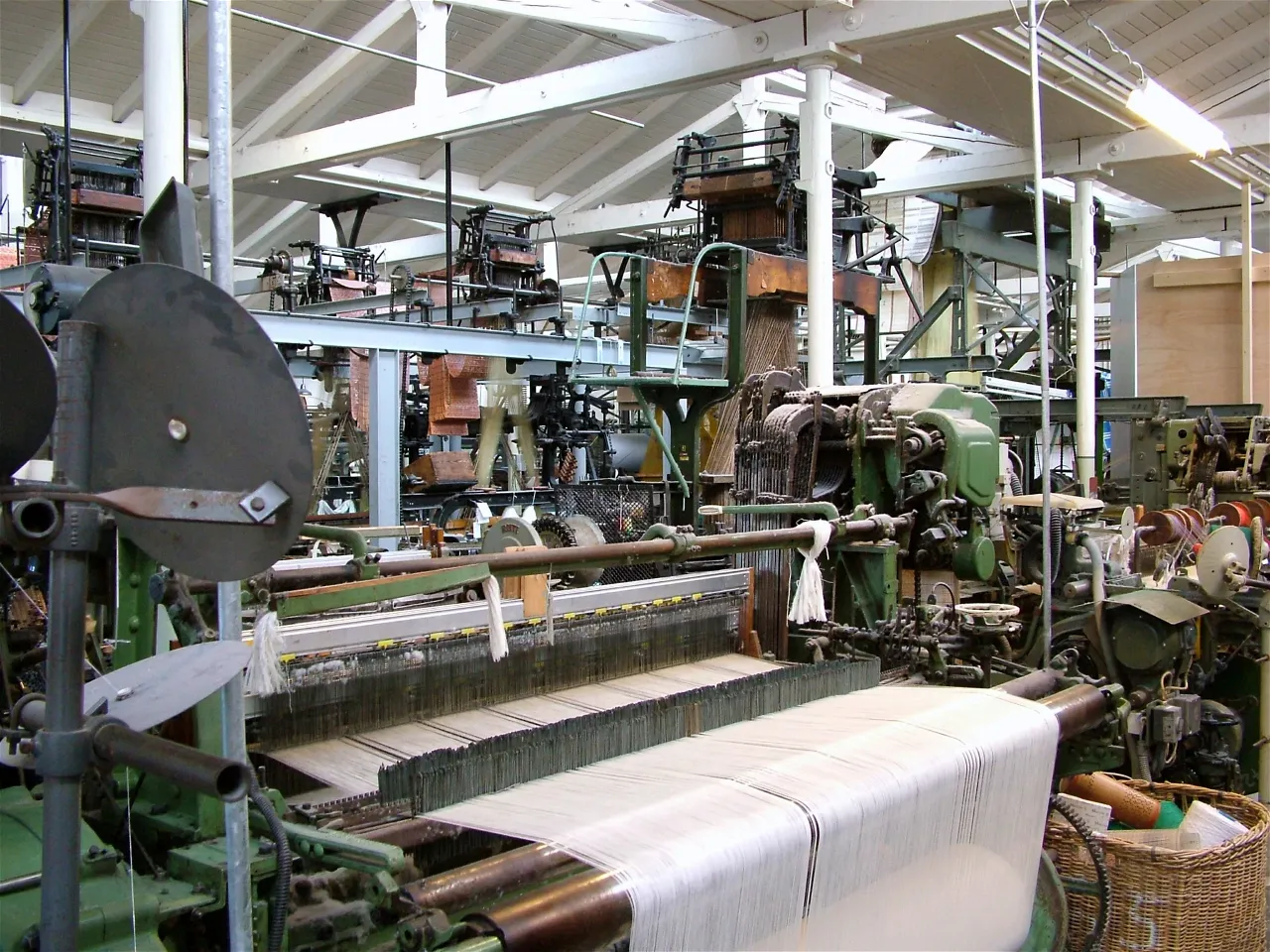
Those who wish to learn more about the history of the textile industry in Bocholt can visit the LWL-Museum Textilwerk. Here, the city’s rich textile past is brought to life with original machinery and various exhibitions.
On Friday evening, approximately 40 interested parties gathered at the Sociëteit to learn more about the tram, while most also appeared to have come to contribute to its realization by purchasing shares.
In response to a question from one of those present as to whether the Prussian government would also provide a subsidy for the section on German territory, the answer was believed to be in the negative. The desirability of a connection to the station in Bocholt was also discussed, but it was thought that the residents of Bocholt would see to this themselves once the line was established. Another expressed doubt about this, as much expense is currently being spent on the Aa and it is not being counted upon, so that many costs would arise from it later.
These and several other points were discussed following the reading of the report, of which we provide some excerpts here:
On February 19 last, a route map with description was sent to His Excellency the Minister of Water Management, Trade and Industry, and in an accompanying address, support was requested for one-third of the construction costs, including rolling stock. The plans, budget, description, etc., of the Dutch-Prussian border–Bocholt steam tram section were prepared by Mr. Regierungsbaumeister G. Küchler, and these documents have been sent to the Mr. Regierungsrath-Präsident in Munster; we have already received word that these documents were submitted to the Mr. Landrath in Borken and to the Mayor of Bocholt for assessment, etc. The “landespolizeiliche Vorprüfung” (state police preliminary examination) of the plans by the relevant authorities took place on Monday, August 27 last.
The choice of the direction for the Lichtenvoorde–Dutch-Prussian border line gave rise to some difficulties. In the first place, we considered it important to include Bredevoort in the plan; to satisfy this, the purchase of a house in the center of the village was necessary. Before marking out the line through Bredevoort, we secured possession of a portion of the house.
Secondly, whether to go around or through Aalten. After various leveling surveys were conducted near and in Aalten, we became convinced that, in view of the steep slopes which would later present many difficulties during the operation of the steam tramway, the route to the east of Aalten should be preferred over the one through the center of the municipality. There was much opposition to that direction from the Municipal Executive of Aalten and private individuals. After discussions with a Committee from the Council, it was again investigated how the objections could be met.
The result was that two new directions were submitted to the Council for judgment. These directions could likewise not obtain the approval of that Council; it maintained its desire that the steam tramway should, if possible, be constructed through the Kerkstraat. After we had the requested route through the Kerkstraat surveyed again, and although it has once more become apparent to us that the consequences of more expensive operation with this route will be inevitable, we felt that, in view of the success of the undertaking, we had to yield to the wish of the Municipal Executive of Aalten.
Tram stop Domme Aanleg
As a result of these considerations, the Lichtenvoorde–Bocholt route will be as follows: The line begins at the junction formed by the Lichtenvoorde–Groenlo gravel road and the Lichtenvoorde–Aalten gravel road, so that a connection is obtained both in the direction of Lichtenvoorde N.W.S. station and in the direction of Zeddam. From the aforementioned junction, the tram line follows the right shoulder of the gravel road to Aalten as far as the “de Domme Aanleg” inn, from there the right shoulder of the gravel road to Bredevoort until approximately 100 meters before the “het Nieuwe Bouwhuis” farm, where it crosses the road and leaves it to continue on its own track in a nearly easterly direction. Then, turning southwards, the Kloosterdijk is crossed and the tramway returns to the left shoulder approximately 300 meters before the center of Bredevoort. The line runs through Bredevoort and leaves the town via the southern shoulder of the gravel road to Aalten. Thereafter across the Markt through the Kerkstraat, subsequently following the east side of the Bocholterweg. Near the border, the road is crossed and the west side of the road is followed on German territory until Bocholt.
A customs station will be established on both Dutch and German territory. At the western end of the village of Lichtenvoorde, a shed for locomotives and carriages will be built, with a workshop and residence (also an office), furthermore a station and goods shed along with a residence for the station master; near Zeddam, an auxiliary shed for locomotives and carriages has been designed. In Aalten and Bocholt, sheds for locomotives and carriages will also be built. In addition to the aforementioned locations, passing places have been designed near Harreveld, in the Heelweg, Varsseveld, Westendorp, and Etten. Furthermore in Bredevoort and at the Dutch-Prussian border. In Lichtenvoorde, Varsseveld, Zeddam, Aalten, and Bocholt, simple facilities will be made for the water supply of the locomotives, as well as halt buildings, etc., where these shall later prove necessary.
A telephone line will be installed along the designed tram lines (of which, however, the public may not make use for the time being).
Tram station Aalten
It is proposed to acquire: 8 locomotives, 10 passenger carriages, and 45 goods wagons. Negotiations have been opened with the Geldersche Stoomtram-Maatschappij in Doetinchem regarding the shared use of the section of that Company’s steam tramway and of the Gendringen tramway company near Terborg, while negotiations are also being conducted with the “Ouden IJssel” Water Board and with the managers of the Terborg–Etten road regarding the conditions for the steam tram crossing the Ouden IJssel bridge.
We have contacted the Hollandsche IJzeren Spoorweg-Maatschappij in Amsterdam regarding the crossing of the G.-O. local railway at Aalten and at Terborg and regarding the laying of rails on the station yard at Lichtenvoorde.
The construction costs for the Lichtenvoorde–Zeddam line are estimated at ƒ453,000, from which interest-free advances from the state and province amounting to ƒ196,300 are deducted, so that a share capital of ƒ260,000 in round figures must be found. Those for the Lichtenvoorde–Bocholt line are estimated at ƒ360,000. It is expected that the state and province will grant an interest-free advance totaling ƒ104,000, so that for this line too, a capital of ƒ260,000 in round figures must be found. During the first twenty years, an interest of 3¼% per annum is guaranteed on the corporate capital of ƒ520,000 through the already promised and the yet to be requested interest guarantee of ƒ16,900.
Since very early times, many commercial relations have existed between the municipalities of Lichtenvoorde, Aalten, and Bocholt, and that these have not yet disappeared but continue to exist is evident from the substantial receipts (± M. 80,000) of the German border office. At this moment, a large number of workers from Bredevoort and Aalten go to the factories in Bocholt, either on foot, by bicycle, or by wagon. These workers will undoubtedly make use of the tram if worker trains run, because they will then not need to set out before dawn and can be home again in good time in the evening. Daily transport of at least 200 workers to Bocholt can be confidently counted upon, in addition to a significant transport of foodstuffs to Prussia. The city of Bocholt is a very flourishing manufacturing town with an ever-growing population. Significant traffic between Aalten and Bocholt is to be expected.
The designed steam tram lines can, as far as location etc. is concerned, be considered approximately equal to the Gendringen Tramway. According to the report of the Director of the Geldersche Stoomtram-Maatschappij (operator of the Terborg–Gendringen steam tramway), the receipts of the said tramway for the 1899/00 financial year per day-kilometer were: passengers ƒ2.76, goods ƒ3.49, totaling ƒ6.25.
Although we can find no reason to expect lower revenue for the designed lines, we wish, for the sake of caution, to reduce the revenue per day-kilometer of Terborg–Gendringen of ƒ6.25 by 25%, thus taking ƒ4.69 as the standard for the new lines, making for 49.2 kilometers x ƒ4.69 x 365 days (rounded) ƒ84,300; the operating costs, generously estimated, will amount to ƒ50,200, and depreciation of 1% of construction ƒ8,100, totaling ƒ58,300, so that a credit balance of ƒ26,000 remains, i.e., 5% of the share capital.
From the foregoing it may therefore appear that, even if the outcome in the first years should not be as favorable as can be deduced from the fairly accurate calculations, the undertaking will prove to be a fairly solid investment for the shareholders, and for the region a pleasant and fast means of transport, which will certainly give a powerful boost to the development of local and tourist traffic and cause trade and industry to increase. The name shall be: Geldersch-Westfaalsche Stoomtramweg-Maatschappij.
After some discussion among themselves, several lists placed on the various tables were taken up and filled in, but the request was made to see the list on which the members of the committee had signed, and a number of persons then placed their signatures on it with the number of shares to be taken. The list was read out upon request, and it then appeared that an amount of ƒ24,500 had been subscribed.
When the members of the committee, in response to the question from Mr. W.H. Lammers, declared that they did not intend to go around to the residents with the lists in order to place even more shares, the latter thought that not much would come of the matter. He and a few other gentlemen, however, declared themselves willing to take lists with them to attempt to further increase the number of shares placed, after which the meeting was closed.
N.B. The photos on this page have been added for illustration purposes and were not part of the original article.
All sorts of true and false rumors regarding the establishment of an electric factory in the municipality of Aalten are going around; for which reason it may be well to bring the following to the public’s attention. The Company “De Laval” in Amsterdam does indeed have the plan to establish an installation for light and power transmission in the municipality of Aalten.
Last week, it already sent its engineers for preliminary discussions and investigations, for which purpose those gentlemen also had a lengthy interview with our honorable Mayor.
Is such an installation of importance to the municipality of Aalten? It is well known enough that electric lighting is not only beautiful and convenient, but also greatly reduces the fire hazard.
“Yes, but the costs! Electric lighting will cost the municipality money!”
Mr. Rittershaussen, engineer of the “De Laval” Company, declared to the undersigned that his Company will provide electric lighting for the municipality for the same price that petroleum lighting currently costs. Thus, better lighting without additional costs.
“But, for private individuals, that new light will be too expensive!”
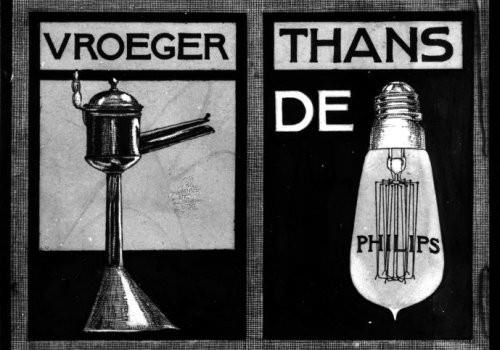
Philips light bulb advert
The engineer assured that for ƒ 12.00 per year, which is just over three cents per day, one can burn a lamp of sufficient intensity to one’s heart’s content; if desired, the Company will also install a lamp in the bedroom, which can be used alternately with the lamp in the living room without a price increase. With such an arrangement, the costs of a meter are saved.
“But that business will not be able to exist here!”
Mr. Rittershaussen answers that if it encounters no opposition, his Company will have the installation ready within six months, and he is certain that within two years it will have placed enough lamps in Aalten and Bredevoort to run its business successfully. He considers it entirely unnecessary to request applications for connections beforehand. However, of even greater importance to our municipality is that the “De Laval” Company, alongside electric lighting, also provides the opportunity for anyone who so desires to rent power to set machines in motion.
In this way, small-scale industry, which is slowly perishing due to competition with the steam factories in our municipality as elsewhere, will be able to flourish vigorously once again. Wood, pipe, and button turners, millers and flour manufacturers, tobacco carvers, wood sawyers, printers, shoemakers, laundries—in a word, all who need driving power for their business—can be enabled by the electrical installation to withstand the competition without great difficulties.
The aforementioned engineer declared that his Company is also inclined to establish the long-desired Lievelde–Bocholt tram connection through the construction and operation of an electric tram. That the Company, in its application for concessions, is not seeking to make money from such concessions but to actually carry out the plans, is evident from the fact that it already has over 1,500 Laval Turbines with approximately 33,000 effective horsepower in operation.
From all this, it is clear of what importance an electrical installation for light and power transmission is for our municipality.
With polite thanks for the publication, I have the honor to be, Mr. Editor,
your humble servant B.S. MULDER, Pastor. Bredevoort, Feb 15. 1899.
Aaltensche Courant, 9 September 1899
Letter to the Editor – A contribution and explanation regarding the electric lighting of Aalten and Bredevoort.
The editorial team accepts no responsibility.
It is now several months ago that the Company “de Laval” in Amsterdam made the plan to provide our municipality with electric light and electric power transmission to give the residents the opportunity to light their houses beautifully, cheaply, and conveniently, but above all to expand or facilitate their industry by means of electricity. After all, this saves a lot of labor and allows one to work much more cheaply than by means of steam engines or motors, which are relatively expensive and involve a lot of labor.
Our esteemed Municipal Council has devoted several sessions to whether or not to grant permission for the establishment of this institution, which is so useful for our municipality. However, nothing has been decided so far and, in my opinion, matters are worse than a few months ago, for delay so easily becomes cancellation, and thus we would cause ourselves harm. The main reason for this standstill, however, is that some Council members are under the misconception that electric light would be dangerous; even Council member Mr. Th. Driessen is of this opinion, although his factory is lit by electricity.
The opposite is true, however; let the following serve as proof:
1°. Electric light can be provided by means of cables which are insulated, i.e., by cables which are so wound or covered that they do not present the slightest danger upon contact with humans or animals. Therefore, there is no danger from this side in laying cables from Bredevoort to Aalten and vice versa, or in making conduits along the houses in Aalten and Bredevoort.
2°. When connecting the buildings to be lit with the main cable, the greatest precaution is observed by placing a piece of lead wire or other soft metal at the point where the current enters the house, through which the current enters the house. If the current becomes too strong, the inserted soft metal melts and all danger (which, incidentally, is not great or dangerous) has vanished. By means of another piece of soft metal, one can easily bring the meanwhile tempered current into contact with the lamps.
3°. Electric light is actually only a current passing through very thin wire, which wire is located in a vacuum glass bulb or pear. Should this bulb or pear break, that thin wire immediately comes into contact with the air; it carbonizes in a minimum of time, whereby the current is broken and no more danger is present.
I believe I have sufficiently proven herewith that electric light does not present the slightest danger, but does bring a very great advantage; for the sometimes very high prices of petroleum remain without influence on our municipality and, moreover, one can have beautiful light for the very low price of ƒ 12 for the entire year, and everything works very easily, namely by simply pulling a lever, and everything is ready.
The greatest advantage, however, lies in the fact that one can drive all kinds of machinery by means of electric power, not to mention a tram. It can serve to set in motion looms, lathes, mills, etc. etc., as is already widely done in Germany. Only by means of electricity can one nickel-plate and gild cheaply and beautifully, and light various apparatus such as large microscopes etc. by means of carbon rods.
Proof enough that electric light and power transmission is not only advantageous but highly desirable for our municipality. Everywhere in Germany one finds electric trams, which even run along cables that are not insulated, as for example in Duisburg, Oberhausen and surroundings and from Krefeld to Dusseldorf etc.; furthermore, one also has electric light and electric labor everywhere there.
I hope and expect that Mr. Driessen, as well as the entire Council, has come to other views and that after the next council meeting an affirmative answer be sent to the Company “de Laval,” so that delay here does not become a refusal. Should the Council, however, not be convinced or not believe these proofs, then I hope they will go and take a look at the specified German places.
Bredevoort, Sept 4, 1899. a QUERCU.
Arnhemsche Courant, 19 February 1900
Aalten, Feb 17. – A concession has been granted to the firm Hofstede Crull, in Borne, by the Council of Aalten for the installation of electric lighting there.
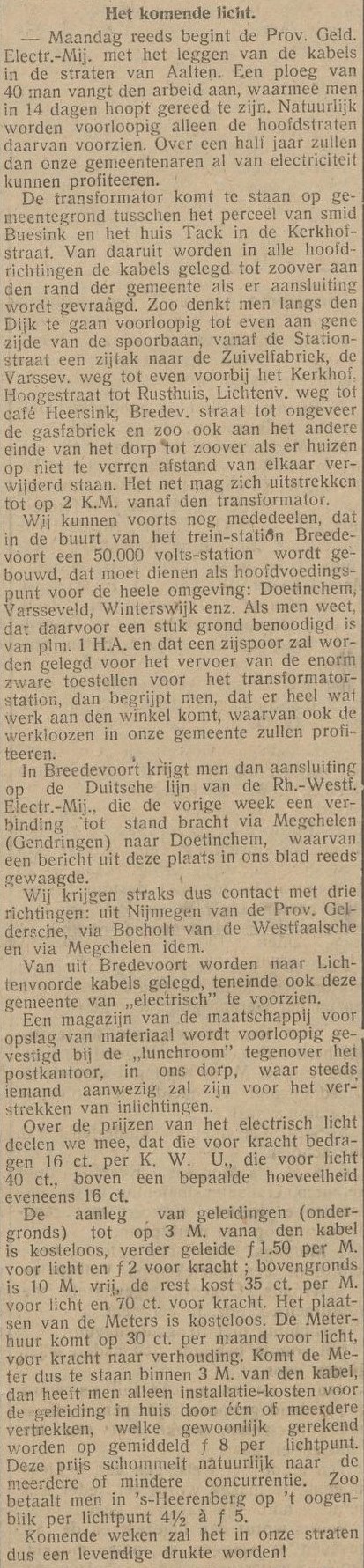
‘The coming light’ – De Nieuwe Aaltensche Courant, June 29, 1923 (click to enlarge)
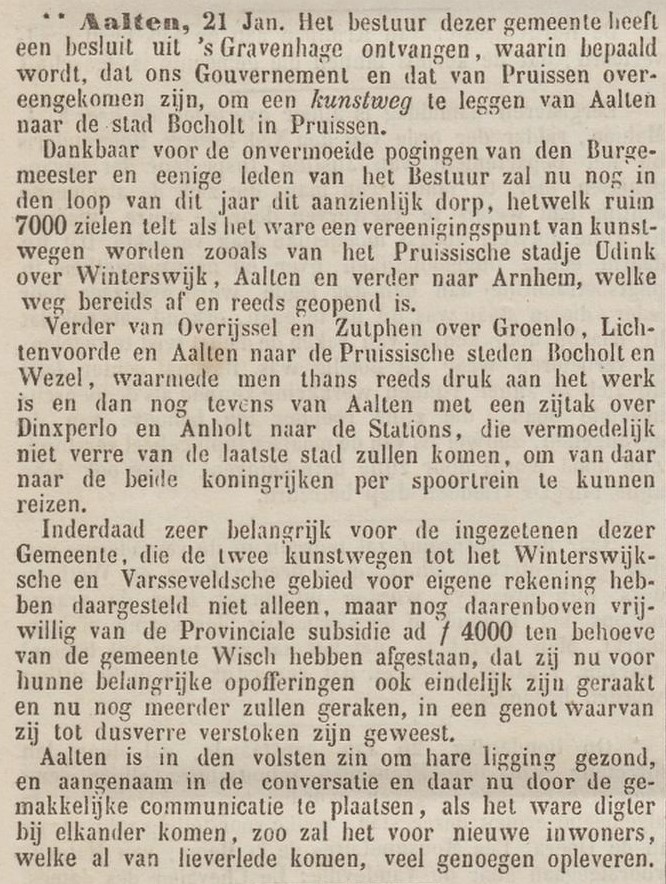
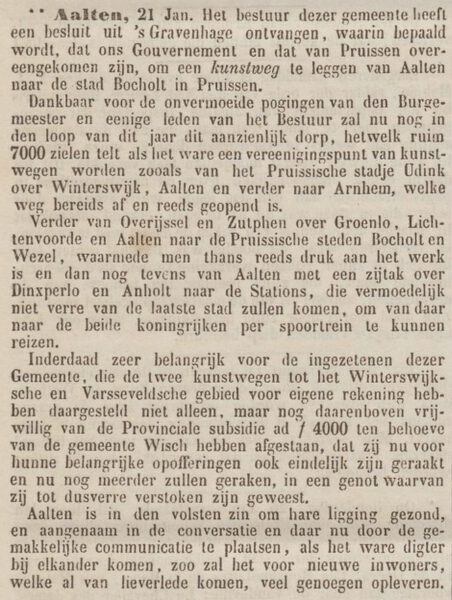
Aalten, 21 Jan. The administration of this municipality has received a decree from The Hague, stating that our Government and that of Prussia have agreed to construct a paved road from Aalten to the city of Bocholt in Prussia.
Grateful for the tireless efforts of the Mayor and several members of the Board, this significant village, which counts over 7,000 souls, will now, in the course of this year, become a junction of paved roads, such as from the Prussian town of Oeding via Winterswijk, Aalten, and further to Arnhem, which road is already finished and opened.
Furthermore, from Overijssel and Zutphen via Groenlo, Lichtenvoorde, and Aalten to the Prussian cities of Bocholt and Wesel, which are currently being worked on, and then also from Aalten with a branch via Dinxperlo and Anholt to the stations, which will presumably be located not far from the latter city, to be able to travel from there to both kingdoms by train.
Indeed very important for the residents of this Municipality, who not only established the two paved roads to the Winterswijk and Varsseveld areas at their own expense, but moreover voluntarily waived the Provincial subsidy of ƒ 4,000 for the benefit of the municipality of Wisch, that they have now finally attained, and will further attain, a benefit of which they have hitherto been deprived, as a result of their significant sacrifices.
Aalten is, in the fullest sense, healthy due to its location and pleasant in social interaction, and since places are now, as it were, coming closer together through easy communication, it will provide much pleasure for new residents, who are already gradually arriving.
The ‘t Walfort Estate lies between Aalten and Bredevoort. Historically, it was part of the ‘t Walfort Manor (Havezathe) and comprises woodlands, hedgerows, and wooded banks. The boundaries of the estate were marked by so-called hunting posts (jachtpalen). Today, 13 of these posts are still visible; one of them stands on the former driveway to the manor and is therefore not on the boundary of the hunting grounds. It is presumed that more posts originally surrounded ‘t Walfort.
According to the re-enacted Hunting Act of 1814, hunting grounds had to be demarcated with posts bearing the text “private hunt of” (private jagt van) followed by the owner’s name. These hunting posts marked the extent of his hunting territory.
A description by the Gelders Genootschap mentions that the hunting posts were placed around 1837/1838 by the then owner, Baron Jan van Pallandt van Walfort (1776–1844). He lived in Arnhem on the Klarenbeek estate and also purchased Angerenstein and Rennenenk in Arnhem. He was also a member of the Provincial Executive (Gedeputeerde Staten) of Gelderland.
The hunting posts are made of red sandstone, presumably sourced from quarries in the vicinity of the Weser or the Main rivers. Their total length is 2.5 to 3 metres. The posts are rectangular (approx. 25 x 20 cm) with chamfered corners. The top is a four-sided pyramid. In terms of finish, they are gefrijnd: horizontally ribbed. On one side, there is a rectangular, smoothly finished field containing the text: “Havezate Walvoort of Walfort Privative Jacht”. Several of the remaining posts are either damaged or have been shortened.
The hunting posts have been designated as a municipal monument by the municipality of Aalten.2
Map of the Free Hunting Grounds of Walfort Manor, 1836
All hunting posts in a row
The numbers of the photographs correspond with the numbers on the map above.
Late in 1664, the Bredevoort church council commissioned Joannes Holthus to construct a new clockwork mechanism for the church tower, as the old one was worn out. It was installed in 1666, marking the beginning of an eventful history that ultimately concluded right where it once began: the Sint Joriskerk (St George’s Church) in Bredevoort.
In the year 1664, the Netherlands was still the Republic of the Seven United Provinces. Johan de Witt governed the country and Michiel de Ruyter ruled the high seas. In the eastern corner of Guelders lay the small town of Bredevoort. Joannes Verschage was the minister here, and Gerhard van Hengel and Bernard Ecckervelt served as the churchwardens.
If you wanted to know roughly what time it was back then, you looked at the sundial which is still present on the exterior wall of the church. But if the sun was not shining, you depended on the clockwork in the church tower. However, that was not working well; it was dilapidated and out of order, according to the church management. A new clock was required.
Joannes Holthus
The church management entered into negotiations with clockmaker Joannes Holthus from Arnhem. In December 1664, they signed a contract stipulating that Holthus would deliver a clock within eighteen months that would strike the hours and half-hours. The agreed price was 300 Carolus guilders, of which 50 guilders was paid as an advance. The clock was delivered neatly on time; by the summer of 1666, it stood in the tower. Afterwards, however, it emerged that the agreed sum was insufficient.
In 1667, all parties signed for an additional sum of 228 guilders. Yet problems must have arisen regarding the payment. Holthus was forced to litigate in court. He fell into poverty, had to enter service somewhere, and had to leave or give up his children, ultimately dying in penury. Following his death, his daughter Jasperina continued the lawsuit until at least 1692. We do not know the outcome.
Through the centuries
After some time, a striking train was added to the turret clock, which also struck the quarters before and after the hour. A chime (voorspel) that announced the strikes was also introduced. This possibly occurred in 1680, a year that is engraved into the ironwork. In 1886, the clock was restored by Gerrit Jan Heinen from IJzerlo, who lived at the ‘Klokkemaker‘ farmstead.
Following nearly three centuries of faithful service, the clock was replaced in 1942 by a new mechanical turret clock. The old clock went to Aalten, where it spent a period gathering dust in the fire station. Afterwards, it ended up in the Aalten Oudheidkamer (historical museum), which was later incorporated into the Frerikshuus Museum and ultimately the Nationaal Onderduikmuseum. In 2017, the clock became a municipal monument.
Back to Bredevoort
However, the Bredevoort clock no longer fitted the museum’s concept, and an alternative location had to be found for it — preferably a place where the public could admire it. At the beginning of 2025, local interest group Bredevoorts Belang took over the turret clock. Reinstalling it in the tower of the Sint Joriskerk was no longer possible. The church’s interior committee proposed placing the clock in the church loft (boerenzolder), and the church council agreed.
The 1666 clock by Joannes Holthus now takes pride of place in the church loft, and everything is still in working order!
The 1666 Bredevoort turret clock (photo: Ap te Winkel)The sundial on the Sint Joriskerk (photo: Jos Wessels)A forged strip with inscription (photo: Ap te Winkel)
Technical Description
The turret clock consists of two interconnected segments. The segment containing the striking trains is 120 cm long, 65 cm wide, and 104 cm high. The section with the time train (gaande werk) and the chime mechanism (speelwerk) is 81 cm long, 58 cm wide, and 104 cm high. The following texts have been applied to forged strips:
“JOANNES HOLTHUS ME FECIT (made me) 1666. JOANNES VERSCHAGÆ PASTOR HUIUS ECCLESIÆ (shepherd of this church) GERHARD VAN HENGEL DR. BERNARD ECCKERVELT KERKMEISTEREN IN BREDEVORT“.
The clock is equipped with a double striking train, which kept Bredevoort on time by striking on both the hours and the half-hours. Furthermore, fifteen minutes before and after the hours, four tones resonated from three bells.
The corner posts are decorated with a beautifully forged scroll. The connections consist primarily of cotter pins. The entire mechanism stands on a wooden platform (beun). A large block of sandstone functions as the driving weight; this stone is almost certainly original. The stone hangs from a rope of braided hemp, as does all the other ropework. The entire mechanism works perfectly.
The clock is described in the book: Achterhoekse klokken en uurwerkmakers, by J.L. Sellink, A.F. Abbink, and R.E. Wiggers, (ISBN 90-9003816-7). On page 8, Mr Wiggers writes about the clock, stating among other things: “The escapement consists of a Graham escapement with a tooth shape according to Schwilgué; this must have been built in after 1715. The chime, however, appears to be original and constructed directly in 1666. The current position for the time train is also authentic, and its winding arbor is likewise identical to the other three arbors.”
Historical sources reveal that Aalten was mentioned in 1152 as the parish of Aladon1. This indicates that a church existed at that time, which was presumably located on the same site as the current Old Helenakerk. A mention from 828 (Aladna)2 is not undisputed, although such an early dating for Aalten is certainly possible from an archaeological perspective. Indeed, traces of human habitation from that period have been found both at De Hoven and on the Damstraat.
Burial Ground
In the late 19th and early 20th centuries, a large number of objects were collected during excavation work on Damstraat. Among the finds are 15 pots of widely varying shapes, some of which are beautifully decorated.
In 1932, under the direction of Professor A.E. van Giffen, a burial ground was uncovered in Aalten behind the Manschot factory, now Manschotplein. Spearheads, stirrups, a shield boss, several small pots, and ten silver links from a belt were found.3 It is not unlikely that these finds originate from the grave of a single warrior.
Part of the Damstraat was likely a Merovingian-Frankish burial ground around the year 800. The Merovingians were a dynasty of Frankish kings. The site has been heavily disturbed by house construction.
Belt fitting, found at Damstraat in Aalten
Medieval Cellar
Naturally, a burial ground is associated with a settlement. You will understand that we were very curious about where this settlement was located. In recent decades, a working group from the archaeological society A.D.W. has closely monitored excavation and construction activities in and around the current center of Aalten. In 1981, this resulted in the discovery of a cellar from the 12th century. The find was made in the renovated premises of what was then the Welkamp company (Bredevoortsestraatweg 5). No remains were found of the farmhouse of which the cellar was a part. However, the cellar itself yielded a wealth of information.
Because the cellar had been destroyed by fire, all objects present at the time of the fire were recovered within it. A total of six pots were found which, given their size, must have been used as storage jars. Unfortunately, five of the six pots were broken. A handle from a saucepan, in the shape of an animal head, was also found. Iron slag and a piece of lime indicate a smithy in the vicinity. It is possible that two hinges found were manufactured in this smithy.
Bone remains showed that horses, sheep or goats, cattle, and pigs were kept. Charred grain remains of oats, wheat, and rye were found in a soil sample. With this find, the mention from 1152 was archaeologically confirmed. Several imported shards from Germany point to a dating in the second quarter of the 12th century.4
Settlement
Although this find was important in itself, no traces had yet been found of the older settlement associated with the burial ground. However, during the redevelopment of De Hoven in December 1982, traces of a Frankish-Merovingian settlement were discovered. The remains of a sunken hut from the 9th century5 are an indication that Aalten already existed at that time, albeit under a different name.
A sunken hut should be imagined as a rectangular pit topped by a gable roof. Usually, these sunken huts had a craft function (e.g., a weaving hut) or a storage function. Only the larger ones were possibly also used as dwellings.
This is what the Aalten hut bowl could have looked like (sketch made by Willem Doodeheefver)
After the sunken hut was abandoned, the pit was used as a refuse pit. A large number of bones from the same livestock as in the cellar find were discovered here. The discovery of bone remains from a deer indicates a minor role for hunting. Furthermore, charred grains and seeds such as barley, rye, emmer wheat (a prehistoric grain type), oats, lentils (possibly peas or vetch), pale-yellow hemp-nettle, goosefoot, and sheep’s sorrel were found.
From the fact that pottery types found in the sunken hut also occur in the burial ground, we may conclude that both are contemporaneous. It is therefore not far-fetched to assume that the people who lived at De Hoven buried their dead at the current Damstraat.
Second Find
In December 1992, during work at De Hoven, not far from the previous site, remains of a sunken hut were found again, this time probably dating from the 8th century. This sunken hut was found on the grounds of De Hoven where road builder Jaartsveld was carrying out excavation work for the construction of a new parking lot.6
This sunken hut was quite small and had almost certainly been the workshop of a weaver. A groove on the side of the pattern found indicated where the loom had stood. Spindle whorls and clay balls that served as weights for the loom were also found. The sunken hut was smaller than the one discovered in 1982. That one may have been a hut where a family lived.
Archaeological research at De Hoven, 1992. Photo: Peter Rhebergen
Willem Doodeheefver, one of the amateur archaeologists involved in the research, told a reporter:
“You know it is an area in the vicinity of which something has been found before. You could see it very clearly during the excavation. Suddenly, in the red sand, the black imprints became visible where posts used to stand. That is always a huge surprise.”
The National Service for Archaeological Heritage (ROB) recognized the importance of the finds and asked the Soil Research Working Group of the Archaeological Society A.D.W. to continue the investigation. An employee of Jaartsveld specifically returned from vacation to further excavate the site using a loader. Several new finds were made during this process. Many of the aforementioned finds can be viewed in the museum on the Markt.
Origin of the place name
Several theories circulate regarding the origin of the name Aalten. But what are they based on and how credible are they? Old Aalten delved into history to discover more about this.
Deze website gebruikt cookies voor een optimale ervaring en analyse van bezoekgegevens. Ga je hiermee akkoord? Zonder toestemming werken sommige onderdelen van de site mogelijk minder goed.
Functioneel
Always active
De technische opslag of toegang is strikt noodzakelijk voor het legitieme doel het gebruik mogelijk te maken van een specifieke dienst waarom de abonnee of gebruiker uitdrukkelijk heeft gevraagd, of met als enig doel de uitvoering van de transmissie van een communicatie over een elektronisch communicatienetwerk.
Voorkeuren
De technische opslag of toegang is noodzakelijk voor het legitieme doel voorkeuren op te slaan die niet door de abonnee of gebruiker zijn aangevraagd.
Statistieken
De technische opslag of toegang die uitsluitend voor statistische doeleinden wordt gebruikt.De technische opslag of toegang die uitsluitend wordt gebruikt voor anonieme statistische doeleinden. Zonder dagvaarding, vrijwillige naleving door je Internet Service Provider, of aanvullende gegevens van een derde partij, kan informatie die alleen voor dit doel wordt opgeslagen of opgehaald gewoonlijk niet worden gebruikt om je te identificeren.
Marketing
De technische opslag of toegang is nodig om gebruikersprofielen op te stellen voor het verzenden van reclame, of om de gebruiker op een site of over verschillende sites te volgen voor soortgelijke marketingdoeleinden.