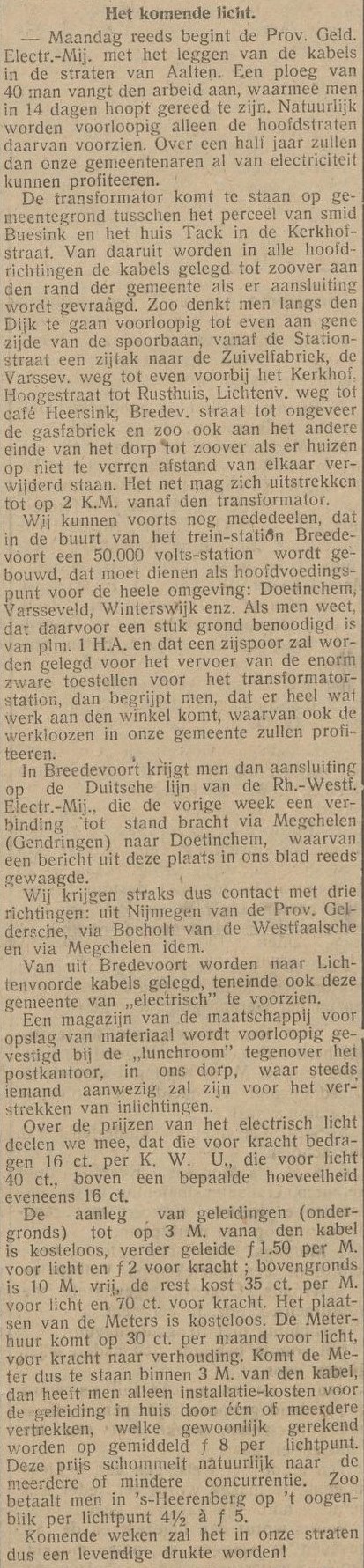
Aaltensche Courant, 18 February 1899
All sorts of true and false rumors regarding the establishment of an electric factory in the municipality of Aalten are going around; for which reason it may be well to bring the following to the public’s attention. The Company “De Laval” in Amsterdam does indeed have the plan to establish an installation for light and power transmission in the municipality of Aalten.
Last week, it already sent its engineers for preliminary discussions and investigations, for which purpose those gentlemen also had a lengthy interview with our honorable Mayor.
Is such an installation of importance to the municipality of Aalten? It is well known enough that electric lighting is not only beautiful and convenient, but also greatly reduces the fire hazard.
“Yes, but the costs! Electric lighting will cost the municipality money!”
Mr. Rittershaussen, engineer of the “De Laval” Company, declared to the undersigned that his Company will provide electric lighting for the municipality for the same price that petroleum lighting currently costs. Thus, better lighting without additional costs.
“But, for private individuals, that new light will be too expensive!”
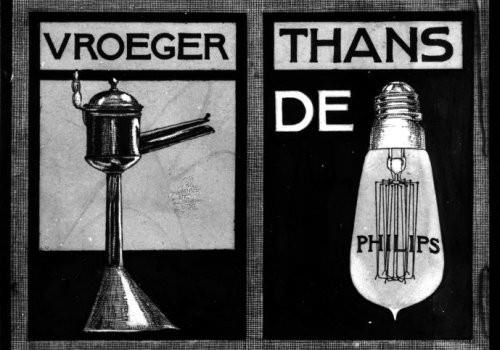
The engineer assured that for ƒ 12.00 per year, which is just over three cents per day, one can burn a lamp of sufficient intensity to one’s heart’s content; if desired, the Company will also install a lamp in the bedroom, which can be used alternately with the lamp in the living room without a price increase. With such an arrangement, the costs of a meter are saved.
“But that business will not be able to exist here!”
Mr. Rittershaussen answers that if it encounters no opposition, his Company will have the installation ready within six months, and he is certain that within two years it will have placed enough lamps in Aalten and Bredevoort to run its business successfully. He considers it entirely unnecessary to request applications for connections beforehand. However, of even greater importance to our municipality is that the “De Laval” Company, alongside electric lighting, also provides the opportunity for anyone who so desires to rent power to set machines in motion.
In this way, small-scale industry, which is slowly perishing due to competition with the steam factories in our municipality as elsewhere, will be able to flourish vigorously once again. Wood, pipe, and button turners, millers and flour manufacturers, tobacco carvers, wood sawyers, printers, shoemakers, laundries—in a word, all who need driving power for their business—can be enabled by the electrical installation to withstand the competition without great difficulties.
The aforementioned engineer declared that his Company is also inclined to establish the long-desired Lievelde–Bocholt tram connection through the construction and operation of an electric tram. That the Company, in its application for concessions, is not seeking to make money from such concessions but to actually carry out the plans, is evident from the fact that it already has over 1,500 Laval Turbines with approximately 33,000 effective horsepower in operation.
From all this, it is clear of what importance an electrical installation for light and power transmission is for our municipality.
With polite thanks for the publication, I have the honor to be, Mr. Editor,
your humble servant
B.S. MULDER, Pastor.
Bredevoort, Feb 15. 1899.
Aaltensche Courant, 9 September 1899
Letter to the Editor – A contribution and explanation regarding the electric lighting of Aalten and Bredevoort.
The editorial team accepts no responsibility.
It is now several months ago that the Company “de Laval” in Amsterdam made the plan to provide our municipality with electric light and electric power transmission to give the residents the opportunity to light their houses beautifully, cheaply, and conveniently, but above all to expand or facilitate their industry by means of electricity. After all, this saves a lot of labor and allows one to work much more cheaply than by means of steam engines or motors, which are relatively expensive and involve a lot of labor.
Our esteemed Municipal Council has devoted several sessions to whether or not to grant permission for the establishment of this institution, which is so useful for our municipality. However, nothing has been decided so far and, in my opinion, matters are worse than a few months ago, for delay so easily becomes cancellation, and thus we would cause ourselves harm. The main reason for this standstill, however, is that some Council members are under the misconception that electric light would be dangerous; even Council member Mr. Th. Driessen is of this opinion, although his factory is lit by electricity.
The opposite is true, however; let the following serve as proof:
1°. Electric light can be provided by means of cables which are insulated, i.e., by cables which are so wound or covered that they do not present the slightest danger upon contact with humans or animals. Therefore, there is no danger from this side in laying cables from Bredevoort to Aalten and vice versa, or in making conduits along the houses in Aalten and Bredevoort.
2°. When connecting the buildings to be lit with the main cable, the greatest precaution is observed by placing a piece of lead wire or other soft metal at the point where the current enters the house, through which the current enters the house. If the current becomes too strong, the inserted soft metal melts and all danger (which, incidentally, is not great or dangerous) has vanished. By means of another piece of soft metal, one can easily bring the meanwhile tempered current into contact with the lamps.
3°. Electric light is actually only a current passing through very thin wire, which wire is located in a vacuum glass bulb or pear. Should this bulb or pear break, that thin wire immediately comes into contact with the air; it carbonizes in a minimum of time, whereby the current is broken and no more danger is present.
I believe I have sufficiently proven herewith that electric light does not present the slightest danger, but does bring a very great advantage; for the sometimes very high prices of petroleum remain without influence on our municipality and, moreover, one can have beautiful light for the very low price of ƒ 12 for the entire year, and everything works very easily, namely by simply pulling a lever, and everything is ready.
The greatest advantage, however, lies in the fact that one can drive all kinds of machinery by means of electric power, not to mention a tram. It can serve to set in motion looms, lathes, mills, etc. etc., as is already widely done in Germany. Only by means of electricity can one nickel-plate and gild cheaply and beautifully, and light various apparatus such as large microscopes etc. by means of carbon rods.
Proof enough that electric light and power transmission is not only advantageous but highly desirable for our municipality. Everywhere in Germany one finds electric trams, which even run along cables that are not insulated, as for example in Duisburg, Oberhausen and surroundings and from Krefeld to Dusseldorf etc.; furthermore, one also has electric light and electric labor everywhere there.
I hope and expect that Mr. Driessen, as well as the entire Council, has come to other views and that after the next council meeting an affirmative answer be sent to the Company “de Laval,” so that delay here does not become a refusal. Should the Council, however, not be convinced or not believe these proofs, then I hope they will go and take a look at the specified German places.
Bredevoort, Sept 4, 1899.
a QUERCU.
Arnhemsche Courant, 19 February 1900
Aalten, Feb 17. – A concession has been granted to the firm Hofstede Crull, in Borne, by the Council of Aalten for the installation of electric lighting there.