
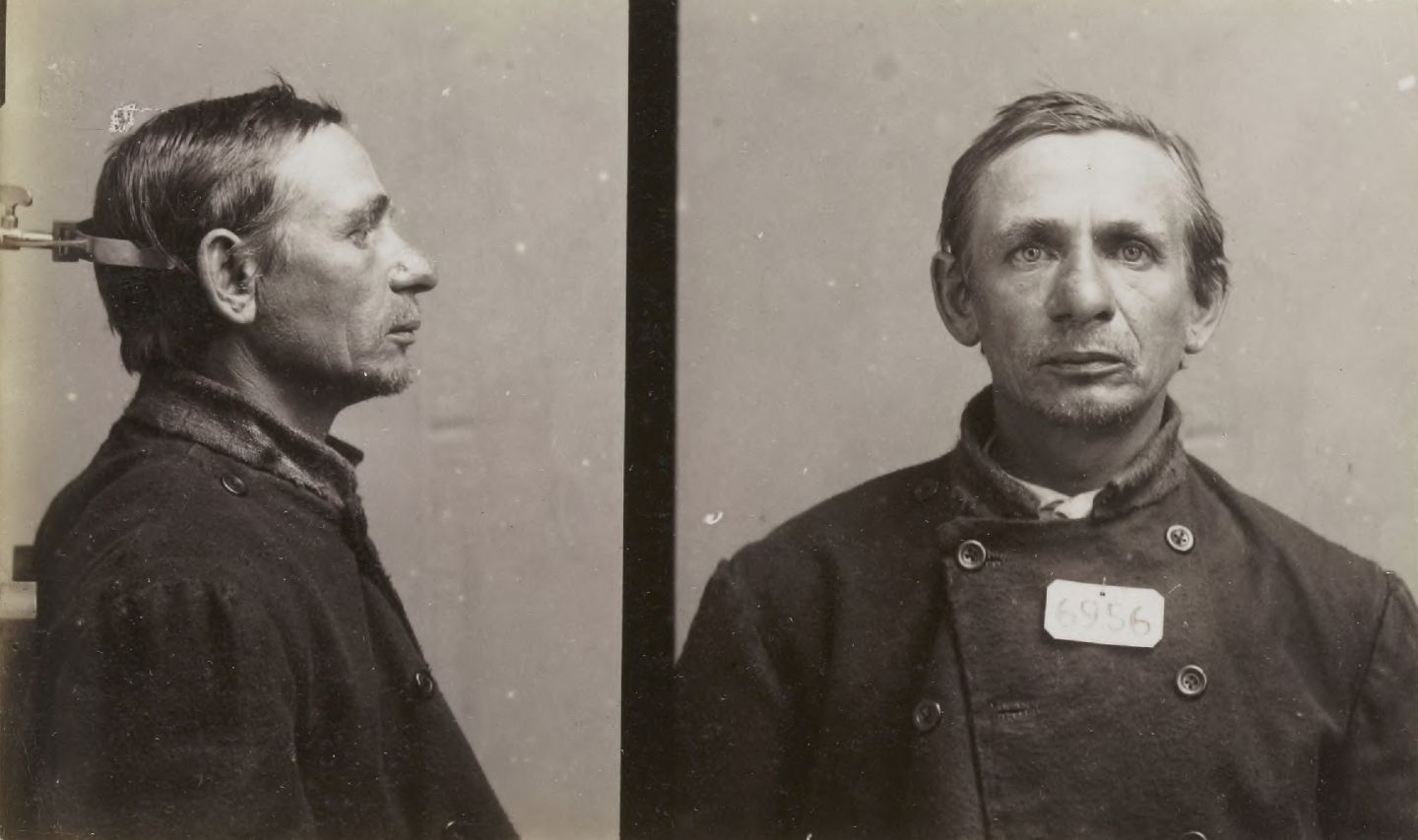
Bernardus Hendrikus Bloemers was born on March 12, 1845, in Bredevoort, house number 7a, in the vicinity of the Misterstraat and Bekendijk. He was a son of Johannes Arnoldus Hendrikus Bloemers and Theodora Sessink. The family lived briefly on the Ambthuiswal, but departed for Terborg in December 1847.
Bernard’s life was no bed of roses. In 1896, he was arrested for vagrancy and, as punishment, admitted to the State Workhouse Veenhuizen I in Drenthe.
A wandering existence
The population register shows that Bernard certainly did not lead a settled life. From the age of sixteen, he stayed in numerous places, interspersed in his younger years with temporary returns to the parental home in Terborg:
- 1861–1862: ‘Esheren in Prussia’ (Esserden near Rees?)
- 1862–1864: Vethuizen, municipality of Bergh, as a farmhand on a farm
- 1867: Tegelen, Limburg
- 1867–1868: Beek near Sterkrade in Prussia (now Duisburg-Beeck)
- 1869: to Sterkrade again
- 1870: working as an iron molder near Ulft, after which he left for Isselburg
- 1872: Liège, Belgium.
Around 1873, Bernard married Johanna Francina Kok, born on January 21, 1848, in Oer near Ulft, presumably in Dinslaken. In 1877, he was recorded as “Bernardus Hendrikus Blummer” in the population register of Oosterhout near Tilburg, where he lived with his family, with the profession of sand molder. A few years later, they lived in Nijmegen, on the Steenstraat.
As far as is known, the couple had four sons:
- Johannes Hermanus (Dinslaken, 1874 – 1876)
- Johannes Arnoldus (Dinslaken, 1875)
- Johannes Hermanus (Oosterhout, 1877 – Rotterdam, 1962)
- Bernardus (Nijmegen, 1880 – Rotterdam, 1949).
In December 1883, the family left for Breda, and only a month later for ‘s-Hertogenbosch. In the population register, there is a difficult-to-read note behind Bernard’s name, possibly: “tried on October 9, 1884, in Utrecht”. Later, the family appeared in Rotterdam, where they seemed to settle permanently. Johanna passed away there in 1909.
It is striking that Bernard reappeared in Nijmegen in 1895 — without his family, coming from Zwolle. Why he left his family remains a matter of speculation. Poverty likely played a significant role. The frequent moves possibly point to an uncertain existence, in which one constantly sought better prospects — or fled from debts and problems.
In any case, Bernard’s life was no bed of roses, and the fact that he had fallen on hard times was confirmed shortly thereafter.
Admission to Veenhuizen
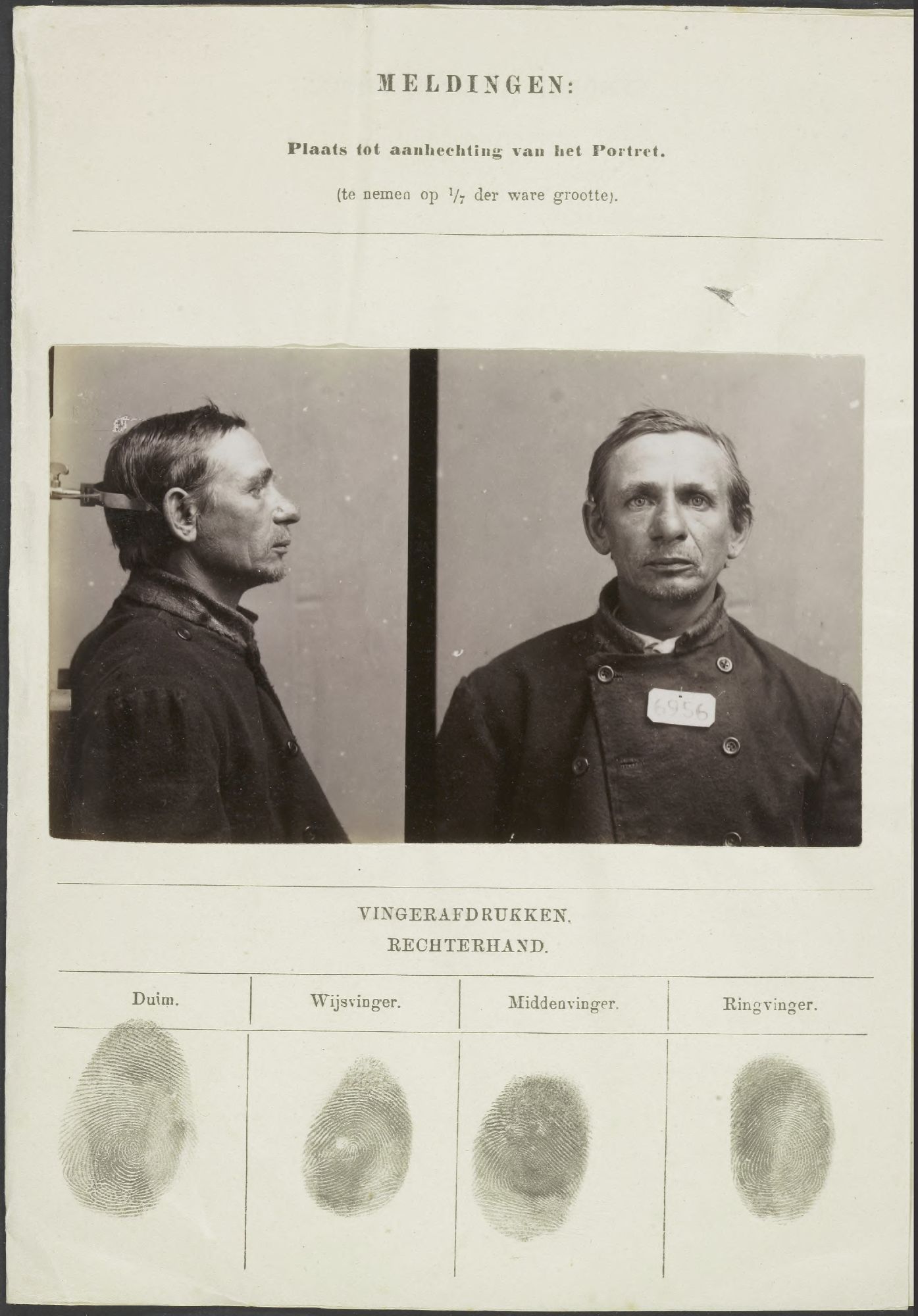
On June 22, 1896, Bernard was admitted to the Veenhuizen I State Workhouse for vagrancy. Upon entry, a description card was drawn up, featuring photographs, fingerprints, and a precise description of his appearance.
It is also mentioned that at that time he had no fixed place of residence (Nijmegen was noted as his last place of residence). His profession was ‘iron molder’, he had no identity papers, and was unmarried (!). He had been convicted of vagrancy in ‘s-Hertogenbosch. He had already been convicted twice before for the same offense.
The description card contains a detailed account of his physical characteristics, including his height (1 meter 51.9). His nose was broad, protruding, ‘with much blood showing through from below’ and with a scar on the right nostril.
What happened to Bernard after that remains unknown. We do not know if he ever left Veenhuizen, nor where or when he died.
Stay in the State Workhouse in Veenhuizen
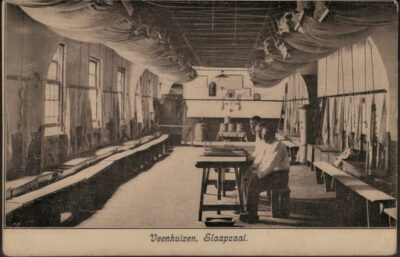
State Workhouse Veenhuizen 1 (the First Asylum) was a closed penal institution for men who had been convicted of begging or vagrancy. In this large-scale complex, discipline and labor were central.
The purpose of the institution was not only retribution, but also to effectively “combat vagrancy and begging” by purging society of individuals considered a nuisance and instilling discipline in them through forced labor.
Daily life was strict and sober under a military regime. Violations of the internal rules were punished with a stay in the punishment cell or a reduction in rations. The residents, referred to as wards, wore mandatory asylum clothing, slept in large communal wards, and were put to work six days a week. The labor consisted of heavy land reclamation on the heath or indoor work in workshops, such as weaving mats and repairing mailbags.