
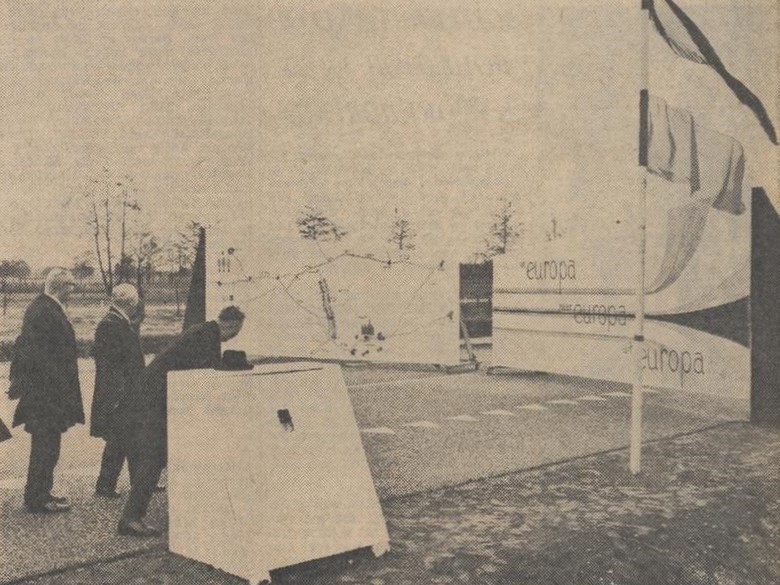
AALTEN – ‘In Europe – towards Europe – from Europe’ was written on the entrance gates to the new Hameland Route – the north–south bypass around Aalten – which the Queen’s Commissioner in Gelderland, Mr H.W. Bloemers, officially opened yesterday afternoon. A large road map had also been painted there, clearly emphasising once again the importance of the Hameland Route for international traffic. Mr Bloemers had been given the honour of ‘cranking’ the entrance gates open by an ingenious mechanism.
An Important New Connection
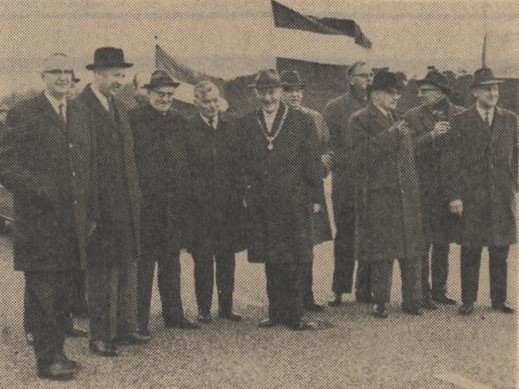
A long procession of cars carrying many invited guests then travelled along the new road almost as far as the border before returning to Aalten. Among them were provincial executive member H.M. Oldenhof, Mayor Mr F.J. Waals and alderman Th.B. Hulshof of Lichtenvoorde, Oberstadtdirektor Gillen of Bocholt, the director of Gelderse Tramwegen, engineer A.H. Robbé Groskamp, the director of the SSOG, Drs K.F. Broekers, and almost the entire municipal council of Aalten. Back in Aalten, the opening ceremony continued at the Sociëteit.
‘Dommen Aanleg’
Before this, the party had travelled from the Heurne–Hemden border crossing along the old route through Aalten, still festively decorated for the royal wedding, to the Dommen Aanleg. ‘Never has this name been more appropriate than now,’ one of the speakers at the Sociëteit, Mr H.J. Kempers, remarked, ‘where the new road comes to an end and Lichtenvoorde can only be reached along the old route, which has long ceased to meet the demands of modern traffic.’ Mayor E.S. van Veen of Aalten added that it had not been his intention on this occasion to show his guests what was still unfinished. The connection to the Twenthe Route had already been promised by higher authorities and would be completed in 1967. Mayor Van Veen therefore suggested to his colleague in Lichtenvoorde that the celebrations could be continued there when the time came.
Opening Up the Region
He was also grateful to the provincial authorities for reversing their original decision to designate the new eight-kilometre road as a motor road. As a result, the Hameland Route now represented an important new connection for Aalten, which was hardly spoiled for choice when it came to roads. The north–south connection had now been completed. What remained was the long-cherished wish for an east–west connection from Winterswijk via Aalten to Doetinchem.
Symbolic
The Queen’s Commissioner called the new road a salute to the old one, along which the party had driven once more that afternoon. The narrow streets through Aalten had eventually been forced to carry an almost unbearable burden and seemed to shrink beneath modern traffic. Now that they could return to their original local function, they would once again contribute to Aalten’s attractiveness. As for the new road, the name Hameland Route was symbolic. The ancient Hamaland had a legendary, almost mythical resonance in this region – a name charged with meaning and therefore with expectations for the future.
Significance
Oberstadtdirektor Gillen of Bocholt considered the new road of great importance to the border region, where the German and Dutch sides shared many interests. The work of the SOG, the TOG and the Interessengemeinschaft Rhein-Ems, which until then had so often seemed merely theoretical, had found practical expression in this new road.
Mr H.J. Kempers, a member of Aalten municipal council and speaking among others on behalf of Aaltens Belang, agreed with Mayor Van Veen that completing the desired east–west connection would further improve access to the region. He did, however, wonder whether the proposed four-lane road might actually delay rapid completion. He also expressed the hope that, now the new road had become a reality, border facilities would be expanded as well, particularly for customs clearance of goods at the Heurne–Hemden crossing. This led him to another long-standing but so far unsuccessful request: keeping the border post open day and night.
Finally, Mayor Mr F.J. Waals of Lichtenvoorde congratulated his Aalten colleague and announced that all the land required for the continuation of the new road within the municipality of Lichtenvoorde had now been acquired. Construction of the road embankment would begin later that year.