


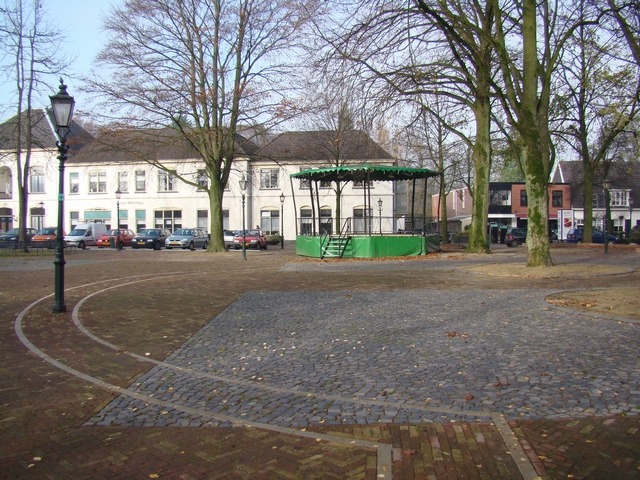
‘t Zand is a square and street in the historic centre of Bredevoort. In fact, ‘t Zand occupies the filled-in castle moat of Bredevoort Castle which was damaged beyond repair during the gunpowder tower disaster. Much of the development around the square consists of historic buildings, including several national and municipal monuments.
The street runs around a former school building; to the south of it, the street opens out into a square. To the north-east it becomes Kruittorenstraat, and it also connects to Hozenstraat to the north-east and east. To the south-east it leads into Gasthuisstraat, to the south into Markt and finally, to the south-west, into Prinsenstraat.
Name
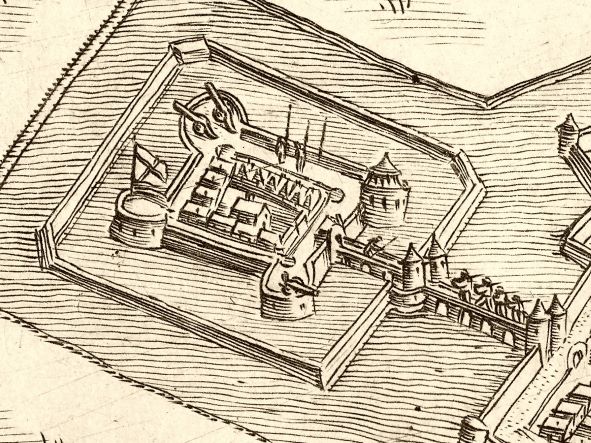
The earliest known reference to ‘t Zand dates from 16 May 1620, when a house within”Bredeforth opt Sant” was pledged as collateral. On the site now occupied by De Borghman town brewery once stood Bredevoort Castle. Most of what is now ‘t Zand was formerly part of the castle moat.
Even before the gunpowder tower disaster, the outer moat had been filled in. This created a sandy open area between Markt and the inner moat. The square must have existed in this form for at least 200 years and was planted with poplar trees. The name ‘t Zand therefore probably dates from the period after the castle moats were filled in.
At ‘t Zand, sentences were publicly pronounced on convicted offenders after they had stood trial in the Ambthuis. In earlier times, this referred to Bredevoort Castle. The offenders were then taken to the gallows mound on Hollenberg, where the sentence was carried out.
History
A town wall once stood at the beginning of the square. From the end of Prinsenstraat it turned through 90 degrees and ran straight towards Gasthuisstraat. Seen from the south of the square, where Markt opens onto it, a gateway was flanked by two wall towers. Behind the gateway was a bridge extending almost to the beginning of the present brewery. There, in the middle of an open area, stood a barbican. It consisted of a large roundel with a second gateway, again flanked by two wall towers. Beyond it, roughly in line with the present façade, a second bridge led to a large, tall gatehouse. This gatehouse must have stood somewhere on the school playground, near the main entrance of the former school.
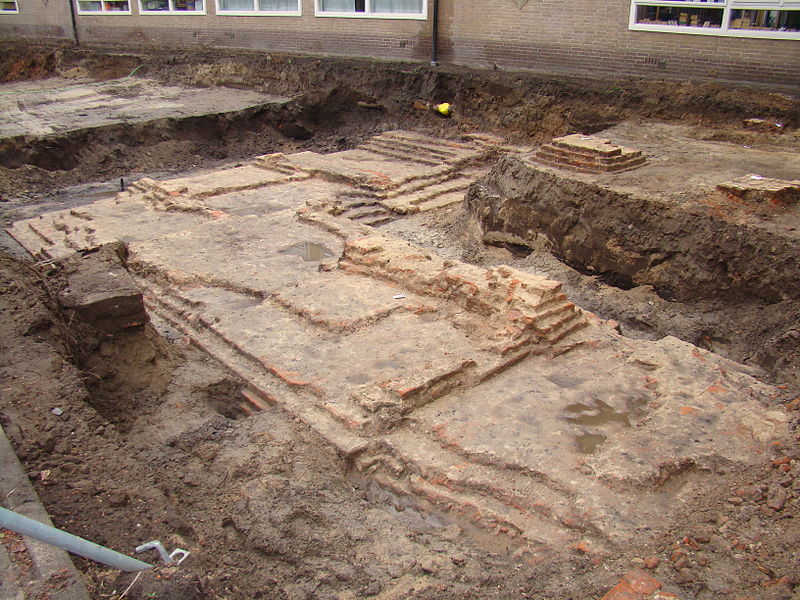
At the rear, a five-metre-thick corner wall was excavated in 2009. These foundations may be remains of the gatehouse. The castle itself began around the middle of the school playground, crossed the present street and extended to somewhere beyond the Breede Huus. One of the corner towers probably stood on the site of the later extension to the house known as Zandlust.
Redevelopment
In 2009, reconstruction and redevelopment of ‘t Zand and Kruittorenstraat began. In 2010, several weathering-steel artworks were installed on the square. The paving of ‘t Zand was completely renewed, with various elements incorporated to recall the former Bredevoort Castle.
The outlines of the historic barbican have been partially marked in the paving with brass strips. The curve of its roundel is clearly visible. On the school playground, a natural-stone marker indicates the location of the entrance to the castle grounds. A weathering-steel history book has been mounted on the side wall of the former school, while the square also contains a model of the fortifications of Bredevoort around 1650 and a statue of Hendrickje Stoffels, the partner of the painter Rembrandt van Rijn.
Changes to house numbering
(provisional)
| 1934 | 1967 |
|---|---|
| 1 | 25 |
| 2 | 1 |
| 3 | 2 |
| 3a | — |
| 4 | 3 |
| 4a | 3a |
| — | 4 to 10 |
| 5 | 11 |
| 6 | |
| 7 | 15 |
| 8 | 14 |
| 9 | 17 |
| 10 | 18 |
| 11 | 19 |
| 12 | 20 |
| 13 | 21 |
| 14 | 22 |
| 15 | 23 |
| 16 | 24-26 |