
In 1973, during restoration work at the Old St Helen’s Church in Aalten, carpenter Henk Heijnen stumbled upon a burial vault beneath the choir containing three coffins with human remains. At the order of the church board, the vault was swiftly resealed. However, before this happened, Heijnen had already climbed inside to meticulously measure and photograph everything. In 2019, Heijnen completed a wooden replica of the burial vault.
The Discovery in 1973
On October 16, 1973, the then 23-year-old carpenter Henk Heijnen was involved in restoration and maintenance work at the Old St Helen’s Church. The floor of the choir had been removed, leaving only sand. During the work, he was visited by Jan Tinnevelt from the Kattenberg, who asked if they were searching for the golden chalice. According to legend, this chalice was buried alongside the last priest of the Old St Helen’s Church. Heijnen’s boss at the time ushered Tinnevelt out.
However, Tinnevelt was persistent, returning at least three more times to ask if anything had been found. This prompted Heijnen to start digging at the spot under the choir that Tinnevelt had pointed out. He soon struck a brick vault. Together with his boss, he used a sledgehammer to create a hole in the structure. Heijnen enlarged the opening until he could descend into the space using a ladder. Below, he found a burial vault containing three partially decayed coffins. Of the deceased, only dust and hair remained. He did not find a golden chalice…
Measured and Resealed
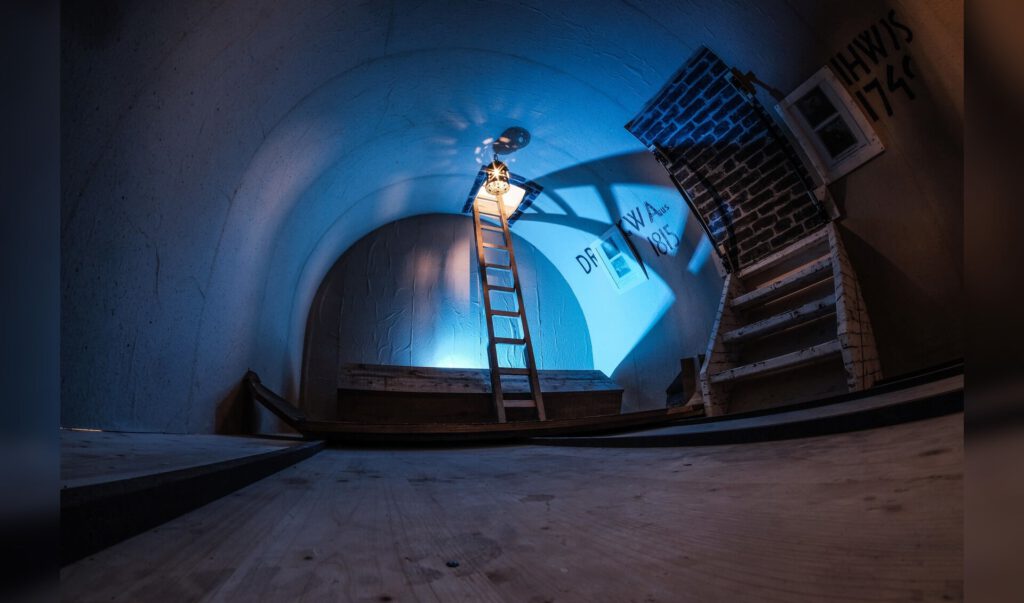
As always, Heijnen had a folding rule, a carpenter’s pencil, and paper with him. Before the vault was closed again, he measured the space precisely, noted the dimensions and initials, and made sketches and photographs of the vault, the inscriptions, and the dates. On the wall of the vault were the initials IHW with the year 1746, GWA with the year 1815, and DR, without a date. He preserved all these notes and images.
Meanwhile, his employer had informed the church council. Around ten o’clock that evening, the members of the church board arrived at the church, accompanied by the Reverend Van der Heiden. The minister pointed out that no one should descend into the vault as it would constitute grave robbery. Because the restoration was being carried out without the involvement of the National Heritage Agency (Monumentenzorg) and there were fears that the work would be halted, Heijnen was sworn to strict secrecy. At the request of the church board, he had to seal the manhole with concrete as soon as possible.
While he was closing the opening, Jan Tinnevelt entered the church once more. Upon realising what had been found, he was again politely requested to leave.
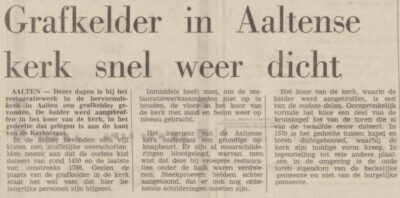
In the week following the discovery, work began on laying the new natural stone floor in the choir, permanently sealing the access to the burial vault. Only Heijnen’s notes and his employer’s photographs remained as a source. Shortly after the completion of the choir, national news channels reported the discovery of a burial vault in the Old St Helen’s Church; it is not known who leaked this information.
Research and Replica
It was only years later, during a trip to Israel with his wife, that Henk Heijnen visited a burial vault in Jerusalem. This gave him the idea to build a replica of the burial vault in the Old St Helen’s Church.
He produced new construction drawings and came into contact with Herbert Welling from Bocholt and Thaddeus van Eijck from Bredevoort, both of whom were interested in cultural heritage. The trio hit it off, and their combined research led them to the historian J. Grooteboer from Borne.
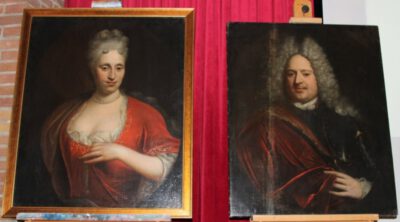
They discovered that Lambert Joost von Hambroick and his wife Mechteld Anna Bentinck van Diepenheim were closely connected to St Helen’s Church. In 1706, they donated two silver communion cups to the Aalten church, which were later found in a safe within the church.
Who Was Buried in the Vault?
Based on the research, it was determined that the following individuals were buried in the vault:
- Judith Hambroick Welvelde († 1746)
The connection to the Welvelde and Hambroick families is still visible in the church via the Welvelde coat of arms, which features a wolf’s head. - Gerharda Wilhelmina Arentsen (1777–1815)
She had purchased the burial vault at a later date. She was the daughter of the sister of Mayor Christiaan Caspar Stumph and the granddaughter of Roelof Arentsen, the scholte (local official) of De Ahof. - Rev. De Roy († 1762/1785)
Uncertainty remains regarding the initials DR. They were linked to a Reverend De Roy. However, in the second half of the 18th century, there were two ministers of that name: Philippus de Roy (1733–1762) and his son Adrianus Rudolphus de Roy (1762–1785). Which of the two might be buried in the vault remains unknown for now.
Completion of the Replica
In 2019, Heijnen completed a wooden replica of the burial vault. Two employees from Broekhout used his drawings to recreate the frame exactly. Heijnen personally handled the painting, including the initials and other details. The replica was later put on public display in the Helenahuis, opposite the church on Landstraat.
Thaddeus van Eijck produced a film titled “Verscholen erfgoed in beeld” (Hidden Heritage Portrayed), which documents the entire process surrounding the replica: from the initial notes and research to the craftsmanship with which the burial vault was reconstructed.
At the presentation of the replica in 2019, Heijnen mentioned that he still always carried his folding rule, even when sitting in church on Sundays, and that he felt nervous if he did not have it on him. That habit led to an extraordinary result: a booklet, a film, the recovery of two silver communion cups, and a skilfully and accurately crafted replica of the burial vault in the Old St Helen’s Church. Hidden heritage, beautifully brought to light.
Sources
- De Gelderlander, 18 juli 2019 – Timmerman Henk uit Aalten creëert replica ‘geheime’ grafkelder
- Aalten Vooruit, 15 december 2019 – Replica van grafkelder gepresenteerd
- Aalten Vooruit, 19 December 2023 – De schatten van de Oude Helenakerk, de grafkelder
- Aalten Vooruit, 4 October 2024 – Herdenking vondst van de grafkelder
- Wikipedia