
Saturday, 9 April 1932
On 11 April, De Telegraaf published a report about a fatal incident on the German border in the Aalten buurtschap of IJzerlo:
German smuggler shot dead on Dutch territory
Drama in Aalten
A German smuggler has been shot dead on Dutch territory by German customs officers. The drama took place in a small pine wood near the home of the border trader Momberg. The mayor of Aalten, assisted by the police and the Royal Marechaussee, immediately opened an investigation. The victim had been hit in the chest and was killed instantly. He was the 18-year-old farmer’s son W. B., who lived about 200 metres from the place where he was hit. His sisters, worried because he had been gone longer than expected, found him mortally wounded. They lifted their brother and carried him home. The public prosecutor’s office from Zutphen is expected here today.
A day later, the Nieuwe Winterswijksche Courant reported further details that cast the incident in an entirely different light:
Border incident
We learn from an authoritative source that at about 10 p.m. last Saturday evening a German boy from Spork, about 16 years old, was shot dead by a German customs officer, probably on Dutch territory (Aalten). We have been given the following details.
The parents of the boy, whose name was Willem Bos, say that their son had gone just across the border to buy a packet of cigarettes. When he had still not returned very late in the evening, his parents became worried and had people search for him. At about half past eleven his sisters found him dead, 18 metres from the border on Dutch territory, at the point where the Aalten–Dinxperlo road comes closest to the boundary post, with a bullet wound in the middle of his chest…
On Sunday morning officials from the public prosecutor’s office in Zutphen visited the scene, including Mr Stam; during the night the mayor of Aalten, the Marechaussee and several government officers had already been there. By then the body had already been taken to the parents’ home on German territory. Only the boy’s cap still lay at the place where he had been found.
About 12 metres from the border, a cartridge case from the revolver of a German officer was found. The public prosecutor asked the parents to bring the body to the Netherlands for a post-mortem examination, but the German judicial authorities had already taken possession of it.
The German officers maintain that they fired at smugglers on German territory just before two of them quickly crossed onto Dutch soil. On Monday afternoon an investigation was carried out by the Attorney General at the Arnhem Court of Appeal, Mr Cnopius, and Major Jonkheer Laman Trip of the Royal Marechaussee. Another cartridge case was found then.
There appear to have been eyewitnesses who claim that the German customs officers had been pursuing smugglers, with whom the victim had nothing to do. The German officers are said to have chased the smugglers onto Dutch territory and then noticed the boy, who, frightened, had hidden behind a tree. According to the witness, they shone a torch on him and then simply shot him dead. The witness, himself a smuggler, then wanted to go to a farmer to raise the alarm, but the German customs officers were still on Dutch territory.
The witness was then fired at another five times. He later tried to reach the victim’s parents by a roundabout route, but by then it was already nearly half past eleven, just when the body was found by the sisters. The witness’s statement agrees exactly with theirs on this point. The matter is now under investigation. Photographs were taken of the body, the scene of the incident and the cartridge cases. Understandably, the incident has aroused deep sympathy and widespread indignation.
De Courant – Het Nieuws van den Dag wrote about the incident on 12 April:
Innocent boy killed by gunshot
The drama on the border near Aalten. Victim accidentally caught up among a group of smugglers.
Regarding the tragic event on the border in which the sixteen-year-old Wilhelm Busch was fatally wounded by a gunshot, it can now be reported that the young man was not involved in smuggling. He had gone onto Dutch territory to run errands for his family. B. then found himself among a group of people suspected of smuggling.
The customs officers, while on patrol, had gone to meet the group. They first fired several shots into the air, but the smugglers ignored them. When a live round was then fired, they heard a cry of distress, but on investigating found nothing. It was only later, when the victim’s sisters went looking for him because he had been gone so long, that they made the sad discovery that their brother had been fatally wounded by a rifle shot fifteen metres from the border.
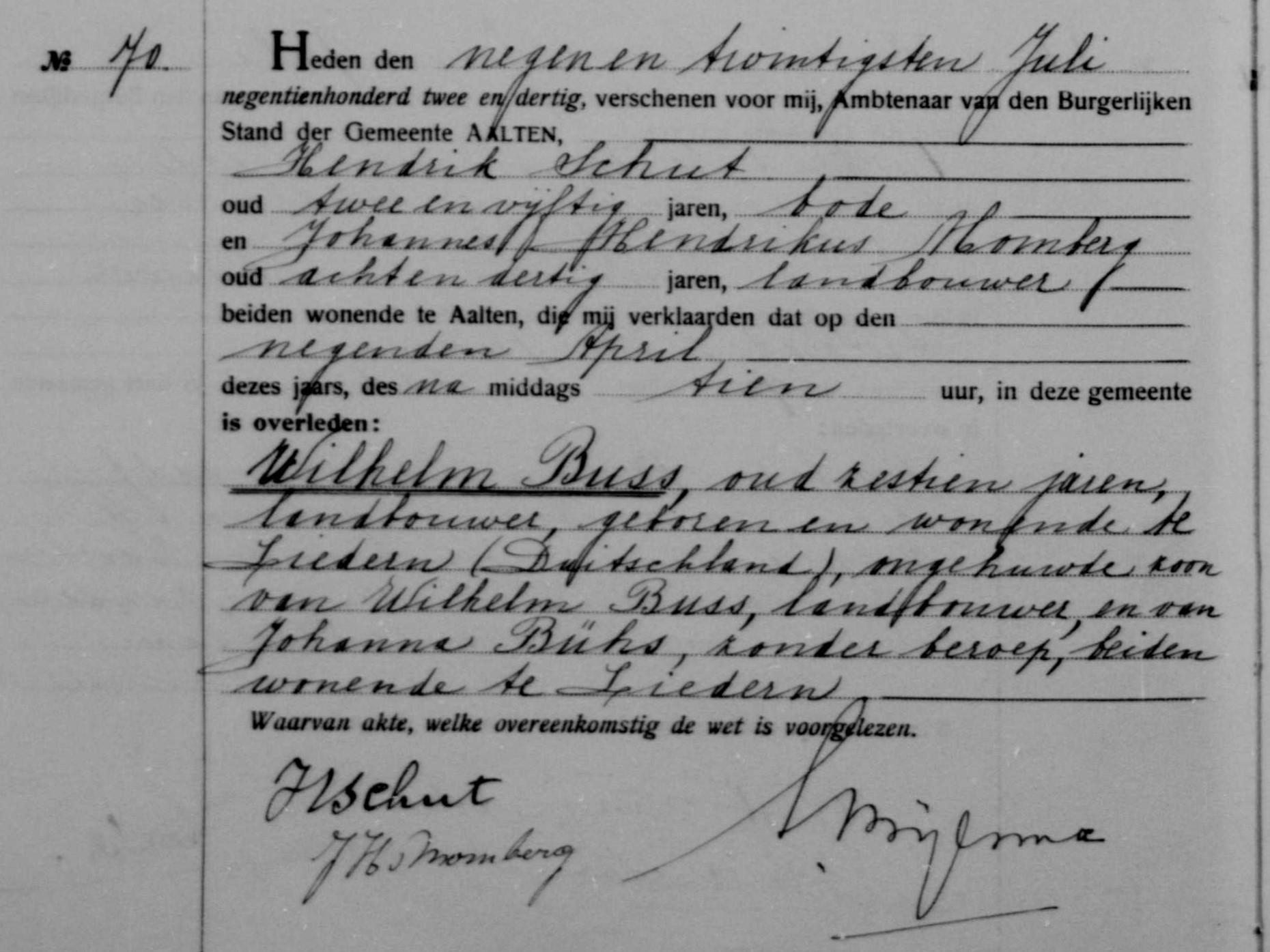
Death register
Although the tragic incident took place on Dutch territory, there was little the Dutch authorities could do, partly because the body had already been taken to Germany before they arrived at the scene. Moreover, both the shooter and the victim were German nationals.
Nearly three weeks later, municipal messenger Schut and farmer Momberg appeared before the registrar in Aalten to report the death. The deceased was recorded as ‘Wilhelm Buss’, aged 16, son of Wilhelm Buss and Johanna Bühs. He had been born and lived in Liedern in Germany (the buurtschap of Spork belonged at the time to Amt Liedern and, since 1975, has formed part of the Stadt Bocholt).
What became of the German customs officer who fired the fatal shot is not known to us.