
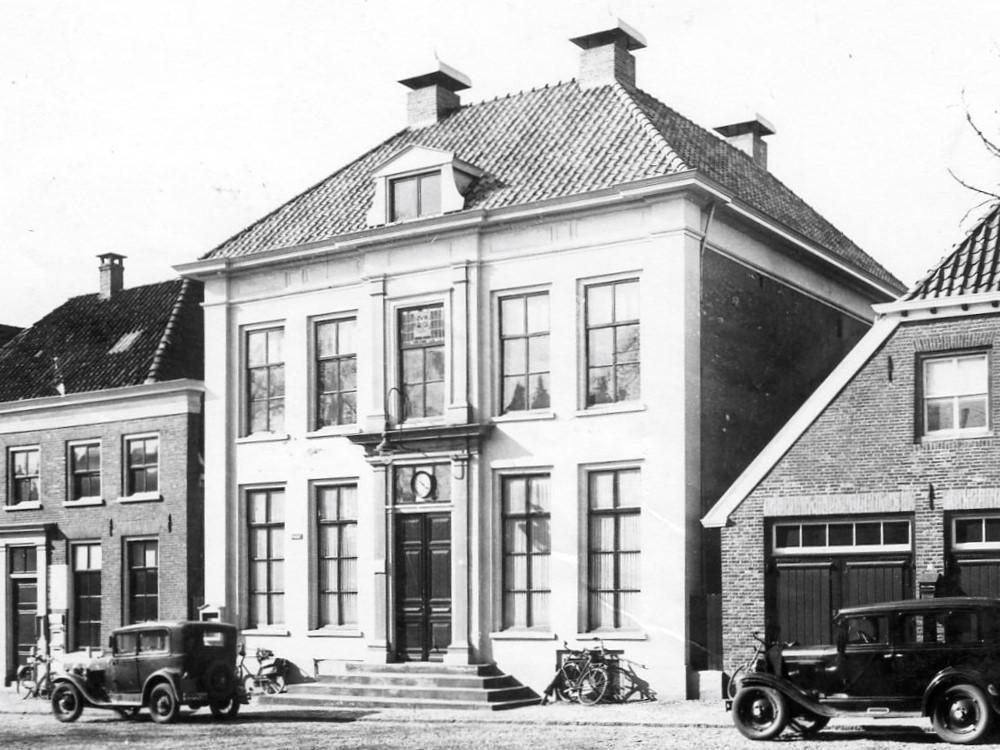
On Friday, another session of the Military Court was held in the council chamber of the town hall. Major Jhr. Mr. van Nispen tot Sevenaer served as president, while Mr. Arriëns acted as military prosecutor.
Behind closed doors, the case against H.A. v. T. was handled first; he was sentenced to 1 year in prison for a sex offense, of which 8 months were suspended with a probation period of 3 years.
Also behind closed doors, the case of F.K. Meijnen was heard, who was sentenced to 9 months in a reform school for looting. The defense counsel in this case was Mr. Voorink from Winterswijk. A. Meijnen, who had stolen cigars and tobacco while clearing rubble from a bombed house, was sentenced after a plea by Mr. Voorink to 3 months in prison with a probation period of 2 years.
E.J. ter Heurne is accused of having taken a lady’s bicycle belonging to Miss J.W. Wesselink. The defendant denies taking the bicycle. According to him, he stored the vehicle after it had been abandoned by an SS man. In view of the bicycle requisitioning, he removed the tires and the saddle. This occurred in October 1944. Miss D. Kuijntjes is heard as a witness for the defense, confirming the defendant’s account. She had even ridden the bicycle.
A debate ensued between the defense counsel and the court regarding the circumstances of this case. No clarity could be reached, as the stolen bicycle was only taken months after October. The case is therefore adjourned to hear several more witnesses.
Meanwhile, M. Wensink appears before the court to answer for the fact that he gave 4 kg of bacon for a stolen bicycle. The defendant denied knowing that the bicycle was stolen property, which the military prosecutor did not find very credible, given the demand: 3 months suspended with a probation period of 2 years and a fine of ƒ 500. The court, however, judged otherwise and acquitted the defendant.
A certain Melitz, an SS man, appeared to have stored a nice amount of fertilizer. Now that he has disappeared, a number of farmers examined the matter and brought the fertilizer to their lands. This brought them before the court, which sentenced them to fines ranging from ƒ 25 or 25 days, while one was acquitted. After mutual consultation, they immediately “opened their purses.” At least it wasn’t a black market price.
H.J. te Grotenhuis needed several items, including a bread knife, a pair of bloomers, and a few cow halters, and stole these from various people. This is the same person who recently attacked an N.B.S. man with a knife during his arrest after escaping. Te Grotenhuis did not make a very reliable impression and is apparently not fully accountable for his actions. The court evidently took this into account and sentenced him to 6 months in prison.
After this, the case of E.J. ter Heurne was resumed. The bicycle was wheeled in and examined by the owner, Miss Wesselink. She declared that it was indeed her bicycle. A.J. Wentink, heard as a witness, stated that he had seized the bicycle in question from ter Heurne. He also recognized the bicycle. The defense witness Miss Kuijntjes also came to view the bicycle and could only partially recognize it. The bicycle she saw at ter Heurne’s in October was in better condition. After the municipal supervisor R. Hoogeveen was also heard as a witness in this case, the military prosecutor demanded a prison sentence of 2 years. The court reduced it by half, so ter Heurne will have to serve 1 year for this offense. Arnoldus Florentinus Voorink also pleaded in this case.
The following defendants have quite a lot on their conscience. A sheep was stolen and slaughtered; about 50 eggs were snatched, as well as a number of chickens and a quantity of tobacco leaves still in the field. Suspected of this are the brothers A.H. and H.J. Bettink in association with H. Dibbets, who in turn, together with T.W. Jansink, stole sheep’s wool and, with one of the Bettink brothers, approximately 500 kg of potatoes.
Messrs. Bettink and Dibbets also worked for their own account. For instance, H.J. Bettink pilfered two shirts, a pair of socks, and a quantity of tobacco while clearing rubble at the house of F.J. te Linde; H. Dibbets took a watch, a shirt, a pair of socks, spools of sewing thread, and a deck of playing cards. Finally, the father of the brothers, H.J. Bettink Sr., was the underlying cause of the thefts of the sheep and the potatoes and had to answer for intentional incitement.
The boys readily confessed to the charges, but Bettink Sr. declared that everything was a lie. The claim that he had encouraged the thefts was pure fabrication. On the contrary, he had always set a good example for the boys and forbidden them to steal. This statement caused quite some hilarity, given the man’s record. The sentences were far from lenient. A.H. Bettink received 3 years, with credit for time served in pre-trial detention.
T.W. Jansink was sentenced to 6 months, while a report will still be issued regarding H. Dibbets on the possibility of placing him in a youth prison. A psychiatric report will be issued for H.J. Bettink Jr., as he was considered to have significantly diminished responsibility. H.J. Bettink Sr. reaped the bitter fruits of his good intentions and will not be able to keep his sons on the right path for the next few years. He was sentenced to 4 years.
Next to stand trial as a victim of his own good intentions was E.J. van de Lende, who, while clearing rubble from the house of F.J. te Linde, had taken a pair of men’s trousers, a piece of lining fabric, and a remnant to keep them safe and out of the hands of the Germans. This happened on 24 March. In the meantime, however, a skirt had already been made from the fabric, which the court took very seriously. He had also forgotten to return the items. The goods were only returned once the case was in the hands of the police. This forgetfulness cost him 8 months in prison, and the goods must be returned.
At the conclusion of the session, the president, Major Jhr. Mr. van Nispen tot Sevenaer, paid tribute to Sergeant Bruggeman, whose excellent work and very good official reports greatly facilitated the work of the court.