
Aalten Vooruit, Wednesday 30 May 1990
by J.G. ter Horst
The old house in Prinsenstraat, next to the building of the Dutch Protestant Union (Nederlandse Protestantenbond), has been demolished. It was a very old house that had seen a great deal of joy and sorrow. It stood somewhat askew in relation to the street. One corner of the property stood more than half a metre closer to the street than the corner opposite it.
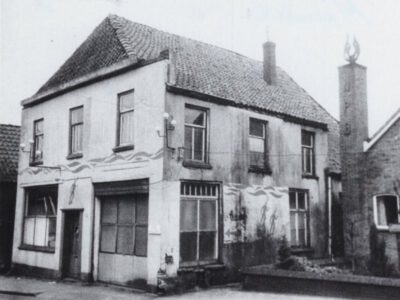
Now, a new building has taken its place. The street has undoubtedly taken on a more attractive appearance due to this redevelopment. The old house was in a state of severe disrepair. It must have stood there for around two centuries and was occupied by the Manschot blacksmith family from the end of the eighteenth century onwards.
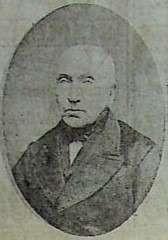
Jacob Manschot and his family lived there in Achterstraat, which was then number 193. His wife, Elizabet Arentzen, was a sister of Roelof Arentzen, who later became the assessor of Aalten. Their son Gerrit Willem, born in 1802 and addressed in daily life by his second name, learned the blacksmith’s trade from his father at an early age and subsequently joined his father in the smithy. An older son in the family, Hendrik Jan, who was also a blacksmith, had a smithy elsewhere in the village.1 Then there was also a daughter named Elisabeth.
Double wedding
On 17 December 1833, celebrations took place in the house. Son Willem married Johanna Geertruijt Becking, known simply as Janna. Elisabeth also entered into marriage on that same day, wedding B.D.G. Muller. Muller was a merchant, and his trade was extensive. In addition to drapery and haberdashery, it encompassed grain, paint, hardware, religious books, musical instruments, hay, and straw.
Apart from the Manschot family, the Beckings and Mullers were also related to the most prominent residents, who, as assessors, municipal tax collectors, or “co-judges”, were able to exert a great deal of influence.
Schaars’s inn
Elisabeth left the house on Achterstraat, and Janna moved in with her parents-in-law. It was then number 228. Janna Becking was born on 24 November 1809. She was a daughter of Lourens Becking, a farmer originally from Varsseveld, and Willemina Geertruijd Schaars, the daughter of an Aalten innkeeper. Following his marriage in 1799, Lourens Becking had become the innkeeper there.
Schaars’s inn was located at the beginning of Peperstraat, on the corner of the Markt. It was run by a member of the Schaars family as early as 1748 and currently, after nearly two hundred and fifty years, still serves the very same purpose. Janna grew up there. She would have attended the village school next to the church, where schoolmaster Schotman taught.
Church organists
As mentioned, Jacob Manschot was a blacksmith, but on Sundays, he played the organ during services in the church on the Markt. When the Zelhem congregation had to appoint a new organist in 1829, Jacob was appointed to act as a judge. He had to assess the playing of the three applicants. In his report on the matter, he wrote: “…having given each of them the same Psalm and hymn, it appeared to me that the last to play possesses the greatest aptitude. Done at Zelhem the 24th of July 1829. J. Manschot”.
However, by 1842, he wished to step down, being 73 years old by then. In a petition to King Willem II, he requested that his son Gerrit Willem succeed him as organist. From that time onward, Willem Manschot served as the organist.
The family
Joy and sorrow alternated in the lives of Willem and Janna. Their eldest infant son, Jacob, passed away at the age of two. Their eldest daughter, Louiza, had been born in 1836. Elisabeth (Betje) followed in 1838. Two years later, Willemina Geertruijda (Mina) saw the light of day, and in 1842, a son followed who was again given the name Jacob. In 1844, Hendrika Johanna (Heintje) was born, and in 1847, Hendrik Jan, who was addressed by his second name. The youngest was Barend Johannis in 1850, or Bernard in daily life. Janna’s father had already passed away in 1830, prior to her marriage. Her mother survived her husband by twelve years and died in 1842.
When grandfather Jacob turned 78, his ten-year-old granddaughter Louiza came to him with a poem: “To greet you with my prayers, On this joyful day of today. Day on which it is your birthday, Grandfather, to me so dear and valued! Day on which I must reflect, What Heaven continued to grant me In possessing you, who always Stands by my side so affectionately.” The verse continued for a bit longer, followed by the signature: “Your loving Granddaughter Louiza”.
The girl also composed a poem on the occasion of her mother’s birthday: “Oh what a joy, dear Mother, Since today is your birthday. Grateful to the Preserver of All, I am gladdened on this day.” This daughter also knew how to express her wishes in poetic form for the New Year, composing a “New Year’s Wish to our highly esteemed Grandfather and dear Parents”. She decorated her wishes with borders of vines, flowers, garlands, or ornaments.
The elderly Jacob Manschot passed away in 1850 at the age of 82, after having been a widower for six years. Willem’s brother had also died by that time.
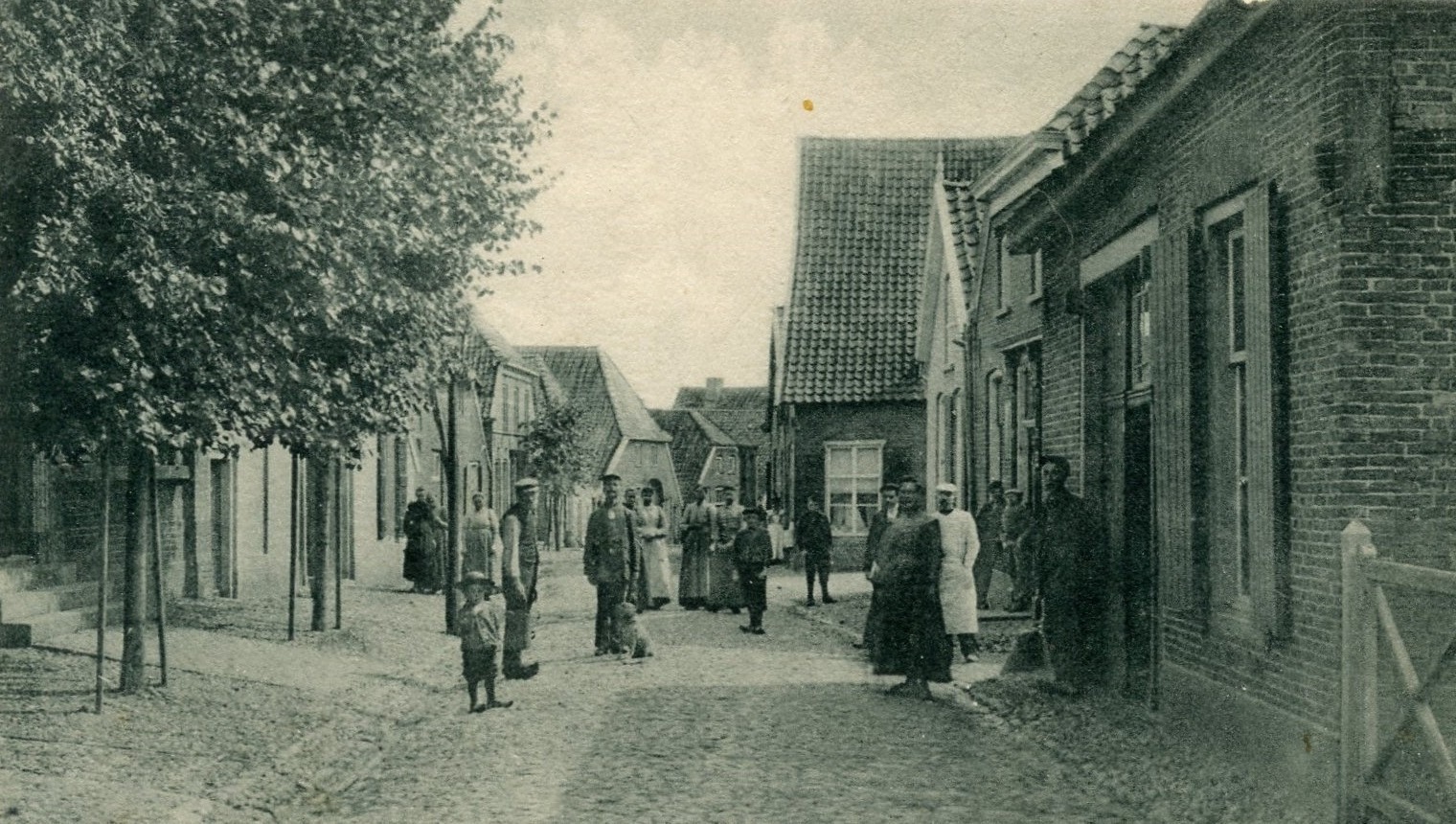
At the time the Manschots lived in Achterstraat, the house had a pointed roof. (Collection: E.M. Smilda).
Willem’s smithy
Willem Manschot dedicated himself diligently to his work in the smithy. For Kobus Prins, he made “a blade for the hoe”. He forged a “haar”, which is a small anvil used to sharpen a scythe or sickle, known as a haarspit. He made a “grepe” (manure fork), repaired the “rear axle of a wagon”, and fitted iron bands around the rims of wagon wheels. He delivered a “knife for cutting bread”, riveted “an iron onto a plate at the hearth”, and manufactured “an oven door” for L. Prins.
In between all these blacksmith duties, Willem also managed his property portfolio of lands and farms, which he leased out. Repairs had to be carried out there from time to time as well. In one place, “4 brass handles with their fittings” were installed; in another, the “latch was repaired, and a new plate bolt with a new catch” was made for the windows.
Sometimes customers paid him in kind, such as Kobus Prins who, for the benefit of Willem’s livestock, collected a few loads of hay from the Ruiterij, the pasture near De Pol. Others transported the harvested rye “from the Esch”. For Willem also ran a small farming operation of his own and owned a barn for his livestock on the opposite side of the street. Like every resident, he kept one or two cows; those of lesser means kept a goat, ‘the poor man’s cow’. In the slaughter month, a home-fattened pig would be hung on a ladder, which a day later was cut into pieces and placed into the salting tub, and even later hung from the kitchen ceiling, the ‘wieme’ (bacon rack). For the daily chores associated with this, he likely employed a farmhand or day labourer. Well-to-do citizens also kept a horse and had a carriage as a means of transport when going visiting.
Horses were no strangers to Willem either. How many had he not provided with new horseshoes in his smithy. Yet on one occasion, this proved fatal to him when he was kicked by a horse. The blow hit very hard. Severely injured, he was placed into his box bed in an unconscious state. His wife nursed him for two weeks, after which he died. Janna had become a widow, the children fatherless, and the church council had to look for a new organist.
Extensive possessions
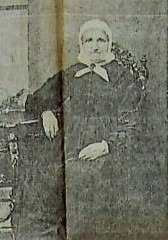
Now Janna suddenly stood alone with her seven, still young children. The eldest daughter, Louiza, was only seventeen years old, and little Bernard was just three. Initially, attempts were made to keep the business running with the help of a journeyman, but this proved impossible. Janna was forced to close the smithy.
It was fortunate that there were substantial property holdings. This enabled her to provide for her livelihood from the income they generated, and furthermore, to pay for her children’s education. None of the boys had been in a position to learn the blacksmith’s trade from their father. Consequently, this profession never occurred in the family again.
Since the passing of her husband, Janna kept the accounts for the leased lands and smallholdings. She maintained these records in a folio-sized “Land Lease” (Landhuur) book. In it, the lands were categorised into garden land, arable land, pasture, and uncultivated plots.
Garden land for vegetable plots
By garden land (hofland), Janna meant the relatively small plots situated close to the village that were used as vegetable gardens. In her accounts, she notes the names of plots, some of which are still known today. Most pieces of the garden land were divided into various parcels, and each parcel had its tenant.
There were four parcels on the “Boskerhof”. This may have been near ’t Boske, at the end of Richterinkstraat and on Varsseveldsestraatweg. The plot in “den Kraayenboom” likewise consisted of four parcels. That name is still known today for the land opposite the agricultural school on Lijsterbeslaan. Hendrik Jan Meinen was a tenant for ƒ 3.50, as was Lammert Prange. Willem Kasseler and Lammert Klompenhouwer clearly had a smaller piece, as they paid ƒ 2.00 and ƒ 1.50 respectively. Later, Janna used a garden there herself, as did Willem Huls, Mrs Hoftijzer, and Abraham ten Dam.
Then mention is made of the Knibbelweide, which must have been located on the Kemena. There were six parcels there. The total yield from this was ƒ 14.20 per year, though this had risen to ƒ 19.70 after 1883. Furthermore, there was a parcel in the Paardeweide leased by a man named Laak. The Paardeweide was also located on the Kemena, where the building of the Christian Comprehensive School stands today.
Finally, Janna’s bookkeeping records thirteen parcels of garden land on Het Smees. Gardening there were, among others, Berend Prins, Jan Kappers nicknamed “Hompele”, and Hendrik-Jan Schaapveld. Later tenants included Jan de Wikker, Kris Veldboom, Jan te Hoonte, and “the wife of the Wildeboer”.
The gardens on Het Smees frequently changed tenants. The names of Willem Walvoort, Jan Neerhof, and H.H. ter Beest also appear, the latter later leased to Fles, as well as D.J. Hoitink, G.J. Rots, and Hendrikus te Hennepe.
Until 1862, the garden land generated an annual rental income of ƒ 81.70. From 1863 to 1882, this was leased out through the mediation of notary B.A. Roelvink. The yield was then significantly higher, namely ƒ 98.05. When this notary passed away in 1882, he was succeeded by notary Maitland, but from then on, Janna made the lease agreements herself again. However, the income was then a few guilders less per year.
Not everyone paid their rent on time. It had been agreed that payment would be made on St Martin’s Day, which is 11 November, but some did not bring the money until the following year. Janna sometimes had to wait until May. In a number of cases, when the rental debt kept mounting, the tenancies of those involved were terminated. Some were three years in arrears.
The leased arable land
In addition to garden land, Janna also owned arable land that she leased out. These were often plots of one or more schepelzaad (an old unit of land area) in size. This arable land was located “at the front of the Esch”, by which is meant the plot where the Sonoco factory stands today on Damstraat. On the Smees lay 64.50 ares, and on the Boskeres 55.10 ares. In the Giezenbos “a molderszaad” (another old land measure), furthermore 50.90 ares were located there; the Draaiom arable land was 28.70 ares, which she sold in 1872 to the “Reformed Poor” (Hervormde Armen); the Holland 58 ares; the Neerhoffer Delle 42.50 ares; Smachtschot 65.10 ares, as well as another “molderszaad”. Then mention was made of Langevoren, nine schepelzaad in size, or 1.27.70 ha. Behind the Linde, Janna held more arable land, as well as the Peereboom piece, measuring 38.40 ares, and four pieces of Kempink, five schepelzaad on Prinsenkamp, and another plot located “on the Nes”.
Janna owned several of these lands jointly with her two brothers. Most plots were leased for a sum of money, but a few were also leased against the “third sheaf” (derde garf). This meant that the tenant owed a third of the yield as rent in kind. For the tenant, this had the advantage that if the harvest yielded little, the rent was also less.
The third sheaf concerned the rye crop, while sometimes the landlord/landlady (lessor) was entitled to some fruit from the orchard. In later years, the third sheaf was abolished on “Smachtschot”, which had been leased under those conditions by Lievers. The latter subsequently “bought the sheaves for 8 guilders”.
Janna also made use of services in return on multiple occasions. In 1880, “Derk Hoftijzer brought back a new water bucket from Bocholt”, and a year later, he sowed for her “a schepelzaad of spurrey … a schepelzaad of turnip seed… two schepelzaad of rye… carted soil for a day and two carts”. For all that work, ƒ 7.77 was deducted from the rent.
A certain Heuzinkveld manufactured 23 ells of coarse linen cloth for Janna in 1866. She had likely supplied the flax (or yarn). The service was worth ƒ 2.75, so Heuzinkveld still had to pay the remainder of the rent, being ƒ 1.75.
Pastures
As previously noted, a pasture behind the Pol, called Ruiterij, belonged to the assets of the Manschots. Janna also owned 1.14.84 ha of pasture on the Smees, which was (probably) sold in 1870 for ƒ 1390.00.
Another pasture measuring 1.82.40 ha was located on Boterdijk in the Goor, which was also sold in 1870. The proceeds from this were considerably less, namely ƒ 600.00. From the estate of her brother Jan, Janna obtained a pasture “on the Broek”, while she also owned pasture and woodland in the Giezenbos.
Turf and peat land
The woodland and peat lands were not leased out. However, the produce from them could be sold privately or by public tender, such as standing timber. This also occurred with peat lands. The field would first be mown, and the top sod containing reed stubble and roots cut away. These were schadden (peat sods), which were dried and used as fuel. Turf (plaggen) was also cut from the heath-covered plots, which often ended up in the deep litter barn or stable and, mixed with animal excrement, was used as manure on the fields.
Janna owned woodland in the Goor, half of which was owned by her sister-in-law Elisabeth, who was married to Muller. Later, following the death of these parents, the half-ownership passed to the five children, the Muller Heirs.
Then mention is made of two pieces of woodland in the Schaarsheide, of woodland on the Kieftsheide, on the Hollenberg, near the Smeesweide (pine forest, coppice, and heath), and “copses in the Barloschen Esch”, peat land in Varsseveld, and peat sod land in ’t Goor, as well as in “Stapelkamps Bosch”, which she had inherited from her late brother Jan and had to share with her brother H.J. Becking.
In the year 1880, Janna sold ƒ 17.90 worth of turf and peat sods. Shortly beforehand, she had “sold wood to the Prange from Lintelo for 260 Guilders” from one of her smallholdings.
The smallholdings
The property of Janna and partners also included a number of smallholdings. The first mentioned is the Neerhof in Dale, of which D.J. Neerhof was the tenant. The tenancy was terminated in 1866 when the farm was sold.
Then there is the Lubbers smallholding in Barlo (Meinenweg), which was initially leased to J.H. Lubbers, but from 1867 to G.J. Mierdink for “sixty guilders and 96 eggs”. In 1877, the farm was sold to the tenant for ƒ 13,370.00.
Next is the Pennings smallholding (Hofstedeweg). Gerrit Jan Pennings is the tenant, who must yield annually for it “the sum of 48 guilders, 8 rent chickens, 96 eggs, and 4 pounds of flax”. In 1872, Pennings “departed for America”, and the farm was leased to Roelof Somsen for “56 guilders and 96 eggs”. Every now and then, Somsen performed services in return by collecting peat sods for Johanna, earning him ƒ 7.65, which was deducted from the rent.
The Slaa in the Heurne was also, together with her brothers, part of Janna’s property. Until 1868, G.J. Huitink was the tenant, followed by Jan de Breukelaar “Who must pay annually 40 Guilders and 60 eggs”. From 1880, the Slaa was leased to Wensink, who had to put down ƒ 48.00 and sixty eggs for it. In those years, Janna also notes: “sold a calf to Wensink for ƒ 5.50”.
Then there is the Slaa Schoppe, which was leased from 1852 to 1867 by J. Weggelaar, and thereafter by Evert Jan Beernink. The rent was ƒ 20.00. In 1874, Beernink scutched flax for Janna, which earned him 75 cents.
When her brother Jan died childless, he left Janna shares in three smallholdings, namely “Brijzak”, leased by farmer Smees, and “De Scheper” on the Haart, which was leased to Hendrik Jan Rensink for ƒ 65.00. This farm was sold in 1890, however. The third smallholding is Bekker on the Haart, which was leased for ƒ 40.00. This farm was also sold and, together with De Scheper, fetched ƒ 12,600.00. Finally, the Grevengoed in Barlo is mentioned, which consisted mainly of arable land. It must have been a large estate, located “next to Zwietink” and “near Wolterink“, thus on the Markerinkdijk.
In conclusion
Finally, a few notes on Janna’s children. Mina married J.G.H. Martens in Eibergen. She was widowed early and later, with those of her children who were still at home, moved back in with her mother on Achterstraat, after recovering over a period of six years from a nervous breakdown brought on by the death of her husband followed by that of her two youngest children.
After her mother’s passing, she moved to a property on the Markt, currently number 12. Louiza married Hendrik Beukenhorst, a goldsmith and silversmith in Winterswijk. At the same time, Betje also entered into marriage, wedding Abraham ten Dam, who later became a comb manufacturer. Her son Jacob suffered a very deep depression, presumably as a result of unrequited love, for which he had to be admitted to an institution in Zutphen for many years. He died unmarried in 1873. His brother Jan became a doctor in Winterswijk and married A.G. Tenkink of “Meenk” in Miste. Daughter Heintje became the wife of her second cousin B.H. Becking, who owned a ham smokery and wholesaled salt. He was consequently known as “Salt-Becking”.
The youngest son, Bernard, managed the Ten Dam & Manschot comb factory alongside his brother-in-law. He had a house built on Bredevoortsestraat, currently number 51. The Ten Dams lived across the street at number 40.
Janna continued to live on Achterstraat until her death and passed away on 22 January 1892. She was 82 years old.
The above is a summary adaptation of a family chronicle, derived in large part from the “Land Lease Book”, compiled by Henk ten Dam in Zwolle, entitled “Johanna Geertruyt Manschot-Beckings Landhuurboek vertelt (1799-1892)”, volumes I and II, 1985, available for consultation in the archives of the municipality of Aalten.
Footnote
- This appears to be incorrect. Gerrit Willem’s older brother Hendrik Jan (*1799) did indeed also become a blacksmith, but he died a bachelor in 1839 in the house on Prinsenstraat, which was then number 228 (sources: ecal.nu and wiewaswie.nl). There was, however, another blacksmith named Hendrik Jan Manschot who lived on Kerkstraat, but he was a brother of Jacob and thus an uncle of Gerrit Willem. ↩︎