In 1813 the Israelite Congregation in Aalten consisted of the following members:
Jacob Gompers Vles(+) (1753), church administrator (1810) ⚭ Sara Isaac (Stadtlohn/D, 1763 – 1825) with 4 children: • Gompert Jacob Vles, 17 years old, ovl. 1854; ⚭ Brandje Simon • Isac Jacob Vles, 14 years old • Gumken Jacob Vles, 25 years old, ⚭ 1815: Simon Jacob Schaap • Fijken Jacob Vles, 21 years old
David Isak Franken (Aalten, 1753 – Aalten, 1823) with 1 child: • Aleida David Franken (Aalten, 1799 – Aalten, 1865), ⚭ Benjamin van Beek
David Jacob Schaap, ⚭ (1) 1789: Duifken Levie, *Elten, 1771, ovl. 1811; ⚭ (2) 1815: Hanna Gompert, *Groenlo, 1767, ovl. 1844; with 1 child: • Levi David Schaap, 6 years old, ovl. 1840, unmarried
David Isac de Haas(+) (Aalten, 1767 – Aalten, 1855); address 1823: Landstraat 31 ⚭ Sophia Gompers (Groenlo, 1772 – Aalten, 1853) with 4 children: • Isac David de Haas (Aalten, 1803 – 1883) • Gompert David de Haas (Aalten, 1809 – 1877) • Eva David de Haas (Aalten, 1806 – 1866) • Sebilla David de Haas (Aalten, 1812)
Moses Jacob de Haas ⚭ 1802 Sophia Isaac (Jilchen/D) with 4 children: • Levi Mozes de Haas, 8 years old • Jacob Mozes de Haas, 6 years old • Sara Mozes de Haas, 2 years old • Hendele Mozes de Haas, 4 years old
Simon Jacob Schaap (Aalten, 25-12-1780 – Aalten, 30-03-1825) ⚭ Sara Casper Cohen (Winterswijk, 1787 – Aalten, 11-04-1814) with 4 children: • Scheune, Simon Schaap (Aalten, 08-11-1807 – Aalten, 20-11-1869) • Klara Simon Schaap (Aalten, 03-10-1809 – Aalten, 18-12-1878) • Diena Simon Schaap (Aalten, 04-01-1811 – Zevenaar, 14-08-1872) • Jacob Simon Schaap (Aalten, 02-02-1813 – Aalten, 28-11-1876)
Sara Joseph, wed. Aron Gompert van Gelder (A.G. van Gelder was born between 1798 and 1804)(+); with 5 children: • Joseph Aron van Gelder (Aalten, 15-03-1778 – Aalten, 20-03-1847) • David Aron van Gelder (Aalten, 06-06-1784 – Aalten, 19-06-1859) • Rachel Aron van Gelder (Aalten, c. 1785) • Gompert, Aron van Gelder (Aalten, 11-11-1792 – Aalten, 08-09-1836) • Liefman Aron van Gelder (Aalten, 05-01-1800 – Aalten, 07-04-1866)
Bilha Abraham van Gelder (= Sibilla Moses), with 1 illegitimate son: • Philip van Gelder, 44 years old
Hindele Ansel van Beek (= Hendele Jacobs, 1772 – Aalten, 1841), with 1 illegitimate son: • Benjamin Nathan van Beek (Aalten, 1800 – Aalten, 1873)
Eliaser / Lazer Levie de Haas
Isaac Abraham de Haas
Samson Jacob Schaap, *1785; ovl. between 1813 and 1823, unmarried
(+) This sign refers to the article by Peter Lurvink in Mishpoge II / 1, Jan. 1989: “David Markus and his descendants, a Jewish family in Aalten”.
After the Union of Utrecht , freedom of religion prevailed in the Netherlands. As a result, many Jews came to the Netherlands at the beginning of the 17th century. The first Jews in Aalten were documented around 1630. At that time, Aalten was a small, isolated and closed agricultural-artisan village community with a poor and still highly superstitious population.
People looked strangely at the Jews with their different religion, customs and clothing. The local population considered them strangers for a long time. Until the Napoleonic era, the number of Jews was limited to four families, who lived in the remote streets of the village of Aalten. The profession was usually ‘merchant’.
Bredevoort
As early as 1631, Bredevoort had Jewish residents. At the time, they lived mainly around the Hozenstraat, where they also had their own cemetery, popularly called ‘De Timp’. Around 1700, a Jewish merchant in manufactures set up a house synagogue in Bredevoort. In 1714, this house synagogue moved to a more spacious location, a large stone barn on the Ganzenmarkt between Hozenstraat and Gasthuisstraat. This barn is still there. Jews from Aalten and Lichtenvoorde also visited this synagogue.
Until 1821 the community was still part of Winterswijk, but in 1830 it became an independent municipality. Around 1830, a real synagogue was built on the Vismarkt.
Around 1800, the Jewish community in Bredevoort had almost as many members as the Aalten community, but steadily declined in size in the course of the 19th century. In 1900 there were not enough members to hold regular services and the Bredevoort congregation was merged with that of Aalten.
The building on the Vismarkt served as a synagogue until the beginning of the First World War. Around 1920 the synagogue was converted into a residence. Nowadays the building is a municipal monument.
Former synagogue Vismarkt 9, Bredevoort
Aalten
It was not until 1776 that a ‘Jewish church’ in Aalten was first mentioned. That must also have been a house synagogue. Between 1800 and 1850, the number of Jewish communities in Aalten grew from 39 to 70, mainly due to the expansion of the family in the existing Jewish families: the number of households hardly increased.
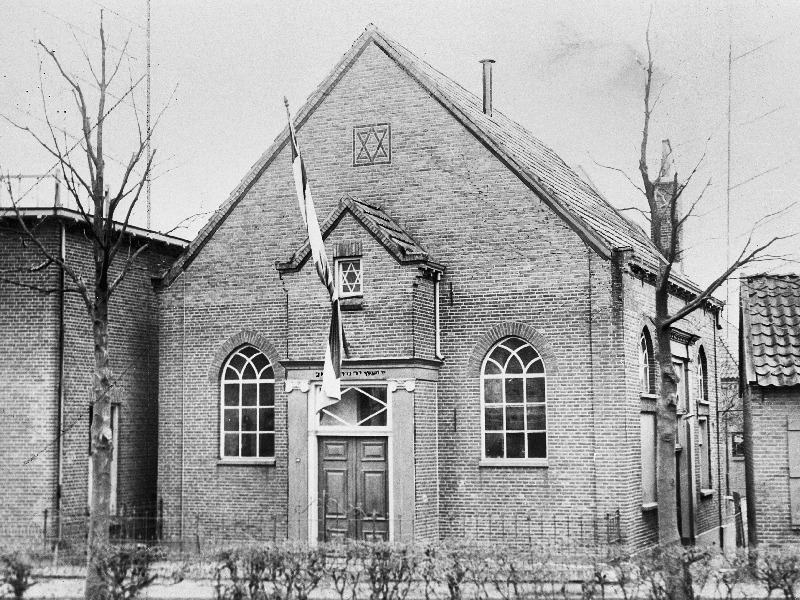
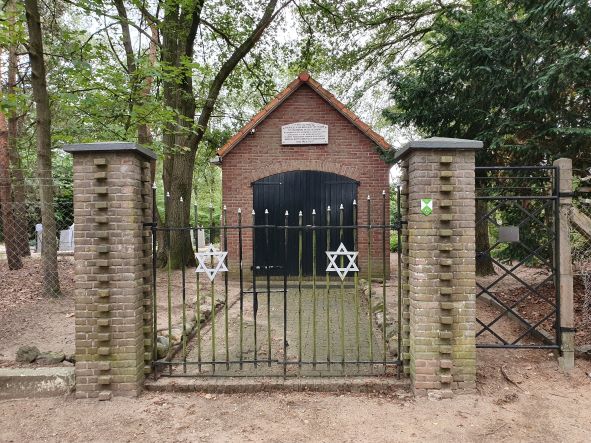
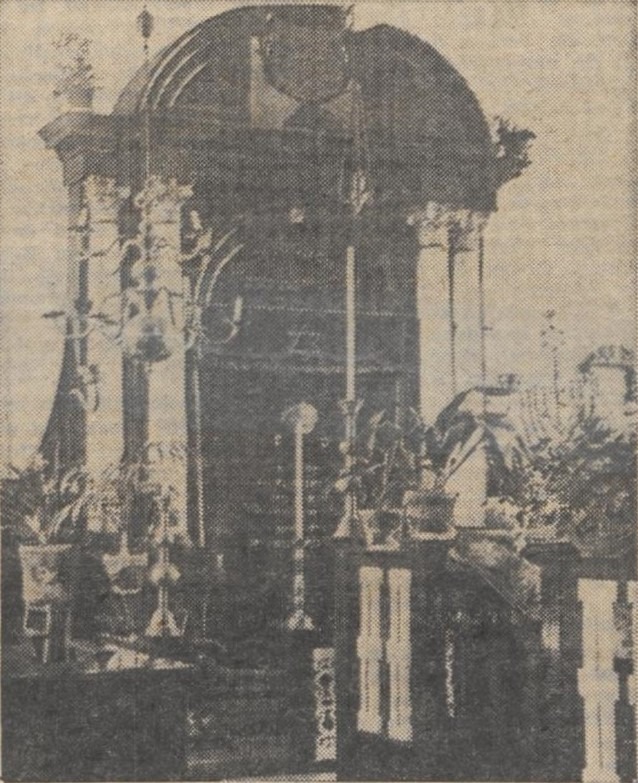
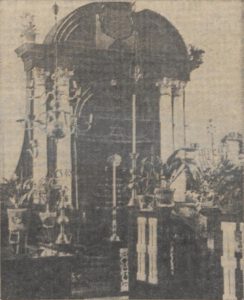
In 1857 the synagogue on the Stationsstraat was put into use. The Jewish community acquired ownership of the cemetery on Haartsestraat in 1852, but had already been used there (we do not know for how long) to bury the dead.
In the period 1870-1900, the number of Jewish inhabitants in Aalten decreased from 80 to 50. This must be explained by local circumstances: the number of Jews who had to earn a living with a small business had become too large for the hardly grown population of Aalten (which even decreased slightly due to emigration) due to the strong growth in the preceding years. Some of the Jews from Aalten therefore also moved away, especially to the larger cities in the east of the Netherlands (Arnhem, Zutphen, Deventer).
Only when the total population of Aalten started to increase again, the number of people working in the small trade could also grow again. And that happened, not only because of birth surplus, but for the first time in a long time also because of the settlement of new families.
Synagogue, Stationsstraat 7, Aalten
Entrance Jewish cemetery, Aalten
Around 1900
At the beginning of 1900, the church board had three members. There was a religious school with one teacher and a ritual bath. In addition to a funeral association for men, Aalten had a women’s society that offered help in case of illness and death.
The Jewish community in Aalten was religious, although some may have done a little more about it than others. Social control did play a role in this. However, the Sabbath rules were not always strictly observed for economic reasons.
The Jewish community in Aalten consisted mainly of cattle traders and butchers. The fact that many within the small congregation belonged to the same professional group often led to quarrels, which were often fought out in or near the synagogue. These tensions and quarrels, between ritual butchers who had to determine whether a cow was kosher, and between butchers who wanted to sell, were just as much a part of the Jewish culture in Aalten as the mutual aid in case of illness and poverty.
Integration
In the 17th and 18th centuries, Jews were still tolerated as foreigners, but in the 19th century a process of integration gradually took place. This led to the fact that the Jews were an accepted minority in the early 20th century. For example, they held board positions in associations such as Aaltens Belang, the Oudheidkamer and the Feestgebouw.
Marcus Gans was co-founder of the Peters en Gans pipe factory on the former Gasthuisstraat. Jewish cattle traders were involved as shareholders in the establishment of the dairy . The public school had Jewish teachers, the Aalten Orchestra Society, the Thalia drama society and Symphonia had Jewish members. Jewish members were part of the Aalten branch of the National Crisis Committee and the volunteer fire brigade.
Most Jewish children also had non-Jewish friends and the older ones were also usually friendly with non-Jews. The municipal council was officially represented at official events in Jewish circles.
Pipe factory Peters & Gans (right), Gasthuisstraat, ca. 1910
Refugees from Germany
In the years after 1933, a stream of refugees started from Germany. After the Reichskristallnacht in 1938, this flow increased sharply. A small part of those who were admitted to the Netherlands were allowed to settle in Aalten. Most were sent to special refugee camps that had been set up in various places in the country.
On 1 January 1942, Aalten had 17 inhabitants with German nationality (which, by the way, they had officially lost on 25 November 1941: the German refugees had effectively become stateless citizens). In the first weeks and months of the German occupation, everything remained quiet in Aalten. Measures taken against the Jews did not directly affect the Jewish community in Aalten in the first year. What would have consequences in the long run was the registration of all Jewish residents in the autumn of 1940. 63 cards were sent to Arnhem.
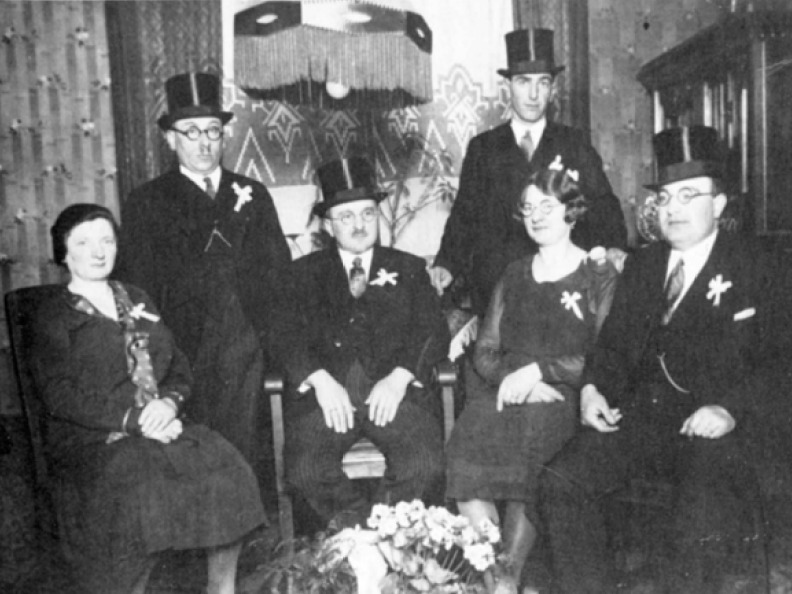
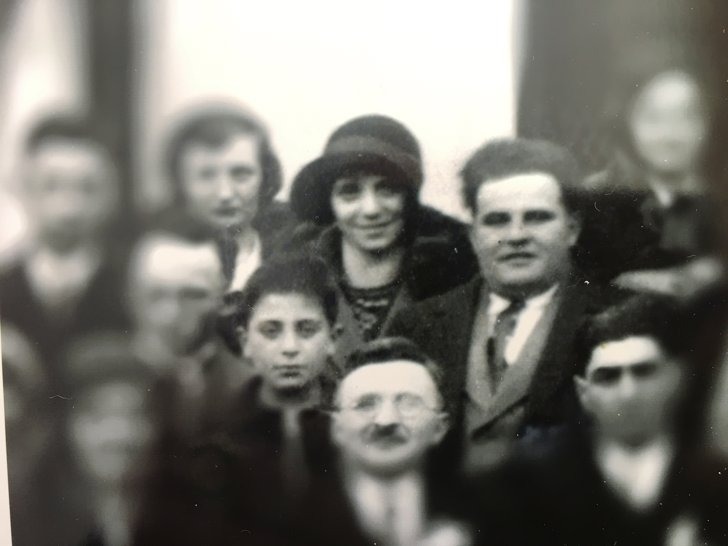
Members of the Jewish community of Aalten in 1932
Choices
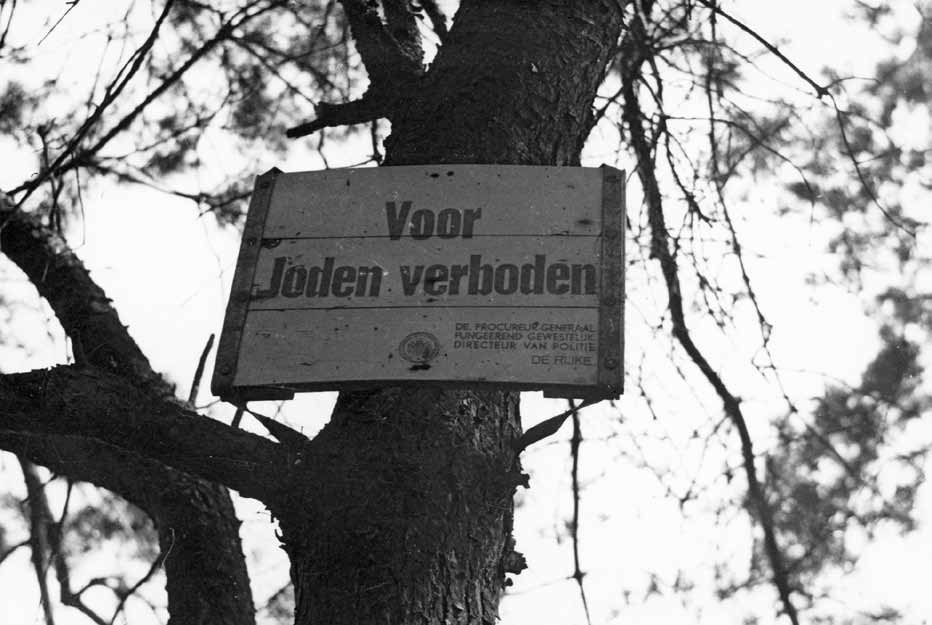
Prohibition at the entrance of the Loohuis
In 1941, the expulsion of Jews from public life began. First there were fewer and fewer advertisements from Jewish shopkeepers in the newspapers, then came the regulations that forbade them to participate in public meetings and access to public spaces. Jewish pupils were banned from education. In the same year 1941, the first Jewish victim fell from the Jewish community in Aalten as a result of a raid.
The list of prohibitions and obligations that applied specifically to Jews continued to grow and in the summer of 1942 the deportations began. They had to decide whether or not to go into hiding. Those who did not opt for the latter were deployed for what was called ‘the expansion of work in the east’ and – as we know afterwards – murdered in the gas chambers.
Hiding
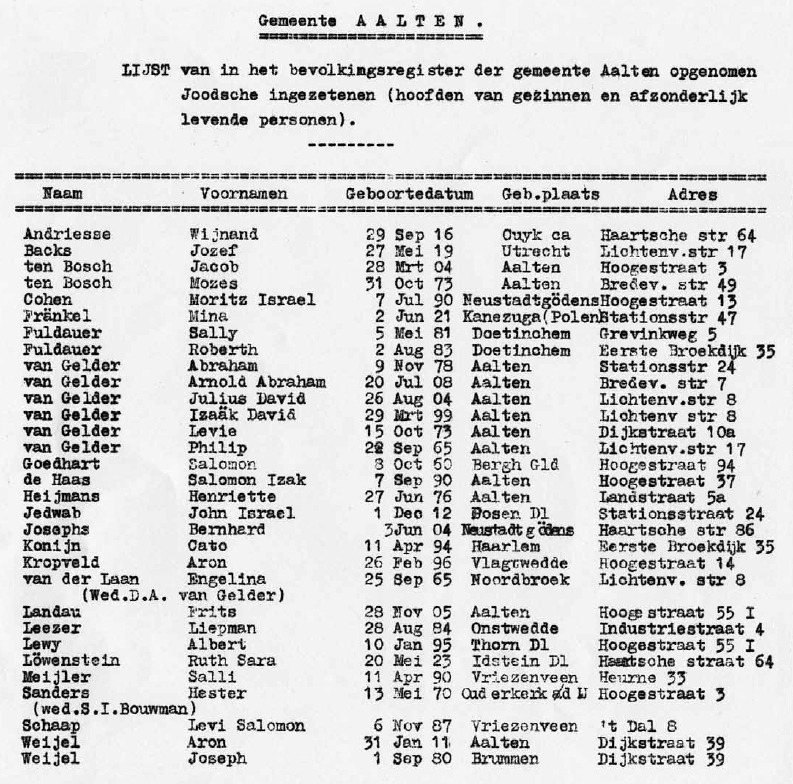
On 13 July 1942, the overview of the Jews in Aalten was sent in five copies to the Zentralstelle für jüdische Auswanderung in Amsterdam. That was the beginning of the end.
With the exception of the NSB members, the non-Jewish population of Aalten generally behaved helpfully. In retrospect, however, one can say that both Jews and non-Jews underestimated the danger and did not see the severity of the measures.
On 4 October 1942, 10 Jews from Aalten, family members of Jews who had been transferred to Westerbork from a number of closed labour camps, were put on a transport to the transit camp and from there to Poland. Shortly afterwards they were removed from the population register ‘because they left for abroad’.
Within a month of that, 37 Jews from Aalten were in hiding. They were also removed from the population register with the addition v.o.w. (left, unknown whereto). At the beginning of 1943, another 15 Jews from Aalten went into hiding. The other 25 were deported via Vught or Westerbork. This made Aalten officially Judenrein on 10 April 1943.
List of Jewish residents of Aalten, 1942
Victims
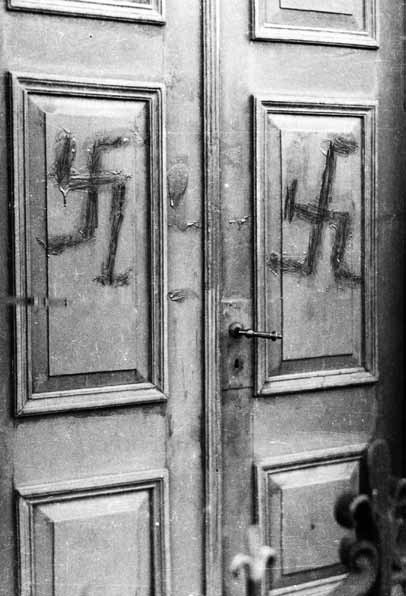
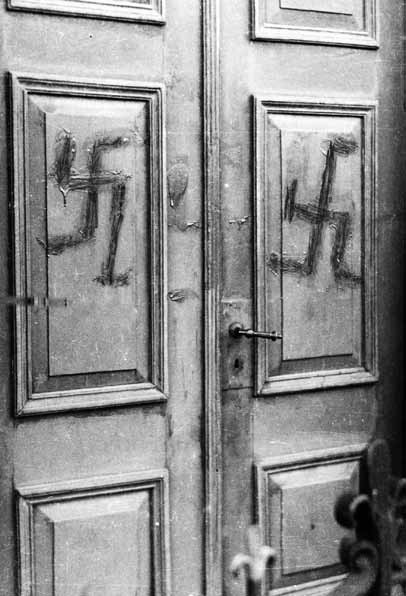
Graffiti synagogue in Aalten
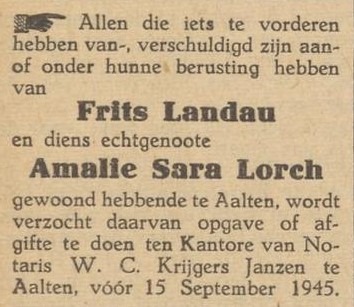
The houses of the deported families were emptied (for the benefit of German Bombengeschädigte) and rented out again. Outstanding bills and transport costs were paid by Lippmann and Rosenthal, the bank in Amsterdam where all Jewish assets were housed.
In 1941 people went into hiding temporarily, but from October 1942 the hiding took on a permanent character. Not everyone returned from hiding.
Of the 52 Jews in hiding, three eventually died during their hiding period and six were arrested, deported and murdered after being betrayed. There have also been Jews who were born in Aalten, who may or may not have spent a large part of their lives there, but who lived elsewhere in the Netherlands during the occupation due to relocation. The information about their fate is not complete. If we count them, the number of victims from Aalten is much larger than the 34 of whom we know for sure.
After the war
The 46 members of the Jewish community in Aalten who had survived the war were distraught. Many had lost a large part of their family and no longer owned anything. Their attempts to get some of their former possessions back did not always meet with cooperation and often met with reluctance.
The number of Jews in Aalten steadily declined after the war. Young people left for Israel or to the west of the country, the older ones died. In 1965 the number was 28, in 1981 21, and now there are only a few.
Hint
The National Hiding Museum in Aalten tells the great history of resistance, hiding and freedom before, during and after the Second World War with ‘small’ stories. The museum examines the choices and dilemmas of ordinary citizens on the Dutch-German border and uses the stories of the past to have a conversation about today.
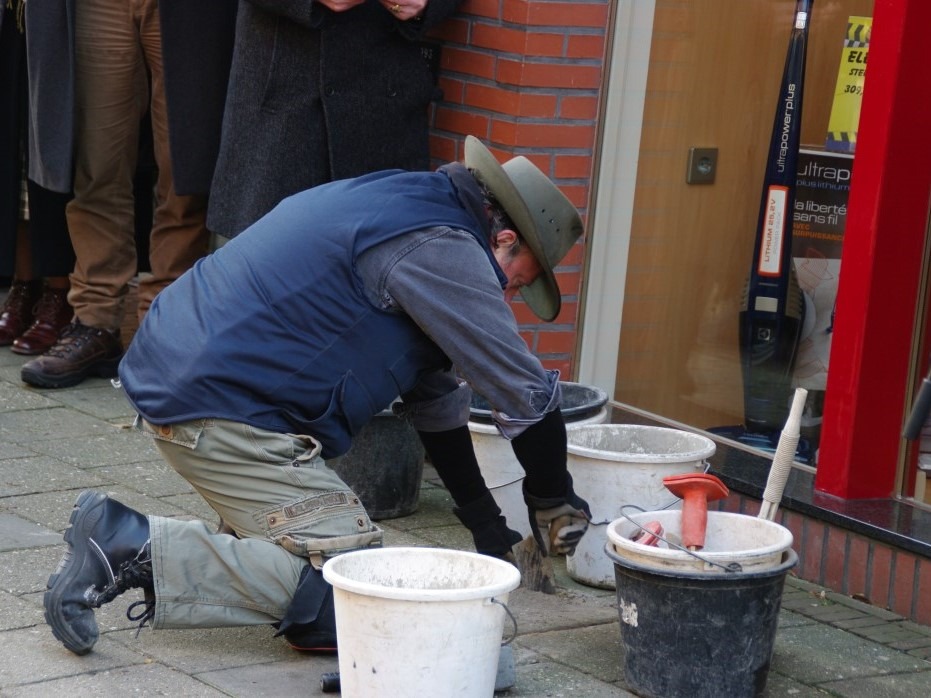
Gunter Demnig placing the first Stolpersteine in Aalten
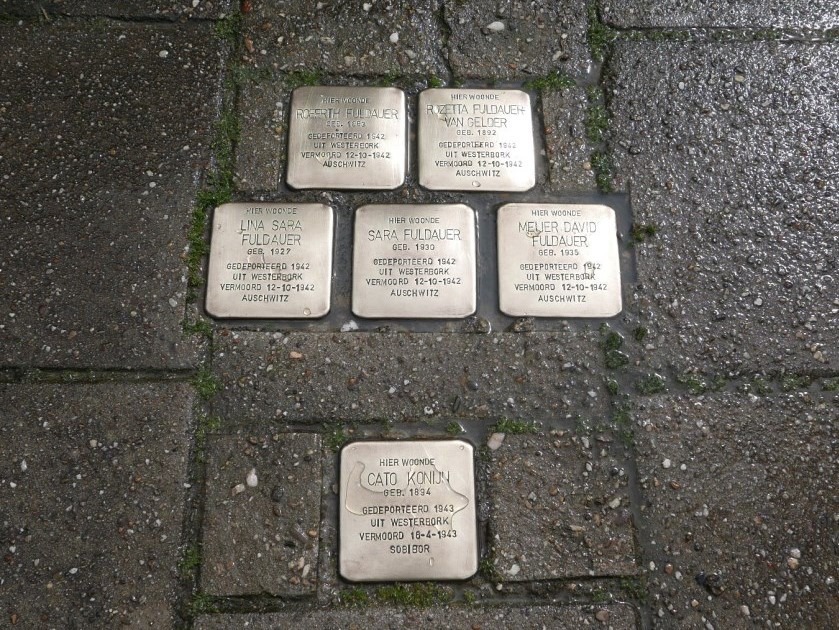
In Aalten, 34 Stolpersteine (stumbling stones) are laid across twelve addresses. A Stolperstein is a memorial stone placed in the pavement in front of the house from which people were deported by the Nazis to extermination camps during World War II. When you see such a stone—usually unexpectedly—with the name of a victim, you are momentarily reminded of how millions became victims of systematic murder during that war.
The stones have a surface area of 10 by 10 cm. A brass plate is affixed to the top, into which the name, year of birth, date of deportation, and the place and date of death are stamped. Each stone serves as a memorial to a single victim: a person who lived in that very spot and was deported from there, never to return.
Originator
The Stolpersteine project was conceived by the German artist Gunter Demnig. He deliberately kept the size of these ‘stones of offence’ small, requiring one to bow down to read the inscriptions.
Demnig began laying the first Stolperstein in 1997 in the Berlin district of Kreuzberg. Today, Stolpersteine can be found in many countries. Gunter Demnig thus gives every victim their own individual monument. His motto is: “A person is only forgotten when his or her name is forgotten.”
Initially, he made all the stones himself, as he felt mass production conflicted with the project’s ethos. However, forced by the project’s rapid growth, he is now assisted by an artist friend. He insists on personally laying the first stones in any given location. The remaining stones are now usually installed by municipal pavers.
Stolpersteine in Aalten
In Aalten, 34 Stolpersteine have been laid at the following addresses:
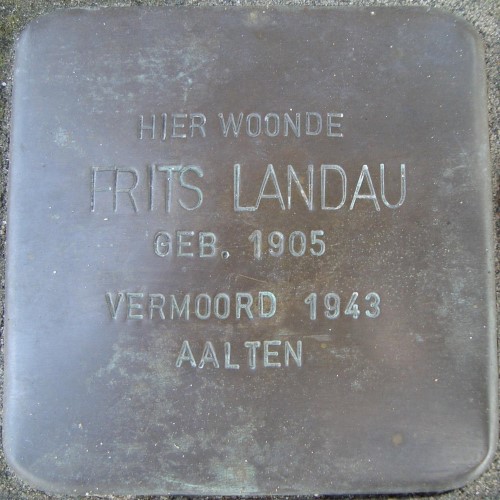
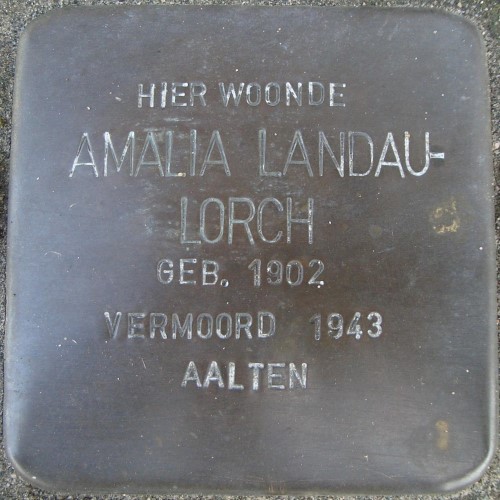
’t Dal 1: Levi Salomon Schaap, Ella Schaap-Philips, Eliazar Hars Schaap, Frits Landau, Amalia Landau-Lorch
Dijkstraat 10a: Levie van Gelder, Jula van Gelder-Landau, Arnold van Gelder
Eerste Broekdijk 51: Roberth Fuldauer, Rozetta Fuldauer-van Gelder, Lina Sara Fuldauer, Sara Fuldauer, Meijer David Fuldauer, Cato Konijn
Grevinkweg 5: Sally Fuldauer, Regina Fuldauer-de Jong
In one instance, the stone could not be placed in front of the victim’s residence because the building (Industriestraat 4) no longer exists, nor is there a pavement where it could be installed. Therefore, this stone was laid in front of the synagogue.
There is still a synagogue in Aalten. In recent weeks, one could read about it in both the national and international press. Seldom before can this Beth Haknesseth have been so much in the public eye. A procession of journalists has flocked to Aalten. “I can’t bear to see another journalist,” I noted from the lips of one of Aalten’s Jews. They travelled to Aalten because the synagogue has been defaced. It was but one incident among a multitude of anti-Semitic expressions reported in the Netherlands and abroad in recent weeks. One could have learned of those other incidents as well—though not in this publication. One simply cannot keep up with them all.
And not only that: anti-Semitism is not a question of us. It is a disease that proliferates and proliferates, usually in silence, occasionally openly. We ourselves are less upset as long as there is no survival involved, than the groups among whom the tumor rages. We ourselves have become more self-aware, more self-confident. On the one hand, it is because of the appalling that we had to go through only a generation ago — and what could happen to us even worse — because of the stimulating effect that the existence of the State of Israel exerts on us.
Synagogue in Aalten defaced
Perhaps these are the reasons that in Aalten there has been hardly any interest from our organizations — only Chief Rabbi E. Berlinger and the Permanent Committee showed their sympathy. The lack of interest on our part is in stark contrast to the dozens of letters that have been received from non-Jewish quarters. This can be read in one of the letters: “… Since the war, only since the war have many people, including myself, taken into account, not only what has been done to a part of our people in particular, without us having done or being able to do anything of significance against it (?)… And now this: what am I to do — how can we, non-Jewish fellow citizens, undo this insult, this terrible blow to the barely healed, so deeply damaged face. That’s the reason I have to write!!”.
In Aalten, people take note of the letters, of the verbal interest. Is it doing them good? Undeniably, it provides support. All the more fiercely one feels that there has been hardly any reaction from our side. What hardly causes a stir in the relatively large Jewish communities in the West, is still the talk of the town in Aalten. It is not surprising, the cold one is only small. What kind of support can one give each other? Not that there is fear, not at all. In Aalten, too, the defacing of the synagogue is considered an incident. But still…
Only nine families make up the chilly Aalten. Nine families with a total of 28 souls, seven of whom are children. They do not view the smearing of the shul, the destruction of the stones in the cemetery in Winterswijk with a shrug of the shoulders. Because there is a connection between one and the other. They are not unrelated facts. The police investigation has finally shown that those who caused destruction in the cemetery of Winterswijk are the same as those who smeared the synagogue in Aalten. It has been proven by comparison of the manuscripts and chemical investigations of the chalk that was used for chalking. But no matter how active the Aalten police are, there is no question yet that the active anti-Semites could be arrested.
Requirements only
There is another synagogue in Aalten. But shul services are held only sporadically on Shabbath. And only with shul services can one actively prove one’s Judaism in the small kehilloth . Until last year, the services still took place every Shabbath. But in the last five years, three shul visitors have died and some young people have left elsewhere. Only when these young people come over to Aalten is there sometimes a service on Shabbath. However, the synagogue is now only populated on Jamiem Towien.
The synagogue in Aalten, 1965
Nevertheless, Aalten still had its own chazan until 1948. He left for America. He was the last of the many excellent chazanim that this kehilla has known in its long history. Since his departure, one of the people from Aalten acted as Sjeliach Tsibboer. During the Jamiem Noraiem one of the young people comes from Amsterdam. It is no longer possible in Aalten to appoint his own chazan — apart from the question of where he should come from. The cold cannot pay his salary from the tax revenue.
“The Permanent Committee demands a share of this proceeds, the Arnhem district demands a share of the money. And people forget that we have to maintain our shul and that we have to take care of (our) large cemetery. Money is demanded of us, but what do we get in return? If we have a bar mitzvah, we have to beg for the arrival of a chazan. The bill will come later. If we need someone for a lewaje, the bill will be presented later: ƒ 0.25 per car kilometer, beyond the requirement that is not on the bill.”
Butcher knows better
There is another synagogue in Aalten. It is hardly used anymore. There is no more chazan. They have been to Aalten. Some were also mohel, most also sjocheet. This has sometimes led to skirmishes in Aalten. Because the four kosher butchers in pre-war Aalten did not agree with the shechete’s decisions. If the shochete said: the cow is treife, then the butchers knew better. The sjochetim then got all kinds of things thrown at their heads. One of them, Levi Gasan, small in stature and slender, was very afraid of the wrath of the butchers. When he found a cow treife, he quietly left the abattoir, ran the last few meters to the door and only then shouted: “The cow is treife!, because he expected to have a cleaver thrown at the head if he said it to the face of the butchers. His work plus the fear of life preservation was honored in those years with 1800 guilders a year. The respective chief rabbis did not exactly understand the butchers in Aalten either. Chief Rabbi Levisson in particular turned against them.
“The chief rabbis were authorities. If they held an inspection once every six months, people were nervous. They decided in more areas than they formally had to decide. They did not want butchers as parnassims. They kept an eye on the administrative decisions of the parnassim. They interfered with the salaries. And no one dared to contradict the chief rabbi”. Nevertheless, the Aalten parnassim often quarreled with the chief rabbi. They blamed them a lot. But these reproaches never reached the chief rabbi. He was back in Arnhem by then. On the heads of the chazanim the wrath of the parnassim was discharged. They received criticism in many areas: also that they did not provide sufficient education. It also happened because some church members had more knowledge than the chazan. Because there were many chewres in Aalten. They are no longer there. The children receive an hour of Jewish lessons every week. For youth meetings they have to travel to Winterswijk.
Things have sometimes been tough in Aalten. The taxes were low. Those who paid a dime more counted themselves among the prominent ones. Many rights were derived from that dime. In Shul people bid against each other to obtain a mitzvah. Partly because of this, the parnassim sometimes knew better what the income of the congregation members was than the inspector of taxes. Perhaps that is also why people were so committed to being elected parnas. The elections were in reality a get-together. But despite the battle for the kawod, there was great cohesion. The quarrel of one day was settled the next.
Quarrel
But there were frequent arguments. Because the Jewish community of Aalten consisted largely of cattle shochriem. On Friday evenings they quarreled with each other in shul because one had bought a cow from a farmer that had been promised to the other. On Shabbath morning, the quarrel was settled in shul. On Shabbath afternoon they visited each other, also to hear each other out. Shabbath evening people wished each other “gut woch”.
Aalten, which had eighty Jewish souls before the war and one hundred and forty souls shortly before the war; of whom many German refugees, was always a pious cold. “On Shabbath, all Jewish businesses were closed here. No Jew worked. That would not have been possible. The population had not taken that. It once happened that a Jewish representative of a Jewish firm from Amsterdam visited a shopkeeper on Shabbath in Aalten. He was thrown out of the store and his monster suitcase was thrown after him. “On Shabbath there is no Jew in my house,” he was shouted at. There is still a synagogue in Aalten…
M. KOPUIT
This article was written with the help of Mr. J. Weyel and Mr. S.I. de Haas of Aalten.
During World War II, the Jewish couple Frits and Amalia Landau lived in Aalten. Their lives ended tragically when they were executed by the resistance due to Frits’ dangerous behaviour. Their bodies were presumably buried in the countryside surrounding Aalten, but the exact location remains unknown to this day.
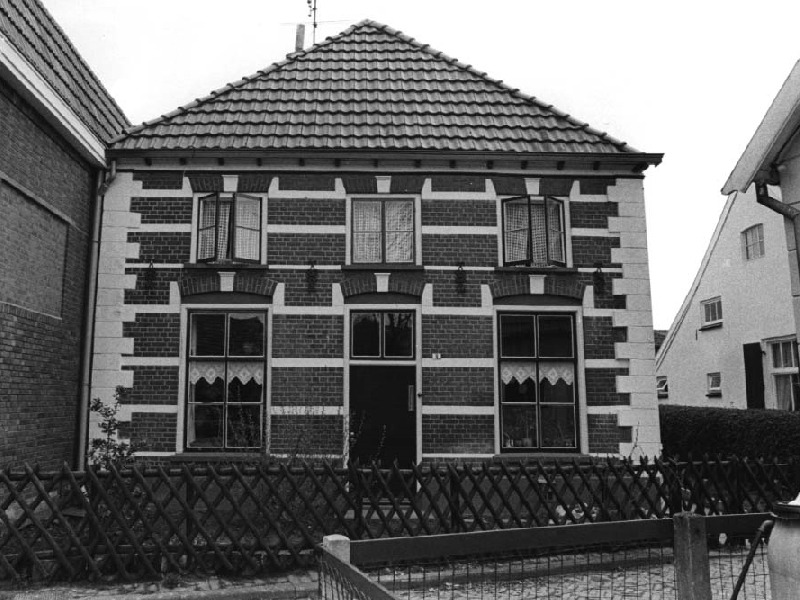
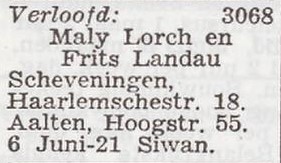
Frits Landau was born on 28 November 1905 in Aalten. He became a travelling salesman and remained unmarried for a long time. On 6 June 1942, he became engaged to Amalia Lorch, known as Maly, born on 20 December 1902 in Bocholt. They married in August of that same year and moved in with the Schaap family at ‘t Dal 1 in Aalten.
Soon, they were forced into hiding. From 1 April 1943, Gelderland was officially to be Juden-frei, Juden-rein (free of Jews). The Aalten population register states that Frits & Amalia departed on 17 March 1943, with no destination recorded. They subsequently stayed at two different hiding addresses, most recently with the Van Eerden family at the farm De Maote in the rural district of Dale.
Unpredictable and dangerous behaviour
It is said that Frits Landau was an alcoholic with a short temper, which led to unpredictable and dangerous behaviour. Reportedly, he did not make things easy for his hosts; he harassed young ladies and demanded his drinks every evening. He was accustomed to a luxurious lifestyle, yet in 1943, alcohol was barely available on the farms.
On several occasions, Frits threatened to betray his hiding places in order to buy his own freedom from the Nazis—at least, he assumed this would succeed. Twice, such attempts were thwarted at the very last minute.
Amalia and Frits Landau-Lorch (photo: Aalten Vooruit)Het Joodsche Weekblad, 5 June 1942
Liquidation by the resistance
Because he was considered a safety risk to other people in hiding by the local resistance, the decision was made to execute him to protect other fugitives and their helpers. The Council of Resistance and even local clergy discussed how to deal with him. Ome Jan Wikkerink proposed keeping Frits under permanent guard by other hiders and pilots. This did not happen, however, as several young resistance members took the initiative to eliminate him themselves.
They told the Landau couple that they would be taken to another hiding address in Vragender—a suitable excuse to get Amalia to come along with Frits. Incidentally, the intention was to separate Frits and Maly, as they wanted to spare her this fate. However, Frits refused to cooperate with being separated, and thus Maly was drawn into his fate.
Frits and Amalia Landau-Lorch were liquidated and buried in the countryside of Aalten by the local resistance in late 1943 or early 1944.
Location unknown
Aaltensche Courant, 28 August 1945
Opinions differ regarding the exact place and date of the liquidation. According to one theory, Frits and Amalia were killed on the Schaarsheide, close to the Nazarethdijk. Another theory points to the Daalse Goor.
The burial site of the Landau couple has been searched for several times, with the aim of giving them a reburial in the Jewish cemetery, but so far without result.
During a search on the Schaarsheide, a lady’s shoe and three rusted shovels were found. Investigation indicated that the shoe likely dates from the 1930s. It is plausible that the first burial site was discovered there. According to those involved, the bodies were later reburied. At the time, everything had to be done quickly, and apparently, it was later decided that the original burial site was unsuitable. During the clearing of the first grave, the lady’s shoe was supposedly left behind. Afterward, the mortal remains were reburied elsewhere, but where is unknown.
The most recent search took place in 2023. In a small patch of forest between Aalten and Lichtenvoorde, twelve experienced amateurs searched for the bodies of Frits and Amalia. Using detectors, they searched at various frequencies for different materials, but no human remains were found.
On 13 April 2016, two Stolpersteine (stumbling stones) for Frits and Amalia Landau-Lorch were laid at their last official residential address at ‘t Dal.